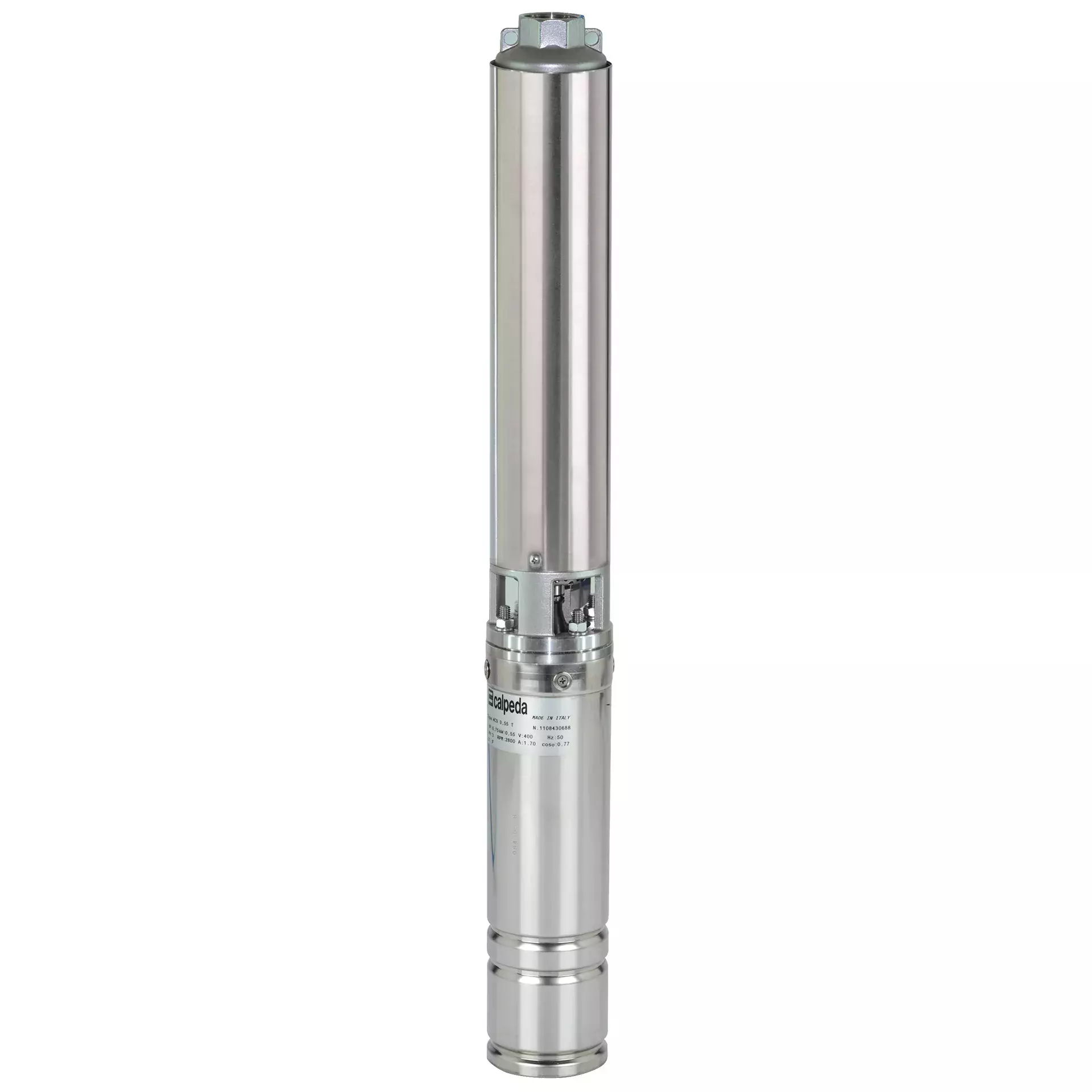
Key features
Calpeda tabulates 4SDP frames from 5 stages to 48 and 6SDP frames from 2 to 76. Within a family the flow envelope holds and each stage adds roughly the same head, so the stack is sized to the lift you have.
4SDP goes down a 4-inch well and 6SDP down a 6-inch. The casing fixes the diameter, which is why the head comes from stages.
External jacket, stage casings, delivery casing, suction lantern, filter and screws are all AISI 304. The 4SDP shaft is AISI 304; the 6SDP shaft is AISI 431.
The valve is part of the pump, so the column above it does not run back through the stages every time the pump stops.
150 g/m³ of sand for the 4SDP and 300 g/m³ for the 6SDP. Abrasive water is what wears a borehole pump out, and this is the number to hold your driller's development work against.
Calpeda rates the motor for inverter operation with a suitable dv/dt filter, between 30 Hz and 60 Hz. Run-up from 0 to 30 Hz and run-down from 30 to 0 Hz get one second at most, because the motor is cooled by the water going past it and has to clear the slow region quickly.
About the Calpeda SD
The SD is Calpeda's multistage submersible borehole pump, and it is a very different machine from the sewage and drainage submersibles it sits beside in the catalogue. It hangs in the water on the end of the rising main, screwed on an ISO 228 connection, with the motor underneath the pump end and the water it delivers passing the motor to cool it. Calpeda lists it for water supply systems, for civil and industrial applications, for fire fighting and for irrigation.
One naming note before you order anything. Calpeda's 50 Hz data sheet prints the range as SDP, and the pumps are designated 4SDP for a 4-inch well and 6SDP for a 6-inch, with M added for single phase. Quote the whole designation, including the stage identification and the number of impellers.
What the range actually covers
The 4-inch frames, all three-phase figures:
| Family | Rated power P2 | Head at zero flow | Curve runs out at |
|---|---|---|---|
| 4SDP 1 | 0.37–1.1 kW | 67–253 m | 1.8 m³/h |
| 4SDP 2 | 0.37–2.2 kW | 34–265 m | 3 m³/h |
| 4SDP 3 | 0.37–2.2 kW | 34–208 m | 4.2 m³/h |
| 4SDP 4 | 0.37–4 kW | 33–309 m | 6 m³/h |
| 4SDP 6 | 0.75–5.5 kW | 42–302 m | 8.4 m³/h |
| 4SDP 8 | 0.75–5.5 kW | 26–202 m | 12 m³/h |
| 4SDP 16 | 2.2–7.5 kW | 49–161 m | 24 m³/h |
The 6-inch frames:
| Family | Rated power P2 | Head at zero flow | Curve runs out at |
|---|---|---|---|
| 6SDP 20 | 1.1–11 kW | 79.6–691 m | 7.2 m³/h |
| 6SDP 25 | 1.5–15 kW | 74.7–685 m | 9.2 m³/h |
| 6SDP 30 | 1.5–22 kW | 51.9–677 m | 13.6 m³/h |
| 6SDP 35 | 1.1–26 kW | 30.4–662 m | 19.2 m³/h |
| 6SDP 40 | 1.5–37 kW | 31.7–642 m | 24 m³/h |
| 6SDP 50 | 2.2–37 kW | 29–476 m | 33 m³/h |
| 6SDP 52 | 2.2–37 kW | 25.6–404 m | 40.2 m³/h |
The 52 family carries a designation break worth catching before you order. Frames to 18.5 kW print as 6SDP 52; from 22 kW upwards Calpeda prints them as 6SDP B52, so the two 37 kW frames at the top of the range are the B52/25A and the B52/28A. The B is part of the model, not a footnote.
Read down the family column first and across second. The family number sets the flow band, and within a family the stage count sets the head. A 4SDP 4/5C has five stages and gives 33 m at zero flow; a 4SDP 4/48C has 48 and gives 309 m. That is about 6.5 m a stage, and it holds right across the family.
Size against the borehole, not against the catalogue
The number that decides a borehole pump is not the one at the top of a curve. It is the pumping water level once the hole has drawn down, and the driller has it from the test pumping. Take the level under drawdown, add the lift from there to the discharge point, add the friction in the rising main, and select against that total dynamic head at the flow the hole will actually give.
Work an example. Say the duty is 6 m³/h at 130 m of total dynamic head. Off Calpeda's 50 Hz tables, the 4 kW 4SDP 6/34C gives 132 m at 6 m³/h, so that is the pump. Going a frame down to the 3 kW 4SDP 6/27C gives 107 m and leaves you short. Worth noting on the same duty: the 6-inch 6SDP 20/30 also runs 4 kW and gives 134 m at 6 m³/h, which is 2 m more for a hole half as wide again. If the bore is 4-inch, the 4SDP is not a compromise on that duty. It is the same pump in a thinner casing.
That is the general shape of it. Choose the bore size on what has been drilled, not on the assumption that bigger is stronger.
The failure that puts most borehole pumps back on the lorry
Almost every borehole pump that dies young takes more water than the hole gives. The mechanism is worth spelling out, because it is not obvious from the curve.
The SD is cooled by the water going past its motor on the way into the strainer. Calpeda gives that as a minimum flow velocity: 0.1 m/s over a 4-inch motor and 0.5 m/s over a 6-inch. Draw the level down towards the inlet and the flow falls, the velocity falls with it, and the motor is running in still water long before it is running in air. Calpeda's own instruction is short on this. Never run the pump dry, not even for a short trial run.
Two things follow, and both belong in the specification rather than in the commissioning notes. Calpeda asks that the delivery connection sits at least 1 m below the deepest dynamic level while the pump is running, with an automatic control system to stop the pump if the water falls below that. It also asks for electrodes fitted to protect against dry running. Treat both as part of the pump, not as extras.
There is a third case people miss. If the well or the tank is a good deal wider than the pump, the water can rise past the motor without ever flowing over it fast enough. Calpeda's answer is a cooling flow shroud, a flow inducer sleeve fitted around the unit to force the water past the motor at velocity. Any hole noticeably wider than the pump wants one.
Water quality decides how long it lasts
Sand is the slow killer, and Calpeda puts a number on it: 150 g/m³ for the 4SDP and 300 g/m³ for the 6SDP. Above that you are grinding the stages, and the pump loses head for a long time before it stops.
That number is a question for the driller, not for us. A borehole that was never properly developed will keep producing fines, and no pump in this range is built to survive it. Calpeda asks you to check at first start that the sand in the water has disappeared or is minimal. If it has not, stop and sort the hole out. Setting the pump clear of the bottom helps as well, far enough up that sand and mud do not build around the motor.
Where Calpeda's headline and its tables disagree
Calpeda's product page gives the head range to 650 m. The 50 Hz tables go further: the 11 kW 6SDP 20/76 is published at 691 m at zero flow, and four other families pass 640 m. Select off the table for the family you are buying, not off the range.
Where the SD stops
Liquid temperature stops at 35°C on a 4-inch motor. On a 6-inch it moves with the frame: Calpeda's motor table allows 40°C up to 15 kW, 35°C from 18.5 to 30 kW and 30°C at 37 kW, so the 30°C printed in the general operating conditions is the worst case rather than the rule. Starts are limited to 30 an hour on the 4-inch and 20 on the 6-inch, which on a borehole feeding a small pressure vessel is a real constraint. The pump is rated for continuous duty, and Calpeda asks you to avoid long periods running against a closed discharge.
Above 7.5 kW you cannot start it direct on line. Calpeda requires star/delta, a soft starter, stator impedance or an autotransformer, to hold down both the starting current and the torque. That is switchgear and panel space, and it belongs in the budget from the start.
Calpeda states that installing the pump in an environment with a potentially explosive atmosphere is forbidden.
How the Calpeda SD works
Water enters the SD through a stainless filter above the motor, passes up through a stack of impellers and diffusers, and leaves through a delivery casing with a built-in non-return valve on a screwed ISO 228 connection. Each stage takes the water from the one below and adds its share of head. The motor is a 2-pole induction motor running at about 2900 rpm at 50 Hz, sized to NEMA standards for connection to the pump, protected to IP 68 and rated for continuous duty.
Two hydraulic builds, one principle
The 4SDP uses radial floating impellers and the 6SDP uses radial impellers. The materials follow the same split. On the 4SDP the diffusers are polycarbonate, the impellers are NORYL, the shaft is AISI 304 and the bearing bushes are polyacetal. On the 6SDP the diffusers are NORYL, the impellers are LEXAN, the shaft is the harder AISI 431 and the bearing bushes are NBR or HNBR. Everything structural on both, the external jacket, stage casings, delivery casing, suction lantern, filter and screws, is AISI 304.
Calpeda notes that the 4SDP 1, 2, 3 and 6 electropumps comply with European Regulation 547/2012.
Setting depth and the rising main
The rising main is not just pipe. Calpeda asks for a pressure gauge, a check valve no more than 7 m from the pump outlet, and further lift-type check valves at least every 50 m of straight vertical pipe above the pump to hold off water hammer. Where the total length of delivery piping passes 100 m, add one or more non-return valves. Fit a gate valve at the surface to regulate delivery, head and absorbed power.
Depth of immersion should always exceed 1 m, and the gap between the motor and the well filter should exceed 1 m. The well diameter has to be wide enough along its whole length for the pump to pass with clearance all round, which is the sort of thing worth confirming against the driller's log before the pump is on site.
Threaded delivery pipes must be tightened properly. Calpeda's warning is blunt: a joint that unscrews drops the pump down the well. It advises spot welding metal pipes to the threaded joints, and proper connections on plastic pipe. Clamp the power cable to the delivery pipe about every 3 m, lower the pump on a safety rope or chain of non-perishable material, and never hang it on the cable.
Where the pump has to run horizontally, Calpeda asks for the axis at least 0.5 m above the bottom of the sump or tank, a supplementary check valve because the built-in valve does not seal properly on its side, and an arrangement that lets the air out at start-up.
The electrical side
Three-phase 4-inch motors run on 230 V or 400 V and 6-inch motors on 400 V or 400/690 V, both ±10%. Single-phase 4SDPM builds run on 230 V up to 2.2 kW, with a capacitor of 20 to 80 µF at 450 V depending on the frame and a full load current from 3.6 A to 14.6 A. Insulation class is F on the 4-inch motors.
The control panel is yours to build, and Calpeda is specific about what goes in it: a disconnecting switch with at least 3 mm of contact separation on all poles, a motor protector with a curve D characteristic set to the nameplate current, the capacitor on a single-phase build, and electrodes for dry-run protection. At 7.5 kW and above, add the reduced-voltage starting.
Pumps normally arrive with the motor and the pump end separate, the exception being the 4-inch units, which come assembled. Torque the suction lantern nuts crosswise to 10 Nm on a 4-inch motor, starting from the one opposite the cable.
Start the pump with the gate valve nearly shut and wait until the delivery pipe is clear of air, then open up. On three-phase, check the direction of rotation by comparing pressure or flow before and after swapping two phases. The right way round is obvious once you look at the gauge. Check that the absorbed current stays inside the rating, and throttle the gate valve if it does not.
On a generator supply, switch the generator on before the motor and off after it, both times without load. Getting that sequence wrong can damage the generator as well as the motor.
Reading the designation
Calpeda's key runs the well diameter in inches, then SDP for the series, then M for single phase, then the stage identification, then the number of impellers, and finally the motor flange coupling. So a 4SDPM 6/14 is a single-phase 4-inch pump on the 6 hydraulic with 14 impellers, and a 6SDP 52/3A 4SM is a three-phase 6-inch pump on the 52 hydraulic with three impellers on a 4-inch motor flange. When you are replacing an existing set, read the whole string and the serial number off the nameplate.
Specifications
| Type | Multistage submersible borehole pump | |
|---|---|---|
| Well diameter | 4" (DN 100 mm) and 6" (DN 150 mm) | |
| Liquid handled | Clean or slightly dirty water | |
| Applications | Water supply systems, civil and industrial applications, fire fighting and irrigation | |
| Impellers | Radial floating impellers on the 4SDP; radial impellers on the 6SDP | |
| Flow rate | up to 40.2 m³/h | 6SDP 52 frames |
| Total head | up to 691 m | 6SDP 20/76 6SM, at zero flow |
| Rated power P2 | 0.37–37 kW | |
| Speed | about 2900 rpm | 2-pole, 50 Hz |
| Delivery connection | Screwed to ISO 228, with a non-return valve built into the delivery casing | |
| Liquid temperature | up to 35°C with a 4" motor; with a 6" motor 40°C to 15 kW, 35°C at 18.5–30 kW and 30°C at 37 kW | Calpeda's 4CS-R and 6CS-R motor table |
| Maximum sand content | 150 g/m³ on the 4SDP; 300 g/m³ on the 6SDP | |
| Minimum cooling flow velocity past the motor | 0.1 m/s on a 4" motor; 0.5 m/s on a 6" motor | |
| Maximum starts per hour | 30 on a 4" motor; 20 on a 6" motor | |
| Minimum depth of immersion | over 1 m | delivery connection at least 1 m below the deepest dynamic level in operation |
| Duty | Continuous | |
| Voltage | 4" motors single-phase 230 V, three-phase 230 V or 400 V; 6" motors three-phase 400 V or 400/690 V | ±10% |
| Single-phase rating | up to 2.2 kW | 4" motors, 4SDPM builds |
| Single-phase full load current | 3.6–14.6 A at 230 V | |
| Capacitor | 450 V, 20–80 µF | single-phase builds |
| Starting | Star/delta, soft starter, stator impedance or autotransformer required at rated outputs of 7.5 kW and above | |
| Motor protection | Curve D motor protector set to the nameplate current, fitted in the control panel | |
| Frequency converter | Suitable with a dv/dt filter, between 30 Hz and 60 Hz | maximum 1 second run-up 0 to 30 Hz and run-down 30 to 0 Hz |
| Protection degree | IP 68 | |
| Insulation class | F | 4" motors |
| External jacket, stage casing, delivery casing, suction lantern, filter and screws | Chrome-nickel steel 1.4301 EN 10088 (AISI 304) | |
| Diffuser | Polycarbonate on the 4SDP; NORYL on the 6SDP | |
| Impeller material | NORYL on the 4SDP; LEXAN on the 6SDP | |
| Shaft | 1.4301 EN 10088 (AISI 304) on the 4SDP; steel 1.4057 EN 10088 (AISI 431) on the 6SDP | |
| Bearing bush | POM polyacetal on the 4SDP; NBR or HNBR on the 6SDP | |
| Regulation | The 4SDP 1, 2, 3 and 6 electropumps comply with European Regulation 547/2012 |
Send us the borehole's tested yield, the pumping water level under drawdown, the setting depth, the bore diameter, the rising main size and length, and the discharge head at the far end, and we will come back with a frame and a stage count. Tell us what the water is carrying too, because the sand figure decides whether this range suits the hole at all. Replacing an existing set? A photograph of the nameplate with the designation and serial number legible is all we need.
Documents & downloads
Frequently asked
What is the Calpeda SD borehole pump?
It is a multistage submersible pump for 4-inch and 6-inch drilled wells, with an AISI 304 stainless jacket and a non-return valve built into the delivery casing. It hangs below the water level on a screwed rising main, with the motor underneath and cooled by the water passing it.
How deep can a Calpeda SD pump lift water?
The tables go to 691 m at zero flow, on the 11 kW 6SDP 20/76. Lift is a function of stage count rather than a fixed ceiling, so the pump is built to the hole. What limits a real job is the yield of the borehole and the cost of the rising main and cable.
What flow will a Calpeda SD give?
Up to 40.2 m³/h on the 6SDP 52 frames. The 4-inch range covers roughly 1.8 m³/h on the 4SDP 1 up to 24 m³/h on the 4SDP 16. The family number sets the flow band; the stage count sets the head.
What size borehole does a Calpeda SD need?
4SDP frames suit a 4-inch well (DN 100 mm) and 6SDP frames a 6-inch well (DN 150 mm). Calpeda asks that the well is wide enough along its whole length for the pump to pass with clearance all round, so check the driller's log rather than the nominal size.
How much sand can a Calpeda SD handle?
150 g/m³ on the 4SDP and 300 g/m³ on the 6SDP. Above that the stages abrade and the pump loses head steadily. Calpeda asks you to confirm at first start that the sand in the water has gone or is minimal.
Why do borehole pumps burn out?
Usually because the pump takes more water than the borehole gives. The level draws down towards the inlet, the flow past the motor falls below the velocity it needs for cooling, and the motor overheats. Calpeda specifies 0.1 m/s past a 4-inch motor and 0.5 m/s past a 6-inch, and asks for dry-run electrodes.
How far below the water level should a Calpeda SD be set?
Calpeda asks for the delivery connection to sit at least 1 m below the deepest dynamic level while the pump is running, with an automatic control to stop it if the level falls further. Depth of immersion should exceed 1 m, and the motor should sit more than 1 m clear of the well filter.
Does a Calpeda SD need a soft starter?
At 7.5 kW and above, yes, or an equivalent. Calpeda requires star/delta, a soft starter, stator impedance or an autotransformer at those ratings to limit both the starting current and the torque. Below that, direct on line is fine with a curve D motor protector.
Can a Calpeda SD run on an inverter?
Calpeda rates the motor for frequency converter operation with a suitable dv/dt filter, held between 30 Hz and 60 Hz. Run-up from 0 to 30 Hz and run-down from 30 to 0 Hz are limited to one second each, because the water flowing past the motor is what cools it and a slow ramp holds it in the region where that flow is too weak.
What does a designation like 4SDPM 6/14 mean?
4 is the well diameter in inches, SDP the series, M single phase, 6 the stage identification and 14 the number of impellers. A trailing 4SM or 6SM on a 6-inch pump is the motor flange coupling.