
What a marine duty does to a pump
Four things account for most of what goes wrong on a marine pump: the water, the suction, the sizing and the solids.
Seawater eats the wrong materials. Chloride attack is the first specification decision, not a detail to settle later. Cast iron is fine on fresh water or condensate and won't last on raw seawater. Wetted parts move up to bronze or gunmetal, to duplex or super duplex stainless, or to a lined pump. Each step costs money and lead time. Stainless isn't an automatic answer either: 316 pits in warm, stagnant seawater, which is the condition inside a line that only runs intermittently. Ask what the wetted parts are, not what the pump is made of.
Suction conditions decide whether the pump survives. NPSHa has to exceed NPSHr at the duty point on the performance curve, and on a vessel that margin is harder to hold than ashore. The tank empties as you pump it. Static suction head shifts with trim and with the roll. The suction line is usually longer, and has more bends in it, than anyone drew. When the margin goes the pump cavitates, which pits the impeller, takes out the seal, and puts vibration and noise into structure that carries both a long way.
Oversizing arrives honestly and then stays. The most common fault we are asked to fix was decided at specification. The customer states a flow rate. The consultant adds margin for future duty. The contractor adds margin. The installer adds a little more flow or pressure. Nobody in that chain is careless, and the pump that falls out of it is far too big. Power rises with flow and pressure, so a 3 kW application ends up with an 11 kW motor on it, and it stays uneconomical for the life of the installation. Worse, a centrifugal pump run off the end of its performance curve needs back pressure it isn't getting. Size for 10 m³/h when the tank will only give you five and you are pumping air.
Rag, grit and dry running finish off whatever is left. On marine sewage, and on the pumping stations that serve a port ashore, rag comes first: wipes and fibre binding up the wet end. Grit is the second, out of ballast tank sediment and dock sumps, abrading the wet end until the pump fails early. Dry running is the third, and it traces back either to those suction conditions or to somebody shutting a valve and forgetting it's shut. A mechanical seal needs liquid to lubricate it. Take the liquid away and the seal goes. On a progressive cavity pump the same event burns through the stator and damages the rotor, which is a rebuild rather than a seal change.
Marine and port environments
What suits each marine duty
Select the pump type against the medium first, then size the unit against the duty point. The table is the short version; the notes expand it.
| Duty | What suits it | The trade-off |
|---|---|---|
| Seawater cooling, ballast transfer, firewater, general service | End suction centrifugal, bronze-fitted or in duplex stainless | Intolerant of solids and of a tight NPSHa margin; the material choice drives cost and lead time |
| Fresh and potable water in port buildings and terminals | A packaged booster set with variable speed control | Needs a clean supply and somewhere dry to sit; an over-specified duty wastes power for twenty years |
| Sewage transfer on board and at quayside stations | Solids-handling wet end, submersible where the sump stays wet | Larger passages mean a physically bigger pump for the same duty |
| Rag-heavy sewage | A macerator or chopper pump ahead of the transfer pump | One more machine with wear parts and a power supply to maintain |
| Sludge, tank bottoms and oily residue above roughly 3–4% solids | Progressive cavity or rotary lobe | Slower, with consumable wear parts; a progressive cavity pump will not tolerate dry running |
| Dock, dry dock and quayside dewatering | Solids-handling submersible drainage pump | Grit abrades the wet end, so budget for wear rather than assuming it away |
| Tank cleaning chemicals and treatment dosing | Sealless or diaphragm construction in a resistant material | The chemical resistance data decides the build, not the flow rate |
On clean seawater the pump type is settled and the materials are the real decision. A bronze-fitted end suction pump such as the Calpeda B-NM is the standard answer for mildly aggressive water at moderate head. Above that, or where the water is warm and the line runs intermittently, the wetted parts move to duplex. Getting this wrong rarely shows up on commissioning, which is the problem. It shows up later, on a duty everyone had already signed off.
Solids change the pump type, not the size. The trade rule of thumb is roughly 3–4% solids. Below that a centrifugal will cope; above it, move to positive displacement. For sewage and sediment-laden water that still sits under the line, a solids-handling wet end is what you want. A screw-centrifugal non-clog, which is what Hidrostal builds, passes solids through one continuous passage rather than chopping them, and that suits a duty where rag would otherwise wrap an impeller.
If it blocks repeatedly, the pump is often not the problem. The request that lands on the desk most often is to replace a blocking pump with a better solids-handling one, when the pump already fitted is a good solids-handling pump. A like-for-like swap fails the same way. What the site usually needs is rag removal upstream, a macerator or a chopper pump, which is a system change nobody asked us to quote for. We have also seen correctly sized pumps blamed for repeated suction inlet blockages, where changing the inlet size fixed it and the pumps stayed where they were.
Air-operated diaphragm pumps have a real place on a vessel, and it is narrower than their popularity suggests. Where there is compressed air, no safe electrical supply, and a portable stripping or bilge duty, they earn it, and they'll run dry without complaint. Against that: compressed air is expensive to produce, so the running cost sits well above an electrically driven pump; the air supply's cleanliness and filtration become failure points; and the air valve can freeze and stop the pump. Where electricity is available we'd specify electric, usually a rotary lobe, a progressive cavity or a peristaltic pump.
When to call us
For a bilge pump on a pleasure craft, a chandler will serve you better and cheaper than we will. Commercial and industrial work is what we're set up for. We're worth calling when nobody has yet worked out what the pump should be, or when one keeps failing and the reason isn't obvious.
Send us the flow, the head, the medium, the temperature and what the pump is drawing from. We will tell you which type, and we will tell you if the honest answer is that you don't need a new pump.
Marine-duty pumps we supply
View all →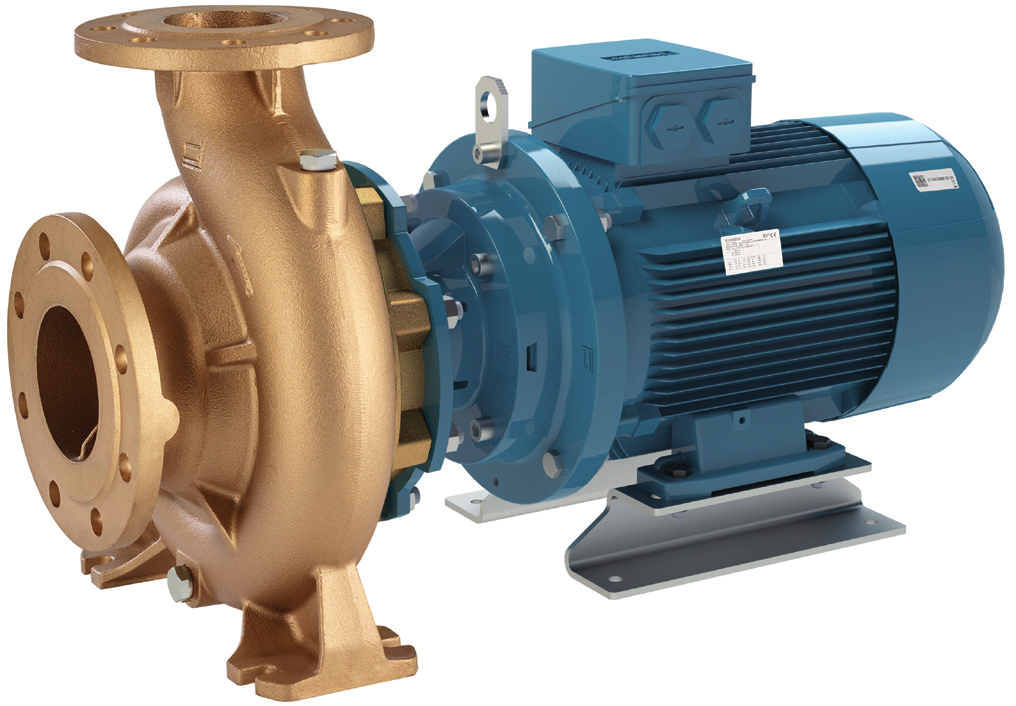
Discharge rules and approvals
On a vessel, what you are allowed to discharge fixes the pumping arrangement before anyone asks a hydraulic question.
- Sewage: MARPOL Annex IV. A ship carries an approved sewage treatment plant, an approved comminuting and disinfecting system, or a holding tank. Treated sewage from an operating approved plant may be discharged at any distance from land; comminuted and disinfected sewage at more than 3 nautical miles from the nearest land; untreated sewage at more than 12 nautical miles, en route at not less than 4 knots. Special Areas are stricter. That is what puts a macerator and a transfer pump on the arrangement drawing.
- Oily bilge water: MARPOL Annex I. Machinery space bilge water passes through approved oil filtering equipment before it goes over the side. The pump feeding that equipment should hold a steady, modest flow rather than a high one, because a separator performs on a consistent feed.
- Ballast water: the IMO Ballast Water Management Convention. Ships manage ballast water to the D-2 performance standard using a treatment system approved under the convention. Two things follow for the pump. Its flow has to match the treatment system's rated capacity, and tank sediment becomes something you handle rather than ignore.
- Class approval. Shipboard equipment is normally type approved by a classification society. That approval belongs to the manufacturer, not to us as a distributor, so ask for the certificate against the exact model and build rather than against the range.
- Hazardous areas. On tankers and at terminals, areas are classified into zones and equipment is certified to a category for use in them. A pump is not "Zone 1 rated"; it is certified for use in Zone 1. Never infer that from the family a pump belongs to. Ask for the certificate.
- Potable water ashore. In the UK, fittings in contact with potable water have to meet the Water Supply (Water Fittings) Regulations, and WRAS approval is the usual evidence. Check it covers the specific pump and its wetted materials.
Where a duty is genuinely hazardous or the discharge is regulated, we bring the manufacturer's engineer in. The performance guarantee sits with them, and on a big project so does the deepest knowledge of their own pump.
Frequently asked
What pumps are used on ships?
Most shipboard duties fall to centrifugal pumps in a seawater-resistant material: cooling water, ballast transfer, firewater and general service. Sewage and sludge move to a solids-handling wet end, or to a progressive cavity or rotary lobe pump once the medium gets past roughly 3–4% solids. Air-operated diaphragm pumps cover portable stripping duties where there is air but no safe electrical supply.
What material should a seawater pump be?
Bronze or gunmetal for most mildly aggressive seawater duties at moderate head, and duplex or super duplex stainless where the water is warmer, faster or the line runs intermittently. Cast iron will not last on raw seawater, and standard 316 stainless is not a safe default either, because it pits in warm stagnant seawater. Specify the wetted parts, not the pump.
Why does a marine sewage pump keep blocking?
Usually rag: wipes and fibre binding up the wet end. If the pump already fitted is a good solids-handling pump, fitting the same thing again will block the same way, so the fix is normally upstream: a macerator or a chopper pump to break the rag down first. Check the suction pipework too, because an undersized inlet produces the same symptom.
Do marine pumps need class approval?
Shipboard equipment is normally type approved by a classification society, and that approval belongs to the manufacturer rather than to the distributor. Ask for the certificate against the exact model and build you are buying, not against the product range. The same applies to any hazardous-area certification on a tanker or terminal duty.
What is a ballast water pump?
A ballast pump fills and empties a vessel's ballast tanks to hold trim and stability, and it is normally a centrifugal pump in a seawater-resistant material. Under the IMO Ballast Water Management Convention the discharge has to meet the D-2 performance standard, so the pump's flow has to match the rated capacity of the treatment system it feeds, and tank sediment has to be handled rather than ignored.