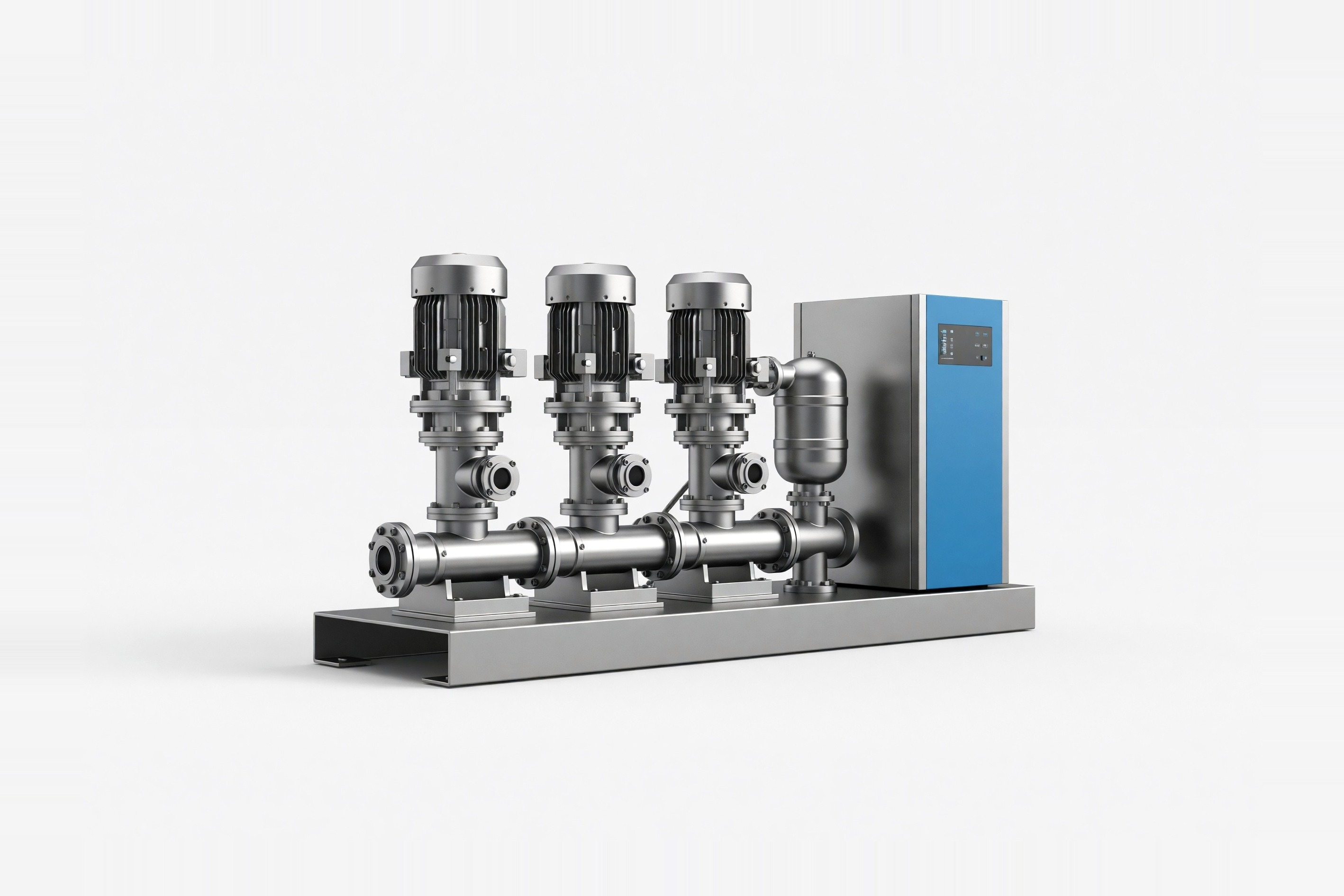
How a cold-water booster set works
A booster set holds a set-point pressure by running only as many pumps as the demand needs.
Several vertical multistage pumps share a common inlet and outlet manifold. A controller reads outlet pressure and varies pump speed to hold the set point as outlets open and close. Cascade control stages pumps in and out in sequence, so at low flow one pump trims on its variable-speed drive and the rest stay off. A small pressure vessel absorbs minor draw-offs, so the pumps do not cycle on every tap. The Grundfos Hydro MPC is a packaged set built on this principle.
When to choose a packaged booster set
Choose a packaged booster set when the incoming main or tank cannot deliver the flow and pressure a building needs at its highest and furthest outlet.
Duty and standby is the standard UK configuration for these, so a pump fault or a service visit does not take the supply with it.
- Apartment blocks and high-rise risers
- Offices, hotels and commercial buildings
- Hospitals and other sites that cannot lose supply
- Industrial process, cooling and washdown supply
- Tank-fed boosting where direct abstraction from the main is limited
- A single dwelling or one shower, where a domestic booster suits
- Dedicated firefighting supply, which is a fire set and specified separately
- Water carrying solids or aggressive chemistry, which these are not built for
- A set you have already specified and only need shipped, where a merchant will beat us on price
Key features & trade-offs
The standard UK configuration. One pump can fail or come out for service without the supply going with it.
Drives hold the set-point pressure at the outlet as demand rises and falls through the day.
Pumps, manifold, vessel and controls arrive on a single baseplate, works-tested.
The customer states a flow, the consultant adds margin, the contractor adds more. Nobody is careless and the set is far too big.
Off the end of its curve a pump gets no back pressure, the suction cannot feed it, and it cavitates. Vibration and noise follow.
A starved inlet cavitates whatever you fit. NPSHa at the duty point has to exceed the pump's NPSHr, and that is a suction problem.
Pumps we supply
View all →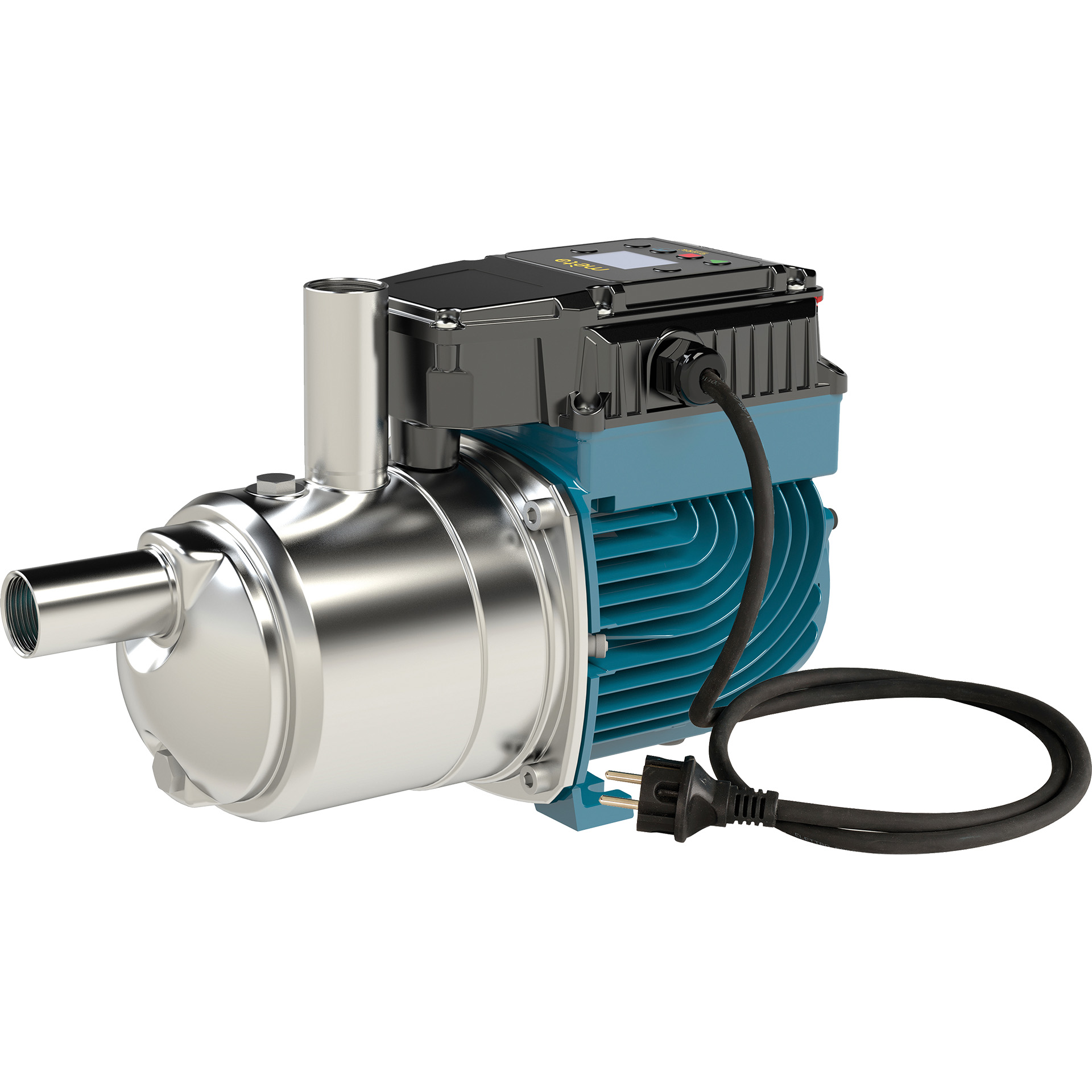
Calpeda e-idos pumps carry the pressure transducer and control on board. MÈTA, E-MXP, E-NGX and E-MPS, to 8 m³/h and 66.5 m per pump.
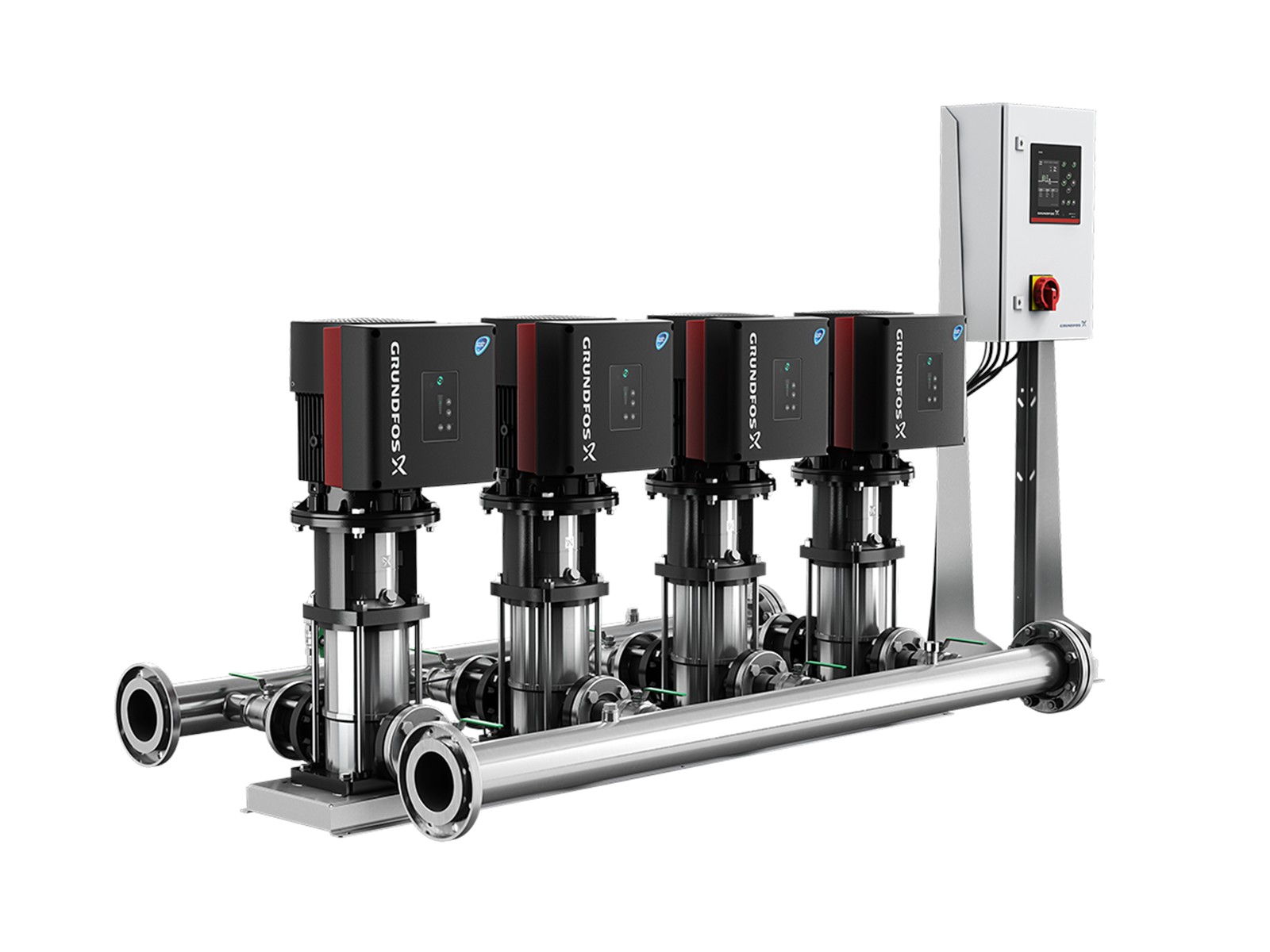
The Grundfos Hydro MPC is a packaged clean-water booster set: 2–6 stainless CR/CRE pumps and a CU 352 controller, flow to 725 m³/h, head to 145 m.
How to size a booster pump set
Size a booster set to the duty point rather than to the size of the building: the peak simultaneous flow, the pressure needed at the highest and furthest outlet, and enough pumps to give you duty and standby.
Send us those, the incoming mains or tank pressure, and whether the feed is direct or through a break tank. Give us the real flow figure, not one that has already collected margin from three people. We come back with the pump count, drive and control arrangement, from manufacturers such as Grundfos.
Frequently asked
How do I choose the right water pressure booster pump?
The right booster pump is the one sized to your duty, so fix the peak simultaneous flow and the pressure needed at the highest outlet first. Then choose enough pumps to cover that duty with a standby in reserve.
What is a booster pump?
A booster pump raises the pressure of a water supply that cannot reach a building's highest and furthest outlets on its own. In commercial buildings several are packaged into a booster set on one manifold.
How does a booster set hold constant pressure?
A controller reads outlet pressure and varies pump speed to hold the set point, staging further pumps in and out through cascade control as demand moves. A pressure vessel covers minor draw-offs between cycles.
What is duty and standby on a booster set?
Duty and standby means the set carries at least one more pump than the peak duty needs. If a duty pump fails or comes out for service, the standby covers the flow and the supply holds.
Why do booster sets get oversized?
Because margin is added at every step of the chain, by the customer, the consultant and the contractor in turn. Each addition is reasonable on its own, and the set that comes out of it is far too big.
Can a booster set connect directly to the water main?
Sometimes, within the limit your water undertaker allows for direct abstraction. Above that limit, or where the main cannot supply the peak flow, feed the set from a break tank and confirm it with the undertaker.