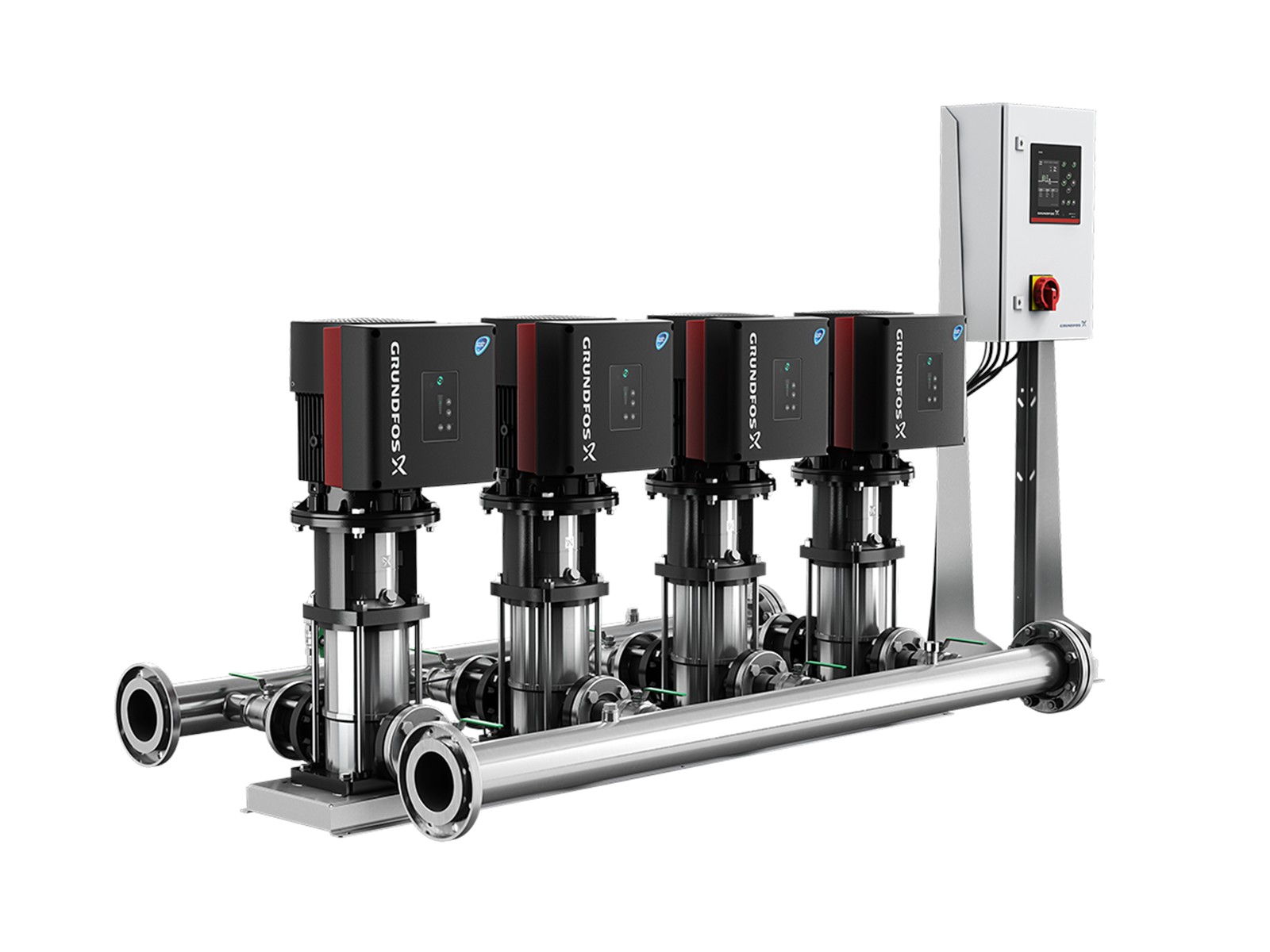
Key features
Duty, standby and assist are built into the set. Pumps stage in and out with demand, so you carry redundancy without running one oversized pump flat out.
On the -E set every pump is speed-controlled, so the set holds a constant pressure and draws only the power the moment needs.
CRI(E) 3 to CRI(E) 20 pumps are stainless steel throughout (EN/DIN 1.4301 / AISI 304); the larger CR(E) 32 to CR(E) 90 use cast iron and stainless steel.
The CU 352 control unit runs constant-pressure, proportional-pressure and cascade control, with automatic changeover, dry-run protection and soft pressure build-up.
Any pump lifts out without disturbing the manifold, so a single person can service even the largest set.
About the Grundfos Hydro MPC
The Hydro MPC does one job: it holds pressure in a clean-water system while the draw on it rises and falls. Grundfos builds it for waterworks, blocks of flats, hotels, hospitals, schools and industrial supply. Two to six CR-family multistage pumps sit in parallel on a base frame, with a stainless manifold, a control cabinet and the fittings already made up, so you install one set rather than assemble a booster from loose parts.
This is Grundfos at the packaged end of its range, and it sits in our pressure booster set category. On duty it belongs to the clean side of water supply and treatment work, not the sewage side. Put ragging media, sludge or grit through a Hydro MPC and the multistage pumps will wear or block. If the medium carries solids, you are looking at the wrong pump type.
The trade-off worth naming is sizing. A booster set earns its keep when demand varies, because the controller stages pumps and, on the -E build, trims speed to match. Spec a set with more pumps and more head than the duty needs and you pay for it twice: in capital and in a set that spends its life throttled well below its best efficiency point. Size it to the real duty point, add standby to suit the risk, and let the staging do the rest.
How the Hydro MPC works
A pressure sensor on the discharge manifold feeds the CU 352 control unit, which decides how many pumps run and, where the pumps are variable-speed, how fast. It holds the setpoint through three control modes: constant-pressure, proportional-pressure (which lets the setpoint fall as flow drops, to cut over-pressure and pumping cost), and automatic cascade control that stages pumps in and out. The unit also rotates the lead pump to equalise wear, caps starts per hour, and shuts down on a dry-run signal.
Grundfos splits the range into seven builds by how the pumps are driven. On the Hydro MPC-E, every pump carries its own integrated frequency converter, so all of them are speed-controlled. The Hydro MPC-F runs two to six pumps from one shared external converter that alternates between them. The Hydro MPC-S uses mains-operated fixed-speed pumps that cut in and out to hold an almost-constant pressure. The -ED, -ES, -EF and -EDF builds mix speed-controlled and mains-operated pumps for duties that don't need every pump on a drive. The published performance curves are rated to ISO 9906 Annex A.
Standard sets are rated to a maximum operating pressure of 16 bar; Grundfos supplies higher-pressure builds on request. Liquid temperature runs 0–70 °C and ambient 0–40 °C. Certification for any specific build is Grundfos's to state on the datasheet, not ours to infer.
Specifications
| Configuration | 2 to 6 pumps in parallel on a base frame | |
|---|---|---|
| Pump type | Grundfos CR / CRI / CRE / CRIE vertical multistage centrifugal | |
| Flow rate | 0–725 m³/h | range maximum |
| Maximum head | 145 m | |
| Maximum operating pressure | 16 bar | higher on request |
| Motor power | 0.37–30 kW per pump | across the range |
| Liquid temperature | 0–70 °C | |
| Ambient temperature | 0–40 °C | |
| Maximum relative humidity | 95% | |
| Wetted materials | Stainless steel EN/DIN 1.4301 (AISI 304) on CRI(E) 3–20; cast iron and stainless steel on CR(E) 32–90 | |
| Shaft seal | HQQE (SiC/SiC/EPDM) | |
| Manifold | Stainless steel (galvanised steel on request) | |
| Union connection | R 2 to R 2½ | |
| DIN flange | DN 80 to DN 250 | |
| Control unit | Grundfos CU 352 | |
| Applications | Clean-water transfer and pressure boosting |
Send us the flow, the head you need at the far end, the water quality and the incoming site pressure. We'll size the set to the duty point, tell you which control build fits, and say whether the job wants six pumps or three.
Documents & downloads
Related pumps
View all →
Frequently asked
How many pumps does a Grundfos Hydro MPC have?
Between two and six. They sit in parallel on one base frame and stage in and out with demand, which is how the set carries standby capacity without running a single oversized pump.
Can the Hydro MPC pump wastewater or water with solids?
No. It is a clean-water booster built on CR-family multistage pumps. Ragging media, sludge and grit will wear or block it. A duty with solids needs a solids-handling pump type, not a booster set.
What is the difference between the Hydro MPC-E, -F and -S?
It is how the pumps are driven. On the -E, every pump is speed-controlled by its own integrated frequency converter. The -F runs the pumps from one shared external converter that alternates between them. The -S uses fixed-speed mains-operated pumps that cut in and out. The -E holds the tightest pressure and uses the least energy on a varying demand; the -S costs less up front.
What flow and pressure does the Hydro MPC cover?
The range runs to 725 m³/h and up to 145 m of head, with a standard maximum operating pressure of 16 bar. Grundfos supplies higher-pressure builds on request. The figure that matters is your duty point, not the range ceiling.
What controller does the Hydro MPC use?
The CU 352 control unit. It manages up to six pumps with constant-pressure, proportional-pressure and cascade control, plus automatic pump changeover, dry-run protection and soft pressure build-up.