About Penn Valley
Penn Valley has built one pump for over forty years, and the design started in Britain. Cecil Hughes designed the original double disc pump in 1969. George Burrage, who had come from Fluid Transfer Ltd in Britain, added the flexible trunnion seal in 1979 and founded Penn Valley Pump Company the following year in Bucks County, Pennsylvania, where it is still based. Manufacture of the pump in the United States began in 1984.
Staying on one design that long matters when you are choosing a pump, because it tells you where the development went. It went into the part that wears. The current owner, Leslie Burrage, developed the patented Maintain In Place housing: three housings split horizontally on integral hinges and drop clear, so the trunnions and the rest of the elastomers change with the discharge housing still in the frame and the suction and discharge pipework still connected. There are five elastomeric components and a gasket set in the whole pump. Where the alternative is breaking the pump out of the line, that is most of the job.
The Penn Valley range we supply
View all →What we supply from Penn Valley is the Double Disc pump. It is the entire range.
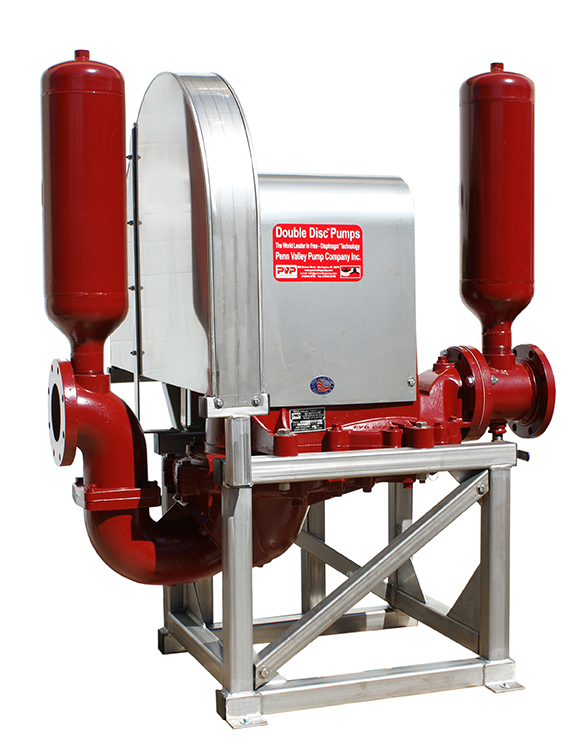
Two large discs do the work of both the pumping element and the valving. They run 180° out of phase off a camshaft, opening and closing a cavity between them, and they are mechanically seated on every revolution rather than relying on the medium to shut a valve. Solids, rag and plastics pass through without stopping the pumping action. The chamber is sealed with flexible trunnions rather than packing or a mechanical seal, so there is no flushing water to plumb and nothing to adjust or lubricate. It self-primes: Penn Valley states a dry prime at 2.1 m (7 ft) and a re-prime at 5.5 m (18 ft). Sizes run from a 2 in port up to 6 in (DN50 to DN150), with the largest models passing 50 mm solids.
The case for it is easiest to make on a sewage works. Three things kill pumps there. Rag and solids build up in the wet end. Grit abrades it, because the grit removal upstream is not doing its job. And it runs dry, because the suction conditions were never right. A double disc is largely immune to all three.
It also matters as a replacement. The Alfa Laval/SSP double disc ceased manufacture in 2017 and the Penn Valley pump directly replaces it. In our experience it outlasts the pump it succeeds. If you would rather keep an SSP running, we continue to supply spares for it other than the major housings, so a new pump is not the only answer.
The trade-off is the one every positive displacement pump carries. This is a sludge and solids machine, not a general transfer pump. For thin, clean media at moderate head a centrifugal costs less to buy and less to run, and that is what we would tell you to fit.
Standards & quality
Certification attaches to a build, not to a range. An ATEX certificate under Directive 2014/34/EU covers a pump built a particular way, in a particular equipment category. The area is what carries the zone classification, and the pump has to be certified for use in it. So a double disc going into Zone 1 and the same pump on an unclassified sludge line are two different orders, even where the hydraulics are identical.
Send us the zone classification and the medium with your enquiry. We take both to Penn Valley, and the certification for the exact build comes back with the quote. The same applies on a hygienic duty: tell us the standard you are being held to and the wetted materials you need, and we specify against it.
Frequently asked
Does the Penn Valley Double Disc pump replace the Alfa Laval/SSP double disc?
Yes. The Alfa Laval/SSP double disc ceased manufacture in 2017 and the Penn Valley pump directly replaces it. In our experience it outlasts the pump it succeeds. If you would rather keep the SSP you have, we still supply spares for it other than the major housings.
Can a double disc pump run dry?
Yes, and that is the exception rather than the rule. The fluid chamber is sealed by flexible trunnions, so there is no mechanical seal to lose its lubricant when the liquid goes. Do not read that across to other pump types. Dry running burns through the stator of a progressing cavity pump, and on a rotary lobe or a centrifugal it takes out the mechanical seal.
Will it handle rag and grit?
It passes solids, rag and plastics without losing pumping action, and it tolerates grit. That is why it earns its place on a works where the grit removal is underperforming. It is not the same as being wear-free. It means grit and rag are not what takes the pump out early, which on that duty is most of the battle.
How do I identify my Penn Valley pump and order a service kit?
Photograph the nameplate and send us the model and the serial number. The model gives the size and the build, the serial number tells the manufacturer what actually went into that pump, and a kit is quoted against both. A double disc rebuild is mostly elastomers, so it is usually a short list of parts rather than a new pump.