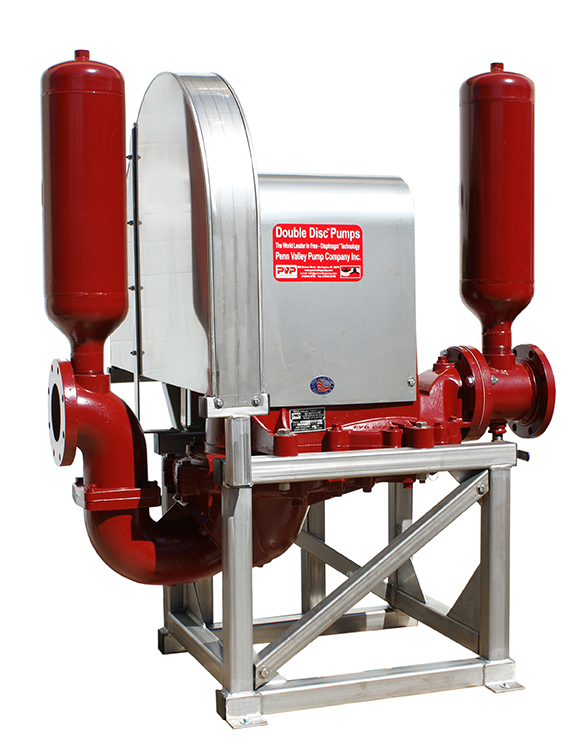
Key features
A non-close-tolerance, low-friction design with no rubbing action to generate flow, so a lost suction does not destroy the pump.
Flexible trunnions seal the fluid chamber. There is no packing gland and no flush water to plumb, adjust or pay for.
Up to 50 mm solids on the 6 in models, plus line-size semi-solids. The discs positively valve on every revolution.
Three horizontally split hinged housings, five elastomeric components and a gasket set. The piping stays connected and the pump stays in its frame.
Dry primes at 2.1 m (7 ft), re-primes at 5.5 m (18 ft) and generates up to 25 inHg.
The discs have large seating areas, which keeps internal velocities down and extends wear life on abrasive sludges and slurries.
About the Penn Valley Double Disc Pump
The Double Disc Pump is Penn Valley's reciprocating positive displacement pump for the media that block everything else. Seven sizes are built. 2DDSX05 at 2 in, 3DDSX11 and 3DDSX22 at 3 in, 4DDSX30 at 4 in, then 6DDSX76, 6DDSX107 and the duplex 6DDDX214 at 6 in. Flow runs from 9 m³/h (40 US gpm) on the smallest to 250 m³/h (1,100 US gpm) on the duplex, all at speeds up to 400 rpm, on ANSI 150# flanged connections.
Three things kill pumps on a sewage works, in this order. Rag and solids binding up the wet end, grit abrading it because the grit removal upstream is not doing its job, and dry running when the suction conditions were never right. A double disc pump is largely immune to all three. It passes the solids rather than chopping them, its low internal velocities take grit better than a close-tolerance pump does, and with no mechanical seal there is nothing to burn out when the liquid goes. That is the whole reason this pump exists on primary sludge, waste activated sludge, digested sludge, scum, septage and lime slurry, and on the feed to belt presses, screw presses, rotary presses and centrifuges.
There is history here that matters if you run an older works. The Alfa Laval and SSP double disc pumps ceased manufacture in 2017, and Penn Valley's pump directly replaces them. In our experience the replacement outlasts the pump it succeeds. We continue to supply SSP spares other than the major housings, so a failed disc or trunnion on an old machine is not automatically the end of it.
Three trade-offs are worth knowing before you specify. The operating ceiling is 4.1 bar (60 psi) on most of the range, so a long high-head rising main is not this pump's duty. It is a reciprocating pump, and although the short stroke and small displacement per revolution give a relatively smooth delivery, a pulse-sensitive dewatering feed wants pulsation dampeners fitted and the pipework designed for them. And the elastomers are the wear parts: five of them plus a gasket set is what a rebuild consumes, so the elastomer has to suit the medium or you will be back inside the pump sooner than the design allows.
Send us the flow, the total dynamic head, what the sludge actually is and its dry solids content, and how the pump is fed. If a progressing cavity or a rotary lobe pump would serve the duty better, we will say so.
How the double disc pump works
Two discs do all the work. A camshaft and connecting rods give them a reciprocating action, and they run 180° out of phase with each other, so at any moment one is pumping and the other is valving. On the suction cycle the suction disc lifts off its seat and creates a vacuum while the discharge disc stays seated, and the cavity between them fills. On the discharge cycle pressure above the suction disc seats it, and the flow leaves through the discharge. Because the discs are placed mechanically on the seating surface, they valve positively on every revolution, which is what stops debris-laden and stringy material breaking the pumping action.
The discs are not captive in the housing. Penn Valley calls this free disc technology, and it removes the flex fatigue failures that captive diaphragm pumps suffer. There is no rotating shaft through the pump body either, so the fluid chamber is sealed with flexible trunnions instead of packing or a mechanical seal. The trunnions need no flush water, no adjustment and no lubrication, and they do not leak, which is why the installation stays dry.
Priming comes from the inlet-side clack valve. The pump will dry prime at 2.1 m (7 ft), re-prime at 5.5 m (18 ft) and pull up to 25 inHg. The clack valve only acts under suction lift or when the suction line is under vacuum. On a flooded suction it never reaches its seat, and the pump will run without it, which is part of why larger solids and rag pass through where an internal check valve would clog.
Stroke length is short and displacement per revolution is small, so the pump runs at higher speeds than a traditional reciprocating pump and delivers a comparatively smooth flow. Pulsation dampeners take the remaining pulse out, which is what makes it usable on pulse-sensitive dewatering feed.
The build is cast iron, lined with porcelain glass, neoprene, PVC or tungsten carbide where the medium warrants it. Neoprene is the standard elastomer, with Buna-N, EPDM, HNBR and Viton available. Connecting rods are high-tensile aluminium. Tell us the medium, the temperature and the chemistry, and the liner and elastomer get specified alongside the pump instead of once it is on site.
Specifications
| Models | 2DDSX05, 3DDSX11, 3DDSX22, 4DDSX30, 6DDSX76, 6DDSX107, 6DDDX214 | seven sizes; the 6DDDX214 is the duplex |
|---|---|---|
| Flow rate | 9–250 m³/h (40–1,100 US gpm) | 2DDSX05 to 6DDDX214 |
| Discharge pressure | up to 4.1 bar (60 psi) operating | 2.1 bar (30 psi) on the 2DDSX05, 3.6 bar (52 psi) on the 3DDSX11 |
| Stall pressure | up to 7.6 bar (110 psi) | 4.1 bar (60 psi) on the 2DDSX05 |
| Solids passed | up to 50 mm (2 in) on the 6 in models | 13 mm on 2 in, 19 mm on 3 in, 25 mm on 4 in, plus line-size semi-solids |
| Operating speed | up to 400 rpm | |
| Suction lift | up to 25 inHg (28 ft, 8.5 m) | |
| Priming | dry prime at 2.1 m (7 ft), re-prime at 5.5 m (18 ft) | |
| Connections | 2 in, 3 in, 4 in and 6 in ANSI 150# flanged | |
| Housing | cast iron | lined with porcelain glass, neoprene, PVC or tungsten carbide |
| Elastomers | neoprene standard | Buna-N, EPDM, HNBR and Viton available |
| Connecting rods | high-tensile aluminium | |
| Shaft sealing | flexible trunnions | no packing gland, no mechanical seal, no seal water |
| Rebuild parts | five elastomeric components and a gasket set |
Channel Pumps sizes and supplies the Penn Valley Double Disc Pump. Send us the flow, the total dynamic head, what the sludge or slurry actually is and its dry solids content, the largest solid it has to pass, and whether the suction is flooded or lifted. We will come back with the model, the liner and elastomer specification and whether you need dampeners.
Documents & downloads
Frequently asked
What is a Penn Valley Double Disc Pump used for?
It moves sludge, slurry and rag-laden media that block conventional pumps. Typical duties are primary sludge, waste activated sludge, digested sludge, scum, septage and lime slurry, and feeding dewatering equipment such as belt presses, screw presses, rotary presses and centrifuges.
Can a double disc pump run dry?
Yes. The non-close-tolerance, low-friction design has no rubbing action to generate flow and no mechanical seal to lose its lubrication, so the pump runs dry without damage. That is the main reason it survives on sites where suction conditions are unreliable.
What size solids will a Penn Valley double disc pump pass?
Up to 50 mm on the 6 in models, 25 mm on the 4 in, 19 mm on the 3 in and 13 mm on the 2 in, plus line-size semi-solids in every size. The discs valve positively on each revolution, so rag and plastics pass rather than stopping the flow.
What flow and pressure does the range cover?
Seven sizes cover 9–250 m³/h (40–1,100 US gpm) at speeds up to 400 rpm. Operating discharge pressure is up to 4.1 bar (60 psi) on most of the range, with stall pressure up to 7.6 bar (110 psi).
What does Maintain In Place mean?
The pump has three horizontally split housings, each with an integral hinge, pinned together with a quick-release ball detent pin. The housings swing down in stages for access, so the wear parts are replaced without removing the pump from its frame or disturbing the suction and discharge piping.
Does the Penn Valley pump replace an SSP or Alfa Laval double disc pump?
Yes. The Alfa Laval and SSP double disc pumps ceased manufacture in 2017 and the Penn Valley pump directly replaces them. We also still supply SSP spares other than the major housings, so send us the model and serial number off the nameplate before you write an old pump off.