Key features
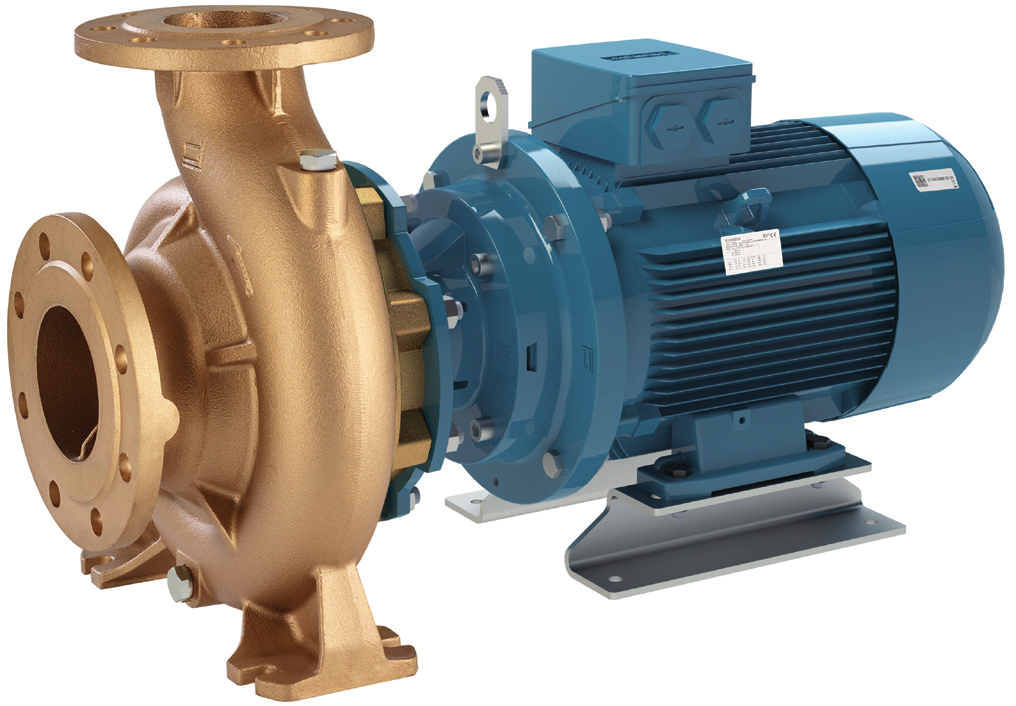
Pump casing in bronze CC480K EN 1982, with the lantern bracket in bronze on the BNM and the casing cover in bronze on the BNMS. The impeller is bronze too, or brass CW617N on the smallest sizes.
The bronze version runs a 1.4401 EN 10088 (AISI 316) shaft where the cast iron NM uses 1.4305 (AISI 303), and 1.4462 (AISI 2205) on the BNMS4 150/400S.
Main dimensions and performance follow EN 733, with extra sizes added beyond the standard, so a same-size EN 733 pump lands on the same pipework centres whoever made the one coming out.
BNM and BNM4 take the motor's extended shaft directly, to 22 kW and 15 kW respectively. BNMS and BNMS4 use the stub-shaft bracket with an integrated thrust bearing and a standard motor.
Flanges are PN 10-16 to EN 1092-2, PN 10 on DN 200. Counter-flanges to EN 1092-1 are available to order.
Three-phase motors are IE2 up to 0.65 kW, IE3 from 0.75 to 55 kW and IE4 from 75 kW, all rated for frequency converter operation.
About the Calpeda BNM
The Calpeda BNM is an end suction water pump with a bronze wet end. The hydraulics, the dimensions and the curves are the NM, NMS range, which Calpeda publishes at 1–660 m³/h and 3–95 m on motors from 0.25 to 90 kW. What the B in front of the designation changes is the metal: bronze CC480K EN 1982 in the pump casing, in the lantern bracket on the close coupled build and in the casing cover on the stub-shaft build, plus a bronze impeller and an AISI 316 shaft.
Bronze is what you specify when the water would eat a cast iron casing. That is the whole reason this version exists, and the limits that come with it are worth stating plainly. Calpeda rates the BNM for clean liquids, non-explosive and non-flammable, without abrasives and non-aggressive to the pump materials, with a solids content up to 0.2%. The material change moves where "non-aggressive to the pump materials" falls. It does not turn the pump into a chemical pump, and it does nothing about grit. Send us the water analysis and the temperature, not just the word for the water, and we will tell you whether bronze is the right answer or whether the duty wants stainless.
The trade-off is pressure. Maximum permissible working pressure on the bronze version is 10 bar. Calpeda's 16 bar rating belongs to the ductile iron casing, so if the system needs 16 bar, bronze is not the build for it. That catches people out on tall buildings and on boosted mains, where the closed-valve head plus the inlet pressure is what the casing has to hold, not the duty point.
The other thing worth checking before you order is whether you need bronze at all. Specified as insurance, it is money spent on a problem the water does not have, and the cast iron NM on the same curve costs less and holds more pressure. Specified because the water genuinely attacks iron, it pays for itself the first time you do not have to lift a corroded casing out. We would rather ask the question than sell you the dearer casing.
Size it against the real duty. On an EN 733 pump the common failure is not the pump at all, it is a duty point that was arrived at by margin stacking: the customer states a flow, the consultant adds margin, the contractor adds margin, and the installer adds a little more. Margin stacking is how a 3 kW duty ends up with an 11 kW motor on it, and how a centrifugal pump ends up running off the end of its performance curve with no back pressure to work against. That is where cavitation, failed seals and vibration come from.
How the Calpeda BNM works
The BNM is a single-stage end suction centrifugal pump. Liquid enters axially at the suction flange, the impeller throws it outwards, and it leaves radially through the delivery flange on top of the casing. A single mechanical seal in carbon, ceramic and NBR keeps the liquid off the shaft. Two-pole units run at about 2,900 rpm at 50 Hz and four-pole units at about 1,450 rpm.
Reading the designation
Calpeda's own worked example is BNM(S)4 EI 32/16A/B. B is the bronze version, and no B means the pump is cast iron. NM is the series, S is the stub-shaft version, and 4 marks the 4-pole build, so no 4 means 2-pole. EI means the pump carries the I-MAT frequency converter. Then 32 is the delivery port diameter in millimetres, 16 is the nominal impeller diameter, A is the impeller size and /B refers to a revision. Calpeda's operating instructions write the same family as B-NM. If you are matching an existing pump, send us the whole string off the nameplate together with the serial number.
Close coupled or stub shaft
BNM and BNM4 are close coupled: the motor has an extended shaft that drives the impeller directly, up to 22 kW on the 2-pole build and 15 kW on the 4-pole. BNMS and BNMS4 use the stub-shaft bracket instead, which takes a standard IEC motor and carries an integrated thrust bearing. The stub-shaft build is also the one that goes to IP 55 as standard, against IP 54 on the close coupled version. On the bronze stub-shaft pumps the casing cover is bronze and the lantern bracket stays cast iron GJL 200 EN 1561, which is what you can see in the photographs.
Where the bronze version is offered
Calpeda marks the bronze build model by model in the data sheet rather than offering it across every size. BNM runs to a DN80 delivery port, BNM4 and BNMS to DN100, and BNMS4 to DN150. If a cast iron model you have been quoted has no bronze equivalent, there is usually a bronze pump on a neighbouring curve that will cover the same duty point, and that is a question worth asking before you settle the specification.
Standards and limits
Main dimensions and performance follow EN 733, with additional sizes for completion, and flanges are PN 10-16 to EN 1092-2 with PN 10 on DN 200. Motors are constructed in accordance with EN 60034-1 and EN 60034-30-1, and the electropumps comply with European Regulation 547/2012. Published performance carries tolerances to UNI EN ISO 9906:2012.
Two published limits are easy to miss and both bite on a boosting duty. Sound pressure and permitted starts per hour both step with motor rating. On the 2-pole pumps that runs 70 dB(A) and 60 starts per hour to 2.2 kW, 80 dB(A) and 40 starts to 7.5 kW, 85 dB(A) and 20 starts to 30 kW, and 90 dB(A) and 10 starts to 75 kW. The 4-pole pumps hit the same steps at 7.5, 30, 75 and 90 kW. A pump sized well above the draw-off will run into the starts limit long before it runs into anything else.
The pump is not self-priming. Fill it completely with liquid before starting and never run it dry, and where the pump sits above the water level, fill the suction pipe and the pump through the priming hole. On a drinking water duty Calpeda requires a thorough flush with clean water before start-up to clear preservatives, test liquid and grease. A small leak from the mechanical seal during the first run is normal, because the seal faces are lubricated by the liquid being pumped.
Specifications
| Type | Single-stage end suction close coupled centrifugal, axial suction, radial delivery on top | |
|---|---|---|
| Versions | BNM and BNM4 close coupled; BNMS and BNMS4 stub-shaft with integrated thrust bearing | |
| Liquid handled | Clean liquids, non-explosive and non-flammable, without abrasives, non-aggressive to the pump materials, solids content up to 0.2% | |
| Flow rate | 1–660 m³/h | as published for the NM, NMS range |
| Total head | 3–95 m | as published for the NM, NMS range |
| Power | 0.25–90 kW | |
| Maximum permissible working pressure | 10 bar on the bronze version | the 16 bar rating belongs to the ductile iron casing |
| Liquid temperature | -10°C to +90°C | |
| Ambient temperature | -10°C to +40°C | relative humidity 10% to 55% non-condensing, to 1,000 m altitude |
| Total suction lift | up to 7 m | |
| Duty | Continuous | |
| Speed | approx. 2,900 rpm on BNM and BNMS; approx. 1,450 rpm on BNM4 and BNMS4 | 50 Hz |
| Bronze version sizes | BNM to DN80; BNM4 and BNMS to DN100; BNMS4 to DN150 | delivery port diameter, marked model by model in the data sheet |
| Connections | Flanges PN 10-16 to EN 1092-2 | PN 10 on DN 200 |
| Counter-flanges | To EN 1092-1, on request. Screwed PN 16 on sizes 32 to 50, for welding PN 10-16 from 65 upwards | |
| Pump casing | Bronze CC480K EN 1982 | |
| Lantern bracket (BNM) | Bronze CC480K EN 1982 | |
| Casing cover (BNMS, BNMS4) | Bronze CC480K EN 1982 | |
| Lantern bracket (BNMS, BNMS4) | Cast iron GJL 200 EN 1561 | |
| Impeller | Bronze CC480K EN 1982; brass CW617N EN 12167 on 32/12, 32/16, 32/20 and NM 40/20 | |
| Shaft | 1.4401 EN 10088 (AISI 316); 1.4462 EN 10088 (AISI 2205) on BNMS4 150/400S | |
| Mechanical seal | Carbon / ceramic / NBR | |
| Finish | Supplied fully painted | |
| Motor | 2-pole or 4-pole induction, 50 Hz | |
| Voltage | 3~230/400 V ±10% up to 3 kW; 400/690 V ±10% from 4 kW | |
| Motor efficiency | IE2 up to 0.65 kW, IE3 from 0.75 to 55 kW, IE4 from 75 kW | |
| Insulation class | F | |
| Motor protection | IP 54 | IP 55 on BNMS and BNMS4 |
| Sound pressure | 70, 80, 85 and 90 dB(A) by motor rating | 2-pole steps at 2.2, 7.5, 30 and 75 kW; 4-pole at 7.5, 30, 75 and 90 kW |
| Maximum starts per hour | 60, 40, 20 and 10 across the same power steps | |
| Construction standards | EN 60034-1, EN 60034-30-1 | |
| Regulation | European Regulation 547/2012 | |
| Test standard | Tolerances to UNI EN ISO 9906:2012 |
Send us the flow, the total dynamic head, the water and its temperature, and a water analysis if you have one, and we will size a BNM against it and say whether bronze is the right casing for the duty. Replacing an existing pump? Photograph the nameplate and send us the full designation and the serial number.
Documents & downloads
Related pumps
View all →
Frequently asked
What is the difference between the Calpeda NM and the BNM?
The metal. NM is the cast iron version and BNM the bronze one, with the pump casing and the lantern bracket or casing cover in bronze CC480K EN 1982 and the shaft in AISI 316 rather than AISI 303. The hydraulics and the dimensions are the same.
What pressure is the Calpeda BNM rated to?
Maximum permissible working pressure on the bronze version is 10 bar. Calpeda's 16 bar rating applies to the ductile iron casing, not to bronze.
What does BNM(S)4 EI 32/16A/B mean?
B is the bronze version, NM the series, S the stub-shaft build and 4 the 4-pole motor. EI means an I-MAT frequency converter is fitted. 32 is the delivery port in millimetres, 16 the nominal impeller diameter, A the impeller size and /B a revision.
What is the difference between the Calpeda BNM and BNMS?
BNM is close coupled, so the motor's extended shaft drives the impeller directly, up to 22 kW. BNMS uses a stub-shaft bracket with an integrated thrust bearing and a standard IEC motor, and is IP 55 rather than IP 54.
Is the Calpeda BNM an EN 733 pump?
Calpeda builds the main dimensions and performance to EN 733, with additional sizes beyond the standard. Flanges are PN 10-16 to EN 1092-2, PN 10 on DN 200.
Can the Calpeda BNM pump water with solids in it?
Only a trace. Calpeda rates it for clean liquids without abrasives and a solids content up to 0.2%. Bronze changes what the casing tolerates chemically, not what the pump tolerates in grit; ask us for a solids-handling pump for that duty.
What sizes does the Calpeda bronze version cover?
Calpeda marks the bronze build model by model rather than across the whole range. BNM runs to a DN80 delivery port, BNM4 and BNMS to DN100, and BNMS4 to DN150.