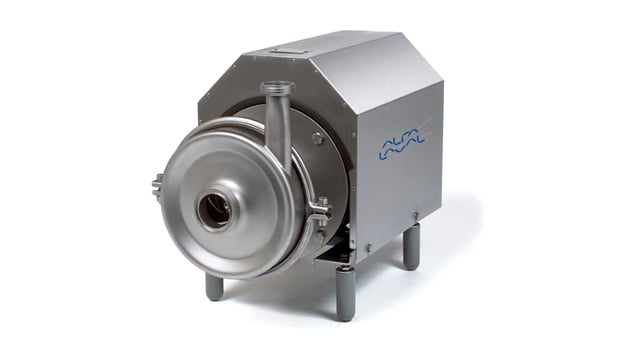
Key features
The housing is a single piece of stainless steel, so inspection and maintenance do not mean breaking the pump casing out of the line.
The spring and washers sit on the atmospheric side, which keeps spring wear out of the product and makes a seal change a short job.
Alfa Laval uses the same external mechanical shaft seal on the SolidC as on its LKH centrifugal pumps, so a plant running both holds one kit.
The semi-open multi-vane impeller keeps the NPSH required particularly low, and its balancing holes cut axial force on the seal.
Alfa Laval states the SolidC complies with 3-A Sanitary Standards, CE, FDA and EHEDG requirements, with verified CIP cleanability.
The SolidC UltraPure adds 3.1 material traceability, USP Class VI elastomers and the Q-doc pack. Alfa Laval states that range has EHEDG certification.
About the Alfa Laval SolidC
The SolidC is Alfa Laval's standardised centrifugal pump for the basic transport of process fluids in hygienic applications. It is designed for cleaning-in-place, and Alfa Laval points it at dairy, food, beverage and personal care work: pumping CIP solutions, utilities, cooling or heating water, and other simple transfer duties.
Read "basic" as the specification, not as a hedge. This is the pump you buy when the duty is straightforward and the money is better spent elsewhere. Four sizes reach 75 m³/h and 8 bar at 50 Hz, and if your duty needs more flow or more pressure than that, this range runs out and you should be looking at a bigger hygienic centrifugal. It is also the wrong technology altogether for a viscous or shear-sensitive medium, or one carrying solids much above 3–4%. That is where a positive displacement pump starts, and no amount of stainless steel changes it.
The range comes in two executions, and the difference is materials and paperwork rather than hydraulics.
| SolidC | SolidC UltraPure | |
|---|---|---|
| Models | SolidC-1 to SolidC-4 | SolidC-1 UltraPure to SolidC-4 UltraPure |
| Product-wetted steel | W. 1.4404 (316L) | W. 1.4404 (316L) with 3.1 traceability to EN 10204 |
| Inside surface finish | Standard blasted | Mechanically polished, Ra ≤ 0.5 |
| Product-wetted elastomers | EPDM | EPDM to USP Class VI, 121°C, Chapter 87 and Chapter 88 |
| Seal faces | Carbon against silicon carbide | Silicon carbide against silicon carbide |
| Capacity | up to 75 m³/h | up to 75 m³/h |
| Differential pressure | up to 8 bar at 50 Hz | up to 8 bar at 50 Hz |
On the standard SolidC, the media-contacting steel components, the pump casing, impeller, impeller nut and back plate, are W. 1.4404 (AISI 316L). A stainless steel shroud protects the motor and four adjustable stainless steel legs carry the unit. Options run to a silicon carbide rotating seal face, NBR or FPM product-wetted elastomers, a mechanically polished Ra ≤ 0.8 product-wetted finish with a surface finish certificate, a flushed shaft seal, a reduced-diameter impeller, a half-speed motor and other voltages or frequencies.
The SolidC UltraPure is the same machine specified for biotechnology and pharmaceutical duties, where equipment has to carry documented material integrity. Every one is delivered with the Alfa Laval Q-doc package, which gives proof of origin and compliance for inspection against Good Manufacturing Practice and ASME BPE requirements. Its options add an electropolished Ra ≤ 0.4 finish, FPM or FEP elastomers, a hydrostatic test certificate and a surface measurement report. If your process will never be inspected against a material certificate, that documentation is cost you will not use, and the standard SolidC moves the same liquid.
Alfa Laval gives a three-year warranty covering all non-wear parts, conditional on genuine Alfa Laval spare parts being used. Channel Pumps supplies the SolidC and sizes it against your duty point.
How the Alfa Laval SolidC works
The Alfa Laval SolidC moves liquid the way any centrifugal pump does. Its impeller is mounted on a shaft driven by an electric motor, and the shaft turns and passes rotational energy to the fluid moving through the pump. Centrifugal force raises the fluid's kinetic energy, its velocity and the pressure inside the pump, then directs it towards the outlet. A compression coupling attaches the stub shaft to the motor shaft in precise alignment, which keeps noise and vibration down and lengthens the working life of the seal and the motor.
The impeller is semi-open with a multi-vane design that gives a particularly low NPSH required. That is what keeps the pump clear of cavitation and the mechanical damage that follows it. Balancing holes in the impeller improve circulation around the shaft seal and reduce axial forces, which makes the seal area cleanable and cuts wear on both the seal and the motor bearings.
The pump housing is a single piece of stainless steel. There is no need to disconnect or remove the pump casing from the process line to inspect or maintain the pump, and with a front-loading seal that is most of the reason the downtime is short. On the SolidC UltraPure the pipe couplings are mounted on the housing, so a spare pump without a casing can be dropped straight in.
The seal is the weak point in almost any pump, so specify it against the duty rather than accepting the default. The standard arrangement is a single mechanical shaft seal with a carbon rotary face against a silicon carbide stationary face; a silicon carbide rotating face is an option, and on the SolidC UltraPure both faces are silicon carbide as standard. A single flushed mechanical seal is the alternative on either execution, its secondary seal a long-lasting lip seal, with the flush water inlet capped at 1 bar, consumption of 0.25–0.5 l/min and a 1/8" G connection. The spring and washers sit on the atmospheric side, and the balanced design limits the risk of the seal opening under an unforeseen pressure shock. Alfa Laval runs the same external mechanical shaft seal across the SolidC and its LKH centrifugal pumps, and the same seal again on the SolidC UltraPure and the LKH UltraPure. On a plant running both, that is one seal kit on the shelf instead of two.
On hygiene, read the two executions separately, because Alfa Laval words them differently. For the SolidC, Alfa Laval states that the design complies with 3-A Sanitary Standards, CE, FDA and EHEDG requirements, and that CIP cleanability is verified. For the high-purity build, Alfa Laval states that the SolidC UltraPure range of high-purity pumps has EHEDG certification. The UltraPure Q-doc pack then carries a declaration of compliance with Regulation (EC) No. 1935/2004, a declaration to EN 10204 type 3.1, a declaration of compliance to U.S. Food & Drug Administration CFR 21 covering the non-metallic parts, a U.S. Pharmacopeia declaration for elastomers and polymers on EPDM only, a TSE/ADI declaration, a surface finish declaration, a passivation and electropolishing declaration where specified, 3.1 certification to EN 10204, and a pump performance test certificate. Both executions ship with EU and UK declarations of conformity against the Machinery Directive 2006/42/EC and the RoHS Directive 2011/65/EU, and their UK equivalents.
The operating limits are the same on both. Maximum inlet pressure is 4 bar (400 kPa) across the SolidC-1 to SolidC-4. The temperature range is -10°C to +120°C with EPDM elastomers, and flush media is capped at 70°C. Drive is a foot-flanged motor to IEC metric standard, two-pole at 3000/3600 rpm or four-pole at 1500/1800 rpm on 50/60 Hz, IP55 with a drain hole and labyrinth plug, insulation class F, in sizes from 1.5 kW to 22 kW.
Specifications
| Pump models | Four sizes, SolidC-1 to SolidC-4 | SolidC-1 UltraPure to SolidC-4 UltraPure in the high-purity execution |
|---|---|---|
| Flow rate | up to 75 m³/h | range maximum |
| Differential pressure | up to 8 bar | at 50 Hz |
| Maximum inlet pressure | 4 bar (400 kPa) | SolidC-1 to SolidC-4 |
| Temperature range | -10°C to +120°C | with EPDM elastomers |
| Flush media temperature | max 70°C | |
| Inlet | 51–76.1 mm (2"–3") | |
| Outlet | 38–51 mm (1.5"–2") | |
| Product-wetted steel parts | W. 1.4404 (316L) | with 3.1 material traceability to EN 10204 on the SolidC UltraPure |
| Other steel parts | Stainless steel | |
| Inside surface finish | Standard blasted | mechanically polished Ra ≤ 0.5 on the SolidC UltraPure; Ra ≤ 0.8 mechanically polished or Ra ≤ 0.4 electropolished optional |
| Product-wetted elastomers | EPDM | NBR or FPM optional; EPDM to USP Class VI, 121°C, Chapter 87 and Chapter 88 on the SolidC UltraPure |
| Shaft seal | Single mechanical, external, front-loading | single flushed mechanical shaft seal optional |
| Seal faces | Carbon rotary against silicon carbide stationary | silicon carbide rotary optional; silicon carbide against silicon carbide on the SolidC UltraPure |
| Flushed shaft seal | max 1 bar water pressure inlet | water consumption 0.25–0.5 l/min, 1/8" G connection |
| Motor | Foot-flanged, IEC metric, IP55, insulation class F | two-pole 3000/3600 rpm, four-pole 1500/1800 rpm at 50/60 Hz |
| Motor sizes | 1.5–22 kW at 50 and 60 Hz | |
| Motor speed range | 900–4000 rpm two-pole; 900–2200 rpm four-pole | |
| Hygienic design, SolidC | Alfa Laval states compliance with 3-A Sanitary Standards, CE, FDA and EHEDG requirements | |
| Certification, SolidC UltraPure | EHEDG | |
| Documentation, SolidC UltraPure | Alfa Laval Q-doc package | |
| Warranty | Three years on non-wear parts | Alfa Laval's warranty, conditional on genuine Alfa Laval spare parts |
Channel Pumps sizes and supplies the SolidC. Send us the flow rate, the differential pressure at the duty point, the medium with its temperature and viscosity, and the connection standard on the line. Tell us whether the process will ever be inspected against a material certificate, because that single answer decides between the two executions.
Documents & downloads
Related pumps
View all →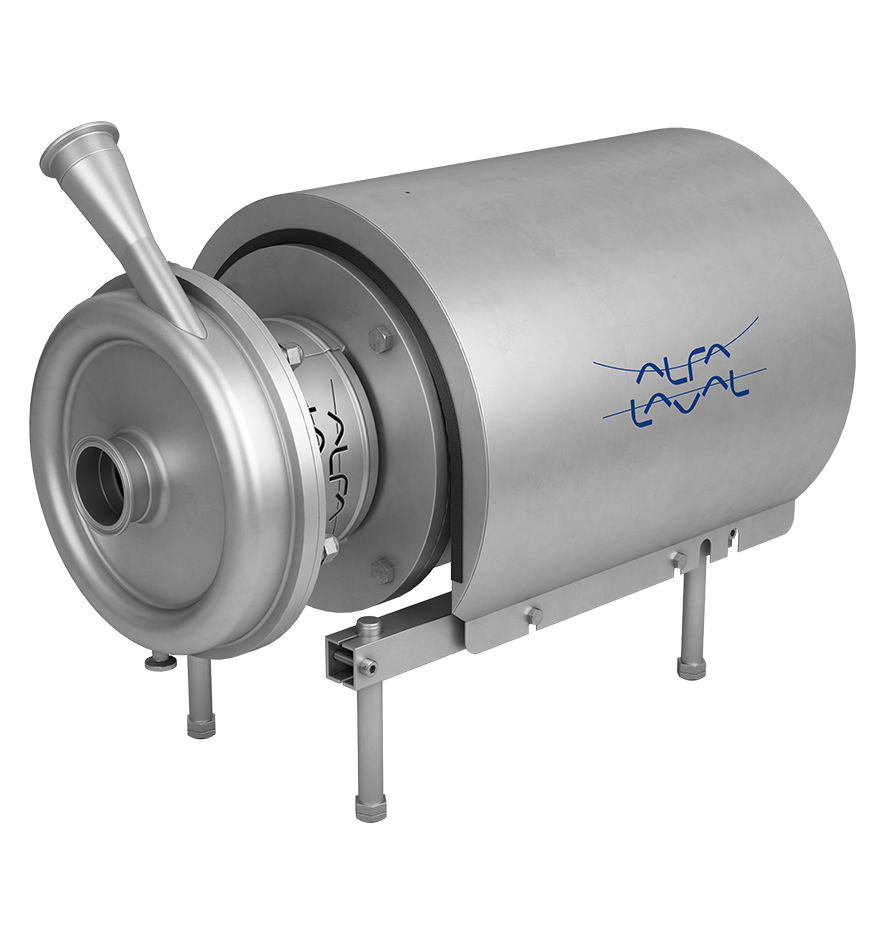
Frequently asked
What is the Alfa Laval SolidC used for?
It is a standardised hygienic centrifugal pump for basic transport duties. Alfa Laval designs it for cleaning-in-place and points it at dairy, food, beverage and personal care work, pumping CIP solutions, utilities, cooling or heating water and other simple transfer duties.
What is the difference between the SolidC and the SolidC UltraPure?
Materials and documentation, not hydraulics. Both cover four sizes to 75 m³/h and 8 bar at 50 Hz, but the UltraPure adds 3.1 material traceability to EN 10204, a Ra ≤ 0.5 inside finish, USP Class VI EPDM elastomers, silicon carbide against silicon carbide seal faces and the Alfa Laval Q-doc package.
Is the Alfa Laval SolidC EHEDG certified?
Alfa Laval states the SolidC complies with 3-A Sanitary Standards, CE, FDA and EHEDG requirements, and that its CIP cleanability is verified. The certification statement Alfa Laval makes is for the high-purity build, where it says the SolidC UltraPure range has EHEDG certification.
What flow and pressure does the SolidC handle?
Capacities reach 75 m³/h and differential pressures reach 8 bar at 50 Hz across the four sizes. Maximum inlet pressure is 4 bar.
How many SolidC sizes are there?
Four, the SolidC-1 to the SolidC-4. Inlets run from 51 mm to 76.1 mm and outlets from 38 mm to 51 mm.
What shaft seal does the SolidC use?
A single mechanical shaft seal as standard, external and front-loading, with a carbon rotary face against a silicon carbide stationary face. A silicon carbide rotating face and a single flushed mechanical seal are the options, and the UltraPure runs silicon carbide against silicon carbide as standard.
Does the SolidC share spares with other Alfa Laval centrifugal pumps?
Yes, on the seal. Alfa Laval uses the same external mechanical shaft seal on the SolidC as on its LKH centrifugal pumps, and the same seal again across the SolidC UltraPure and LKH UltraPure ranges. Quote against the model and the serial number off the nameplate.
Can the SolidC handle a medium carrying solids?
Not much of one. A centrifugal pump is the wrong technology once solids get much above 3–4%, or where the medium is viscous or shear-sensitive. Send us the medium and we will tell you whether a positive displacement pump is the honest answer.