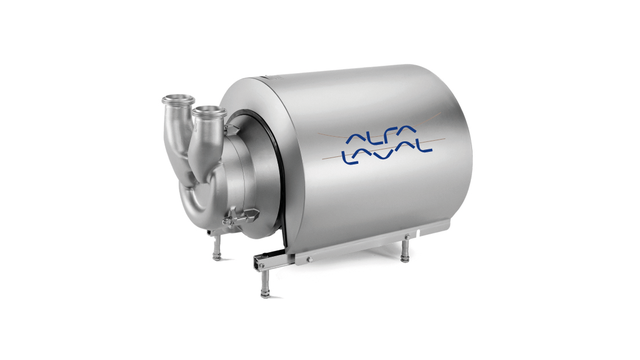
Key features
The liquid ring holds the prime where entrained air would stall a conventional centrifugal.
The construction suits returning cleaning fluid from tanks and pipework, where liquid and air arrive mixed.
Alfa Laval rates the suction capability as good enough that changing fluid characteristics have limited effect on performance.
Product-wetted steel parts in AISI 316L, with EPDM elastomers as standard and NBR or FPM alternatives.
A single external mechanical seal fits up to three models, so a site running more than one holds fewer spares.
About the Alfa Laval MR
The MR earns its place on one job: moving liquid that is carrying gas. On a CIP return line that is the normal condition. Cleaning fluid comes back from a tank or a run of pipework with air drawn in behind it, and the mixture reaching the pump changes as the tank empties. Alfa Laval is blunt about the alternative on its own product page: standard pumps have difficulty with this.
So specify the MR where the medium is aerated, and don't specify it where it isn't. If the liquid is clean and gas-free, a conventional hygienic centrifugal is the pump for that duty and we will say so.
A CIP return pump does get asked to strip a tank, so it will see the point where there is more air arriving than liquid. That is the duty it was designed for. It is still not an invitation to run it dry, because a mechanical seal needs liquid to lubricate it, and the seal is the weak point in almost any pump.
Three sizes cover the range: MR-185S, MR-200S and MR-300. Channel Pumps supplies the MR and sizes it against your duty point.
How the Alfa Laval MR works
The MR runs on centrifugal force, like any other centrifugal pump. What it does differently is where the liquid goes. A volute pump throws it into a casing around the impeller periphery. The MR feeds it into channels cut on either side of the impeller, in the front plate and the back plate. Those channels open up in volume as the impeller passes the suction port, and the vacuum that creates pulls liquid in. At the discharge port the volume closes down again, which builds pressure and pushes the liquid out.
Some of the centrifuged liquid never leaves. It stays at the periphery and re-circulates as a ring, and that ring is what keeps the pump primed. The expansion and contraction of volume, the centrifugal force and the liquid ring together raise the gas content the pump will take in the medium. That is the whole reason to fit one.
Sealing is a single mechanical seal, which Alfa Laval mounts externally for hygiene. The stationary ring is carbon and the rotating ring is acid-resistant duplex-grade steel, with EPDM O-rings as standard and NBR or FPM alternatives. Silicon carbide seal faces are an option on the MR-185S and MR-200S. Drive is a foot-flanged IEC motor to metric standard, four pole, IP55 with drain holes and labyrinth plug, insulation class F, running at 1500 rpm on 50 Hz and 1800 rpm on 60 Hz.
Alfa Laval's MR-300 instruction manual carries an EU Declaration of Conformity to the Machinery Directive 2006/42/EC and the RoHS Directive 2011/65/EU.
Specifications
| Flow rate | up to 80 m³/h | range maximum |
|---|---|---|
| Differential pressure | up to 5 bar | at 50 Hz |
| Maximum inlet pressure | 400 kPa (4 bar) | |
| Temperature range | -10°C to 140°C | with EPDM elastomers |
| Sizes | MR-185S, MR-200S, MR-300 | |
| Motor power (50 Hz) | MR-185S 5.5–7.5 kW; MR-200S 5.5–11 kW; MR-300 15–22 kW | |
| Speed | 1500 rpm at 50 Hz, 1800 rpm at 60 Hz | four-pole IEC motor |
| Product-wetted steel parts | AISI 316L | |
| Product-wetted seals | EPDM standard; NBR or FPM alternatives | |
| Shaft seal | External mechanical single seal, carbon against duplex-grade steel | |
| Connections | Clamp ISO 2037, or union to ISO (IDF), DIN/ISO, SMS or (BS)RJT | |
| Inlet and outlet size | 76.1 mm (3") | other dimensions on request |
Channel Pumps sizes and supplies the MR. Send us the flow rate, the differential pressure and the temperature, tell us what the medium is and how much gas it carries, and give us the density and viscosity. We also need the connection standard on the line and your voltage and frequency. We'll come back with the size and the build.
Documents & downloads
Related pumps
View all →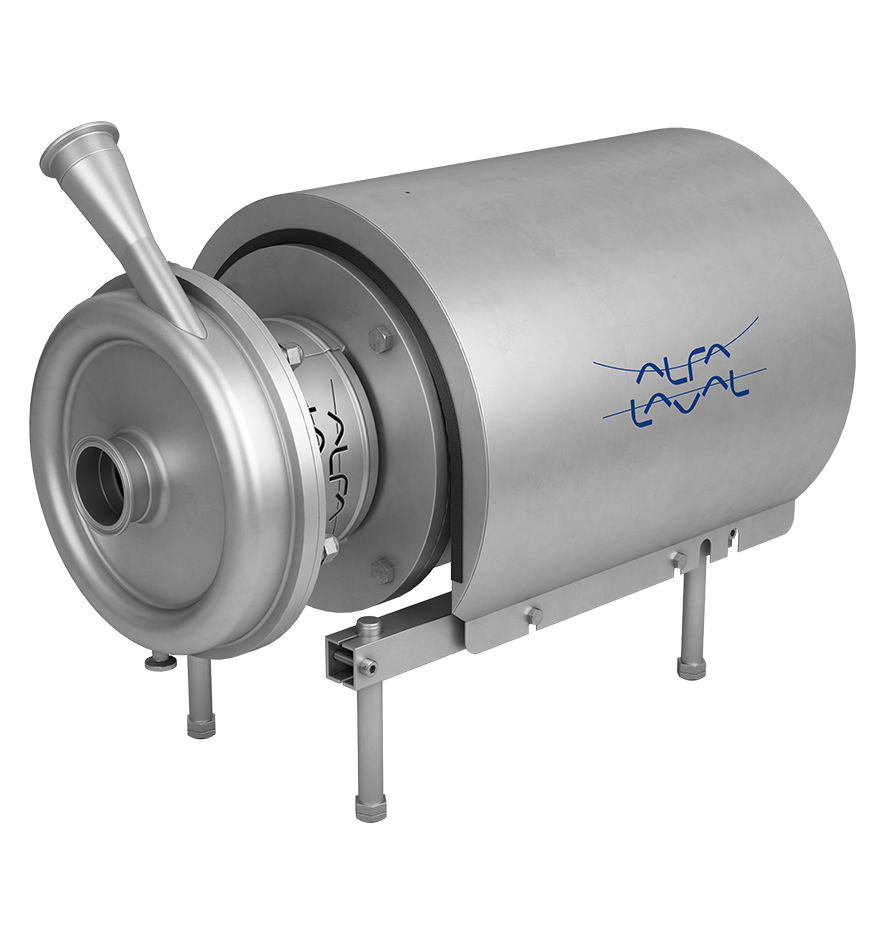
Frequently asked
What is the Alfa Laval MR used for?
The MR is a liquid-ring pump for liquids that contain air or gas. Its most common duty is CIP return across food, dairy, beverage and pharmaceutical processing.
Why use a liquid-ring pump for CIP return?
Cleaning fluid comes back from a tank with air entrained in it. A proportion of the liquid in an MR re-circulates at the impeller periphery as a liquid ring, which maintains the prime and raises the gas content the pump will accept.
What flow and pressure does the Alfa Laval MR handle?
The range handles capacities up to 80 m³/h and differential pressures up to 5 bar at 50 Hz. Maximum inlet pressure is 400 kPa (4 bar).
What sizes does the MR come in?
Three. MR-185S, MR-200S and MR-300. On 50 Hz the motors run from 5.5 kW on the MR-185S to 22 kW on the MR-300.
What are the MR's wetted materials?
Product-wetted steel parts are AISI 316L. Product-wetted seals are EPDM as standard, with nitrile (NBR) and fluorinated rubber (FPM) as alternatives.
What connections are available on the MR?
Clamp to ISO 2037, or unions to ISO (IDF), DIN/ISO, SMS or (BS)RJT. Inlet and outlet are 76.1 mm (3"), with other dimensions on request.