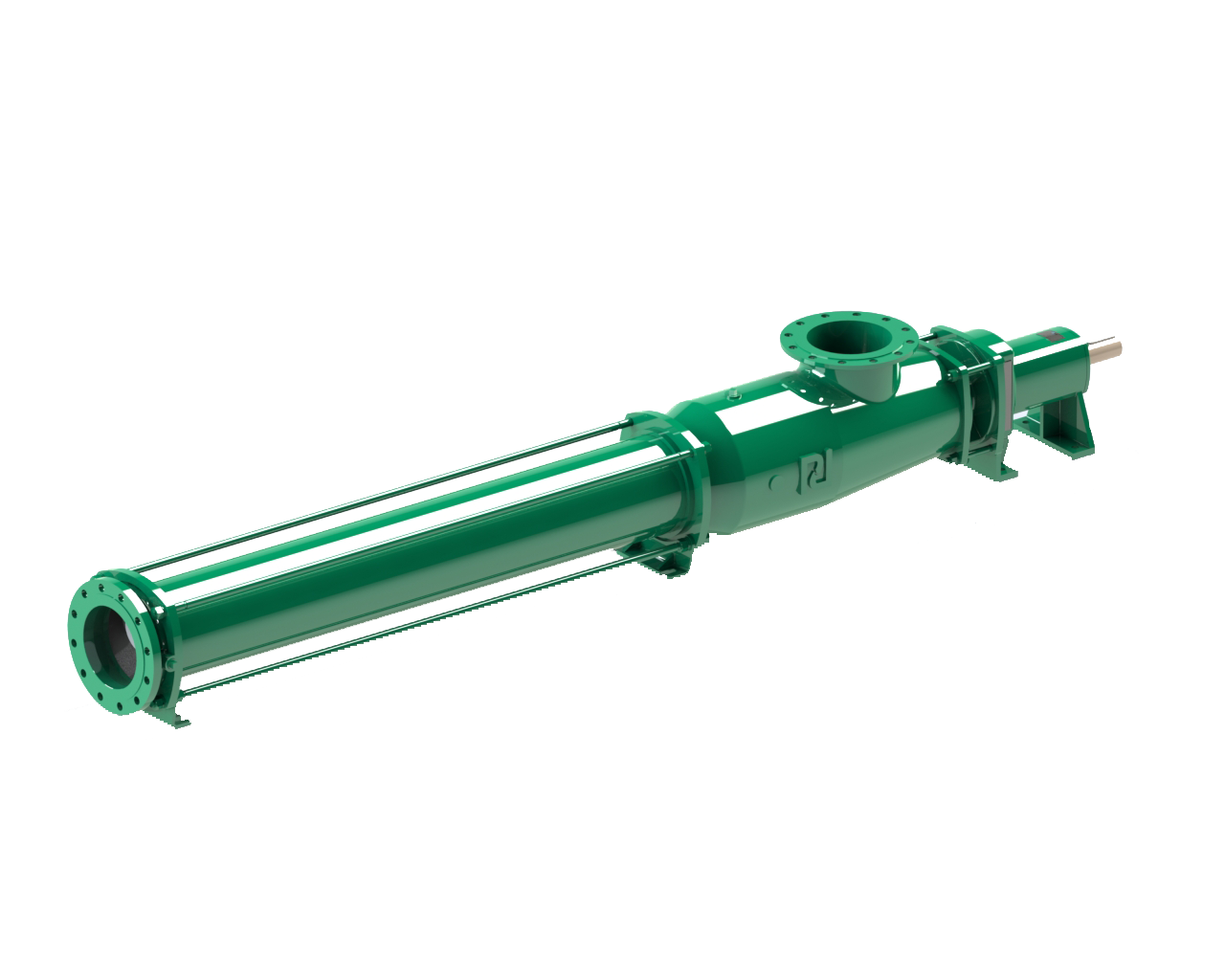
Key features
0.11 m³/h at the smallest size and 17 m³/h at the largest, so one range covers dosing through to small transfer duties.
D43 is rated to 48 bar, D55 to 6 bar. Size the RD against pressure as well as flow.
Rated to 30,000 cSt kinematic viscosity, up to 7% solids, and up to 150 °C.
Suction lift to 9.5 metres water column, and the pump will run on snore.
Roto's standard geometry eases fluid entry and cuts entry losses; the suction port rotates in steps of 90° to suit the pipework.
The stuffing box is externally mounted, so gland packing or a mechanical seal is maintained without dismantling the bearing housing.
About the Roto RD series
The RD is the small-capacity part of Roto's standard-geometry progressive cavity range, sitting below the RM sizes on the same rotor and stator geometry. The eight sizes run D41, D43, D45, D47, D49, D51, D53 and D55, from 0.11 to 17 m³/h, in close-coupled or bare shaft configuration, with six-stage and eight-stage builds in selected sizes. Roto rates the range to 30,000 cSt, up to 7% solids and up to 150 °C.
A progressive cavity pump earns its place where a centrifugal stops working: thick media, solids in suspension, shear-sensitive product, or a duty that has to be metered rather than throttled. Flow is proportional to shaft speed and largely independent of discharge pressure, so an RD holds its rate as the system changes. That is what makes it a dosing pump at the D41 end and a sludge or process transfer pump at the D55 end.
Note where the pressure sits in the table, because it is easy to get wrong. The highest rating in the range is on one of the smallest sizes: D43 carries 48 bar at 0.3 m³/h, while D55, the largest, carries 6 bar at 17 m³/h. If you need both flow and pressure, the answer is usually a larger frame from the RM sizes, not a harder-worked RD.
The trade-off is the stator. It is an elastomer wear part, it has to be matched to the medium, and it is the component you will be buying again. Dry running is what kills these pumps: with no liquid to carry the heat away, the stator burns out and the rotor is damaged with it, and that happens in minutes rather than hours. Roto's dry running protection device screws a temperature sensor into the stator wall and trips the pump at a preset temperature, and on any duty where the suction can be lost we would fit one. Abrasive media want pumping slowly for the same reason a stator lasts longer at lower speed.
If your medium is clean and as water, and the duty is high flow at modest head, an RD is the wrong pump and a centrifugal will cost less to buy and less to run. Send us the flow, the pressure, the medium and how thick it gets, and we will tell you which way it goes.
How the Roto RD series works
The wet end is two parts. A precision-machined single external helix rotor turns inside a double internal helix elastomer stator. The rotor profile holds a sealing line along the axis of the pump, static and dynamic, so cavities form at the suction end and progress along the pump to discharge. Each revolution carries a fixed volume, which is why flow is metered and near enough non-pulsating, why capacity is proportional to speed, and why the head the pump develops is not.
Torque reaches the rotor through double-sealed cardan universal joints. Each joint uses two sets of perpendicular pins, which gives freedom of angular movement and smoother transmission of angular loads, and it is built to take the high axial forces that dominate in a progressive cavity pump. Roto's housing is sloped to reduce entry losses and to drain, and the suction port can be rotated in steps of 90° to suit the installation.
The build is what you actually specify. Housings come in cast iron, cast stainless steel, fabricated steel or fabricated stainless steel. Rotors come in tool steel, case-hardened steel, alloy steel or stainless steel, with ceramic, tungsten carbide or hard chrome coatings where the medium is abrasive. Stator elastomers run natural rubber, nitrile, high nitrile, EPDM, chloro-sulphonated rubber, fluoroelastomer, Aflas and HNBR, and this is the material decision that matters most: get the elastomer wrong for the medium or the temperature and the stator swells, hardens or is attacked, whatever the housing is made of.
Shaft sealing is gland packing or a mechanical seal, chosen from Roto's seal codes. Codes M and L are single-acting elastomer bellow seals rated to 12 bar for sewage duties; N, P, R and S are rated to 25 bar for solids-laden and corrosive media; T is a double-acting seal to 25 bar for toxic, food and pharmaceutical media; V is a metal bellow seal to 12 bar for high temperature and high viscosity, such as bitumen and asphalt. Tell us the medium and the temperature and we will specify the seal with it, not after it.
Specifications
| Sizes | D41, D43, D45, D47, D49, D51, D53, D55 | small capacity, standard geometry |
|---|---|---|
| Flow rate | 0.11–17 m³/h | D41 to D55 |
| Pressure | 6–48 bar | D41 24 bar, D43 48 bar, D45–D49 24 bar, D51 and D53 12 bar, D55 6 bar |
| Viscosity | up to 30,000 cSt | |
| Temperature | up to 150 °C | |
| Solids handling | up to 7% | |
| Suction lift | up to 9.5 metres water column | |
| Configuration | close-coupled or bare shaft | six-stage and eight-stage builds in selected sizes |
| Housing materials | cast iron, cast stainless steel, fabricated steel, fabricated stainless steel | |
| Rotor materials | tool steel, case-hardened steel, alloy steel, stainless steel | ceramic, tungsten carbide or hard chrome coatings available |
| Stator elastomers | natural, nitrile, high nitrile, EPDM, chloro-sulphonated rubber, fluoroelastomer, Aflas, HNBR | |
| Shaft sealing | gland packing or mechanical seal | Roto seal codes M, L and V to 12 bar; N, P, R, S and T to 25 bar |
Channel Pumps sizes and supplies the Roto RD series. Send us the flow, the discharge pressure, the medium and its viscosity and temperature, the solids content, and how the pump is fed on the suction side. We will come back with the size, the stator elastomer and the sealing arrangement, and tell you if a different pump type would serve the duty better.
Documents & downloads
Related pumps
View all →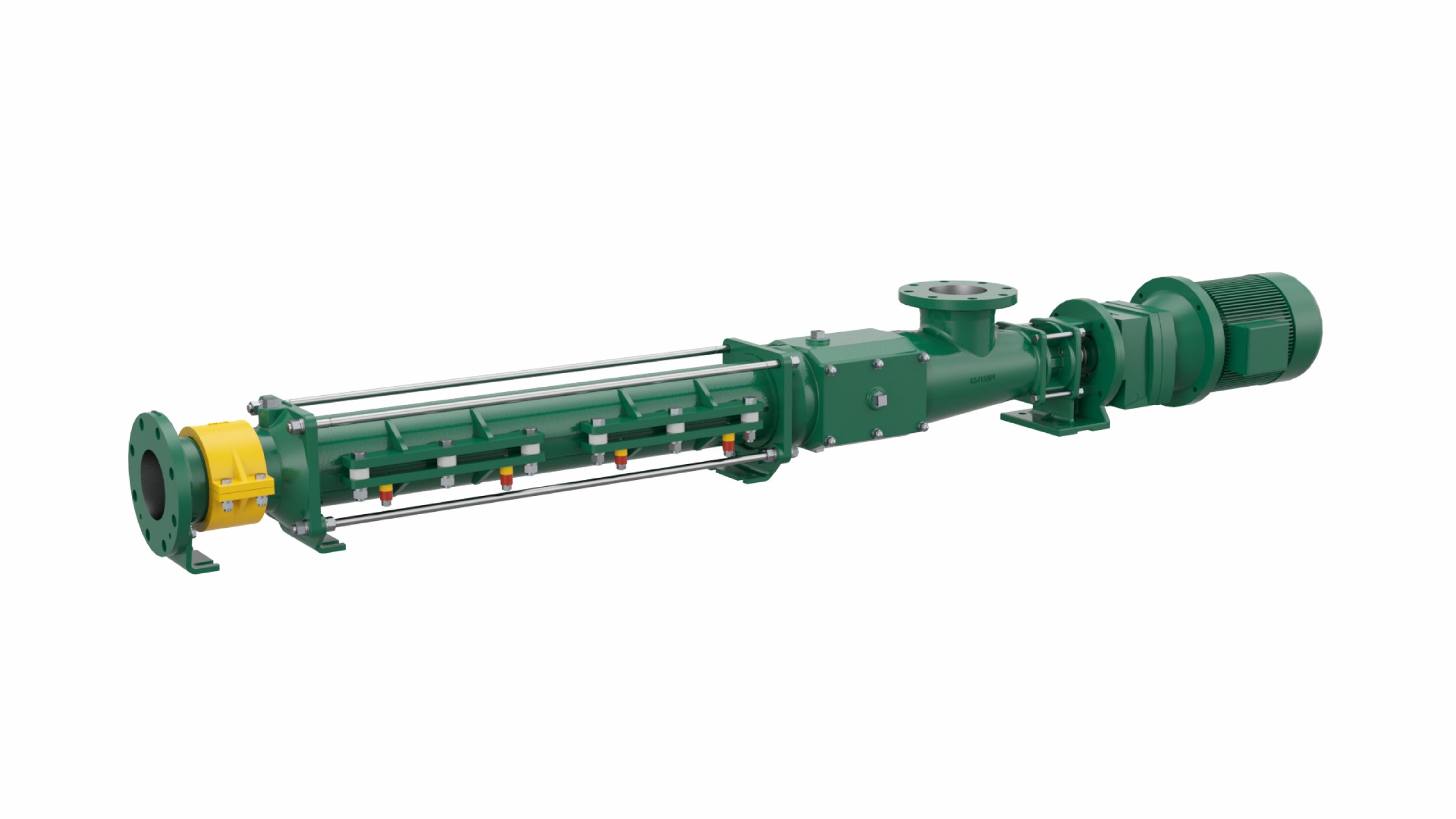
Frequently asked
What flow and pressure does the Roto RD series cover?
The RD series covers 0.11–17 m³/h across eight sizes. Pressure runs from 6 to 48 bar and falls as capacity rises. D43 is rated to 48 bar at 0.3 m³/h, D45 to D49 to 24 bar, D51 and D53 to 12 bar, and D55 to 6 bar at 17 m³/h.
What sizes are in the Roto RD series?
Eight. D41, D43, D45, D47, D49, D51, D53 and D55, available in close-coupled or bare shaft configuration, with six-stage and eight-stage builds in selected sizes.
What is the difference between the Roto RD, RM and RL series?
The RD and RM series share Roto's standard rotor and stator geometry; the RD is the small-capacity end at 0.11–17 m³/h and the RM covers 4–250 m³/h. The RL series uses extended geometry, from 14 to 420 m³/h, and every RL size is rated to 6 bar. So pick RD or RM when you need pressure, and RL when you need volume at low pressure.
Can a Roto RD handle solids and viscous media?
Yes. Roto rates the range to 30,000 cSt kinematic viscosity and up to 7% solids, at temperatures up to 150 °C. The stator elastomer is what has to match the medium, so tell us what you are pumping and how hot it gets.
Can a progressive cavity pump run dry?
No. Without liquid to carry the heat away, the stator burns out and takes the rotor with it, in minutes. Roto's dry running protection device screws a temperature sensor into the stator wall and trips the pump at a preset temperature, and it is worth fitting wherever the suction can be lost.
Is the Roto RD self-priming?
Yes. Roto quotes suction lift of up to 9.5 metres water column, and the pump will run on snore, so no foot valve is needed. Suction conditions still decide whether the pump survives, so give us the tank level and the suction pipework when you enquire.