Key features
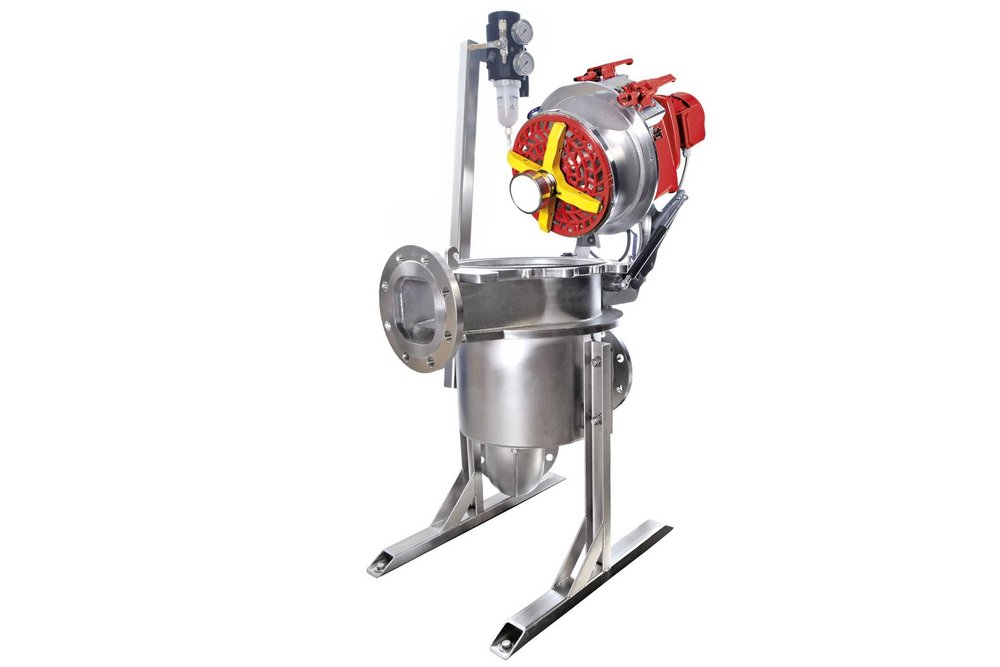
Every RotaCut carries an integrated heavy material separator. Stones and metal parts drop out by gravity while the medium keeps flowing, and are cleared later through a cleaning port.
Free passage runs from 4 mm to 50 mm depending on the machine size. The screens are wear-resistant special steel, stainless for aggressive media, and can be run on both sides.
The blade holder in the rotor is self-adjusting, so the martensitic stainless steel blades keep constant contact with the screen. That contact is what lets it cut hair and industrial fibre rather than push it through.
ACC holds the contact pressure between blades and screen without stopping the machine. ACCplus adds online blade-wear status on an external display for the RCQ and RCX series, so nobody has to open the cutter to find out.
When the cutter head blocks, the function reverses the blade rotor and cuts from the other side, repeating until the material goes through. Regular reversal also keeps a sharp pair of edges in use.
The blades and screen come out in a few movements. The RotaCut does not have to be removed from the pipework and the cutter head does not have to be dismantled.
About the Vogelsang RotaCut
The RotaCut protects the plant behind it, and conditions the medium while it does that. Vogelsang developed it 25 years ago and it does two jobs in one housing. It separates heavy matter out of the flow, and it macerates what is left against a cutting screen, so the medium turns into a pumpable, homogeneous suspension. Vogelsang lists it on faecal matter, liquid manure, organic suspensions, potato pulp, food waste, abattoir waste, sewage and oil sludge.
The reason to buy one is almost always something downstream that keeps failing. The mistake that lands on the desk most often is a pump replaced like for like because it keeps clogging on rag. If the pump already installed is a decent solids-handling pump, a bigger one of the same thing fails the same way, and the money is gone. We have declined to quote a submersible on exactly that basis and said what the site needed was rag removal upstream. A macerator is the system change, not the pump.
What it costs you
A machine you did not have before, with two consumables in it. Cutting blades and cutting screens wear, and the rate depends on your medium and your grit. That is the honest trade against fewer blocked pumps and fewer callouts. It is also why ACC and ACCplus exist. They hold the cutting pressure where it should be, and they tell you the blades are near the end instead of letting you find out through a drop in performance. Budget for the wear parts at specification, not at the first service.
Where it is the wrong machine
If the problem is bulk rag, textiles and gross solids in a sewer or a pumping station rather than fibre in a process medium, look at the XRipper twin-shaft grinder instead. And if nothing downstream is actually blocking, a macerator adds a maintenance point for no return. Tell us what is failing and how often before you specify one.
How the Vogelsang RotaCut works
The medium flows continuously through the machine. Stones, metal parts and anything else heavy separate out by gravity into the separator chamber, because they will not lift with the flow. What stays floating or in suspension is carried on to the cutting screen and cut there by the rotating, self-sharpening blades: fibre, hair, bones, wood, entangled material, whole plant silage, grass. The medium is homogenised in the same pass.
Vogelsang develops the screen geometry with its own software so the hole pattern suits the size-reduction ratio and the medium, and the screens are made to be used from either side.
How a RotaCut is configured
A RotaCut is a cutter head design plus a separator design, and the two are specified separately.
Five cutter head designs. The RC is the basic series. The RCpro takes media with high solids and fibre content. The RCQ is built around ease of maintenance and online monitoring, and the RCQpro combines that with the RCpro's cutting head. The RCX is the largest and the most robust.
Five separator designs. Inline puts intake and discharge directly opposite each other, at a maximum of 2 bar depending on size. MXL mounts on a tanker, at a maximum of 0.5 bar. Compact XL handles high foreign-object content at a maximum of 4 bar. RCX runs to 6 bar. RCX with DRS adds the Debris Removal System, which clears separated heavy material without shutting the machine down or opening it; Vogelsang states it reduces the work required by 80%.
The types and what they pass
Ten electrically driven types cover 90 to 1,200 m³/h. Throughput depends on dry solids content, so read these as ceilings rather than duty points.
| Type | Max throughput | Drive power | Cutting screen free passage |
|---|---|---|---|
| RCQ-20 | 90 m³/h | 1.1–2.2 kW | 10–20 mm |
| RC 3000 | 180 m³/h | 1.5–4.0 kW | 4–28 mm |
| RCQ-26 | 180 m³/h | 2.2–5.5 kW | 4–28 mm |
| RC 5000 | 300 m³/h | 1.5–7.5 kW | 4–30 mm |
| RCQ-33 | 300 m³/h | 2.2–7.5 kW | 4–30 mm |
| RC 10000 | 600 m³/h | 2.2–7.5 kW | 4–38 mm |
| RCQ-43 | 600 m³/h | 5.5–7.5 kW | 4–38 mm |
| RCX-48 | 600 m³/h | 5.5–11 kW | 4–38 mm |
| RCX-58 | 780 m³/h | 7.5–15 kW | 4–50 mm |
| RCX-68 | 1,200 m³/h | 11–18.5 kW | 30–50 mm |
Drive and materials
Electrically driven machines run at 66–330 rpm. The RC 3000, RC 5000, RC 10000 and RCX-58 are also available with a hydraulic drive, which is how the tanker installations are usually powered: 50–125 bar of oil pressure and 40–75 l/min depending on the type. The housing is steel and fully galvanised, with stainless steel variants for particularly aggressive applications, and the screens and blades come in steel or stainless.
Control
Automatic Cut Control adjusts the blades and holds the contact pressure constant during operation, as high as necessary and as low as possible, which is what keeps power consumption and blade wear down. ACCplus, available on the RCQ and RCX series, reports blade status online to an external display or the control system. The Performance Control Unit goes further and supervises a group of pumps and grinders together, communicating over PROFINET with an OPC UA interface for remote access.
Specifications
| Type | Inline wet cutter (macerator) with integrated heavy material separator | |
|---|---|---|
| Cutter head designs | RC, RCpro, RCQ, RCQpro, RCX | |
| Separator designs | Inline, MXL, Compact XL, RCX, RCX with DRS | |
| Max throughput | 90 to 1,200 m³/h | by type; depends on dry solids content |
| Pressure | Inline max 2 bar, Compact XL max 4 bar, RCX max 6 bar, MXL max 0.5 bar | by separator design; Inline figure depends on size |
| Drive power | 1.1 to 18.5 kW | electrically driven types |
| Speed | 66 to 330 rpm | |
| Hydraulic drive | 50–125 bar oil pressure, 40–75 l/min | RC 3000, RC 5000, RC 10000 and RCX-58 |
| Cutting screen free passage | 4 to 50 mm | by machine size; screens usable on both sides |
| Cutting screen material | Wear-resistant special steel; stainless steel for aggressive media | |
| Cutting blades | Wear-resistant martensitic stainless steel, self-adjusting against the screen | |
| Housing | Steel, fully galvanised; stainless steel variants | |
| Control options | ACC, ACCplus, Auto-Reverse, Performance Control Unit | ACCplus on the RCQ and RCX series |
| Debris Removal System | RCX series | clears separated heavy material during operation |
Tell us what is downstream and what it keeps doing. Send the flow rate, the medium and its dry solids content, what is getting into it, the free passage the next machine needs, and whether the install is in a pipe run or on a vehicle. We will specify the cutter head, the separator design, the screen and the drive against that, or tell you the blockage is a system problem a macerator will not fix.
Documents & downloads
Related pumps
View all →
Frequently asked
What does a Vogelsang RotaCut do?
It cuts fibre and coarse matter in a flowing liquid down to a defined size and separates out the stones and metal parts that cannot be cut. The result is a pumpable, homogeneous suspension and a pump downstream that stops blocking. It is a cutter, not a pump, so it sits in a line that something else is pumping.
What is the difference between the RotaCut and the XRipper?
The RotaCut cuts against a perforated screen and carries a heavy material separator, so the hole pattern fixes the free passage at 4 mm to 50 mm and stones and metal come out ahead of the cutter head. The XRipper shreds between two counter-rotating shafts of monolithic Ripper rotors, with no screen. Specify the RotaCut where the medium must leave at a controlled size, and the XRipper on bulk wipes and textiles in a sewer or a treatment works.
How small does a RotaCut cut?
The cutting screen decides it. Free passage runs from 4 mm to 50 mm depending on the machine size, and Vogelsang lists the available hole patterns per type. Pick the screen from what the next machine in the line can pass, not from the finest available, because a finer screen means more cutting work and faster wear.
What flow rate can a RotaCut handle?
From 90 m³/h on the RCQ-20 up to 1,200 m³/h on the RCX-68, across ten electrically driven types. Vogelsang qualifies every figure as depending on dry solids content, so they are ceilings rather than duty points. Four types are also available with a hydraulic drive.
Can a RotaCut be fitted on the discharge side of a pump?
Yes, within the pressure limit of the separator design. Vogelsang gives a maximum of 2 bar for the Inline design depending on size, 4 bar for the Compact XL, 6 bar for the RCX, and 0.5 bar for the MXL on a tanker. Send us the pressure at the point you want it fitted.
How much maintenance does a RotaCut need?
The blades and the cutting screen are wear parts, and how fast they go depends on the medium and the grit in it. Both are replaced on site, in a few movements, without removing the machine from the pipework or dismantling the cutter head. ACC keeps the cutting pressure right between changes, and ACCplus tells you when the blades are close to the end.