Key features
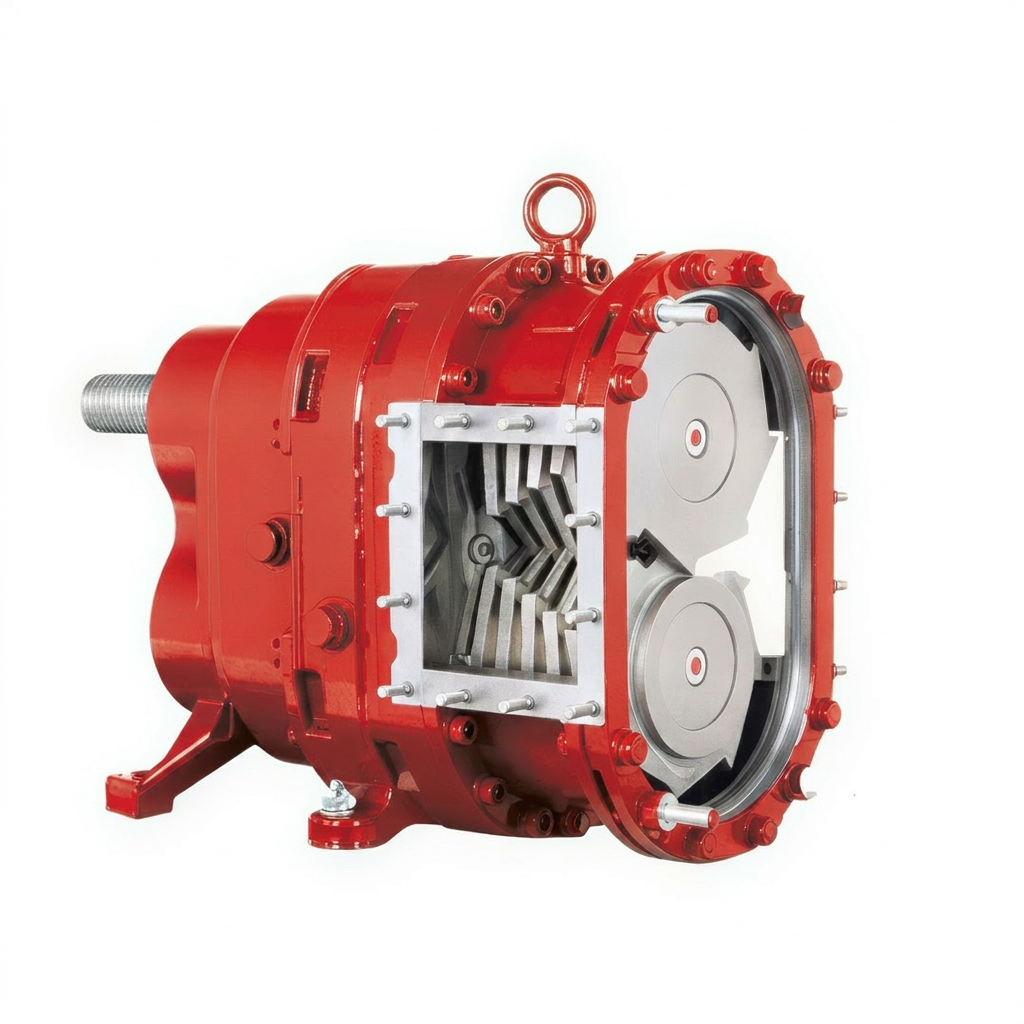
Each Ripper rotor is machined from a single block of steel, so a rotor change swaps two parts rather than a column of cutting discs and spacers on a carrier shaft.
Standard blade widths run 5.5 mm to 10.6 mm depending on the type, and Vogelsang lists rotors from 6 mm to 11 mm to adjust the size-reduction ratio.
The shafts turn at 34 to 57 rpm on 1.5 to 7.5 kW. Torque does the shredding, so the drive stays small and grit passes slowly rather than being flung through.
The two shafts run at different speeds, so material lodged in the gaps between the rotors is raked out as they turn rather than building into a wrap.
A seal is where most rotating equipment gives up first. Vogelsang fits a preinstalled cartridge mechanical seal, so a seal change is a swap on site rather than a rebuild in the chamber.
The same rotors sit in an inline body from Ø100 mm flanges, a vertical unit 406 mm flange to flange, a channel unit on rails, or the 7,164 m³/h XRG.
About the Vogelsang XRipper
The XRipper exists because of what people flush. Wet wipes, sanitary items and textiles bind into rag, rag wraps an impeller or bridges a valve, and a pumping station that used to run itself starts generating callouts. The XRipper is Vogelsang's answer to that: a twin-shaft shredder that sits in the flow, catches the material and cuts it down to a size the plant behind it can pass. Vogelsang also puts it on entangled material coming back out of digesters, and on bones, fruit, vegetables and food-production waste on the industrial side.
It is a grinder, not a pump and not a screen. It adds nothing to the flow and takes nothing out of it. Everything that goes in comes out the other side, smaller. Get that straight before you look at the model list, because it decides whether the machine is any use to you.
Which series
Four of them, and the installation picks it more often than the duty does.
The XRS is the horizontal inline unit and the cheapest way into the range: grey cast iron chamber, Ø100 mm to Ø200 mm flanges, 50 to 325 m³/h. The XRP does the same job with the motor stacked vertically above the rotors, which is what you specify when the machine has to go into a shaft with no floor space. It starts at 406 mm flange to flange and runs to 1,140 m³/h. The XRC-SIK is for open channels. It hangs on a Sewer Integration Kit rail system so a crane can lift the whole machine out of the channel for service, and it takes inlet openings from 219 × 320 mm up to 500 × 1,300 mm. The XRG is the large-flow machine, with sieve drums either side of the rotors that let water past while holding the rubbish back and feeding it in continuously. That is what gets it to 7,164 m³/h in a 1,370 mm wide frame.
Read the throughput figures properly
Every throughput number Vogelsang publishes for the XRipper is a maximum theoretical figure for water, at a stated pressure loss: 0.25 bar for the XRS, 0.15 bar for the XRP. The channel machines are quoted at optimum sewer conditions. Sewage carrying the rag you bought the machine for will not behave like water, and the useful figure is the one that comes out of Vogelsang's sizing software against your channel or your pipe. Treat the table figures as ceilings, the way you would read the end of a performance curve.
What it costs you
A machine you did not have before, in a line that previously had nothing in it. The Ripper rotors and the axial wear plates are consumables, and on a works where the grit removal is not doing its job they will go faster than the brochure life. Rotors can be turned 180 degrees and run the other way round, which buys you a second life out of the same part, but they are still a wear item to budget at specification rather than at the first service.
There is a second cost that gets missed. Grinding does not remove anything. If your consent or your process needs the rag off site, you want screening and a skip, because the XRipper will pass a finer version of the same material straight into the works. It earns its place where the problem is mechanical damage and blockage downstream, not where the problem is solids load.
Where it is the wrong machine
If the medium is a process liquid that must leave at a controlled particle size, or if stones and metal are getting in, look at the Vogelsang RotaCut instead. It cuts against a perforated screen, so the hole pattern fixes the free passage, and every machine carries a heavy material separator as standard. The XRipper has no screen and separates nothing by default; a connector box can be added ahead of the XRS and the XRP to drop stones and metal out, but on the XRC and XRG that option is not on the list.
And the honest one: check the pump first. The mistake we see most often on a blocking station is a pump swapped like for like, when the pump was never the fault. A grinder is a system change and it fixes a system problem. If nothing is actually failing downstream, an XRipper is a drive, a gearbox and a set of wear parts you have volunteered to maintain.
How the Vogelsang XRipper works
Solids arrive with the flow and are guided into the centre of the housing, where the two Ripper rotors intermesh. Water passes the rotors more or less unhindered, because the housing is deliberately oversized and the pressure loss across it is small. Solid matter is ripped, long fibre is cut by the sharp edges, and coarse brittle material is ground. The size the material leaves at is set by the width and contour of the Ripper blades, not by a screen.
Two details do most of the work. The axial wear plates carry a counter-cutter, which is what stops disruptive matter slipping past the rotors unshredded. And the two shafts turn at different speeds, so anything that settles into the gaps between the rotors gets raked out as the rotors pass each other. That is the self-cleaning action, and it is why the machine resists ragging rather than collecting it.
The rotors themselves are cut from a single block of steel on CNC machines: a high-strength core, narrow gaps, hardened cutting edges. Because the drive torque is carried by the rotor body rather than through a carrier shaft and a stack of discs, the assembly is stiff enough not to need intermediate bearings. Shafts and rotors are dimensioned to the largest diameters that will fit, which is what makes the unit torsionally stiff and hard to stall.
The XRipper XRS, inline in cast iron
| Type | Blade widths | Drive power | Speed | Max throughput | Max pressure | Flange |
|---|---|---|---|---|---|---|
| 100-90Q | 5.5 / 7.4 mm | 1.5 kW | 53 rpm | 50 m³/h | 8 bar | Ø100 mm |
| 136-140Q | 6.2 / 9.8 mm | 2.2 kW | 41 rpm | 110 m³/h | 8 bar | Ø150 mm |
| 186-130Q | 7.9 / 10.6 mm | 4.0 kW | 40 rpm | 165 m³/h | 8 bar | Ø150 mm |
| 186-260Q | 7.9 / 10.6 mm | 4.0 kW | 40 rpm | 325 m³/h | 6 bar | Ø200 mm |
The XRipper XRP, inline with the motor above
| Type | Blade widths | Drive power | Speed | Max throughput | Max pressure | Flange | Flange to flange |
|---|---|---|---|---|---|---|---|
| 100-90Q | 5.5 / 7.4 mm | 1.5 kW | 57 rpm | 85 m³/h | 8 bar | Ø100 mm | 406 mm |
| 136-140Q | 6.2 / 9.8 mm | 2.2 kW | 46 rpm | 165–190 m³/h | 8 bar | Ø100–Ø150 mm | 406–483 mm |
| 136-200Q | 5.9 / 9.5 mm | 2.2 / 4.0 kW | 45–46 rpm | 265–300 m³/h | 6 bar | Ø100–Ø200 mm | 488–590 mm |
| 186-260Q | 7.9 / 10.6 mm | 4.0 kW | 38 rpm | 490–550 m³/h | 4 bar | Ø250–Ø300 mm | 692–794 mm |
| 186-520QD | 7.9 / 10.6 mm | 4.0–7.5 kW | 36–41 rpm | 980–1,140 m³/h | 4 bar | Ø300–Ø450 mm | 895–1,200 mm |
Note the direction of travel in that last column. The biggest inline XRippers are the lowest pressure rated: 8 bar on the small frames, 4 bar by the time you reach the 186 series. If the machine is going on the discharge side of a pump, the pressure at that point decides the frame before the flow does.
The XRipper XRC-SIK, for open channels and shafts
| Frame | Types | Blade widths | Drive power | Speed | Max throughput | Inlet opening |
|---|---|---|---|---|---|---|
| 100 | 320QD to 960QD | 5.5 mm | 2.2 kW | 50 rpm | 140–690 m³/h | 219 × 320 to 219 × 960 mm |
| 136 | 280QD to 1120QD | 9.8 mm | 3.0 kW | 44 rpm | 115–940 m³/h | 365 × 280 to 365 × 1,120 mm |
| 186 | 260Q to 1300QD | 9.8 mm | 4.0 kW | 34 rpm | 170–1,770 m³/h | 500 × 260 to 500 × 1,300 mm |
The XRipper XRG, for high flow
| Frame | Blade widths | Drive power | Speed | High Capacity Unit drive | Max throughput | Width |
|---|---|---|---|---|---|---|
| 100 + HCS | 5.5 mm | 2.2 kW | 50 rpm | 1 × 0.25 kW | 496–1,164 m³/h | 530 mm |
| 136 + HCS | 9.8 mm | 4.0 kW | 45 rpm | 1 × 0.25 kW | 883–2,431 m³/h | 740 mm |
| 136 + HCD | 9.8 mm | 4.0 kW | 45 rpm | 2 × 0.25 kW | 1,218–3,300 m³/h | 1,067 mm |
| 186 + HCD | 9.8 mm | 5.5 kW | 37 rpm | 2 × 0.55 kW | 2,738–7,164 m³/h | 1,370 mm |
On the XRG the rotors and the High Capacity Units are driven independently, so each can be geared to its own job and each can be monitored on its own. If one stalls you know which one, and the other keeps working.
Materials, options and the drive
The chamber is grey cast iron on the XRS and steel on the other three series, with stainless steel and cast stainless steel available. Ripper rotors and axial wear plates are a highly wear-resistant special steel as standard, and a stainless variant is offered for chemically aggressive media. Flow-optimised housings are an option on the XRP and the XRC.
For long rotor sets, or where hard blockages are expected, the QD design adds a third support bearing. That stops the shafts deflecting far enough for the rotors to touch each other, which is the failure the length would otherwise buy you. Every QD machine keeps the same on-site serviceability as the rest of the range.
Drive is normally a geared motor or a parallel shaft geared motor, rated IP55 on the XRP and XRC. Versions suitable for temporarily or permanently flooded operation are available, and the XRipper can be driven hydraulically instead. Vogelsang can supply an ATEX-compliant version for equipment going into a hazardous area; specify the zone when you enquire, because that decides the drive and the certification the manufacturer has to issue against it.
What it looks like in service
Vogelsang publishes a case study at the Nigg wastewater treatment works in Aberdeen, a 250,000 population equivalent site run by Scottish Water, where an XRC186-520QD SIK replaced twin-shaft grinders that had to go off site for overhaul. Vogelsang reports a 60% reduction in maintenance cost over the first 12 months against the units it replaced, with the servicing done by the plant's own engineers. That figure is the manufacturer's, not ours. The mechanism behind it is the part to take away. On the XRP, XRC and XRG the whole functional unit lifts out in one piece, motor, gearbox, shafts and rotors together, while the housing stays bolted where it is. On the XRS the cover comes off and the wear parts follow it. Nothing has to leave the works, which is where the cost of a grinder overhaul normally goes.
Specifications
| Type | Twin-shaft grinder, inline or open channel | not a pump; requires its own drive |
|---|---|---|
| Series | XRS, XRP, XRC-SIK, XRG | |
| Max throughput | 50 to 7,164 m³/h | maximum theoretical figure for water, by type |
| Reference pressure loss | 0.25 bar (XRS), 0.15 bar (XRP) | the condition the throughput figures are quoted at |
| Drive power | 1.5 to 7.5 kW | electric geared or parallel shaft geared motor |
| High Capacity Unit drive power | 1 × 0.25 kW to 2 × 0.55 kW | XRG only, driven independently of the rotors |
| Drive speed | 34 to 57 rpm | |
| Max pressure | 8 bar on the 100 and 136 frames, 4 bar on the 186 frame | inline XRS and XRP; the channel machines carry no pressure rating |
| Flange connection | Ø100 to Ø450 mm | Ø100–Ø200 mm on the XRS, Ø100–Ø450 mm on the XRP |
| Installation width, flange to flange | 406 to 1,200 mm | XRP |
| Channel inlet opening | 219 × 320 mm to 500 × 1,300 mm | XRC-SIK |
| Frame width | 530 to 1,370 mm | XRG |
| Cutting elements | Monolithic Ripper rotors, machined from a single steel block | symmetrical, so they can be turned 180 degrees |
| Blade widths | 5.5 to 10.6 mm as standard | rotors listed from 6 to 11 mm to set the size-reduction ratio |
| Rotor and wear plate material | Highly wear-resistant special steel | stainless steel variant for chemically aggressive media |
| Chamber material | Grey cast iron (XRS) or steel | stainless steel and cast stainless steel available |
| Shaft seal | Preinstalled cartridge mechanical seal | replaced as a complete cartridge on site |
| Wear plates | Axial, with counter-cutter | |
| Bearing option | QD design with a third support bearing | for long rotor sets or where hard blockages are expected |
| Heavy material separation | Connector box, upstream | available for the XRS and XRP |
| Positioning system | Sewer Integration Kit (SIK) guide rails | XRC; the machine lifts out of the channel on the rails |
| Housing option | Flow-optimised housing | XRP and XRC |
| Drive options | Geared and parallel shaft geared motors, floodable and submersible versions, or a hydraulic motor | |
| Motor protection | IP55 | parallel shaft geared motors on the XRP and XRC |
| Hazardous area | ATEX-compliant version available | per Vogelsang; certification is issued by the manufacturer against the zone |
Tell us what is blocking and how often. Send the flow rate, whether the machine is going into a pipe or an open channel, the pressure at that point if it is a pipe, the channel dimensions if it is not, the free passage the next machine in the line needs, and any hazardous area classification. We will specify the series, the frame, the blade width and the drive against that. If the blockage is a system problem a grinder will not fix, we will tell you that instead.
Documents & downloads
Related pumps
View all →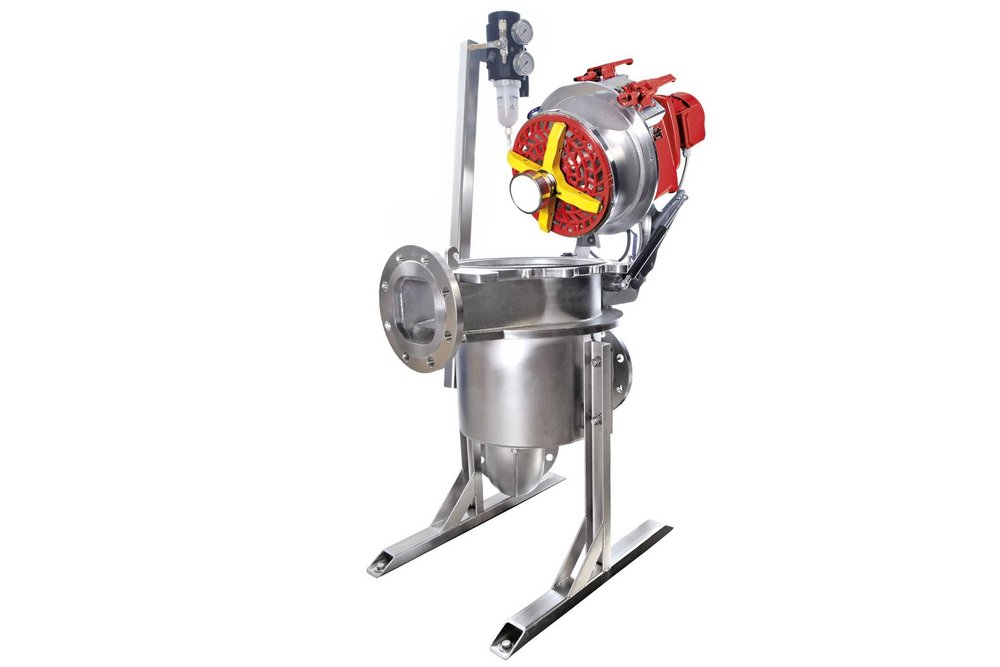
Frequently asked
What is the Vogelsang XRipper used for?
The Vogelsang XRipper shreds coarse and fibrous material in wastewater so it stops damaging and blocking the plant downstream: wet wipes, sanitary items, textiles, wood, plastic and rag in sewers, pumping stations and treatment works, plus entangled material coming out of digesters. On the industrial side Vogelsang lists bones, fruit, vegetables and food-production waste. It is a grinder, so it sits in a line or a channel that something else is moving.
What is the difference between the XRipper and the RotaCut?
The XRipper shreds between two counter-rotating rotors with no screen, so the blade width and contour set the size and there is no fixed free passage. The RotaCut cuts against a perforated screen and carries a heavy material separator as standard, so stones and metal come out before the blades and the hole pattern fixes the size at 4 mm to 50 mm. Specify the XRipper on bulk rag and gross solids in a sewer or a channel, and the RotaCut where a process medium has to leave at a controlled size.
What flow rate can a Vogelsang XRipper handle?
A Vogelsang XRipper is rated from 50 m³/h on the smallest XRS up to 7,164 m³/h on the largest XRG. Every one of those figures is a maximum theoretical throughput for water at a stated pressure loss, 0.25 bar for the XRS and 0.15 bar for the XRP, or at optimum sewer conditions for the channel machines. Real sewage with rag in it will not reach them, so treat them as ceilings and let Vogelsang's sizing software work out the figure for your line.
Which XRipper model do I need?
The installation decides the XRipper series more often than the duty does. The XRS is the horizontal inline unit, Ø100 mm to Ø200 mm, 50 to 325 m³/h; the XRP puts the motor above the rotors for shafts with no floor space, from 406 mm flange to flange up to 1,140 m³/h. The XRC-SIK hangs in an open channel on guide rails and takes inlet openings from 219 × 320 mm to 500 × 1,300 mm, and the XRG uses sieve drums either side of the rotors to reach 7,164 m³/h.
Is the Vogelsang XRipper available for hazardous areas?
Vogelsang states that an ATEX-compliant version can be supplied for use in areas subject to explosion hazards. Certification is the manufacturer's to issue and it is issued against a specific build, so give us the zone classification and the medium with the enquiry rather than after it. Flooded and submersible drive versions and a hydraulic drive are also available, and which of those you need changes the ATEX build.
What maintenance does an XRipper need?
The Ripper rotors and the axial wear plates are the wear parts, and the cartridge mechanical seal is replaced whole. All of it is done on site. On the XRP, XRC and XRG the complete functional unit lifts out while the housing stays in the pipe or the channel; on the XRS the cover comes off and the parts are behind it. The rotors are symmetrical, so they can be turned 180 degrees and run on the other pair of edges before they are scrapped.
Will an XRipper stop my pump blocking?
If the pump is blocking on rag and wipes, yes, that is the failure an XRipper is built for; if it is blocking for another reason, a grinder adds a maintenance point and fixes nothing. So check two things first. Is the pump right for the duty at all, or was it sized on flow and head and then asked to pass solids it was never going to pass? And does the site need the rag taken away rather than made smaller, because grinding removes nothing from the flow. Send us what is failing and how often and we will tell you which of the three you have.