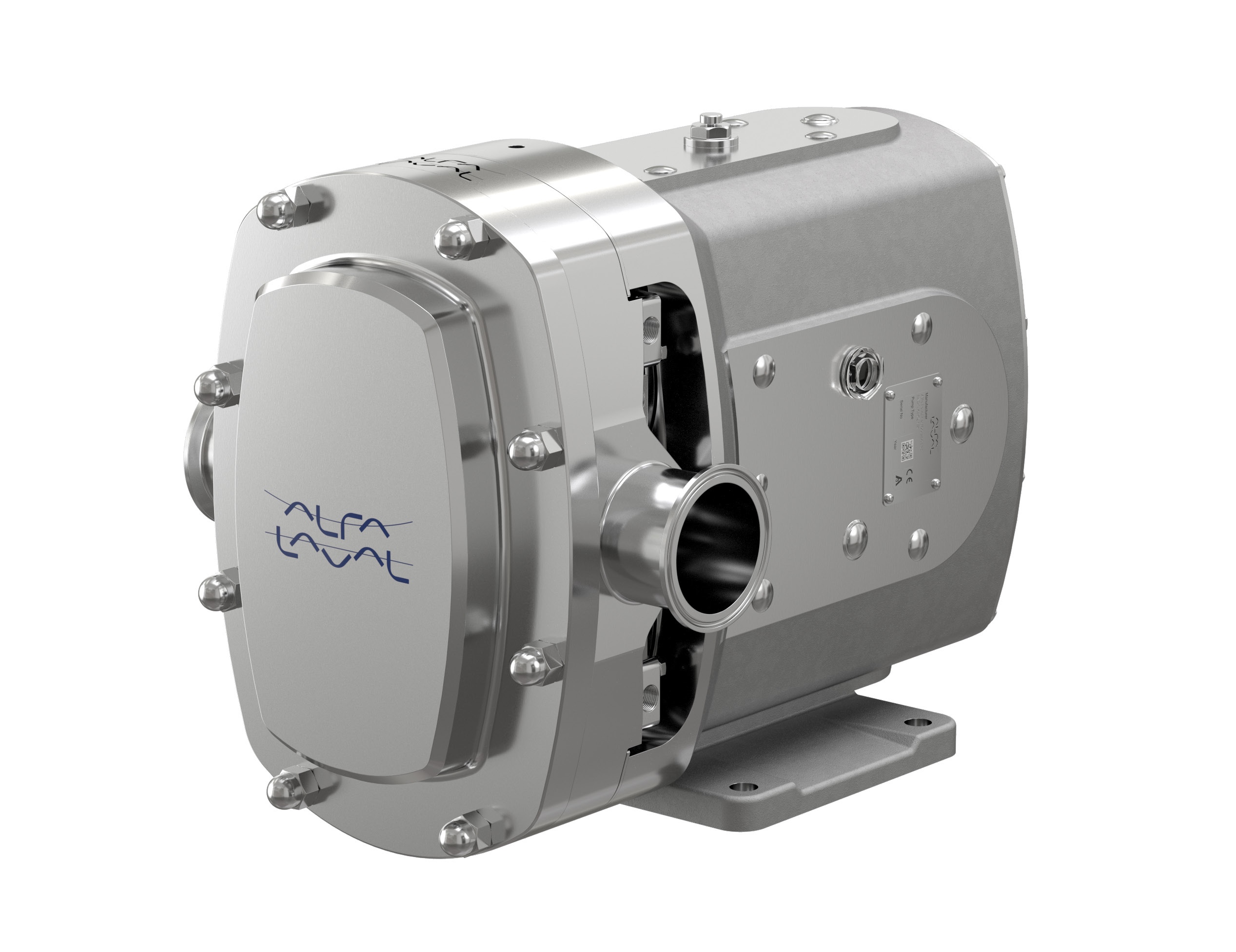
Key features
Close pump head clearances hold slip down, which is what keeps a thin liquid moving against pressure.
Alfa Laval certifies the DuraCirc to both, with profiled defined-compression elastomers that remove crevices and dead zones.
Port and pump head geometry give a low NPSHr characteristic, which widens your margin on a difficult suction.
The seal is inspected or replaced in situ, without breaking the pipework or stripping the gearbox.
Drops into pipework built for an existing circumferential piston pump, Alfa Laval's own or another brand's, without changing the pipework.
About the Alfa Laval DuraCirc
The DuraCirc is the pump for thin liquid that has to move against real pressure. Alfa Laval designed it around cleaning-in-place and points it at low-viscosity duties with medium to high discharge pressure, in dairy, food, beverage, and home and personal care.
That is worth stating plainly, because it is where a circumferential piston pump parts company with a rotary lobe. A lobe pump is the gentler machine and the usual choice for viscous, shear-sensitive product. The DuraCirc sits at the other end: a low-viscosity medium, close clearances keeping slip down, and differential pressures reaching 40 bar at the top of the range.
The build is all stainless on the outside. Piston rotors are a non-galling alloy; other product-wetted steel parts are W. 1.4404 (AISI 316L); the shafts are duplex 1.4460 (329); the gearcase, feet, base plate and coupling guard are stainless steel. Inside surface finish is mechanically polished to Ra ≤ 0.8. Product-wetted elastomers are EPDM as standard, with FPM as the alternative. You can take it bare shaft, or mounted on a base plate with coupling, guard, gear motor and shroud.
Alfa Laval gives a three-year warranty on the DuraCirc covering all non-wear parts, conditional on genuine Alfa Laval spare parts being used. Channel Pumps supplies the DuraCirc and sizes it against your duty point.
How the Alfa Laval DuraCirc works
Two rotors turn inside a pumping chamber called a rotorcase. The rotor pistons travel around the circumference of a channel in the casing. As they unmesh at the suction port they create a partial vacuum, which drops the local pressure and lets fluid into the pump. The pistons carry that fluid round the channel and displace it as they re-mesh, which generates pressure at the discharge port. Flow direction is reversible.
Each rotor sits on a shaft held rigidly in the gearcase, and timing gears keep the pair in step. Clearances are set by shimming, done outside the rotorcase rather than inside the gearbox, so no rotor touches the other rotor or the case. That is also why servicing does not mean a gearbox strip.
The seal is where a specifier needs to concentrate, because it sets the real pressure ceiling. The standard front-loading single mechanical seal runs a silicon carbide rotary face against a carbon stationary face, and Alfa Laval limits that combination to 15 bar process pressure. Silicon carbide against silicon carbide takes the full pressure of the pump. Single-flushed, double mechanical and O-ring seals are the other options, and an O-ring seal is limited to 7 bar process pressure. Specify the seal against the actual duty, or the pressure figure on the datasheet means nothing.
On hygiene, the DuraCirc is certified to EHEDG and 3-A. The product-wetted elastomers are profiled with a defined compression, which is what takes the crevices and dead zones out of the wet end, and the shaft seal faces sit immersed in the pumped medium so CIP reaches them. The gearbox lubricant is FDA-compliant with a 3,000-hour change interval. Maximum process and CIP temperature is 150°C.
Drive is a gear motor, four pole, to IEC metric standard, 50/60 Hz, suitable for frequency conversion, IP55, insulation class F.
Specifications
| Flow rate | up to 150 m³/h | range maximum |
|---|---|---|
| Differential pressure | 13–40 bar | by model; 40 bar on the DuraCirc 72 |
| Pump models | 13 displacements, DuraCirc 32 to DuraCirc 74 | |
| Displacement | 0.03–4.14 litres/rev | |
| Maximum speed | 600–1000 rpm | by model; 1000 rpm on the DuraCirc 32, 33 and 34 |
| Maximum process and CIP temperature | 150°C | |
| Inlet and outlet | 25–150 mm (1"–6") | |
| Piston rotors | Non-galling alloy | twin-wing |
| Other product-wetted steel parts | W. 1.4404 (AISI 316L) | |
| Shafts | Duplex 1.4460 (329) | |
| Inside surface finish | Mechanically polished, Ra ≤ 0.8 | |
| Product-wetted elastomers | EPDM standard; FPM alternative | |
| Shaft seal | Front-loading single mechanical, silicon carbide against carbon | single-flushed, double mechanical and O-ring seals optional |
| Maximum process pressure, silicon carbide against carbon seal | 15 bar | |
| Maximum process pressure, O-ring seal | 7 bar | |
| Hygienic certification | EHEDG and 3-A | |
| Motor | Gear motor, four pole, IEC metric, 50/60 Hz, IP55, insulation class F | suitable for frequency conversion |
| Warranty | Three years on non-wear parts | Alfa Laval's warranty, conditional on genuine Alfa Laval spare parts |
Channel Pumps sizes and supplies the DuraCirc. Send us the flow rate, the differential pressure at the duty point, the medium and its viscosity and temperature, and the connection standard on the line. Tell us what the seal has to survive if the pump runs dry, because that is the decision that usually matters most.
Documents & downloads
Related pumps
View all →
Frequently asked
What is the Alfa Laval DuraCirc used for?
The DuraCirc is a hygienic circumferential piston pump designed around cleaning-in-place. Alfa Laval aims it at low-viscosity duties with medium to high discharge pressure in dairy, food, beverage, and home and personal care.
Is the Alfa Laval DuraCirc EHEDG and 3-A certified?
Yes. Alfa Laval certifies the DuraCirc to both EHEDG and 3-A. The product-wetted elastomers are profiled with a defined compression, and the gearbox lubricant is FDA-compliant.
What flow and pressure does the DuraCirc handle?
Flow rates reach 150 m³/h across the range. Differential pressure runs from 13 bar to 40 bar depending on the model, with 40 bar on the DuraCirc 72.
How many DuraCirc models are there?
There are 13 pump head displacements, from the DuraCirc 32 at 0.03 litres/rev to the DuraCirc 74 at 4.14 litres/rev, with connections from 25 mm to 150 mm.
What is the difference between a circumferential piston pump and a rotary lobe pump?
Both are positive displacement pumps with two timed rotors. A rotary lobe pump is the gentler choice for viscous, shear-sensitive product. The DuraCirc runs close pump head clearances to hold slip down, which is why Alfa Laval points it at low-viscosity media at higher discharge pressure.
Can a DuraCirc replace an existing circumferential piston pump?
Often, yes. The DuraCirc Uni-Fit port option is built for direct replacement of circumferential piston pumps from Alfa Laval and other brands without changing the pipework. Send us the model and serial number off the nameplate.
What seal should I specify on a DuraCirc?
It depends on the duty pressure. The standard silicon carbide against carbon single seal is limited to 15 bar process pressure, silicon carbide against silicon carbide takes the full pump pressure, and an O-ring seal is limited to 7 bar.