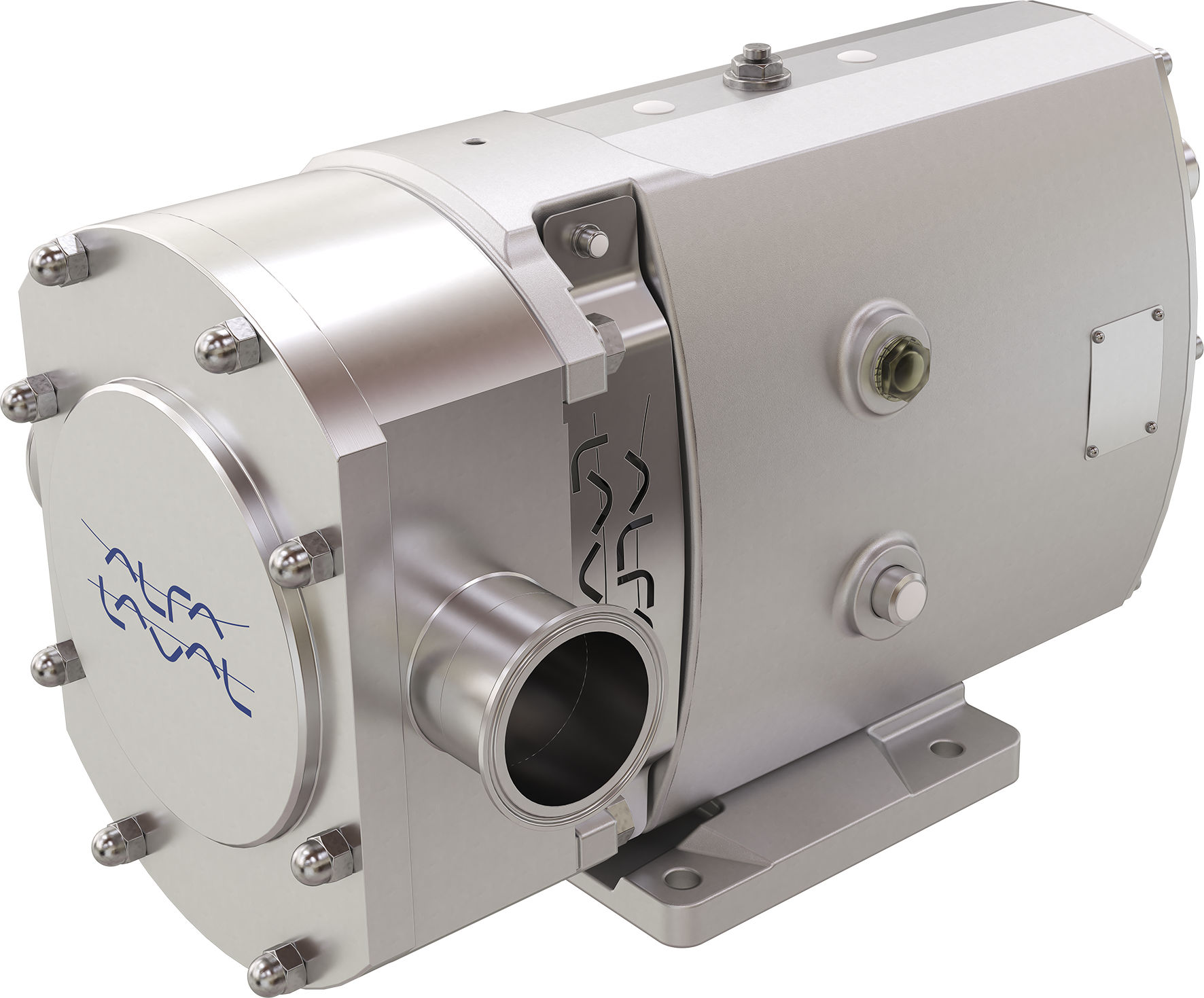
Key features
Twelve pump head displacements from 0.053 to 3.53 litres/rev, built on six gearbox modules. The top flow and the top pressure are not the same pump.
Every rotor comes in three temperature ratings, covering process and CIP alike. The 70°C tri-lobe rotor is the standard build, so say if your cleaning cycle runs hotter than your product.
Tri-lobe rotors pass spherical solids from 6 mm on the SRU1 to 24 mm on the SRU6/353. Bi-lobe rotors take that to 8 mm and 37 mm.
Single, single flushed or quench, double mechanical, and packed gland flushed or unflushed. Mechanical seals are rated to 20 bar; single flush is capped at 0.5 bar.
The universal gearbox takes one of two bolt-on feet, so port orientation can be swapped after the pump is installed rather than only at order.
Certified units are classified Group II Category 2G for Zone 1 and Category 3G for Zone 2, to EN 80079-36:2016 and EN 80079-37:2016.
About the Alfa Laval SRU
The SRU is the rotary lobe pump you specify when the product has to survive the transfer. Alfa Laval built it for gentle handling of sensitive process fluids across dairy, food, beverage, brewing, chemical, pharmaceutical, and home and personal care. The media list in its own leaflet is the useful part: creams, gels, emulsions, aerated mixtures, and delicate cells and organic solids in suspension. Those are the products a centrifugal pump damages on the way through.
The range is built from 12 pump head displacements on six gearbox modules, from the SRU1/005 at 0.053 litres/rev to the SRU6/353 at 3.53 litres/rev. Hygienic ports run 25 mm to 100 mm, with enlarged ports from 40 mm to 150 mm. Bare shaft weights run from 15 kg to 265 kg, which matters more than it sounds once you are planning the base and the lift.
Read the range ceilings as ceilings, not as a specification. 106 m³/h is the SRU6/353 at its 500 rpm limit. 20 bar is available on three builds, the SRU4/055, SRU5/116 and SRU6/260, and all three carry duplex stainless shafts. The SRU6/353 that gives you the flow stops at 15 bar, and several models in the range stop at 7 or 8 bar. Pick the head against your duty point and the two headline figures stop mattering.
Materials are fixed where it counts. Media-contacting steel, meaning the rotor case, front cover, rotors and rotor nuts, is W. 1.4404 (AISI 316L) finished internally to Ra ≤ 0.8. The gearbox, base plate and coupling guard are stainless. Product-wetted elastomers are EPDM as standard and other elastomers are NBR. You can take the pump bare shaft, or on a base plate with coupling, guard, gear motor and shroud.
Alfa Laval gives an extended three-year warranty on the SRU covering all non-wear parts, conditional on genuine Alfa Laval spare parts being used. Channel Pumps supplies the SRU and sizes it against your duty point.
Where it is the wrong pump
The SRU is the wrong pump for thin, clean liquid at high flow and moderate head. Where the medium is water, or as water, a centrifugal pump costs less to buy and less to run, and nothing about the duty needs a synchronised rotor pair. The SRU earns its price on viscosity, on shear sensitivity, or where the flow has to stay put while the discharge pressure moves around.
Abrasive product wants care too. Running a positive displacement pump fast in an abrasive medium is among the quickest ways to shorten its life, and a lobe pump has close running clearances to lose. If your product carries grit or hard crystal, size for a lower speed and accept the larger pump head. Or tell us, and we will look at a technology that wears better.
Dry running is the one that catches people out, and it is usually a system fault rather than a pump fault. On a lobe pump the result is a failed mechanical seal. Alfa Laval's troubleshooting table lists a pump allowed to run dry as a cause of seal failure, and both remedies it gives are about the installation rather than the pump: ensure the system operation prevents it, and fit a flushed mechanical seal or a flushed packed gland. A mechanical seal is lubricated by the liquid it runs in. Take the liquid away, on any pump, and you are booking a seal replacement. Somebody shutting a valve and forgetting it is shut does the same damage as a badly designed suction.
Then there are the ceilings. If the duty is general hygienic work that stays comfortably inside a lower pressure, the pump we would point you at first is the Alfa Laval OptiLobe, and there is no reason to pay for an SRU. Send the duty point rather than the ends of the range and we will tell you which of the two it is.
How the Alfa Laval SRU works
A gear train in the gearbox drives the two rotors and holds them accurately synchronised, so nothing inside the pump head touches. The counter-rotating rotors create a partial vacuum at the inlet, and atmospheric or other external pressure forces fluid into the pump chamber. As the rotors revolve, an expanding cavity forms and fills with product. As the rotor blades engage again, that cavity diminishes and the fluid is displaced into the outlet port.
Flow is displacement multiplied by speed, which is why the pump holds its rate as discharge pressure changes, and also why the biggest head does not give proportionally the biggest flow. Series 1 to 4 run to 1000 rpm, series 5 to 600 rpm, and series 6 to 500 rpm. An SRU6/353 at 3.53 litres/rev and 500 rpm gives 106 m³/h; an SRU4/079 at 0.79 litres/rev and 1000 rpm gives 47.4 m³/h. Work from those two numbers rather than from the range headline.
Rotor selection does more than set the solids size. Tri-lobe rotors are standard and pass spherical solids of 6 mm to 24 mm depending on pump size. Bi-lobe rotors are the option for fluids carrying large delicate solids, and take that to 8 mm and 37 mm. All rotors come in three temperature ratings, 70°C, 130°C and 200°C, and the rating applies to both the pumped fluid and the CIP cycle. The standard build is the 70°C tri-lobe, so a hot caustic wash is a specification question, not an assumption.
The shaft seal decides most of the build
Five seal arrangements are available: single mechanical, single flushed or quench, double mechanical, and packed gland in flushed or unflushed form. The standard is an R90 single mechanical seal with a carbon rotary face running against a stainless steel stationary face. Face materials also come in tungsten carbide against tungsten carbide and silicon carbide against silicon carbide, though not every variant is offered on every R90 or Hyclean seal type.
Flush limits are firm and easy to get wrong. A single flushed seal takes 0.5 bar maximum, and Alfa Laval states that any further increase in pressure will result in lip seal failure. A double mechanical seal or a flushed packed gland wants 1.0 bar above the pump discharge pressure, set to the maximum condition if the discharge fluctuates. Minimum flow is 30 litres per hour per shaft seal, through a female BSPT or NPT connection, and the flush is turned on with or before the pump and off with or after it. The separate 20 bar figure on the spec table is the mechanical seal's own pressure rating, which sits above the differential pressure of every model in the range bar three.
Hygiene, cleaning and what the connection decides
Alfa Laval states the SRU meets 3-A Sanitary and FDA hygienic standards, and that the pump is designed with verified, effective cleaning-in-place. The design features behind that are a front cover seal with defined compression, a rotor nut retention design, a drainable pump head and ultra-clean surface finishes. EHEDG is the one to be precise about: compliance applies only where Hyclean type mechanical seals are fitted, so the standard R90 seal does not get you there. Tell us at enquiry if you are relying on EHEDG, because it rewrites the seal specification and the price with it.
Alfa Laval publishes a typical CIP regime of a cold water or bore water flush at around 6°C, then 20 to 30 minutes of hot caustic soda at 2.5% dilution and 70–80°C, then a final cold flush, and asks that specific advice be sought for each application. It also warns against rapid temperature change during CIP, because thermal shock can seize the pump, and recommends a suitable by-pass.
The port connection standard carries its own pressure rating, and it is frequently lower than the pump head's. Screwed BSP, DIN11851, SMS, ISS/IDF and RJT are available, as are flanges to EN1092-1 B1 PN16, ASA/ANSI 150 and BS10E. SMS and RJT are rated to 10 bar in every size, and IDF/ISS to 16 bar at 25–50 mm and 10 bar at 65–150 mm. Order a 20 bar pump head onto SMS fittings and you have bought a 10 bar installation. On the 150 mm size of the SRU6/353, only DIN11851, SRJT and Tri-clamp connections are offered at all.
Hazardous areas
ATEX is an option, not the standard build. Certified pumps carry a second nameplate on the gearbox housing and are classified under ATEX Directive 2014/34/EU Group II, Category 2G for Zone 1 and Category 3G for Zone 2, assessed against the harmonised standards EN 80079-36:2016 and EN 80079-37:2016. Markings run from II 2G Ex h IIB T4..T2 Gb through to II 3G Ex h IIC T4..T2 Gc, and conformity for the motor and coupling comes from their own EU type examination certificates rather than from the pump's.
One line in the ATEX addendum matters more than the rest: the differential pressure, maximum speed and maximum capacity in the standard pump data table do not apply to ATEX applications. A certified pump is governed by the seal operation data issued against its serial number, and the seal face temperature has to stay inside the certified temperature class. Single flushed and double mechanical seals can be monitored on barrier or buffer fluid temperature; a single mechanical seal without a thermocouple has no monitoring at all and depends on the process to cool it.
That addendum also publishes gearbox bearing change intervals against differential pressure, and they are worth reading whether or not your duty is hazardous. An SRU6/353 is given 12,000 running hours at 0–8 bar, 6,000 hours at 8–10 bar and 2,000 hours at 10–15 bar. An SRU4/079 drops from 30,000 hours to 5,500 across the same three bands. Pressure is bought with bearing life, and that is the trade-off to weigh before specifying a pump at the top of its band.
Specifications
| Flow rate | up to 106 m³/h | the SRU6/353 at its 500 rpm maximum |
|---|---|---|
| Differential pressure | up to 20 bar | 20 bar on the SRU4/055, SRU5/116 and SRU6/260 duplex builds only; 5–15 bar elsewhere in the range |
| Pump models | 12 displacements, SRU1/005 to SRU6/353 | built on six gearbox modules |
| Displacement | 0.053–3.53 litres/rev | |
| Maximum speed | 500–1000 rpm | 1000 rpm on series 1 to 4, 600 rpm on series 5, 500 rpm on series 6 |
| Maximum process and CIP temperature | 70°C, 130°C or 200°C | set by rotor selection; the 70°C tri-lobe rotor is standard |
| Hygienic port sizes | 25–100 mm (1"–4") | |
| Enlarged port sizes | 40–150 mm (1.5"–6") | |
| Rotor | Tri-lobe standard | bi-lobe optional, for fluids carrying large delicate solids |
| Maximum spherical solids, tri-lobe | 6–24 mm | 6 mm on the SRU1, 24 mm on the SRU6/353 |
| Maximum spherical solids, bi-lobe | 8–37 mm | |
| Product-wetted steel parts | W. 1.4404 (AISI 316L) | rotor case, front cover, rotors and rotor nuts |
| Inside surface finish | Mechanically polished, Ra ≤ 0.8 | |
| Gearbox, base plate and coupling guard | Stainless steel | |
| Product-wetted elastomers | EPDM | |
| Other elastomers | NBR | |
| Shaft seal, standard | Single mechanical, R90 type | carbon rotary face against a stainless steel stationary face |
| Shaft seal options | Single, single flushed or quench, double mechanical, packed gland flushed or unflushed | EHEDG compliance only with Hyclean type mechanical seals |
| Seal face materials | Carbon/stainless steel, tungsten carbide/tungsten carbide, silicon carbide/silicon carbide | not every variant is available on every R90 or Hyclean seal type |
| Mechanical seal pressure rating | 20 bar | |
| Maximum flush pressure | 0.5 bar single flush; 1 bar over product pressure on double mechanical and flushed packed gland | |
| Flush water consumption | 0.5 l/min | minimum 30 l/h per shaft seal |
| Flush connections | BSPT or NPT, female | |
| Port connection standards | Screwed BSP, DIN11851, SMS, ISS/IDF, RJT; flanged to EN1092-1 B1 PN16, ASA/ANSI 150, BS10E | the connection carries its own rating: SMS and RJT 10 bar, IDF/ISS 10–16 bar, DIN11851 16–40 bar |
| Port orientation | Horizontal or vertical | changed by moving one of two bolt-on feet on the gearbox |
| Bare shaft weight | 15–265 kg | by model and port orientation |
| Gearbox oil capacity | 0.3–7.0 litres | by model and port orientation |
| Motor | Gear motor, four pole, IEC metric, 50/60 Hz, IP55, insulation class F | suitable for frequency conversion |
| Hygienic standards | 3-A Sanitary and FDA, per Alfa Laval | EHEDG compliance requires Hyclean mechanical seals |
| Hazardous area | Optional ATEX, Group II Category 2G (Zone 1) and 3G (Zone 2) | to EN 80079-36:2016 and EN 80079-37:2016; the standard pressure, speed and capacity ratings do not apply to ATEX pumps |
| Options | Rotorcase cover with integral pressure relief valve; heating and cooling saddle jackets; material traceability to BS EN10204 3.1 | the jackets are not available with the relief valve fitted |
| Warranty | Three years on non-wear parts | Alfa Laval's warranty, conditional on genuine Alfa Laval spare parts |
Channel Pumps sizes and supplies the SRU. Send the flow rate, the differential pressure at the duty point, the medium with its viscosity and density, and both the process and the CIP temperature. Tell us the connection standard on the line and whether the suction can ever run empty, because those two decide the port rating and the seal.
Documents & downloads
Related pumps
View all →
Frequently asked
What is the Alfa Laval SRU used for?
The SRU is a hygienic rotary lobe pump for gentle, low-shear transfer of viscous and shear-sensitive product. Alfa Laval designs it for dairy, food, beverage, brewing, chemical, pharmaceutical, and home and personal care duties, and names creams, gels, emulsions, aerated mixtures and delicate cells and organic solids in suspension as the media it suits.
What flow and pressure does the Alfa Laval SRU handle?
Flow reaches 106 m³/h and differential pressure reaches 20 bar, but not on one pump. There are 12 displacements from the SRU1/005 at 0.053 litres/rev to the SRU6/353 at 3.53 litres/rev. 20 bar is offered on the SRU4/055, SRU5/116 and SRU6/260 duplex builds; the SRU6/353 that reaches 106 m³/h stops at 15 bar, and several models stop at 7 or 8 bar.
What temperature can an Alfa Laval SRU run at?
Up to 200°C, if you specify it. Rotors come in three ratings, 70°C, 130°C and 200°C, and the rating covers the pumped fluid and the CIP cycle alike. The standard build is the 70°C tri-lobe rotor, so give us your cleaning temperatures as well as your process temperature.
Is the Alfa Laval SRU EHEDG compliant?
The Alfa Laval SRU is EHEDG compliant only with Hyclean type mechanical seals fitted, which Alfa Laval states in the product leaflet; the standard R90 single mechanical seal does not carry it. Alfa Laval separately states the SRU meets 3-A Sanitary and FDA hygienic standards.
What shaft seals are available on the SRU?
Single mechanical, single flushed or quench, double mechanical, and packed gland in flushed or unflushed form. Faces are carbon against stainless steel as standard, with tungsten carbide and silicon carbide combinations available. Single flush is limited to 0.5 bar; a double mechanical seal or flushed gland runs at 1 bar above discharge pressure.
Can the Alfa Laval SRU be used in a hazardous area?
Yes, as an option. ATEX units are classified under Directive 2014/34/EU Group II, Category 2G for use in Zone 1 and Category 3G for Zone 2, to EN 80079-36:2016 and EN 80079-37:2016, and carry a second nameplate on the gearbox. Note that the standard differential pressure, speed and capacity ratings do not apply to an ATEX pump; it runs to the seal operation data issued against its serial number.
What size solids will an SRU pass?
Tri-lobe rotors pass spherical solids from 6 mm on the SRU1 sizes to 24 mm on the SRU6/353. Bi-lobe rotors are the option where the fluid carries large delicate solids and raise that to 8 mm and 37 mm respectively.
Can an Alfa Laval SRU run dry?
Design the system so it cannot. Alfa Laval's troubleshooting table lists a pump allowed to run dry as a cause of seal failure, and its remedies are to ensure the system operation prevents it and to fit a flushed mechanical seal or flushed packed gland. A mechanical seal needs liquid to lubricate it.
Can Channel Pumps size an SRU for my duty?
Yes. Send the flow, the differential pressure at the duty point, the medium with its viscosity and density, the process and CIP temperatures, and the connection standard on the line, and we will specify the pump head, rotor, seal and drive.