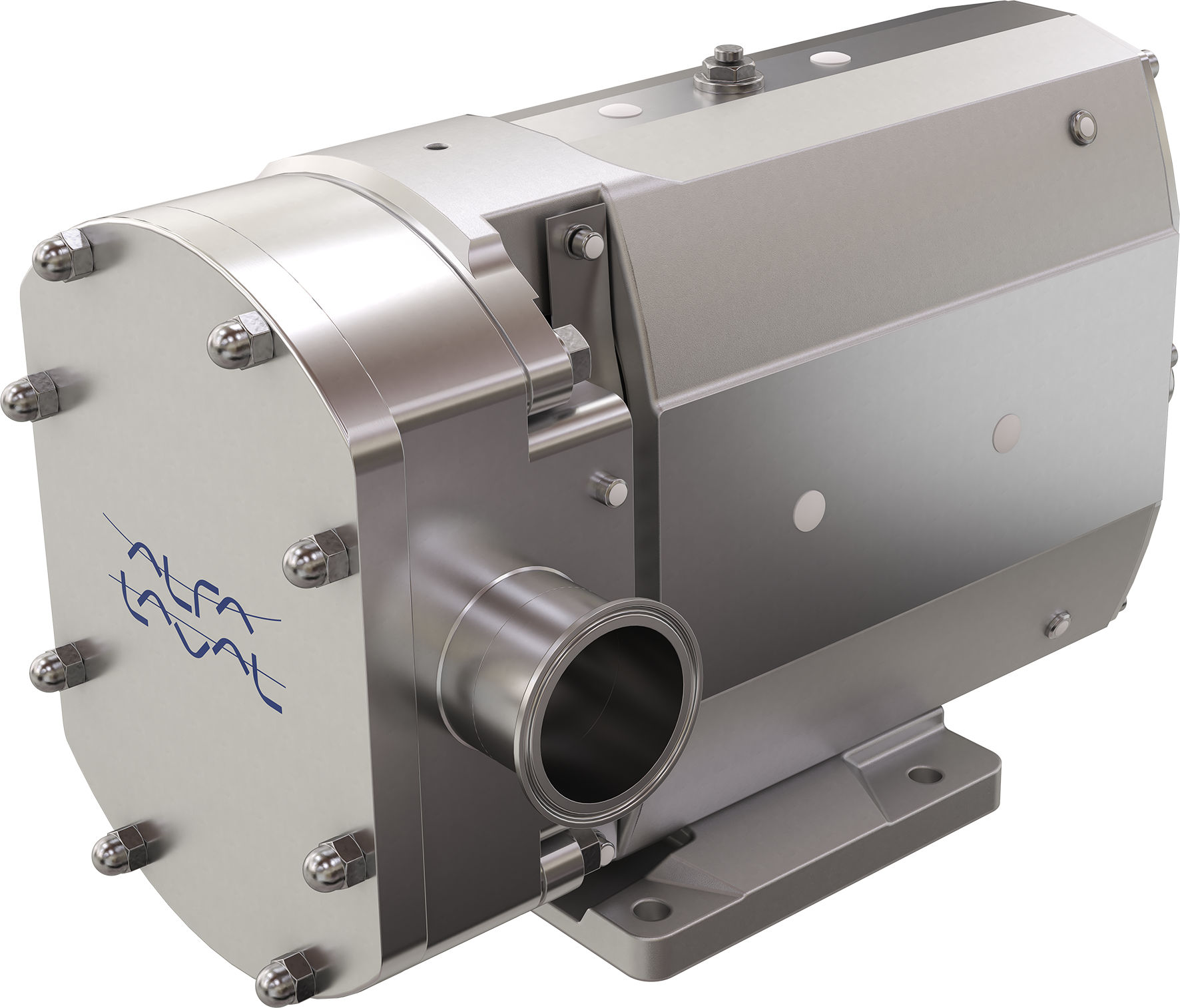
Key features
Alfa Laval used computational fluid dynamics to set the rotor and rotor case geometry, which is what keeps the pumping action gentle.
A 3° fall angle, a low-profile rotor nut and defined compression front cover sealing, so the wet end empties and cleans.
The standard four-lobe rotors are rated to 150°C, which is what makes sterilisation-in-place possible on the standard build.
Single, single-flushed and double mechanical seals all load from the front and interchange without changing pump components.
Alfa Laval lists ATEX compliance as a standard specification option, with its own addendum manual and its own duty limits.
Change the foot and its position to mount the inlet and outlet ports vertically or horizontally.
About the Alfa Laval SX
The SX is Alfa Laval's premium rotary lobe pump, and the one it points at hygienic and ultra-clean work: biotechnology and pharmaceutical processing, home and personal care, and demanding food applications. It is a positive displacement pump, so it holds its flow as discharge pressure rises.
Fourteen pump head displacements run from the SX1/005 at 0.05 litres/rev to the SX7/380 at 3.80 litres/rev, built on seven gearbox modules, with connections from 25 mm to 150 mm. Flow reaches 115 m³/h, differential pressure reaches 15 bar and maximum process and CIP temperature is 150°C. Maximum speed falls as the pump gets bigger, from 1200 rpm on the SX1 down to 500 rpm on the SX7.
Read the pressure column by model rather than off the headline. Alfa Laval rates each displacement at 7, 10, 12 or 15 bar, so the SX2/013 takes 15 bar and the SX2/018 next to it takes 7. Pick the pump on the duty pressure, not on the range maximum.
That is also where the SX parts company with the Alfa Laval OptiLobe, the cost-effective pump in the same family. The OptiLobe has tri-lobe rotors, 10 displacements on five gearbox modules, and stops at 77 m³/h, 8 bar and 130°C. The SX has four-lobe rotors, 14 displacements on seven gearbox modules, and Alfa Laval aims it at ultra-clean duties rather than general ones. If your duty sits inside the OptiLobe's envelope and the specification is a general hygienic one, the OptiLobe is the cheaper right answer.
Media-contacting steel parts, including the rotor case, front cover, rotors and rotor nuts, are W. 1.4404 (AISI 316L), finished internally to Ra ≤ 0.8. Product-wetted elastomers are EPDM, and the other elastomers are FPM. Ports come screwed male to DIN11851, DIN11864, SMS, ISS/IDF, RJT or Tri-clamp. You can take the pump bare shaft, or on a base plate with coupling, guard, gear motor and shroud.
Alfa Laval gives an extended three-year warranty on the SX covering all non-wear parts, conditional on genuine Alfa Laval spare parts being used. Channel Pumps supplies the SX and sizes it against your duty point.
How the Alfa Laval SX works
A gear train in the gearbox drives the two rotors and keeps the four-lobe profiles synchronised, so nothing inside the pump head touches. The counter-rotating rotors create a partial vacuum at the inlet, and atmospheric or other external pressure pushes fluid into the pump chamber. Product is carried round in the cavities formed between the dwell of the rotor and the interior of the rotor case, then displaced into the outlet as the blades re-engage. Four lobes rather than three is what cuts the pulsation, and low pulsation is why the pump is gentle on shear-sensitive product.
The cleanability is in the geometry. The pump head is fully drainable on a 3° fall angle, the rotor nut is low profile, the front cover seals on defined compression, and surface finishes are available sanitary or ultra-clean. Every media-contacting elastomer is a controlled compression joint: the front cover compression joint, the spline sealing cup seal, the cup seal and the squad ring. Alfa Laval describes those as static and dynamic elastomer seals that stop pumped media leaking to atmosphere.
The seal is the part to think hardest about, because it is the weak point in almost any pump, and on the SX it also sets a real ceiling. Alfa Laval rates the mechanical seals at 15 bar, and the port connection you choose carries its own rating on top of that. The instruction manual gives SMS and RJT at 10 bar in every size, DIN11851 at 40 bar in 25–50 mm falling to 16 bar at 150 mm, and IDF/ISS at 16 bar in 25–50 mm falling to 10 bar from 65 mm up, with a support ring. A Tri-clamp connection takes whatever its clamp band is rated for. So a 15 bar pump on an RJT connection is a 10 bar installation. Specify the connection against the duty pressure, or the figure on the datasheet means nothing.
The standard seal is a single mechanical R00 with a carbon rotary face against a stainless steel stationary face. Single-flushed and double mechanical versions are options, all fully front-loading and interchangeable without extra housings or component changes, and the seal is dimensionally set on assembly so it needs no setting on site. Flush pressure is limited to 0.5 bar on a single flush and 1 bar over product pressure on a double mechanical, at about 0.5 l/min of water through a BSPT or NPT connection. Silicon carbide against silicon carbide is the alternative face combination, and Alfa Laval states that the seal seat and face material combinations are all EHEDG compliant.
That flush arrangement is the answer to a duty that might lose its suction. A mechanical seal is lubricated by the liquid it runs in, so on a rotary lobe pump the usual result of dry running is a failed seal. Alfa Laval's instruction manual lists a pump allowed to run dry as a cause of seal failure, and the remedy it gives is a flushed seal arrangement. Tell us if the suction can ever run empty, because it changes the seal you should be buying.
On hygiene and hazardous areas, Alfa Laval states that all SX rotary lobe pumps comply with EHEDG, 3-A, 3.1 and FDA hygienic standards, and that the range has ATEX approval for use in explosive environments. Treat an ATEX build as a different specification rather than a badge: the manual is explicit that the differential pressure, maximum speed and maximum capacity in the standard tables do not apply to ATEX applications, and it routes you to a separate ATEX addendum manual. Give us the zone and the medium when you enquire.
Specifications
| Flow rate | up to 115 m³/h | range maximum |
|---|---|---|
| Differential pressure | 7–15 bar | by model; 15 bar on the SX2/013, SX3/027, SX4/046, SX5/082, SX6/140 and SX7/250 |
| Pump models | 14 displacements, SX1/005 to SX7/380 | built on seven gearbox modules |
| Displacement | 0.05–3.80 litres/rev | |
| Maximum speed | 500–1200 rpm | by model; 1200 rpm on the SX1 |
| Maximum process and CIP temperature | 150°C | |
| Inlet and outlet | 25–150 mm (1"–6") | screwed male to DIN11851, DIN11864, SMS, ISS/IDF, RJT or Tri-clamp |
| Rotor | Four-lobe, rated to 150°C | |
| Maximum spherical solid size | 7–28 mm | 7 mm on the SX1, rising to 28 mm on the SX7 |
| Product-wetted steel parts | W. 1.4404 (AISI 316L) | rotor case, front cover, rotors and rotor nuts |
| Inside surface finish | Mechanically polished, Ra ≤ 0.8 | sanitary or ultra-clean finishes available |
| Base plate and coupling guard | Stainless steel | |
| Product-wetted elastomers | EPDM | controlled compression joints |
| Other elastomers | FPM | |
| Shaft seal | Single mechanical R00, carbon against stainless steel | single-flushed and double mechanical optional; silicon carbide against silicon carbide available |
| Mechanical seal pressure rating | 15 bar | |
| Maximum flush pressure | 0.5 bar single flush; 1 bar over product pressure, double mechanical | 0.5 l/min water, BSPT or NPT connection |
| Bare shaft weight | 15–366 kg | by model and porting orientation |
| Hygienic standards | EHEDG, 3-A, 3.1 and FDA, per Alfa Laval | |
| Hazardous area | ATEX approval available | standard pressure, speed and capacity ratings do not apply to ATEX builds |
| Motor | Gear motor, four pole, IEC metric, 50/60 Hz, IP55, insulation class F | suitable for frequency conversion |
| Warranty | Three years on non-wear parts | Alfa Laval's warranty, conditional on genuine Alfa Laval spare parts |
Channel Pumps sizes and supplies the SX. Send us the flow rate, the differential pressure at the duty point, the medium with its viscosity and temperature, and the CIP and SIP temperatures if they differ. Name the connection standard on the line and the zone if the area is classified, because those two decide the pressure you can actually run at.
Documents & downloads
Related pumps
View all →
Frequently asked
What is the Alfa Laval SX used for?
The SX is a hygienic rotary lobe pump for gentle transfer of process fluids in ultra-clean applications. Alfa Laval aims it at biotechnology and pharmaceutical processing, home and personal care, and demanding food duties.
What flow and pressure does the Alfa Laval SX handle?
Flow reaches 115 m³/h across the range and differential pressure reaches 15 bar. Ratings run 7, 10, 12 or 15 bar depending on the model, across 14 displacements from the SX1/005 to the SX7/380.
Is the Alfa Laval SX EHEDG certified?
Alfa Laval states that all SX rotary lobe pumps comply with EHEDG, 3-A, 3.1 and FDA hygienic standards. The leaflet also confirms that the seal seat and face material combinations are all EHEDG compliant.
What is the difference between the Alfa Laval SX and the OptiLobe?
The SX has four-lobe rotors, 14 displacements on seven gearbox modules, and reaches 115 m³/h, 15 bar and 150°C; the OptiLobe has tri-lobe rotors, 10 displacements on five gearbox modules, and reaches 77 m³/h, 8 bar and 130°C. Alfa Laval aims the SX at ultra-clean biotechnology and pharmaceutical work and the OptiLobe at general hygienic duties.
Can the Alfa Laval SX be used in a hazardous area?
Yes, ATEX compliance is a standard specification option and Alfa Laval states the range has ATEX approval for explosive environments. The standard differential pressure, speed and capacity figures do not apply to an ATEX build, so tell us the zone and the medium.
What size solids can an SX pass?
Maximum spherical solid size runs from 7 mm on the SX1 to 28 mm on the SX7. Send us the largest particle in the medium as well as the flow, because it can decide the pump size on its own.
Does the connection affect the pressure an SX can run at?
Yes, and it often decides it. SMS and RJT connections are rated at 10 bar in every size, while DIN11851 runs from 40 bar in 25–50 mm down to 16 bar at 150 mm. A Tri-clamp takes whatever its clamp band is rated for.