Key features
Calpeda rates the GMC at 45 mm and the GMV at 50 mm. It is the one build in this manual's list of free passages that passes less than its own vortex counterpart, so the choice costs solids as well as head.
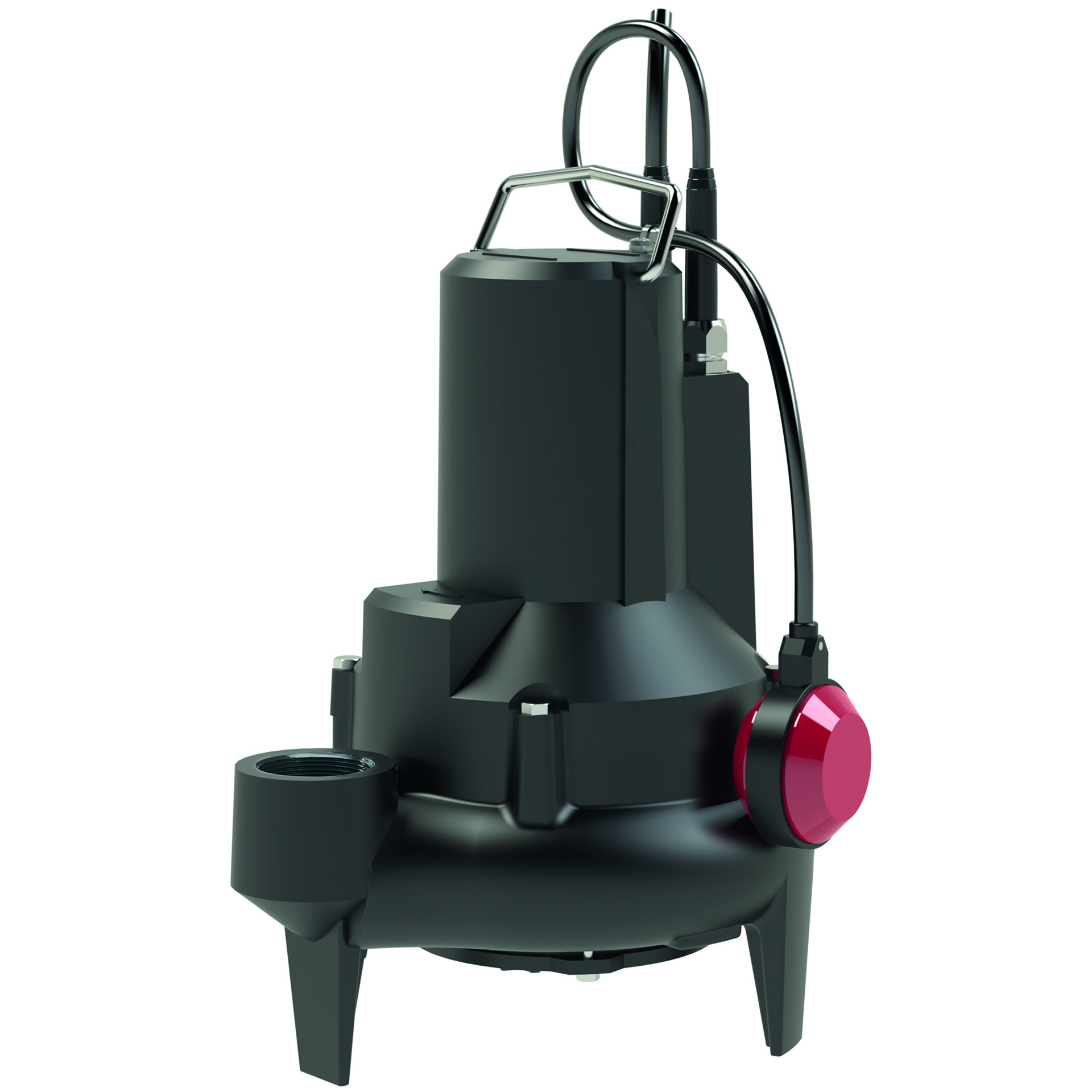
Pump casing, casing cover, impeller, motor housing and motor cover are all cast iron GJL 200 to EN 1561. Calpeda's designation key defines the GM series as the cast iron pump.
The lower mechanical seal runs silicon carbide against silicon carbide with NBR elastomers. The upper seal is ceramic against carbon, with a 0.5 litre oil chamber between the two.
Calpeda lists GMC 50-65 and GMV 50-65 for fixed installation on automatic coupling feet and guide rails. Specify the DN65 flange when the pump has to come out of the chamber without anyone going in.
Three-phase GMC and GMV carry two protectors in series between two phases, on a 4G1.5 mm² + 2x0.5 mm² cable. They cover overload, not a blocked rotor, so Calpeda asks for a hot-wire ammeter relay as well.
With a suitable cable length. The standard cable is 10 m of H07RN-F, and the motor is rated for continuous duty while it stays submerged.
About the Calpeda GM 50
The GM 50 is the cast iron member of Calpeda's submersible family, and the designation key says exactly that: GM is the cast iron pump, GX the stainless one, GQ the cast iron and stainless combination. Calpeda puts it on civil and industrial wastewater that is not aggressive to the pump materials, and on dirty water carrying solids to 45 mm on the GMC or 50 mm on the GMV. It is a 2-pole machine on a G 2 threaded or DN65 flanged delivery, and at 26.5 kg to 31 kg with its cable it is heavy enough that Calpeda's own handling rule, two people to a package over 25 kg, applies to every build in the range.
Size it against the 50 Hz tables rather than a range summary. Three impeller diameters cover each wet end, and the letter at the end of the designation is the impeller, not the motor frame.
| Model | Rated output | Head at shutoff | Last point on the curve |
|---|---|---|---|
| GMC 50/CE | 0.75 kW | 12.8 m | 36 m³/h at 1 m |
| GMC 50/BE | 1.1 kW | 15.5 m | 42 m³/h at 1 m |
| GMC 50/AE | 1.5 kW | 17.3 m | 48 m³/h at 1 m |
| GMV 50/CE | 0.75 kW | 9.2 m | 30 m³/h at 1.5 m |
| GMV 50/BE | 1.1 kW | 10.7 m | 35 m³/h at 1 m |
| GMV 50/AE | 1.5 kW | 12.9 m | 39 m³/h at 1 m |
Note where the 48 m³/h headline lands. It is the last tabulated point on the 1.5 kW GMC 50/AE, at 1 m of head, and nobody specifies a pump there.
Channel or vortex, and why the GM 50 is the odd one out
Calpeda's other submersible ranges pass the same sphere on either wet end. The stainless GXC and GXV both take 35 mm; the GQN and the GQV both take 50 mm. Free passage is not what separates those pairs, so the vortex is a straight trade of duty for rag tolerance. The GM 50 does not work like that. Calpeda rates the single-channel GMC at 45 mm and the free-flow GMV at 50 mm, so on this range the vortex build wins twice, on solids as well as on fouling, and the channel build has to earn its place on head alone.
It does earn it, and the size of the gap is in Calpeda's own tables rather than up for argument. The same three motor ratings carry both wet ends.
| Rated output | Channel | Head at 24 m³/h | Vortex | Head at 24 m³/h |
|---|---|---|---|---|
| 0.75 kW | GMC 50/CE | 5 m | GMV 50/CE | 3.5 m |
| 1.1 kW | GMC 50/BE | 6.5 m | GMV 50/BE | 4.5 m |
| 1.5 kW | GMC 50/AE | 9 m | GMV 50/AE | 6.5 m |
Take a duty of 30 m³/h at 5 m. The 1.1 kW GMC 50/BE lands on it exactly. Nothing in the vortex range reaches it: the largest GMV 50/AE gives 4.3 m at that flow, on twice the rated output the channel build needed. Going vortex on the GM 50 does not cost you a frame size. Past about 30 m³/h it costs you the duty.
So the question is what the wastewater is carrying, and Calpeda answers it directly. Where the liquid has a high solid content or carries filamentous particles, the instructions send you to the free-flow construction, and the GMV is named on that list. The GMC is not. Read that as the wipes test. If the chamber takes foul drainage off occupied buildings, specify the GMV, because a single passage that binds costs you a lifted pump and a call-out every time it happens. If it takes screened effluent, surface water or plant room drainage, the GMC is the better pump on the curve and the cheaper one to run.
Neither build is a macerator. If a good solids-handling pump is already blocking on rag, another impeller will not fix it and we will say so before quoting.
Threaded or flanged is an installation decision
The port is where the GM 50 stops being a portable pump. The GMC 50 and GMV 50 carry a G 2 ISO 228 threaded delivery, which suits a hose or a screwed riser and a pump you lift out on a chain. The GMC 50-65 and GMV 50-65 carry a DN65 flange to EN 1092-2 PN 10, and those two are the builds Calpeda lists for fixed installation on automatic coupling feet and guide rails.
That matters more than the extra 15 mm of bore. On a guide rail set the coupling foot bolts to the floor of the sump with the delivery pipe, two guide tubes run up to a bracket at the cover, and the pump seals on its own weight as it lands. Inspection becomes a lift on a chain instead of an entry into the chamber, which on a foul sump is the difference between a routine job and a confined-space procedure. Order the threaded build for that duty and you have bought the wrong pump, whatever the curve says.
Whichever you take, keep the internal diameter of the delivery pipe at or above the pump connection, fit a check valve against back flow, and arrange a gate valve and union so the pump can come out without draining the system. Where slime collects in the bottom of the pit, stand the pump clear on a support.
Where the GM 50 stops
Liquid temperature stops at 35°C, pH at 6 to 11, and liquid density at 1100 kg/m³. Maximum immersion is 10 m with a suitable cable length, and the continuous duty rating holds only while the motor is submerged. Maximum permissible working pressure in the pump body is 25 m, which is 2.5 bar, and the tallest curve in the range never comes near it.
Calpeda allows 30 starts an hour at regular intervals. That limit is a chamber calculation rather than a pump one, and on a tight sump it decides the frame before the duty point gets a say. Exceed it and the motor is what pays for the undersized wet well.
Calpeda's tables hold for a medium at 1.0 kg/dm³ and 20 cSt or below, which is to say a medium behaving as water. Sludge that thickens beyond that is a different hydraulic problem, and the figures above stop describing it.
How the Calpeda GM 50 works
The GM 50 draws through the base of the pump, works the medium with a cast iron single-channel or free-flow impeller, and discharges through a G 2 threaded port or a DN65 flange. The motor is a 2-pole submersible induction motor running at about 2900 rpm at 50 Hz, IP X8 for continuous immersion, insulation class F, with a triple impregnation humidity-proof dry winding. Calpeda builds it to EN 60034-1, EN 60335-1 and EN 60335-2-41. Sound pressure is under 70 dB(A) at minimum immersion depth and falls away as the pump submerges.
The two impellers
A single-channel impeller carries the whole flow down one passage cast through the vane. The medium is worked by that vane, which is why the pump holds its head as flow rises, and the passage itself is the limit on what will fit: 45 mm on the GMC.
A free-flow impeller sits recessed up in the casing and drives the medium by the vortex it sets up in the open chamber ahead of it. Most of what you pump never reaches a vane, so there is nothing in the path for a length of fibre to hang on and gather more behind it. That open chamber is also why the GMV takes the larger 50 mm solid. You pay for both in efficiency, for every hour the pump runs.
The seal stack and the oil chamber
The shaft runs through two mechanical seals with an oil chamber between them, which Calpeda describes as protection against dry running. The two faces are not the same specification. The upper seal is ceramic against carbon with NBR elastomers. The lower one, the seal that meets the sewage, runs silicon carbide against silicon carbide, which is the harder pairing and the one that survives grit in the medium.
Dry running is still what finishes the arrangement fastest. Take the liquid away and the faces run against each other with nothing between them. On a submersible that usually traces back to a float that has stopped swinging or a chamber pulled down further than the design allowed, not to the pump.
The chamber holds 0.5 litres. Calpeda specifies white oil suitable for food machinery and pharmaceutical use, and adds that on the GMC and GMV a normal SAE 10W-30 engine oil will also do. Do not fill the chamber completely; enough air has to stay inside to take up the expansion when the oil warms. There can be slight pressure behind the plug, so open it with that in mind.
The electrical side, which differs from the rest of the family
Three-phase GMC and GMV run on 230 V or 400 V ±10%, drawing 1.9 A, 2.7 A and 3.8 A at 400 V across the 0.75, 1.1 and 1.5 kW builds. The cable is 10 m of H07RN-F 4G1.5 mm² plus 2x0.5 mm², with no plug. Those two extra cores are the reason the cable is not a plain four-core: the motor carries two thermal protectors in series, inserted between two different phases, and they are brought out for connection to your control box.
Read Calpeda's qualification on them carefully, because it is the part people miss. The protectors guard against overloading, not against operation with a blocked rotor. The control box therefore needs an overload-protective device with a curve D characteristic set to the nameplate current, and a hot-wire ammeter relay coupled with the control contactor on top of that. A rag-bound impeller is a stalled rotor, which is precisely the case the thermal protectors do not cover.
Single-phase GMCM and GMVM run on 230 V ±10% with a float switch, a thermal protector and an incorporated capacitor already fitted, on 10 m of H07RN-F 3G1.5 mm² with a CEI-UNEL 47166 plug. Full load current is 4.5 A and 6.5 A, with 16 µF and 25 µF capacitors rated at 450 V. Watch the input against the output when sizing the supply: the 1.1 kW GMCM 50/BE draws 1.5 kW at the input. Single-phase stops at 1.1 kW, so the 1.5 kW A builds are three-phase only.
Other voltages, 60 Hz and a motor suitable for operation with a frequency converter are all listed by Calpeda as available on request.
Reading the designation
Calpeda's key runs GM for the series, then the impeller letter, then M for single-phase, then the port, then the impeller diameter. C is the single-channel impeller and V the free-flow vortex. No M means three-phase. The 50 is the delivery port in millimetres, and on the flanged pumps the 65 that follows it is the flanged port diameter. So a GMCM 50-65C is a single-phase single-channel pump on the DN65 flange.
The last letter is the one worth knowing. It is the impeller diameter, and it runs the opposite way to the numbers: the C builds are the 0.75 kW pumps and the A builds the 1.5 kW ones, on a common pump body. If you are matching an existing unit, photograph the nameplate and send us the full designation and the serial number rather than the size.
Checking it over
With three-phase, check the direction of rotation before it goes in. Running backwards costs delivery and can damage the mechanical seal, and the arrow on the pump is what the impeller should follow. To look at the impeller, take out the screws (12.20) and lift off the casing cover (12.00), then turn the impeller by hand to check it is free. The impeller comes off with the nut (28.04), and the GMV impeller has threaded dismantling holes for the purpose.
For the seal, drain the oil chamber through the plug (14.46) and its washer (14.47) with the hole turned downward, then reach the mechanical seal (36.00) by removing the impeller key (28.20), the screws (14.24) and the pump casing (14.00). After pumping muddy liquid, run the pump briefly on clean water before it stands idle.
Where it must not go
The exclusions here are Calpeda's, and they are absolute. Explosive or flammable environments are out, and putting the pump anywhere the atmosphere is potentially explosive is forbidden outright. If your chamber is a classified hazardous area, this is not the pump. Tell us the zone and we will quote a certified unit against it instead.
The pump must also not be used in garden ponds, tanks or swimming pools while people are in the water. For pond and pool duties Calpeda requires a residual current device with I∆N no greater than 30 mA in the supply circuit. The unit is earthed in every case, including on a non-metallic delivery pipe, and the supply needs a disconnecting switch with at least 3 mm of contact separation on all poles.
Specifications
| Type | Close coupled electric submersible pump, sewage and drainage | |
|---|---|---|
| Impeller | Single-channel (GMC) or free-flow vortex (GMV), cast iron | |
| Liquid handled | Civil and industrial wastewater, and dirty water | not aggressive to the pump materials |
| Maximum solids passage | 45 mm on GMC; 50 mm on GMV | |
| Flow rate | up to 48 m³/h | GMC 50/AE, at 1 m |
| Total head | up to 17.3 m | GMC 50/AE at shutoff |
| Rated output P2 | 0.75, 1.1 and 1.5 kW | single-phase builds stop at 1.1 kW |
| Maximum power input P1 | 1.1 and 1.5 kW | single-phase GMCM and GMVM builds |
| Speed | about 2900 rpm | 2-pole, 50 Hz |
| Voltage | three-phase 230 V or 400 V ±10%; single-phase 230 V ±10% | |
| Full load current | 1.9–3.8 A at 400 V three-phase; 4.5–6.5 A single-phase at 230 V | |
| Capacitor | 16 µF and 25 µF at 450 V | single-phase builds |
| Motor protection | Two thermal protectors in series, for connection to a control box | three-phase GMC and GMV; overload protection, not blocked-rotor protection |
| Delivery connection | G 2 ISO 228 (DN50) threaded, or DN65 flanged to EN 1092-2 PN 10 | |
| Liquid temperature | up to 35°C | |
| pH | 6–11 | |
| Maximum liquid density | 1100 kg/m³ | |
| Maximum immersion depth | 10 m | with a suitable cable length |
| Maximum working pressure | 25 m (2.5 bar) | in the pump body |
| Maximum starts per hour | 30 | at regular intervals |
| Duty | Continuous, with the motor submerged | |
| Pump casing, casing cover and motor housing | Cast iron GJL 200 EN 1561 | |
| Impeller material | Cast iron GJL 200 EN 1561 | |
| Motor cover | Cast iron GJL 200 EN 1561 | |
| Shaft | Steel 1.4104 EN 10088 (AISI 430F) | |
| Upper mechanical seal | Ceramic / carbon / NBR | |
| Lower mechanical seal | Silicon carbide / silicon carbide / NBR | |
| Shaft seal arrangement | Double seal with an interposed oil chamber, protected against dry running | |
| Oil chamber | 0.5 litres | white oil for food machinery and pharmaceutical use, or SAE 10W-30 engine oil |
| Protection degree | IP X8 | for continuous immersion |
| Insulation class | F | |
| Winding | Triple impregnation humidity-proof dry winding | |
| Motor standards | EN 60034-1, EN 60335-1, EN 60335-2-41 | |
| Power cable | 10 m of H07RN-F | 4G1.5 mm² + 2x0.5 mm² three-phase without plug; 3G1.5 mm² single-phase with a CEI-UNEL 47166 plug |
| Float switch | Fitted on single-phase GMCM and GMVM | |
| Sound pressure | under 70 dB(A) | at minimum immersion depth |
| Weight | 26.5–31 kg | with the 10 m cable |
| Curve basis | Density 1.0 kg/dm³, kinematic viscosity up to 20 cSt |
Two things decide this pump, so send us both. Tell us what the wastewater carries and how much rag comes with it, and we will tell you whether it is the channel GMC or the free-flow GMV. Tell us how the pump has to come out of the chamber, and we will tell you whether it is the threaded G 2 build or the DN65 flange on a guide rail set. The flow and the total dynamic head fix the impeller diameter after that, and the chamber dimensions matter too, because 30 starts an hour is a wet well calculation. Replacing an existing unit? Photograph the nameplate and send us the designation and the serial number.
Documents & downloads
Related pumps
View all →
Frequently asked
What is the difference between the Calpeda GMC and the GMV?
The impeller, and on this range it changes two things. GMC is a single-channel impeller passing 45 mm solids; GMV is a free-flow vortex passing 50 mm. The GMC holds more head for the same motor, giving 9 m at 24 m³/h on 1.5 kW against the GMV's 6.5 m.
Does the GMV vortex build pass bigger solids than the GMC?
Yes, on the GM 50. Calpeda rates the GMV at 50 mm and the GMC at 45 mm. That is unusual in this family, where the channel and vortex builds of the GX and GQ ranges pass the same size as each other.
Which Calpeda GM 50 build should I specify for wipes and rag?
The GMV. Calpeda's instructions say to use only the free-flow vortex construction where the liquid has a high solid content or carries filamentous particles, and the GMV is on that list while the GMC is not. If a correctly specified solids-handling pump is already blocking, though, the answer is screening or maceration upstream, not a different impeller.
What flow and head does the Calpeda GM 50 give?
Neither headline is a duty point. The 1.5 kW GMC 50/AE opens at 17.3 m against a shut valve, gives 9 m at 24 m³/h, and has fallen to 1 m by the time it reaches 48 m³/h. The vortex GMV 50/AE tops out at 12.9 m and 39 m³/h.
What power range does the Calpeda GM 50 cover?
Rated output runs 0.75 kW, 1.1 kW and 1.5 kW across the three impeller diameters, on both wet ends. The single-phase GMCM and GMVM builds go up to 1.1 kW only, so a 1.5 kW GM 50 is three-phase.
What is the difference between a GMC 50 and a GMC 50-65?
The delivery port. GMC 50 has a G 2 ISO 228 threaded port; GMC 50-65 has a DN65 flange to EN 1092-2 PN 10. The flanged builds are the ones Calpeda lists for fixed installation on automatic coupling feet and guide rails.
Does a three-phase Calpeda GM 50 need extra motor protection?
Yes. The motor's two thermal protectors are wired in series between two phases and connect to your control box, but Calpeda states they protect against overloading and not against a blocked rotor. The box needs an overload device with a curve D characteristic set to the nameplate current, plus a hot-wire ammeter relay coupled with the control contactor.
How deep can a Calpeda GM 50 be installed?
Maximum immersion depth is 10 m, with a suitable cable length. The standard cable is 10 m, so anything approaching that depth wants the cable length checked at order.
What oil goes in the Calpeda GM 50 seal chamber?
0.5 litres of white oil suitable for food machinery and pharmaceutical use. Calpeda adds that on the GMC and GMV a normal SAE 10W-30 engine oil can also be used. Leave an air space so the oil can expand.
Can a Calpeda GM 50 be used in a hazardous area?
No, and Calpeda is unambiguous about it. The GM 50 cannot go in explosive or flammable environments, and installation in a potentially explosive atmosphere is forbidden outright. Send us the zone classification and we will quote a certified pump, rather than write a risk assessment around this one.