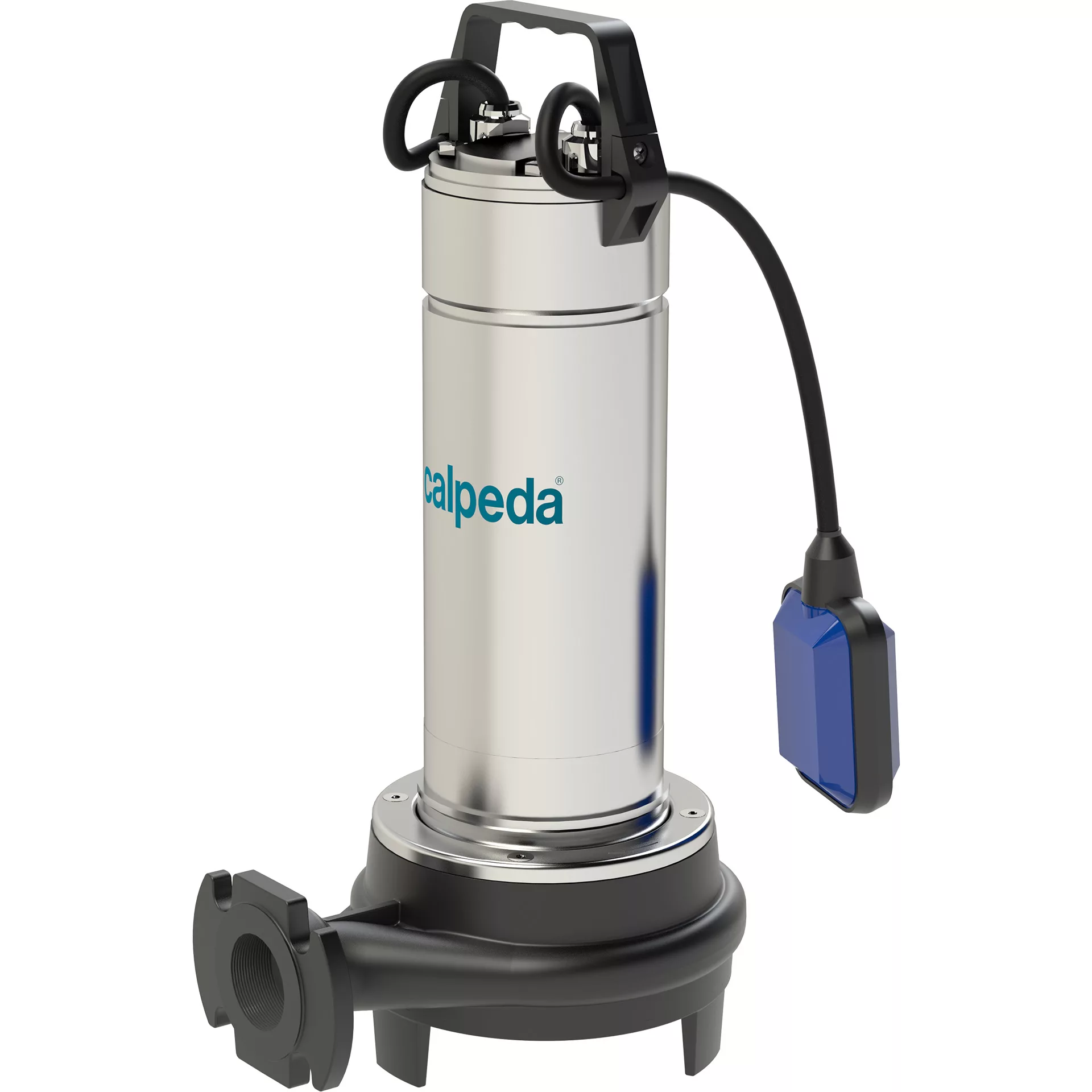
Key features
A rotating blade runs against a fixed cutting blade at the inlet, both in 1.4125 (AISI 440C) hardened steel. Nothing separate goes upstream, and the impeller only ever handles reduced material.
A horizontal G 1½ thread or a DN 32 PN 6 flange. Calpeda's pipe schedule puts the channel and vortex sewage builds at DN50 or larger, so this is the one that runs unscreened material up a thin line.
The GQG 6-25 starts at 25 m at zero flow. The vortex GQV 50-15 on the same rated output starts at 15 m, and the channel GQN 50-17 at 16.4 m.
Calpeda lifts the maximum permissible working pressure to 30 m (3 bar) on the GQG. Most of the GQ, GX and GM range stops at 25 m (2.5 bar).
Upper and lower seals in ceramic, carbon and NBR, with a chamber of oil for food and pharmaceutical machinery between them, to protect against dry running.
GQGM ships with a control box carrying the overload-protective device and the starting capacitors, plus a float switch, on 10 m of H07RN-F. There is no plug on this build.
About the Calpeda GQG
The GQG is the cutting build in Calpeda's GQ submersible family, and it is the only one of them that reduces what it pumps. Calpeda puts it on water containing long filamentary materials, paper or textile material, in domestic, residential and industrial installations. Three frames, all 2-pole, all on a horizontal G 1½ threaded port or a DN 32 PN 6 flange.
Calpeda's 50 Hz tables give the three-phase range in full:
| Model | Rated power P2 | Current at 400 V | Head at zero flow | Head at 6 m³/h | Last tabulated point |
|---|---|---|---|---|---|
| GQG 6-18 | 0.9 kW | 2.3 A | 18 m | 14.5 m | 13.2 m³/h at 4.5 m |
| GQG 6-21 | 1.1 kW | 2.8 A | 21 m | 17 m | 15 m³/h at 4 m |
| GQG 6-25 | 1.5 kW | 3.8 A | 25 m | 20.5 m | 16.8 m³/h at 4 m |
Single-phase GQGM builds carry the same three rated outputs and the same heads, drawing 7 A, 7.5 A and 9.5 A at 230 V, with maximum power input P1 of 1.3 kW, 1.5 kW and 2 kW. Size the supply against P1, not against the rated output.
What the cutter buys you, and what it costs
Buy the GQG when the medium would foul any impeller and the rising main is small. That is the verdict. The reasoning is worth setting out, because the grinder is the most expensive way to move a given flow in this family and the cheapest way to keep a small-bore line open.
Take all four GQ wet ends at 1.5 kW, at a common duty of 6 m³/h, off Calpeda's own 50 Hz tables:
| Build | Model | Impeller | Free passage | Delivery | Head at 6 m³/h | Last tabulated point |
|---|---|---|---|---|---|---|
| Grinder | GQG 6-25 | Cutter plus impeller | 6 mm | G 1½ / DN32 | 20.5 m | 16.8 m³/h at 4 m |
| Open | GQR 6-32-27 | Open, behind a strainer | 6 mm | G 1½ / DN32 | 23.5 m | 25 m³/h at 1.7 m |
| Channel | GQN 50-17 | Single channel | 50 mm | G 2 / DN50 | 14.9 m | 48 m³/h at 3.6 m |
| Vortex | GQV 50-15 | Free-flow vortex | 50 mm | G 2 / DN50 | 13.7 m | 36 m³/h at 3.5 m |
Read the head column and the flow column together, because they pull in opposite directions.
Against the solids-handling builds, cutting buys head. At 1.5 kW and 6 m³/h the GQG holds 20.5 m where the channel GQN holds 14.9 m and the vortex GQV holds 13.7 m. That is 5.6 m more lift than the channel build and 6.8 m more than the vortex, on the same rated output, and it comes with a DN32 line instead of DN50 and a casing Calpeda rates to 3 bar instead of 2.5. If the pump has to push unscreened sewage up a long, thin rising main, none of the 50 mm builds will do it.
What it costs is flow. The GQG runs off the end of its curve at 16.8 m³/h. The GQN 50-17 is still delivering 3.6 m at 48 m³/h, and the GQV reaches 36 m³/h. On a wet well that has to empty quickly, the grinder is the wrong pump however clean it keeps the line, and you would take the channel build and a bigger pipe.
The sharper comparison is the one nobody makes, because the two pumps look unrelated in the catalogue. The open-impeller GQR 6-32 has the same 6 mm passage, the same G 1½ and DN 32 PN 6 delivery, and the same 3 bar casing rating. At 1.5 kW and 6 m³/h it gives 23.5 m against the GQG's 20.5 m, and it carries on to 25 m³/h where the GQG stops at 16.8. So on paper the GQR is the better pump on that port, by about 3 m of head and half again the flow.
What separates them is what you are allowed to put through them. Calpeda rates the GQR for clean water with suspended solids up to 6 mm, behind a stainless strainer. The GQG takes long filamentary material, paper and textile, because it destroys them first. That 3 m of head and the missing flow are the price of the cutter, and it is a price worth paying only when the medium would have blocked the GQR anyway.
Grinder pump, not macerator
The GQG is a grinder pump: it cuts and pumps in one unit. Calpeda's materials list is the evidence, and it is unambiguous. The pump carries a rotating blade and a fixed cutting blade, both in steel 1.4125 EN 10088 (AISI 440C), sitting at the inlet ahead of a cast iron impeller, and it discharges through its own G 1½ or DN 32 PN 6 port. One machine, one motor, one set of pipework.
An inline macerator is the other arrangement. It cuts only, in the pipeline, and a separate pump downstream moves the reduced medium on. That suits a station where the pump already suits the duty and the problem is what arrives at it. The GQG does not fit that job, because there is nothing to fit it to. It is the pump.
The practical consequence is the pipework. A grinder pump lets you take unscreened sewage out of a chamber on a DN32 pressurised line rather than a gravity sewer sized for whole solids, and that is usually the whole reason it gets specified.
Where Calpeda's own figure and its tables disagree
Calpeda's product page gives the flow range as 3 to 17 m³/h. The 50 Hz tables stop at a 16.8 m³/h column, which is where the GQG 6-25 gives its last 4 m. Size against 16.8 m³/h.
Where the GQG stops
Liquid temperature stops at 35°C. A single-phase motor run for long above that will stop on its thermal protector and restart once the windings have cooled. Maximum liquid density is 1100 kg/m³. Maximum immersion is 5 m and minimum immersion is 300 mm, which is deeper than the small GQS frames need and worth checking against a shallow chamber. Starts are limited to 30 an hour at regular intervals, so the drawdown volume between the float levels sizes the wet well as surely as the duty point sizes the pump.
The published heads hold for a medium at density 1000 kg/m³ and a kinematic viscosity no higher than 20 cSt. A grinder tolerates rag; it does not exempt you from that.
Calpeda states plainly that the pump cannot be used in explosive or flammable environments, and that installing it in an environment with a potentially explosive atmosphere is forbidden. It must not be used in garden ponds, tanks or swimming pools while people are in the water.
One more limit, and it is the one people forget on a grinder. Calpeda lists cutting of fingers or the hand as a residual risk on this build, and calls for water-resistant anti-cut gloves during maintenance. Never put a hand near the suction opening unless the supply is isolated, the pump cannot be switched on by accident, and the impeller has stopped.
How the Calpeda GQG works
The GQG draws the medium onto a cutting pair at the inlet, works the reduced material with a cast iron impeller, and discharges horizontally through a G 1½ ISO 228 thread or a DN 32 PN 6 flange. Calpeda calls the arrangement a patented system. The motor is a 2-pole induction motor running at about 2900 rpm at 50 Hz, rated for continuous duty with the motor submerged, IP X8 for continuous immersion, insulation class F, with a triple-impregnation humidity-proof dry winding. Calpeda builds it to EN 60034-1, EN 60335-1 and EN 60335-2-41.
The cutting pair
A rotating blade turning against a fixed cutting blade does the cutting, and Calpeda specifies both in steel 1.4125 EN 10088 (AISI 440C), a hardenable martensitic stainless. Solids drawn in are reduced against that pair before they reach the impeller, which is why the impeller behind it is an ordinary cast iron GJL 200 wet end rather than a vortex or a channel build.
Treat the blades as wear parts, because they are. When throughput falls off and nothing about the system has changed, the cutters are the first thing to look at. Calpeda's dismantling procedure for the GQG runs through them: take out the nuts, then the grinder system, then the screws and the cover, and use the threaded holes to draw the impeller.
The 6 mm figure on the datasheet is the solid passage through the pump once the cutter has done its job. It is not a limit on what you may feed the pump, which is the mistake it invites. It is the size the cutter reduces to, and it is also the reason the discharge can be DN32.
The seal, and why it matters more here
Two mechanical seals run in series on the shaft with an oil chamber between them, ceramic against carbon with NBR elastomers at both faces, in an oil for food and pharmaceutical machinery. Calpeda gives protection against dry running as the reason for the arrangement.
That arrangement earns its keep on a cutting pump. Everything the blades reduce goes past the seal as fine, abrasive debris, and every solid the cutter meets puts a shock load into the shaft that carries the seal. Two faces in series means wearing the pump-side one does not put sewage into the windings, because the oil chamber is still between them.
The seal is where this pump dies, and dry running is what does it. Take the liquid away and the film goes with it, and the faces follow. So watch the 300 mm minimum immersion, and treat a float that has stopped swinging as a seal problem rather than a control problem. Never lift the pump out while it is still turning. When you pull the oil plug, expect slight pressure behind it.
The air release valve
A relief valve vents air from around the impeller so the pump picks up after standing. That matters on a grinder more than on a drainage pump, because a grinder usually sits on a foul chamber that fills slowly and runs for a couple of minutes at a time. Calpeda asks you to check periodically that the valve, item 14.80, has not clogged with impurities. It is the sort of part that fails without announcing it.
The electrical side
Three-phase GQG runs on 230 V or 400 V ±10% on 10 m of H07RN-F, drawing 2.3 A, 2.8 A or 3.8 A at 400 V. There is no plug. Calpeda is explicit that you install the overload-protective device in the control box, with a curve D characteristic set to the nameplate current, and that where the water level is not under direct visible control you add a float switch wired to the panel to set the start and stop levels.
Single-phase GQGM runs on 230 V ±10% and is the odd one out in the GQ range. Where the other single-phase builds arrive with a plug on the end of the cable, the GQGM comes with a control box holding the overload-protective device and the starting capacitors, 30 and 80 µF at 450 V, with a float switch and no plug. Full load current runs 7 A to 9.5 A. The cable is H07RN-F 4G1 mm², rising to 4G1.5 mm² on the 6-25 frame.
Check the direction of rotation at first start on a three-phase supply. Running backwards costs you delivery, causes vibration, and can damage the mechanical seal.
Other voltages, a 60 Hz build, a different mechanical seal, a 20 m cable, a vertical magnetic float switch and a three-phase pump with an incorporated float switch are all listed by Calpeda as available on request.
Installing and servicing it
The delivery pipe must never have a smaller bore than the port, which here means G 1½ (DN 32 PN 6). Fit a ball-type check valve against back flow, and arrange a gate valve and a union so the unit can come out without draining the line. Stand the pump on a support where slime collects on the floor of the chamber, and raise it off the ground in stagnant water so it is not lifting sand and grit. Grit is what wears a submersible out, and the blades feel it first.
Calpeda lists the GMC 50-65, GMV 50-65 and GQV for fixed installation on automatic coupling feet and guide rails. The GQG is not on that list, so plan on lifting it out on a rope or a chain, never on the power cable, and leave the cable a little slack against the pipe expanding under load.
Give it a couple of minutes on clean water after a muddy duty and before it stands idle. Lift it out and store it dry if there is any risk of freezing.
Reading the designation
Calpeda's key runs GQ for the series, then G for the high-power grinder build, then M for single phase, then the passage of solids in millimetres, then the total head in metres. So a GQGM 6-21 is the single-phase 1.1 kW grinder with a 6 mm passage and about 21 m of head, and a GQG 6-25 is the three-phase 1.5 kW frame. Matching an existing unit? Read the whole designation and the serial number off the nameplate before you order.
Specifications
| Type | Submersible pump with high-power grinding system, horizontal delivery port | |
|---|---|---|
| Liquid handled | Water containing long filamentary materials, paper or textile material | |
| Solid passage | Ø 6 mm | |
| Flow rate | up to 16.8 m³/h | GQG 6-25, at 4 m |
| Total head | up to 25 m | GQG 6-25, at zero flow |
| Rated power P2 | 0.9, 1.1 and 1.5 kW | |
| Maximum power input P1 | 1.3–2 kW | single-phase builds |
| Speed | about 2900 rpm | 2-pole, 50 Hz |
| Voltage | three-phase 230 V or 400 V ±10%; single-phase 230 V ±10% | |
| Full load current | 2.3–3.8 A at 400 V three-phase; 7–9.5 A single-phase | |
| Capacitors | 450 V, 30 and 80 µF | single-phase builds |
| Overload protection | In the control box supplied with the single-phase build; fitted by the user on three-phase, curve D to the nameplate current | |
| Delivery connection | G 1½ ISO 228 threaded, or DN 32 PN 6 flanged | horizontal |
| Liquid temperature | up to 35°C | |
| Maximum liquid density | 1100 kg/m³ | |
| Maximum immersion depth | 5 m | |
| Minimum immersion depth | 300 mm | |
| Maximum working pressure | 30 m (3 bar) | |
| Maximum starts per hour | 30 | at regular intervals |
| Duty | Continuous, with the motor submerged | |
| Pump casing | Cast iron GJL 200 EN 1561 | |
| Impeller material | Cast iron GJL 200 EN 1561 | |
| Casing cover | Cast iron GJL 200 EN 1561 | |
| Rotating blade | Steel 1.4125 EN 10088 (AISI 440C) | |
| Fixed cutting blade | Steel 1.4125 EN 10088 (AISI 440C) | |
| Motor jacket and jacket cover | Chrome-nickel steel 1.4301 EN 10088 (AISI 304) | |
| Shaft | Chrome-nickel steel 1.4305 EN 10088 (AISI 303) | |
| Handle | Polypropylene on a 1.4301 (AISI 304) frame | |
| Shaft seal | Double mechanical shaft seal with interposed oil chamber; upper and lower seals ceramic, carbon and NBR | |
| Seal lubrication oil | Oil for food and pharmaceutical machinery | |
| Protection degree | IP X8 | for continuous immersion |
| Insulation class | F | |
| Winding | Humidity-proof dry winding, triple impregnation | |
| Power cable | 10 m of H07RN-F 4G1 mm² | 4G1.5 mm² on the 6-25 frame; no plug on either build |
| Sound pressure | under 75 dB(A) | at minimum immersion depth; it falls further once submerged |
| Weight | 18.4–18.7 kg three-phase; 21.8–22 kg single-phase | with the 10 m cable |
| Curve basis | Density 1000 kg/m³, kinematic viscosity up to 20 cSt | |
| Standards | EN 60034-1, EN 60335-1, EN 60335-2-41 |
Send us the flow, the total dynamic head, the bore of the rising main and what the chamber is actually receiving, and we will tell you whether this wants the grinder, a vortex or a channel impeller on a bigger pipe. Give us the chamber dimensions too, because at 30 starts an hour the wet volume decides the frame. Replacing an existing pump? A photograph of the nameplate, with the designation and the serial number legible, is all we need.
Documents & downloads
Related pumps
View all →
Frequently asked
What is the Calpeda GQG used for?
Moving water that carries long filamentary materials, paper or textile material, in domestic, residential and industrial installations. A rotating blade and a fixed cutting blade reduce that material at the inlet, so it leaves through a G 1½ or DN32 port rather than blocking a conventional wastewater pump.
What flow and head does the Calpeda GQG give?
Calpeda's 50 Hz tables run to 25 m and 16.8 m³/h, but not on the same duty point. The 1.5 kW GQG 6-25 starts at 25 m at zero flow and still gives 4 m at 16.8 m³/h. The smallest frame, the 0.9 kW GQG 6-18, starts at 18 m and runs out at 13.2 m³/h.
What is the difference between a grinder pump and a macerator?
A grinder pump cuts and pumps in one unit, with the cutter at its inlet. An inline macerator cuts only, in the pipeline, and a separate pump downstream moves the reduced medium on. The GQG is a grinder pump. Its cutting pair and its impeller sit in the same casing on the same shaft.
Should I use the Calpeda GQG or a vortex pump like the GQV?
Take the GQG when the rising main is small and the lift is long. At 1.5 kW and 6 m³/h it holds 20.5 m against the GQV's 13.7 m, on a DN32 line instead of DN50. Take the vortex when you need flow, because the GQV reaches 36 m³/h where the GQG stops at 16.8.
What does the 6 mm solid passage on the Calpeda GQG mean?
It is the size of solid that passes through the pump after the cutter has reduced it, not a limit on what you may feed it. That small passage is what allows the DN32 discharge, and it is why the GQG can push unscreened material up a small-bore pressurised line.
Is the Calpeda GQG available single-phase?
Yes, as the GQGM builds on 230 V ±10%, at the same 0.9 kW, 1.1 kW and 1.5 kW rated outputs. They come with a control box holding the overload-protective device and the starting capacitors, a float switch, and 10 m of H07RN-F cable with no plug.
How deep does a Calpeda GQG need to be submerged?
Minimum immersion is 300 mm and maximum immersion is 5 m. The motor is rated for continuous duty only while it is submerged, so a shallow chamber is worth checking before the curve is.
Can a Calpeda GQG go on guide rails?
No. Calpeda lists the GMC 50-65, GMV 50-65 and GQV for fixed installation on automatic coupling feet and guide rails, and the GQG is not among them. Plan on lifting it out on a rope or a chain, never on the power cable.
What does a designation like GQGM 6-21 mean?
GQ is the series, G the high-power grinder build, M single phase, 6 the passage of solids in millimetres and 21 the total head in metres. No M means three phase.
Can a Calpeda GQG be used in a hazardous area?
No. Calpeda's instructions state that the pump cannot be used in explosive or flammable environments, and that installing it where there is a potentially explosive atmosphere is forbidden. Tell us the zone and we will quote against it.
- 1Calpeda — GQG submersible pumps with high power grinder product page
- 2Calpeda — GQG 50 Hz data sheet, English, ed. 10/2025
- 3Calpeda — GQ, GX, GM operating instructions, Rev. 100000260_03
- 4Calpeda — GQR 50 Hz data sheet, English, ed. 10/2025
- 5Calpeda — GQN 50 Hz data sheet, English, ed. 10/2025
- 6Calpeda — GQV, GQS 50 Hz data sheet, English, ed. 10/2025