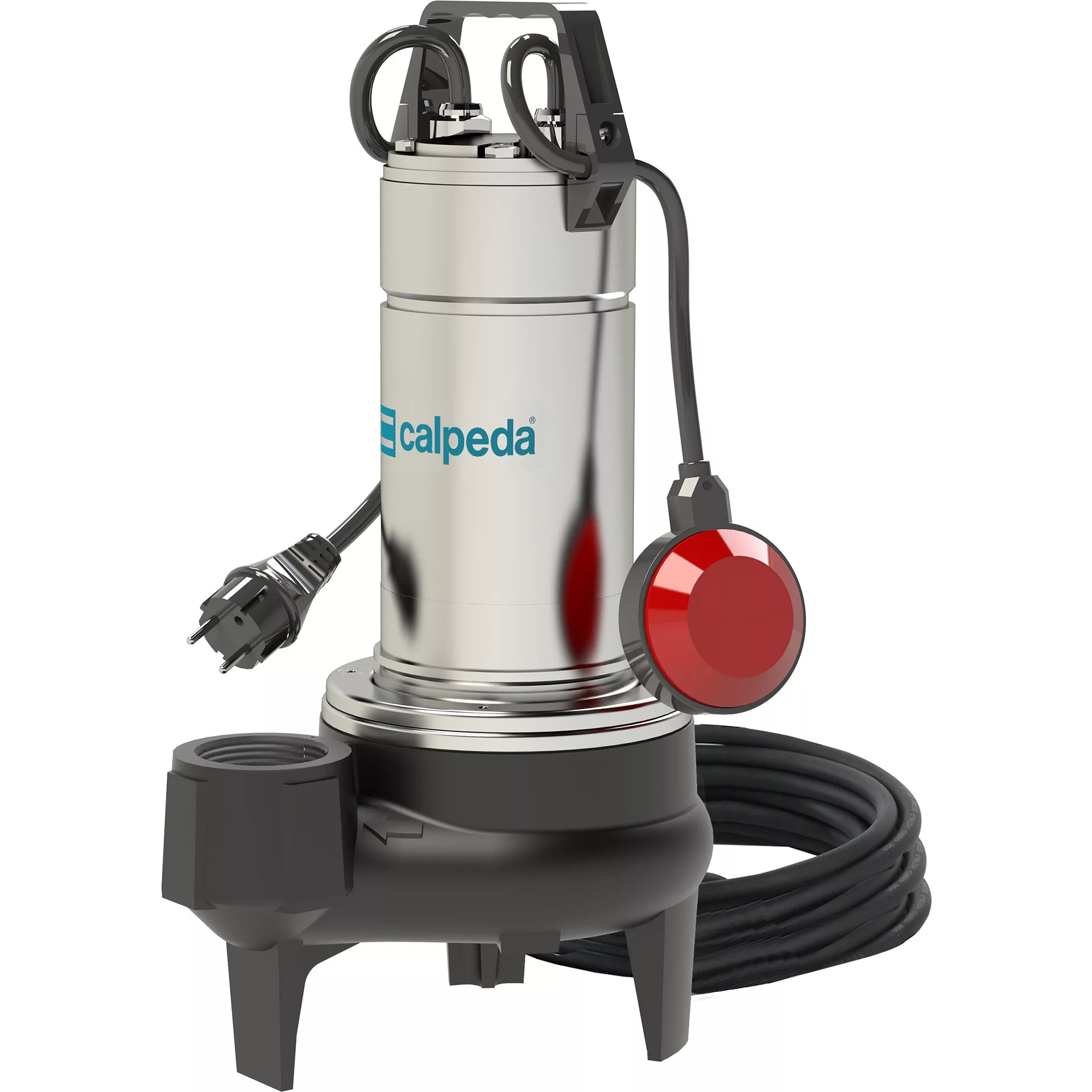
Key features
The impeller sits back out of the flow and moves liquid by the swirl it creates, so very little of the medium touches it. Calpeda's own instructions direct you here where the liquid has a high solid content or carries filamentous particles.
The GQV 50 frames pass 50 mm solids and the GQV 65 frames pass 65 mm. That 65 mm is the largest free passage in the GQ range.
G 2 on the 50 frames and G 2 1/2 on the 65, or a DN50 or DN65 flange for a counterflanged pipe. The port comes out sideways, which changes how the pipework leaves the chamber.
0.55 kW to 2.6 kW across the three-phase range. Above 1.5 kW there is no channel-impeller GQ to trade against, so the vortex is not costing you a duty point at the top of the range.
Two seals in series, ceramic against carbon with NBR elastomers at both ends, with an oil chamber between them to protect against dry running.
Calpeda fits an air release around the impeller so the pump primes properly after a long period standing idle. On a stormwater or standby duty that is what gets it going again.
About the Calpeda GQV
The GQV is Calpeda's free-flow vortex submersible, built in two frame sizes on a 2-pole motor. Calpeda puts it on civil and industrial wastewater that is not aggressive to the pump materials, on dirty water carrying solids, on emptying flooded rooms and tanks, and on drawing water from ponds, streams and rainwater collection pits. One note before you read the source data: Calpeda publishes the GQV in a shared catalogue with the vertical-discharge GQS, so check the model prefix on the row you are pricing.
The 50 frames, on a G 2 or DN50 connection with a 50 mm free passage:
| Model | Rated output | Head at shutoff | Last point on the curve |
|---|---|---|---|
| GQV 50-8 | 0.55 kW | 8 m | 24 m³/h at 1.8 m |
| GQV 50-9 | 0.75 kW | 9.3 m | 27 m³/h at 2.2 m |
| GQV 50-11 | 0.9 kW | 11 m | 33 m³/h at 1.8 m |
| GQV 50-13 | 1.1 kW | 12.8 m | 36 m³/h at 2 m |
| GQV 50-15 | 1.5 kW | 15 m | 36 m³/h at 3.5 m |
| GQV 50-16 | 2 kW | 16 m | 44 m³/h at 2 m |
| GQV 50-18 | 2.6 kW | 18 m | 48 m³/h at 2.6 m |
The 65 frames, on a G 2 1/2 or DN65 connection with a 65 mm free passage:
| Model | Rated output | Head at shutoff | Last point on the curve |
|---|---|---|---|
| GQV 65-9 | 1.1 kW | 9.1 m | 36 m³/h at 2.1 m |
| GQV 65-11 | 1.5 kW | 11.4 m | 42 m³/h at 2.3 m |
| GQV 65-13 | 2 kW | 13 m | 51 m³/h at 1.2 m |
| GQV 65-15 | 2.6 kW | 15 m | 57 m³/h at 2 m |
Read the frame, not the range. The 57 m³/h headline belongs to the 2.6 kW GQV 65-15 and arrives at 2 m of head. At the same rating the GQV 50-18 gives 18 m at shutoff but only reaches 48 m³/h. The 65 frames buy flow and passage size; the 50 frames buy head.
When the vortex is the right call
Specify the GQV when the medium carries rag, wipes or fibre, and the cost of a site visit to lift a blocked pump is the number that matters.
Calpeda states the case in the instructions covering the GQ, GX and GM ranges: where the liquid has a high solid content or carries filamentous particles, use the free-flow vortex or the grinder build. The channel-impeller GQN is not on that list, and it passes exactly the same 50 mm sphere as a GQV 50. Free passage is not what separates them. What separates them is what happens to a length of fibre once it is inside.
A vortex impeller sits back out of the flow. The liquid is moved by the swirl the impeller sets up in the casing rather than by direct contact with a vane, so fibre has far less to catch on and far less to wrap around. A channel impeller works the medium through a hydraulic passage, which is efficient right up until something ropey wedges in it.
What the vortex costs
The vortex costs you head at any given motor size, and Calpeda's coverage charts put a figure on it. Up to 1.5 kW you can buy either wet end on the same DN50 body:
| Rated output | Vortex | Head at 24 m³/h | Channel | Head at 24 m³/h |
|---|---|---|---|---|
| 0.9 kW | GQV 50-11 | 5.2 m | GQN 50-13 | 6.3 m |
| 1.1 kW | GQV 50-13 | 6.7 m | GQN 50-15 | 8.3 m |
| 1.5 kW | GQV 50-15 | 8.5 m | GQN 50-17 | 10.3 m |
The gap widens the further right you go. At 1.1 kW and 36 m³/h the vortex gives 2 m and the channel build gives 5 m, and past 36 m³/h the GQV 50-13 has run off the end of its curve while the channel pump is still working.
In practice that means going up a frame. A duty of 24 m³/h at 8 m sits on the 1.1 kW GQN 50-15 at 8.3 m and draws 3.3 A at 400 V. To reach it with a vortex you take the 1.5 kW GQV 50-15, which gives 8.5 m and draws 4 A. That is a bigger motor and more current, every hour, for the life of the installation.
Whether that is worth paying is an arithmetic question about your chamber, not a matter of preference. One blocked impeller a year on a pump that needs lifting will cost more than the extra frame. A clean sump that has never blocked anything will not.
Above 1.5 kW the trade disappears. The 2 kW and 2.6 kW GQV frames have no channel-impeller counterpart in this range, and neither does the 65 mm free passage, so at that end you are choosing the GQV on duty and passage size rather than against a channel alternative.
Neither build is a macerator. Where a chamber is putting through more wipes than any impeller was going to clear, the answer is screening or maceration upstream. Fitting a vortex to a station that is genuinely overwhelmed just moves the blockage further down the rising main.
Threaded, flanged, and the 65 mm frame
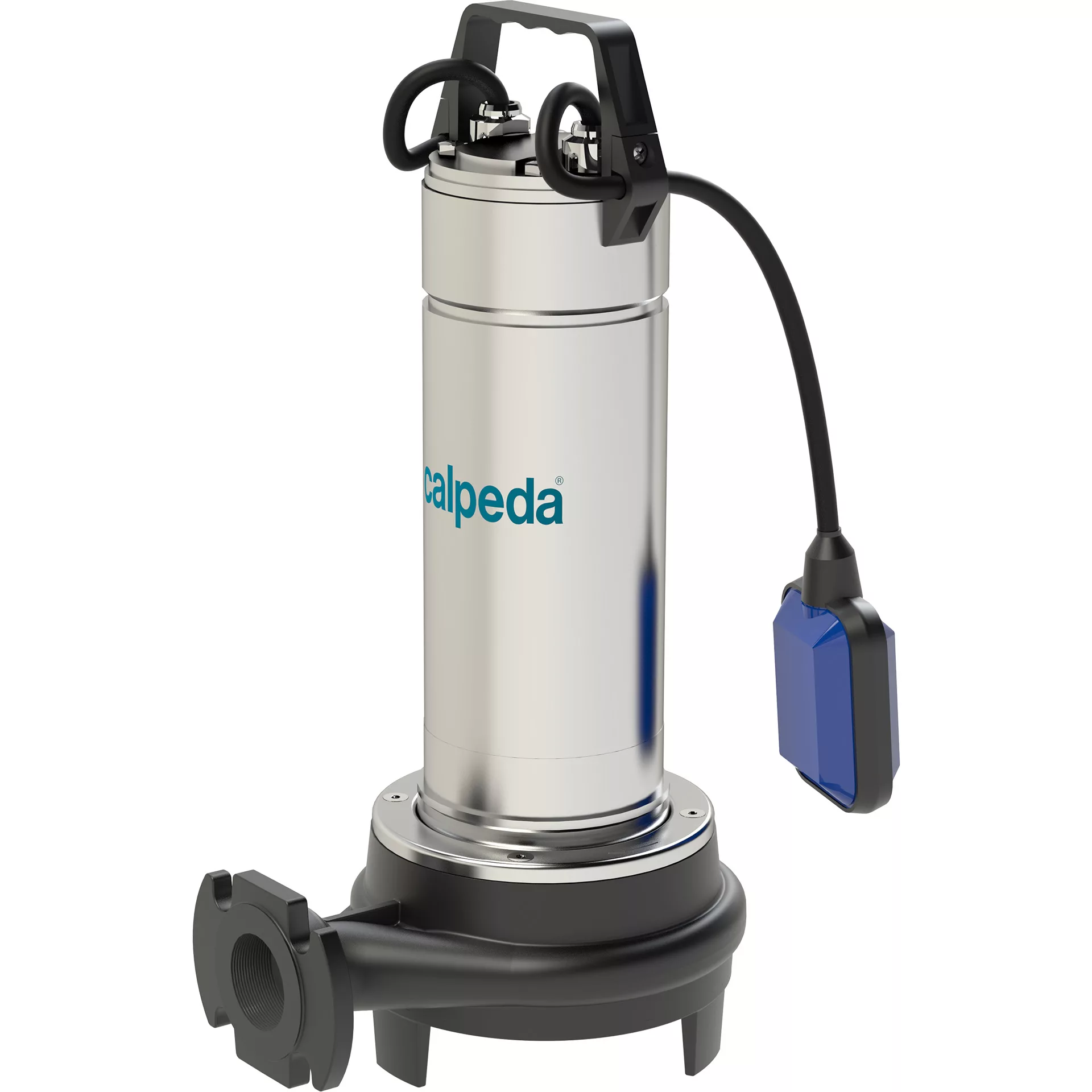
The GQV brings its discharge out horizontally, which is the practical difference from the vertical-discharge builds. On the 50 frames that is a G 2 thread or a DN50 flange; on the 65 frames a G 2 1/2 thread or a DN65 flange. Calpeda's installation drawing for the DN65 shows the pipe taken off with a counterflange to EN 1092-2 PN 10.
A horizontal port suits a pump that sits on the floor of a chamber with the rising main leaving sideways, and the flanged version suits a fixed installation you expect to break for service. The threaded version takes pipe screwed straight into the port or union couplings, which is quicker to fit and slower to remove.
The 65 frames want more water over them. Minimum immersion is 355 mm against 275 mm on the 50 frames, so a chamber sized for the smaller pump will not simply accept the bigger one.
Where the GQV stops
The GQV takes liquid to 35°C and no hotter, at pH 6 to 11 and a density up to 1100 kg/m³. Maximum immersion is 5 m and the motor is rated for continuous duty only while submerged. Maximum permissible working pressure in the pump body is 25 m, which is 2.5 bar.
Calpeda allows 30 starts an hour at regular intervals. On a small chamber that limit sizes the wet well as surely as the duty point does, because the drawdown volume between the float levels is what sets the cycle rate.
The published heads assume a medium behaving as water: density 1.0 kg/dm³ and kinematic viscosity no greater than 20 mm²/s. A vortex tolerates solids well, but it does not exempt you from that. Thicken the medium beyond it and the curve you selected against is no longer the curve you have.
How the Calpeda GQV works
The GQV draws the medium in through the base and moves it with a free-flow vortex impeller recessed into the casing, discharging horizontally through a threaded port to ISO 228 or a flange. Calpeda calls the arrangement a patented system. The motor is a 2-pole submersible induction motor running at about 2900 rpm at 50 Hz, and the unit is IP X8 for continuous immersion.
Why a recessed impeller passes fibre
The impeller does not sit in the path the liquid takes through the pump. It spins in a recess at the back of the casing and drives the whole body of liquid into a vortex, and it is that rotating column, rather than the vane itself, that carries the medium to the discharge. A rag passing through the casing largely misses the impeller.
That is also why it gives up head. Work transferred through a moving column of liquid is less efficient than work transferred by a vane pushing directly on it, so at the same speed and the same motor rating the vortex builds sit lower on the chart than the channel builds.
Two seals and an oil chamber
Two mechanical seals run in series on the shaft with an oil chamber between them, ceramic against carbon with NBR elastomers at both ends, in an oil for food and pharmaceutical machinery.
That arrangement matters more on a vortex than it looks. You buy this pump because the medium is dirty, and the media that justify a vortex impeller are the same ones that abrade and foul a seal face. Two seals in series means wearing the pump-side face does not put sewage into the windings, because the oil chamber is still in the way. The weak point in almost any pump is the seal. Dry running is what finishes it quickest, because a mechanical seal needs liquid to lubricate it and the faces go as soon as the film does. Watch the minimum immersion figure for your frame, and treat a float that has stopped swinging as a seal problem rather than a control problem.
The wetted materials
The pump casing and the impeller are cast iron GJL 200 to EN 1561. The motor jacket, jacket cover, casing cover and shaft are AISI 304, and the handle is polypropylene on an AISI 304 frame. Cast iron is the right call for a sewage pump carrying grit, which is what wears out a wastewater pump once rag has been dealt with.
The electrical side
Three-phase GQV runs on 230 V or 400 V ±10%. On the 50 frames the full load current runs 1.5 A at 0.55 kW to 7.5 A at 2.6 kW; on the 65 frames it is 3 A at 1.1 kW to 7.5 A at 2.6 kW. It ships with 10 m of H07RN-F 4G1 mm² cable and no plug, so the overload protection comes from your starter or your board.
Single-phase GQVM runs on 230 V ±10% with a built-in capacitor, a thermal protector and a float switch fitted as standard, on 10 m of H07RN-F 3G1 mm² cable with a CEI-UNEL 47166 plug. It covers 0.55 kW to 1.5 kW on the 50 frames and 1.1 kW to 1.5 kW on the 65. Watch the input power against the output: a 1.5 kW GQVM 50-15 draws 2.2 kW at the input and 13 A at 230 V, which is a real consideration on a domestic supply.
On request Calpeda will supply other voltages, 60 Hz, a different mechanical seal, a 20 m cable, a motor set up to run on a frequency converter, and a three-phase pump with an integral float switch.
Reading the designation
GQ is the series and V is the vortex impeller on the horizontal discharge. An M after that means single-phase, and no letter means three-phase. Then 50 or 65 is the free passage in millimetres, and the last number is the nominal total head in metres. So a GQVM 65-11 is the single-phase 1.5 kW pump with a 65 mm passage. If you are matching an existing unit, photograph the nameplate and send us the full designation and the serial number.
Where it must not go
This is worth saying plainly on a vortex page, because the duties that call for a vortex are often the ones that generate gas. Calpeda's instructions forbid installing the pump in a potentially explosive atmosphere, and forbid using it in ponds, tanks or swimming pools while people are in the water. A septic wet well that has been classified as a hazardous area needs a certified pump, and no amount of ventilation reasoning turns this one into that. Tell us the zone and we will quote the right thing instead.
Specifications
| Type | Submersible sewage and drainage pump | |
|---|---|---|
| Impeller | Free-flow vortex impeller, cast iron | |
| Liquid handled | Civil and industrial wastewater, and dirty water | not aggressive to the pump materials |
| Flow rate | up to 57 m³/h | GQV 65-15, at 2 m |
| Total head | up to 18 m | GQV 50-18 at shutoff |
| Maximum solids passage | 50 mm on the GQV 50; 65 mm on the GQV 65 | |
| Rated output | 0.55–2.6 kW three-phase; 0.55–1.5 kW single-phase | |
| Speed | about 2900 rpm | 2-pole, 50 Hz |
| Voltage | 3~230 V or 400 V ±10%; 1~230 V ±10% | |
| Full load current | 1.5–7.5 A three-phase at 400 V; 4.3–13 A single-phase at 230 V | |
| Discharge connection | G 2 or DN50 flange on the GQV 50; G 2 1/2 or DN65 flange on the GQV 65 | horizontal port, threaded to ISO 228 |
| Liquid temperature | up to 35°C | |
| pH | 6–11 | |
| Maximum liquid density | 1100 kg/m³ | |
| Maximum immersion depth | 5 m | |
| Minimum immersion depth | 275 mm on the GQV 50; 355 mm on the GQV 65 | |
| Maximum working pressure | 25 m (2.5 bar) | in the pump casing |
| Maximum starts per hour | 30 | at regular intervals |
| Sound pressure | under 70 dB(A) | at minimum immersion depth |
| Duty | Continuous, with the motor submerged | |
| Pump casing | Cast iron GJL 200 EN 1561 | |
| Impeller material | Cast iron GJL 200 EN 1561 | |
| Motor jacket, jacket cover and casing cover | AISI 304 (1.4301 EN 10088) | |
| Shaft | AISI 304 (1.4301 EN 10088) | |
| Handle | Polypropylene on an AISI 304 frame | |
| Shaft seal | Double mechanical seal with an interposed oil chamber; ceramic, carbon and NBR at both ends | |
| Seal lubricating oil | Oil for food and pharmaceutical machinery | |
| Protection degree | IP X8 | for continuous immersion |
| Insulation class | F | |
| Winding | Dry, with triple moisture-resistant impregnation | |
| Motor standards | EN 60034-1, EN 60335-1, EN 60335-2-41 | |
| Power cable | 10 m | H07RN-F 4G1 mm² three-phase without plug; 3G1 mm² single-phase with a CEI-UNEL 47166 plug |
| Float switch | Fitted as standard on single-phase GQVM; on three-phase to order | |
| Weight | 15–21.6 kg three-phase; 16–24.2 kg single-phase | with 10 m of cable, GQV 50-8 to GQV 65-11 |
| Curve basis | Density 1.0 kg/dm³, kinematic viscosity up to 20 mm²/s |
Send us the flow, the total dynamic head, what the wastewater is carrying and how much rag comes with it, and we will tell you whether this wants the vortex GQV, the channel GQN or a bigger pump altogether. Say whether you want the threaded or the flanged build and give us the chamber dimensions, because minimum immersion and the 30 starts an hour decide the frame as often as the duty point does. Replacing an existing pump? Photograph the nameplate and send the full designation and the serial number.
Documents & downloads
Related pumps
View all →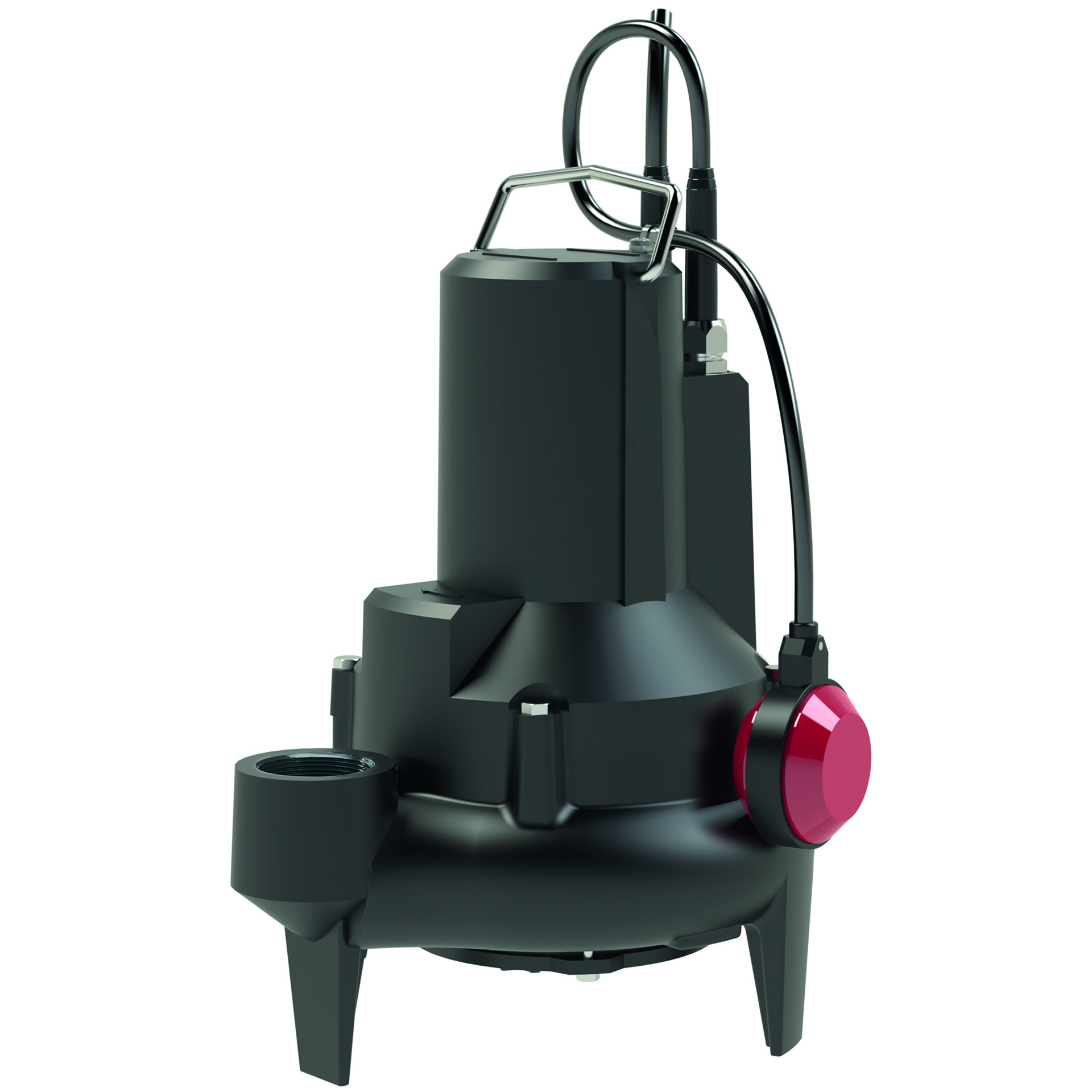
Frequently asked
What is the difference between the Calpeda GQV and the GQN?
The impeller. GQV is a free-flow vortex and GQN is a channel impeller. Both pass 50 mm solids on the DN50 frames and run the same 2-pole motor, but the vortex sits back out of the flow, so it fouls less and delivers less. At 1.1 kW and 24 m³/h the GQV gives 6.7 m against the GQN's 8.3 m.
When should I use a vortex impeller instead of a channel impeller?
When the flow carries rag, wipes or fibre. Calpeda's instructions direct you to the free-flow vortex or grinder builds where the liquid has a high solid content or carries filamentous particles. On grey water or a clean sump the channel build is the better pump and the cheaper one to run.
What size solids will the Calpeda GQV pass?
50 mm on the GQV 50 frames and 65 mm on the GQV 65 frames. The number in the designation is the free passage in millimetres.
What flow and head does the Calpeda GQV give?
Up to 57 m³/h and up to 18 m, but not on the same pump. The 57 m³/h belongs to the 2.6 kW GQV 65-15 at 2 m of head, and the 18 m belongs to the 2.6 kW GQV 50-18 at shutoff.
Does the Calpeda GQV come with a flanged connection?
Yes. The 50 frames take a G 2 thread or a DN50 flange and the 65 frames a G 2 1/2 thread or a DN65 flange. Calpeda's DN65 installation drawing shows the pipe taken off with a counterflange to EN 1092-2 PN 10.
Is the Calpeda GQV available single-phase?
Yes. The GQVM runs on 1~230 V ±10% from 0.55 kW to 1.5 kW on the 50 frames and at 1.1 kW and 1.5 kW on the 65, with a float switch, thermal protector and capacitor built in and a fitted plug on 10 m of cable.
How deep does a Calpeda GQV need to be submerged?
275 mm minimum on the GQV 50 frames and 355 mm on the GQV 65, with a maximum immersion of 5 m. The motor is rated for continuous duty only while it is submerged.
Can the Calpeda GQV be used in a hazardous area?
No. Calpeda's instructions state that the pump must not be installed in an environment with a potentially explosive atmosphere. A classified area wants a certified pump, so tell us the zone and we will quote against it.