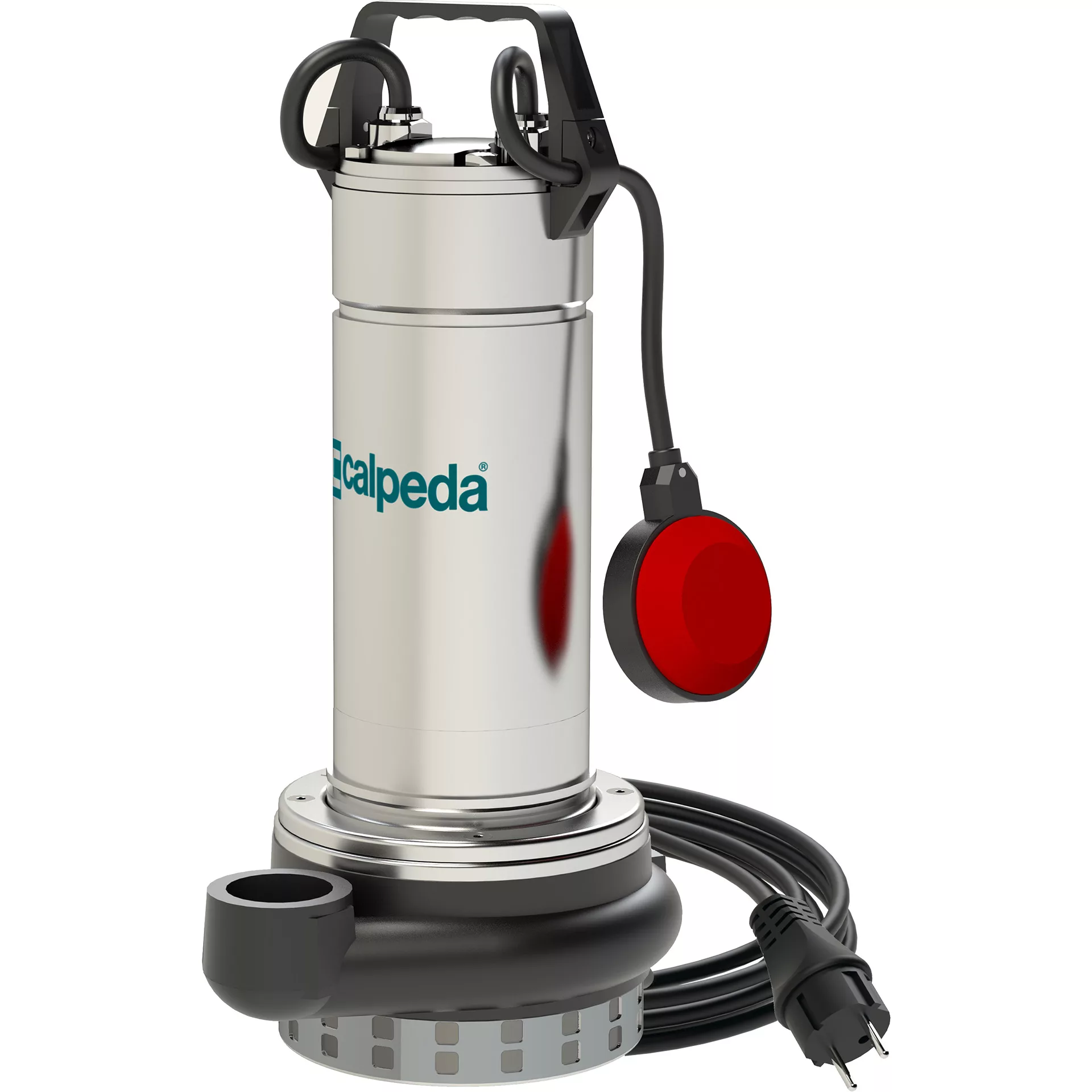
Key features
The impeller is open and the inlet is covered by a 1.4301 (AISI 304) strainer. That pairing sets the duty, which is clean water with suspended solids up to 6 mm on the GQR 6 and 10 mm on the rest.
The GQR 6-32-30 starts at 30.2 m at zero flow, and Calpeda raises the permissible working pressure to 30 m (3 bar) on the GQR 6 builds to suit it.
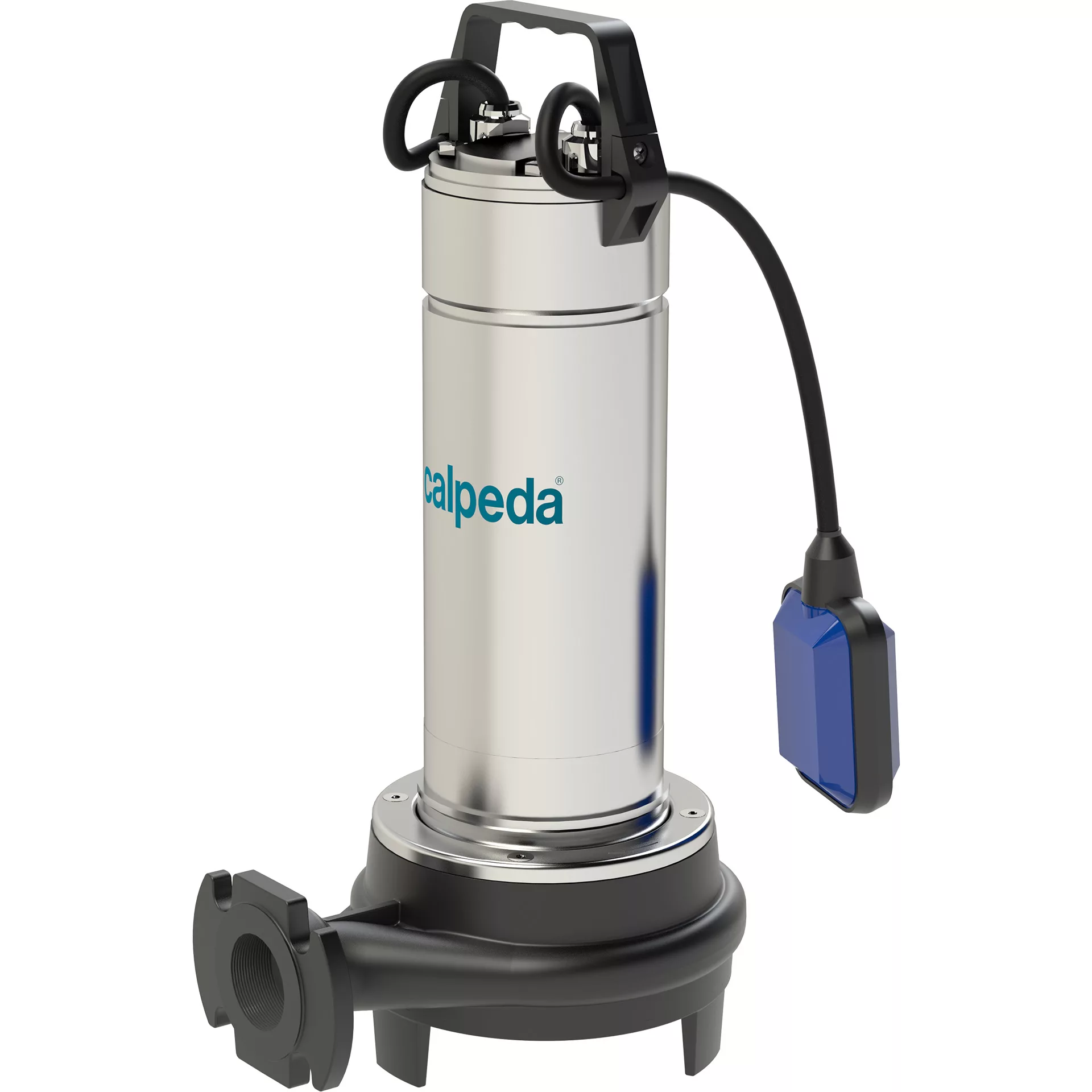
A vertical G 1½ threaded port, a horizontal DN 32 PN 6 flange with a G 1½ thread on the 10-32 and 6-32, and a horizontal DN 50 PN 10 flange with a G 2 thread on the 10-50.
The GQR 10-50-18 holds 15.1 m at 24 m³/h against 17.7 m at shutoff, so the head barely moves across most of its range. Useful where the flow varies and the lift does not.
Two ceramic, carbon and NBR seals with an oil chamber between them, which Calpeda fits to protect the motor against dry running.
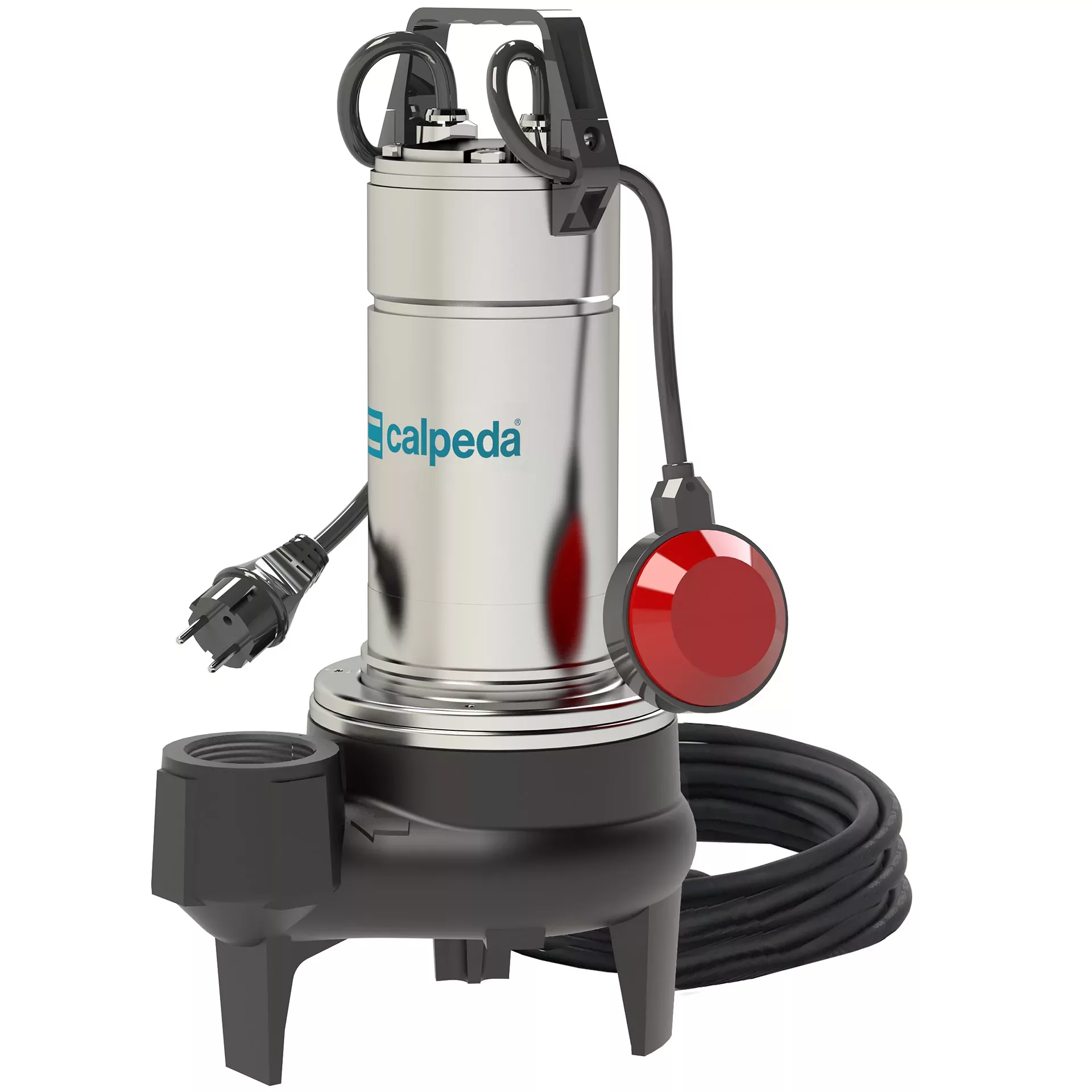
GQRM carries a capacitor, a thermal protector, a float switch and a plug on 10 m of H07RN-F. On three-phase the overload device is yours to fit.
About the Calpeda GQR
The GQR is Calpeda's open-impeller submersible drainage pump. Calpeda puts it on clean water with suspended solids, on emptying flooded rooms and tanks, on drawing water out of ponds, streams and rainwater pits, and on irrigation. It is 2-pole, cast iron in the wet end with a stainless jacket, and it sits in the sump on a screwed pipe, a hose or a short flanged connection.
The published range needs reading against the tables before you size anything. Calpeda's product page gives 3 to 30 m³/h and 3 to 20 m, which describes the vertical G 1½ builds and stops there. The 50 Hz datasheet carries three more families: the GQR 6-32 reaches 30.2 m at zero flow, and the GQR 10-50-18 is still delivering at 52 m³/h. Size against the datasheet.
The open impeller is what makes this a drainage pump
Use the GQR where the water is clean and the solids in it are small and hard. That is what an open impeller behind a strainer is for, and it is the line between this pump and the rest of the GQ range.
An open impeller has vanes standing proud on a back shroud, running close to the casing. It handles grit and small suspended solids and it converts the motor's work efficiently, which is why the GQR reaches heads the sewage builds never see. What it will not do is pass rag. Fibre catches on a vane and stays there, and in any case Calpeda covers the inlet with a strainer that keeps anything larger than the rated passage out of the pump altogether.
Calpeda's own manual draws the same line. Where the liquid has a high solid content or carries filamentous particles, it says to use the free-flow vortex construction or a grinder. The GQR appears nowhere in that instruction. If the medium is wastewater carrying wipes or rag, the pump you want is the GQS or one of the other sewage builds, and specifying a GQR instead buys you a blocked strainer and a site visit.
Grit is the other thing to think about. Sand and grit are what wear a submersible out, and an open impeller running close to the casing has little clearance to lose before the duty drops off. Calpeda's answer is mechanical: in stagnant water or a river, mount the pump on a flat surface raised off the ground so it is not lifting sand off the bottom.
Four builds, and the duty each one covers
Calpeda splits the GQR into four families, and they are not four sizes of the same pump. Two of them share a curve and differ only at the flange; the other two are a head build and a flow build.
| Build | Free passage | Delivery | Rated power P2 | Head at zero flow | Last tabulated point |
|---|---|---|---|---|---|
| GQR 10-10 to 10-20 | 10 mm | G 1½ vertical | 0.45–1.5 kW | 10–20 m | 30 m³/h at 3 m |
| GQR 10-32-10 to 10-32-20 | 10 mm | DN 32 PN 6 flange, G 1½ | 0.45–1.5 kW | 10–20 m | 30 m³/h at 3 m |
| GQR 6-32-24 to 6-32-30 | 6 mm | DN 32 PN 6 flange, G 1½ | 1.1–1.8 kW | 23.9–30.2 m | 25 m³/h at 4.1 m |
| GQR 10-50-14 to 10-50-18 | 10 mm | DN 50 PN 10 flange, G 2 | 1.1–2 kW | 13.7–17.7 m | 52 m³/h at 2 m |
The vertical and the 10-32 share their curves exactly, model for model, so the flange is a connection decision rather than a hydraulic one. Pick it on what the pipework in the pit already is.
The other two are different pumps. The GQR 6-32 is the head build: it drops the free passage to 6 mm and buys 30.2 m at zero flow, and Calpeda lifts the permissible working pressure in the casing to 30 m (3 bar) to match. The GQR 10-50 is the flow build, and its curve is the interesting one. The 1.5 kW GQR 10-50-16 gives 15.8 m at zero flow and is still holding 13.5 m at 21 m³/h. The 1.5 kW GQR 10-20, on the same rated output, starts at 20 m and has fallen to 10.8 m by that flow. If the lift is short and the flow is what matters, the 10-50 is the frame.
Work an example. Say the duty is 21 m³/h at 10 m. The 1.5 kW GQR 10-20 just makes it, with 10.8 m at that flow and next to no margin left. Take the 1.5 kW GQR 10-50-16 instead and you get 13.5 m on the same rated output, because a flatter curve holds more of its head out at flow. That is nearly 3 m more for the same motor, and it is why the flange size on this range is worth a second look.
Where the GQR stops
Liquid temperature stops at 35°C, and a single-phase motor run for long above that will stop on its thermal protector and restart when the windings have cooled. Maximum liquid density is 1100 kg/m³. Maximum immersion is 5 m. Minimum immersion runs from 205 mm on the smallest build to 335 mm on the 6-32-30. Starts are limited to 30 an hour at regular intervals, which on a small chamber is a wet-volume calculation as much as a pump selection. Maximum permissible working pressure in the casing is 25 m (2.5 bar), or 30 m (3 bar) on the GQR 6.
Calpeda states plainly that the pump cannot be used in explosive or flammable environments, and that it must not be used in garden ponds, tanks or swimming pools while people are in the water. Where it is used in a pool with nobody in it, or a garden pond, Calpeda requires a residual current device with a rated tripping current no higher than 30 mA in the supply circuit.
How the Calpeda GQR works
The GQR draws water through a stainless steel strainer in the base, works it with an open cast iron impeller, and discharges through a vertical G 1½ port or a horizontal flange. The motor is a 2-pole induction motor running at about 2900 rpm at 50 Hz, rated for continuous duty with the motor submerged, IP X8 for continuous immersion and insulation class F, with a triple-impregnation humidity-proof dry winding. Calpeda builds it to EN 60034-1, EN 60335-1 and EN 60335-2-41. The tabulated figures hold for a liquid at density 1.0 kg/dm³ and a kinematic viscosity no higher than 20 cSt.
The strainer sets the duty
The strainer is a 1.4301 (AISI 304) part in Calpeda's own materials list, and it is what makes the 6 mm and 10 mm ratings mean anything. Nothing larger reaches the impeller, so the pump stays inside its duty as long as the strainer stays clear.
That makes it the maintenance item. A strainer blinded with leaf litter or fibre starves the pump, and the symptoms read like a worn impeller: less delivery, more noise, longer run times. Calpeda calls for water-resistant, anti-cut gloves whenever you take the filter off, and asks you to check periodically that the air relief valve (item 14.80) has not clogged with impurities either.
Two seals and an oil chamber
The shaft runs through a double mechanical shaft seal with an oil chamber between the faces. Upper and lower seals are both ceramic against carbon with NBR elastomers, and the chamber holds oil for food and pharmaceutical machinery. Calpeda's stated purpose for the arrangement is protection against dry running.
Dry running is what kills the arrangement fastest, and on a drainage duty that is a live risk rather than a theoretical one. A mechanical seal needs liquid to lubricate it, and the faces go as soon as the film does. This pump's job is emptying a space, so it spends its working life heading towards the moment there is nothing left to pump. Calpeda's instruction is short: avoid running dry, and on a build without a float, start the pump only when it is fully immersed. The manual also warns against taking the pump out of the water while it is still running, and notes there may be slight pressure in the oil chamber when you open the plug.
The electrical side
Single-phase GQRM builds run on 230 V ±10% with an incorporated capacitor, a thermal protector, a float switch and a CEI-UNEL 47166 plug, on 10 m of H07RN-F 3G1 mm² cable, or 3G1.5 mm² on the 1.5 kW frames. Capacitors run 12.5 to 35 µF at 450 V. Full load current is 3.1 A to 13 A across the frames, and maximum power input P1 runs from 0.7 kW to 2.4 kW. Size the supply against P1 rather than the rated output.
Three-phase GQR builds run on 230 V or 400 V ±10% on 10 m of H07RN-F 4G1 mm² with no plug, drawing 1.2 A to 5.6 A at 400 V. Calpeda's manual is explicit that you install the overload-protective device in the control box, with a curve D characteristic set to the nameplate current, and that where the water level is not under direct visible control you add a float switch wired to the panel to set the start and stop levels. Check the direction of rotation at first start. Running backwards costs you delivery, causes vibration and can damage the mechanical seal.
Other voltages, a 60 Hz build, a different mechanical seal, a 20 m cable, a switch with a fixed magnetic float, a motor set up for inverter duty and a three-phase pump with a built-in switch and float are all listed by Calpeda as available on request.
Installing and servicing it
Keep the internal diameter of the delivery pipe at or above the port size, and fit a check valve in the delivery against back flow. Calpeda specifies a swing valve here rather than the ball valve it calls for on the sewage builds, so do not carry the fitting across from a GQS or GQV installation. Arrange a gate valve and a union so the pump can come out without draining the system, and where slime collects at the bottom of the pit, stand the pump on a support to keep it clear. Use a rope or chain to lower and lift it, never the power cable, and leave a little slack in the cable so the delivery pipe expanding under load does not strain it.
To inspect the impeller, take out the screws (15.70) and the strainer (15.50), then the screws (14.24) and the pump casing (14.00), and check the impeller turns freely by hand. The impeller comes off with the nut (28.04). After pumping muddy water, run the pump briefly on clean water before it stands idle. If there is a risk of freezing, take it out of the water and leave it somewhere dry.
Reading the designation
Calpeda's key runs GQ for the series, then R for the open impeller, then M for single phase, then the free passage, then the delivery port diameter on the flanged builds, then the maximum head. So a GQRM 10 32-12 is a single-phase open-impeller pump with a 10 mm free passage on a DN 32 delivery, giving 12 m. On the vertical builds the port number is absent, so a GQR 10-14 is the three-phase 10 mm build giving 14 m. If you are matching an existing unit, read the full designation and the serial number off the nameplate and send us both.
Specifications
| Type | Single-impeller submersible drainage pump with open impeller | |
|---|---|---|
| Liquid handled | Clean water with suspended solids | |
| Impeller | Open | |
| Flow rate | up to 52 m³/h | GQR 10-50-18, at 2 m |
| Total head | up to 30.2 m | GQR 6-32-30, at zero flow |
| Maximum solids passage | 6 mm on the GQR 6; 10 mm on the GQR 10 | |
| Inlet strainer | Chrome-nickel steel 1.4301 EN 10088 (AISI 304) | |
| Liquid temperature | up to 35°C | |
| Maximum liquid density | 1100 kg/m³ | |
| Maximum immersion depth | 5 m | |
| Minimum immersion depth | 205–335 mm | by build |
| Maximum working pressure | 25 m (2.5 bar); 30 m (3 bar) on the GQR 6 | |
| Maximum starts per hour | 30 | at regular intervals |
| Rated power P2 | 0.45, 0.55, 0.75, 0.9, 1.1, 1.5, 1.8 and 2 kW | |
| Maximum power input P1 | 0.7–2.4 kW | single-phase builds |
| Speed | about 2900 rpm | 2-pole, 50 Hz |
| Voltage | three-phase 230 V or 400 V ±10%; single-phase 230 V ±10% | |
| Full load current | 1.2–5.6 A at 400 V three-phase; 3.1–13 A single-phase | |
| Capacitor | 450 V, 12.5–35 µF | single-phase builds |
| Overload protection | Thermal protector built into the single-phase motor; fitted by the user in the control box on three-phase, curve D to the nameplate current | |
| Delivery connection | G 1½ ISO 228 vertical; DN 32 PN 6 with G 1½ on the 10-32 and 6-32; DN 50 PN 10 with G 2 on the 10-50 | |
| Duty | Continuous, with the motor submerged | |
| Pump casing | Cast iron GJL 200 EN 1561 | |
| Impeller material | Cast iron GJL 200 EN 1561 | |
| Motor jacket, jacket cover and casing cover | Chrome-nickel steel 1.4301 EN 10088 (AISI 304) | |
| Shaft | 1.4301 EN 10088 (AISI 304); 1.4305 EN 10088 (AISI 303) on the GQR 6-32 | |
| Handle | Polypropylene on a 1.4301 (AISI 304) frame | |
| Shaft seal | Double mechanical shaft seal with interposed oil chamber; upper and lower seals ceramic, carbon and NBR | |
| Seal lubrication oil | Oil for food and pharmaceutical machinery | |
| Protection degree | IP X8 | for continuous immersion |
| Insulation class | F | |
| Winding | Triple impregnation, humidity-proof dry winding | |
| Power cable | 10 m of H07RN-F | 4G1 mm² without plug on three-phase; 3G1 mm² with plug on single-phase, 3G1.5 mm² at 1.5 kW |
| Sound pressure | under 70 dB(A) | at minimum immersion depth; it falls further once submerged |
| Weight | 12.8–21.3 kg | with the 10 m cable |
| Standards | EN 60034-1, EN 60335-1, EN 60335-2-41 |
Send us the flow, the total dynamic head, and what the water is actually carrying, because that last answer decides whether this range is right at all. Give us the pit dimensions and the pipework in it too, since at 30 starts an hour the sump volume decides the frame, and the flange size decides how flat a curve you can have. If the water carries rag or fibre, say so and we will move you off the GQR before you buy one. Replacing an existing pump? Photograph the nameplate and send the full designation and the serial number.
Documents & downloads
Related pumps
View all →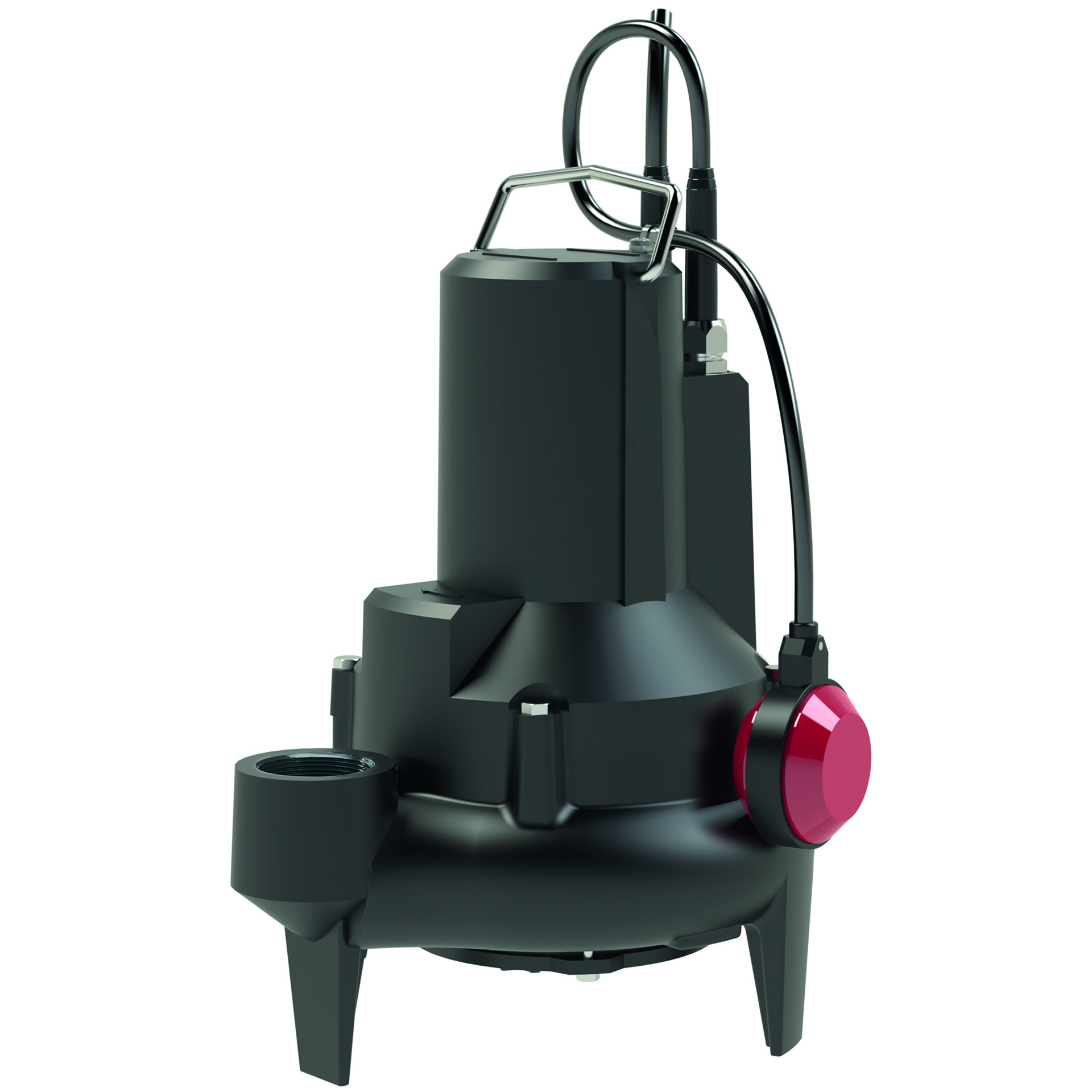
Frequently asked
What is the Calpeda GQR used for?
Draining clean water that carries small suspended solids. Calpeda lists emptying flooded rooms and tanks, drawing water from ponds, streams and rainwater pits, and irrigation. Solids are limited to 6 mm on the GQR 6 and 10 mm on the rest.
Can a Calpeda GQR pump sewage?
No. It has an open impeller behind a strainer and Calpeda rates it for clean water with suspended solids. Where the liquid has a high solid content or filamentous particles, Calpeda's manual directs you to a free-flow vortex or grinder build instead.
What flow and head does the Calpeda GQR give?
The 50 Hz tables run to 52 m³/h and 30.2 m, but not on the same pump. The head comes from the 1.8 kW GQR 6-32-30 and the flow from the 2 kW GQR 10-50-18, which still delivers 2 m of head at 52 m³/h.
What size solids will a Calpeda GQR pass?
6 mm on the GQR 6 builds and 10 mm on the GQR 10 builds. A stainless steel strainer over the inlet keeps anything larger out of the pump.
What is the difference between the GQR, the GQR 10-32 and the GQR 10-50?
The delivery. The plain GQR has a vertical G 1½ port, the 10-32 a horizontal DN 32 PN 6 flange with a G 1½ thread, and the 10-50 a horizontal DN 50 PN 10 flange with a G 2 thread. The vertical and 10-32 share their curves; the 10-50 is a flatter, higher-flow pump.
Which Calpeda GQR gives the most head?
The GQR 6-32-30, at 30.2 m at zero flow on 1.8 kW. It buys that by dropping the free passage to 6 mm, and Calpeda raises the permissible working pressure in the casing to 30 m (3 bar) on the GQR 6 builds.
Is the Calpeda GQR available single-phase?
Yes, as the GQRM builds, on 230 V ±10% with a capacitor, a thermal protector, a float switch and a plug on 10 m of H07RN-F cable. Three-phase builds run on 230 V or 400 V and come without a plug.
Does a three-phase Calpeda GQR need separate overload protection?
Yes. Calpeda's manual gives the overload-protective device as something you install in the control box, with a curve D characteristic set to the nameplate current. The single-phase builds already have a thermal protector in the motor.
What temperature and depth can a Calpeda GQR handle?
Liquid up to 35°C at a density up to 1100 kg/m³, immersed to 5 m. Minimum immersion runs from 205 mm on the smallest build to 335 mm on the largest.
What does a designation like GQRM 10 32-12 mean?
GQ is the series, R the open impeller, M single phase, 10 the free passage in millimetres, 32 the delivery port diameter on the flanged builds and 12 the maximum head in metres. No M means three phase.