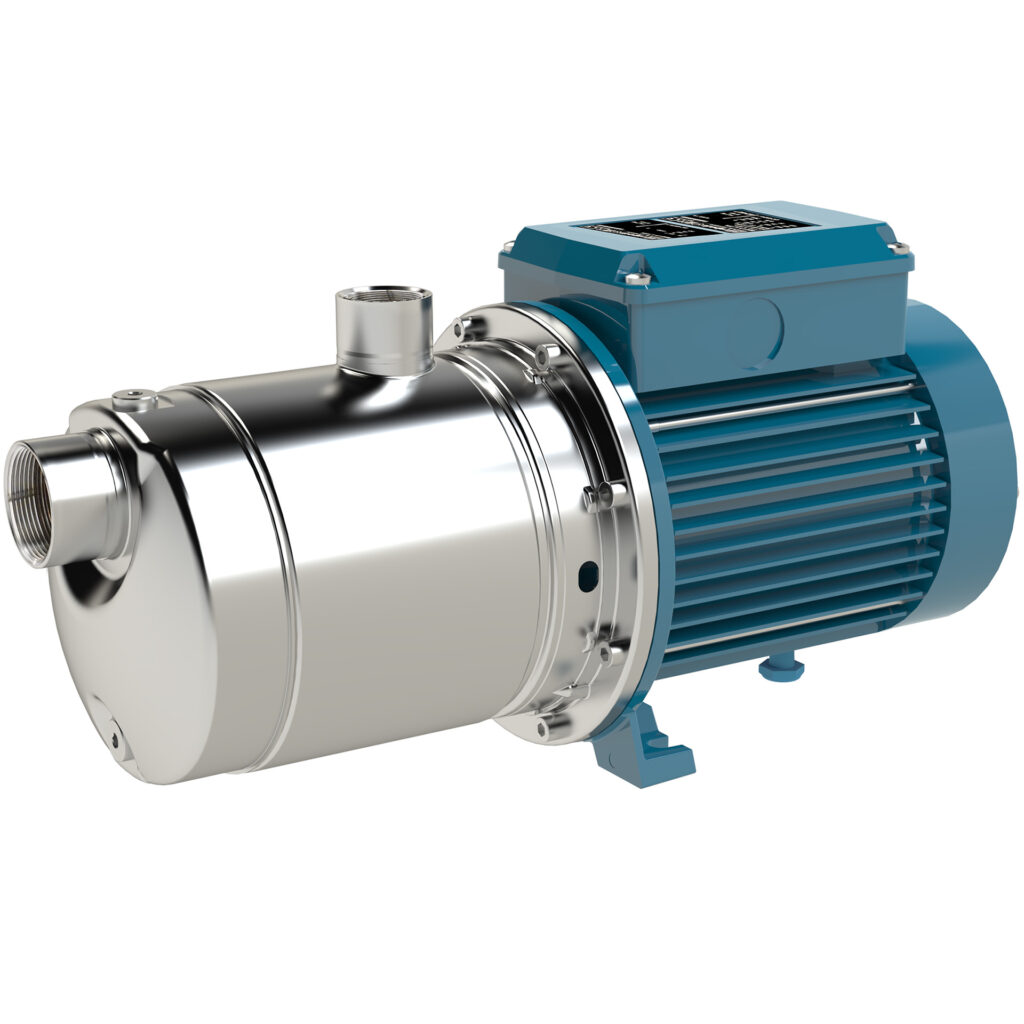
Key features
Calpeda holds approval 1906314 for the MXH and MXHL, tested to BS 6920. The listing sits in the WRAS directory under that number.
Pump casing, stage casings, impellers and casing cover in 1.4301 EN 10088 (AISI 304). No cast iron in the wet end, so treated water needs no material upgrade.
MXHL builds the 2, 4 and 8 frames in 1.4404 EN 10088 (AISI 316L), the molybdenum-bearing grade, for water 304 will not take.
Up to nine impellers in series, and head to 97 m, with no baseplate, no coupling and no alignment to hold.
Both plugs sit mid-casing and can be reached from any side, as can the terminal box, so commissioning does not depend on which way round the unit was fitted.
The MXH EI carries an I-MAT frequency converter on the motor from 0.55 to 7.5 kW, with constant pressure, proportional pressure, constant flow, fixed speed and constant temperature modes.
About the Calpeda MXH
The Calpeda MXH is a general-duty pressure pump. Calpeda lists it for water supply systems and calls it a universal pump: domestic use, civil and industrial installations, garden use and irrigation. It is what you reach for when the duty needs real head out of a small footprint and the medium is clean. Frame sizes run from MXH 2 to MXH 48, and within each frame the number of impellers sets the head.
Read the liquid specification before anything else. Calpeda rates the MXH for clean liquids that are non-explosive, non-flammable, not hazardous to health or the environment, non-aggressive to the pump materials, and free of abrasives, solid or fibrous particles. That is a narrow window, and it is the right one for a multistage pump. The stage casings and wear rings run at close clearances. Grit wears them open and fibre wraps the impellers, and both show up as head you have lost and cannot get back. If the medium carries solids, this is the wrong pump, and we would rather point you at a solids-handling one than sell you this. With EPDM seal rings it is also not suitable for oil.
It is not self-priming. Calpeda's instructions are blunt about it: fill the pump completely before starting and never run it dry. Where the pump sits above the water level, or the positive suction head is under 1 m and will not open the non-return valve, it fills through the priming hole. What dry running takes out is the mechanical seal, because a mechanical seal needs liquid to lubricate it, and on a pump this size the seal is most of the repair bill.
Two published limits matter on a boosting duty. Calpeda allows 30 starts per hour at regular intervals, dropping to 15 on the MXH 208, 209, 408, 409 and 808 and on the 20, 32 and 48 frames. And the pump should not run for more than five minutes against a closed gate valve, because the water shut in the casing heats up. Both are sizing constraints as much as operating ones. A pump sized well above the draw-off will short cycle against those figures, and an undersized vessel will make it worse. Send us the demand you actually have rather than the demand with everybody's margin stacked on it. Margin stacking is how a 3 kW duty ends up with an 11 kW motor on it.
Between MXH and MXHL the question is water chemistry, not duty. The hydraulics are the same and the published curves cover both. MXH is 1.4301 (AISI 304) through the wetted path; MXHL builds the 2, 4 and 8 frames in 1.4404 (AISI 316L), which holds up better where there are chlorides. On treated mains water 304 is normally enough, and 316L is money you do not need to spend. Where the analysis shows chloride, spend it.
How the Calpeda MXH works
Each impeller adds head, and the MXH puts up to nine of them in series inside a single-piece barrel casing. Liquid enters at the front suction port, which sits above the pump axis, passes through the stages, and leaves radially at the top of the casing. There is no baseplate and no coupling. The pump hangs off a 2-pole induction motor turning at about 2,900 rpm on 50 Hz, carried on a one-piece lantern bracket and base.
Reading the designation
Calpeda writes the full string as MXH(L) (-V, -F) EI 206/B. MXH is the series. L is the 1.4404 (AISI 316L) version, offered on the 2, 4 and 8 frames. -V is the version with Victaulic couplings and -F the version with flanged ports, both on the larger frames and both to order. EI means the pump carries the I-MAT frequency converter. The first figure is the rated flow in m³/h and the last two digits are the number of impellers, so an MXH 206 is a 2 m³/h frame with six impellers and an MXH 409 is a 4 m³/h frame with nine. The /B refers to a revision. If you are matching an existing unit, that whole string and the serial number off the nameplate are what we need.
Materials and the seal
Pump casing, stage casings, impellers, casing cover and spacer sleeve are 1.4301 EN 10088 (AISI 304) on the MXH and 1.4404 EN 10088 (AISI 316L) on the MXHL. Wear rings are PPS. The shaft is 1.4305 (AISI 303) on the 2, 4, 8 and 16 frames and 1.4401 (AISI 316) on the 20, 32 and 48. The mechanical seal is ceramic alumina against carbon on EPDM elastomers, with the seat to ISO 3069. That seal is the weak point in the pump, as it is in almost any pump, and it is the part that dry running destroys first.
Running one on an inverter
Motors are suitable for frequency converter operation from 1.1 kW, and the MXH EI arrives with the converter already fitted and programmed. Calpeda sets two floors on inverter operation: the minimum frequency should not fall below 25 Hz, and the total head should never be below 3 m. A dv/dt filter goes at the converter output where the motor cable runs longer than 2 m. Calpeda also calls for a dv/dt filter or an insulated bearing where the converter's PWM frequency is above 8 kHz and the rating is over 7.5 kW on a 2-pole motor or over 4 kW on a 4-pole.
Approvals and standards
Calpeda holds WRAS approval 1906314 for the MXH and MXHL. That is a materials approval: it confirms the parts in contact with the water meet BS 6920, the British standard covering materials in contact with drinking water, and it runs on the scheme's five-year renewal cycle. The listing is published in the WRAS directory under 1906314. On a potable duty, Calpeda requires the pump to be flushed thoroughly with clean water before start-up to clear preservatives, test liquid and grease left from manufacture and testing.
Motors are constructed in accordance with EN 60034-1, EN 60034-30-1, EN 60335-1 and EN 60335-2-41. Three-phase motors are IE3 efficiency class, IE2 up to 0.65 kW; single-phase motors are IE2 up to 1.1 kW. Insulation is class F and protection IP 54, with IP 55 available as a special construction. Published performance carries tolerances to UNI EN ISO 9906:2012, tested on clean cold water without gas content, and Calpeda recommends adding a 0.5 m safety margin to the published NPSH figure before you compare it with the NPSHa your suction side can offer.
Specifications
| Type | Horizontal multistage close coupled centrifugal, single-piece barrel casing, front suction port above the pump axis, radial delivery | |
|---|---|---|
| Liquid handled | Clean liquids, free of abrasives and of solid or fibrous particles, non-aggressive to stainless steel | |
| Flow rate | 1–66 m³/h | |
| Total head | 5.5–97 m | |
| Frame sizes | MXH 2, 4, 8, 16, 20, 32 and 48 | the figure is the rated flow in m³/h |
| Impellers | 1 to 9 in series, by model | |
| Maximum permissible pressure in the pump casing | 10 bar | 8 bar on the MXH 16 |
| Liquid temperature | -15°C to +110°C | |
| Ambient temperature | -10°C to +40°C | relative humidity 10% to 55%, non-condensing |
| Duty | Continuous; S3 60% on single-phase pumps to 1.5–1.8 kW | |
| Rated motor power (P2) | 0.25–7.5 kW | |
| Speed | approx. 2,900 rpm | 2-pole, 50 Hz |
| Suction connection | Threaded, G 1 1/4 to G 3 by frame size | |
| Discharge connection | Threaded, G 1 to G 2 1/2 by frame size | |
| Port options | Victaulic couplings (-V) or flanged ports (-F) on the larger frames, to order | |
| Pump casing, stage casing, impeller, casing cover | 1.4301 EN 10088 (AISI 304); 1.4404 EN 10088 (AISI 316L) on MXHL 2, 4 and 8 | |
| Wear ring | PPS | |
| Pump shaft | 1.4305 EN 10088 (AISI 303) on MXH 2, 4, 8 and 16; 1.4401 EN 10088 (AISI 316) on MXH 20, 32 and 48 | |
| Mechanical seal | Ceramic alumina / carbon / EPDM, seat to ISO 3069 | |
| Motor | 2-pole induction, 50 Hz | |
| Voltage | 3~230/400 V ±10% to 3 kW and 400/690 V ±10% from 3.7 to 7.5 kW; MXHM 1~230 V ±10% with thermal protector | |
| Motor efficiency | IE3 three-phase, IE2 up to 0.65 kW; IE2 single-phase up to 1.1 kW | |
| Insulation class | F | |
| Motor protection | IP 54 | IP 55 as a special construction |
| Sound pressure | < 70 dB(A) | |
| Maximum starts per hour | 30 at regular intervals | 15 on MXH 208, 209, 408, 409 and 808 and on the 20, 32 and 48 frames |
| Approvals | WRAS approval 1906314, to BS 6920, covering MXH and MXHL | |
| Construction standards | EN 60034-1, EN 60034-30-1, EN 60335-1, EN 60335-2-41 | |
| Test standard | Tolerances to UNI EN ISO 9906:2012 |
Send us the flow, the total dynamic head, the water and its temperature and we will size an MXH against it, and say so if another pump suits the duty better. Tell us if the duty is potable so the quote lands on the right build. Replacing an existing unit? Photograph the nameplate and send us the full designation and the serial number.
Documents & downloads
Related pumps
View all →
Frequently asked
Is the Calpeda MXH WRAS approved?
Yes. Calpeda holds WRAS approval 1906314 covering the MXH and MXHL, a materials approval tested to BS 6920, the British standard for materials in contact with drinking water. The listing is published in the WRAS directory under 1906314 and runs on the scheme's five-year renewal cycle.
What is the difference between the Calpeda MXH and the MXHL?
Materials, not hydraulics. The MXH is 1.4301 EN 10088 (AISI 304) through the wetted path; the MXHL builds the 2, 4 and 8 frames in 1.4404 EN 10088 (AISI 316L), which stands up better to chlorides. Curves and dimensions are the same.
What do the numbers in Calpeda MXH 206 mean?
The first figure is the rated flow in m³/h and the last two digits are the number of impellers. An MXH 206 is a 2 m³/h frame with six impellers; an MXH 409 is a 4 m³/h frame with nine. A trailing /B refers to a revision.
What flow and head does the Calpeda MXH cover?
1–66 m³/h and 5.5–97 m, on rated motor powers from 0.25 to 7.5 kW. Maximum permissible pressure in the pump casing is 10 bar, or 8 bar on the MXH 16.
Can the Calpeda MXH pump water with solids in it?
No. Calpeda rates it for clean liquids free of abrasives and of solid or fibrous particles. The stage casings and wear rings run at close clearances, so grit wears them open and fibre wraps the impellers; ask us for a solids-handling pump instead.
Is the Calpeda MXH self-priming?
No. Fill it completely with liquid before starting, and never run it dry. Where the pump sits above the water level, or the positive suction head is under 1 m, fill it through the priming hole on the casing.
Can a Calpeda MXH run on a variable speed drive?
Yes. Motors are suitable for frequency converter operation from 1.1 kW, and the MXH EI comes with an I-MAT converter already fitted. Keep the frequency at or above 25 Hz and the total head at or above 3 m, and fit a dv/dt filter at the converter output where the motor cable is longer than 2 m.