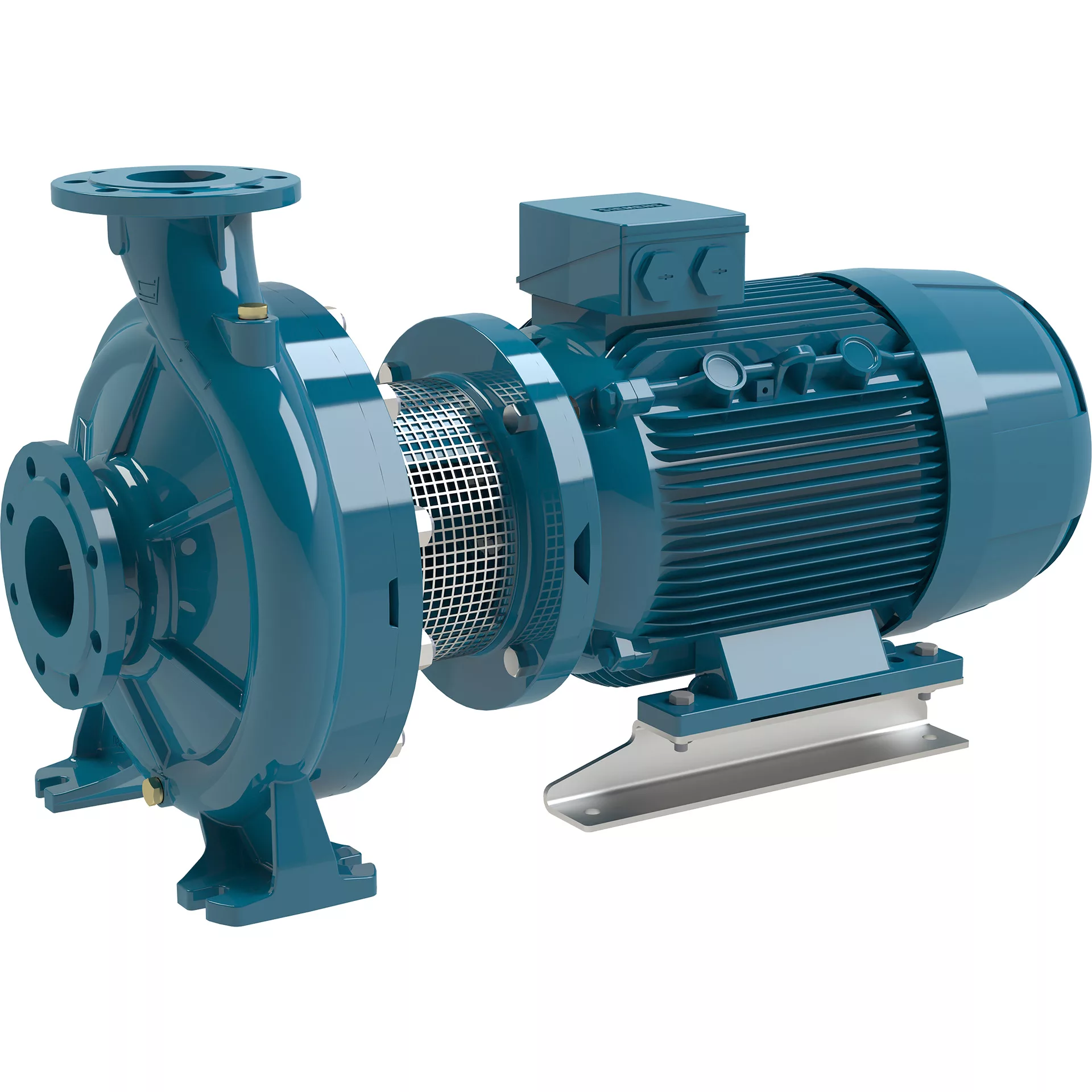
Key features
The bracket is built for standard motors, so the motor is an off-the-shelf item rather than a special extended-shaft build. That matters most the day one fails.
The bracket carries its own thrust bearing between the stub shaft and the motor, so the hydraulic thrust is taken in the pump end.
The two-pole NMS runs from 0.75 to 75 kW. The close-coupled NM stops at 22 kW, so above that the bracket build is the range.
Motor protection is IP 55 rather than IP 54, and the shaft is 1.4401 stainless to EN 10088 instead of the AISI 303 used on the NM.
Main dimensions and performance follow EN 733, with sizes added outside the standard to complete the range. Flanges are PN 10-16 to EN 1092-2, DN32 to DN100.
BNMS puts the casing, casing cover and impeller in bronze CC480K to EN 1982. The lantern bracket stays cast iron.
About the Calpeda NMS
The Calpeda NMS is a clean-water transfer and pressure pump built around a bracket rather than a monobloc motor. The hydraulics belong to the same family as the close-coupled NM, and Calpeda catalogues both for water supply, heating, air conditioning, cooling and circulation plant, civil and industrial duties and irrigation. What changes on the NMS is everything behind the casing.
The bracket is the reason to buy one. It carries a stub shaft and an integrated thrust bearing, and it is machined for a standard motor. On the NM the motor has an extended shaft and is part of the pump, so a burnt-out motor is a Calpeda part rather than a trip to the local motor factor. On the NMS you fit a standard frame, which also means you choose its efficiency class, its protection rating and where it comes from. Two poles takes the NMS to 75 kW where the NM stops at 22 kW.
What you give up is length, weight and a coupling to align. The NMS needs the baseplate set true and the coupling guard back on before anyone starts it. Where the duty is small and permanent, the NM does the same job with fewer parts to buy and nothing to align, and we will tell you so.
The bracket changes nothing about what the pump will handle. Calpeda rates the NMS for clean liquids that are non-explosive and non-flammable, free of abrasives, non-aggressive to the pump materials, and carrying solids up to 0.2%. That is well under the 3–4% rule of thumb where centrifugal pumps give way to positive displacement. Grit abrades the wet end and fibre binds on the impeller. If the medium carries either, ask us for a solids-handling pump instead.
Then size it honestly. Total suction lift is up to 7 m, and when one of these fails early the suction side is almost always where it started: NPSHa has to beat NPSHr at the duty point, or you cavitate and pit the impeller. The other half is margin stacking, where the consultant, the contractor and the installer each add a little and a 3 kW duty arrives with an 11 kW motor on it. Give us the duty before the margins went on, and the pipework it has to work against.
How the Calpeda NMS works
The Calpeda NMS is a single-stage centrifugal pump with an axial suction flange and a radial delivery flange on top of the casing. Everything that makes it an NMS sits between that casing and the motor. A carbon, ceramic and NBR mechanical seal keeps the liquid off the shaft, and Calpeda publishes the curves with tolerances to UNI EN ISO 9906:2012.
The bracket, the bearing and the motor
The NMS puts a bracket between the pump and the motor. A stub shaft runs through it to carry the impeller, and an integrated thrust bearing takes the hydraulic load in the pump end. The motor bolts to the front and drives that stub shaft through a coupling, which is why the NMS needs a coupling guard and the NM does not. The bracket is cast iron GJL 200 to EN 1561, and it stays cast iron even on the bronze BNMS build.
Reading the designation
Calpeda's worked example is BNM(S)4 EI 32/16A/B. A leading B is the bronze version, NM is the series, the S marks the stub-shaft build, and a 4 marks the four-pole version, so a plain NMS is the two-pole cast iron stub-shaft pump. Then comes the delivery port diameter in millimetres, the nominal impeller diameter, the impeller size, and a revision. On the NMS, Calpeda writes the impeller diameter in full: an NMS 80/250A/A has a DN80 delivery port on the 250 impeller, where the NM equivalent would read 80/25. Send us that full string and the serial number off the nameplate when you are matching an existing unit.
Standards, efficiency and the nameplate
Main dimensions and performance follow EN 733, with additional sizes added to complete the range, and flanges are PN 10-16 to EN 1092-2. Motors are built to EN 60034-1 and EN 60034-30-1, insulation class F, IP 55, and suit converter operation. Three-phase efficiency runs IE2 up to 0.65 kW, IE3 from 0.75 to 55 kW and IE4 from 75 kW, so only the 75 kW pump at the top of the two-pole range gets IE4 as standard. Supply is 230/400 V ±10% up to 3 kW and 400/690 V ±10% from 4 to 75 kW.
Efficiency on the hydraulic side is a different number, and a less flattering one. The pumps are declared under European Regulation No 547/2012, and Calpeda's index for the two-pole hydraulics gives a minimum efficiency index of MEI ≥ 0.4 against a benchmark of MEI ≥ 0.70 for the most efficient water pumps. Check it against your scheme's energy target before you commit. The nameplate carries the type, the flow and head range, rated power, supply voltage, current, speed, duty, insulation class, weight, year of manufacture and serial number, along with the ESCC classification and the MEI figure.
Duty cycle and noise
Calpeda caps starts per hour by motor rating: 60 up to 2.2 kW, 40 up to 7.5 kW, 20 up to 30 kW and 10 up to 75 kW. Maximum sound pressure runs 70 dB(A), 80 dB(A), 85 dB(A) and 90 dB(A) across the same bands. A 75 kW unit cycling more than ten times an hour is a control problem, and it will show up as a seal first. Never run it dry either: the seal faces are lubricated by the liquid, and a short period without it is enough to take them out.
Specifications
| Type | Single-stage end suction centrifugal on a stub-shaft bracket for standard motors, axial suction, radial delivery on top | |
|---|---|---|
| Liquid handled | Clean liquids, non-explosive and non-flammable, free of abrasives and non-aggressive to the pump materials | solids content up to 0.2% |
| Flow rate | up to 300 m³/h | two-pole, 50 Hz |
| Total head | up to 95 m | two-pole, 50 Hz |
| Power rating | 0.75–75 kW | three-phase, two-pole |
| Speed | approx. 2,900 rpm | 2-pole, 50 Hz |
| Maximum working pressure | up to 16 bar | 10 bar on the bronze version |
| Liquid temperature | -10°C to +90°C | |
| Ambient temperature | up to 40°C | |
| Total suction lift | up to 7 m | |
| Duty | Continuous | |
| Connections | Flanges PN 10-16 to EN 1092-2 | |
| Delivery port sizes | DN32 to DN100 | |
| Pump casing | Cast iron GJL 250 to EN 1561 for PN 10; cast iron GJS 400-15 to EN 1563 for PN 16 | |
| Casing cover | Cast iron GJL 200 to EN 1561 | |
| Lantern bracket | Cast iron GJL 200 to EN 1561 | stays cast iron on the bronze version |
| Impeller | Cast iron GJL 200 to EN 1561 | |
| Shaft | Steel 1.4401 to EN 10088 (AISI 316) | |
| Mechanical seal | Carbon / ceramic / NBR | |
| Bronze version (BNMS) | Casing, casing cover and impeller in bronze CC480K to EN 1982, AISI 316 shaft | |
| Motor | Standard two-pole three-phase induction, insulation class F, IP 55, suitable for converter operation | |
| Motor efficiency | IE2 up to 0.65 kW, IE3 from 0.75 to 55 kW, IE4 from 75 kW | EN 60034-1 and EN 60034-30-1 |
| Voltage | 3~230/400 V ±10% up to 3 kW; 3~400/690 V ±10% from 4 to 75 kW | |
| Starts per hour | 60 up to 2.2 kW, 40 up to 7.5 kW, 20 up to 30 kW, 10 up to 75 kW | |
| Sound pressure | 70 dB(A), 80 dB(A), 85 dB(A) and 90 dB(A) across the same power bands | maximum |
| Ecodesign | MEI ≥ 0.4, declared under Regulation (EU) No 547/2012 | |
| Test tolerances | UNI EN ISO 9906:2012 | |
| On request | Other voltages, AISI 316 impeller on the 32 to 80 sizes, 60 Hz, special mechanical seal, IE4 motors, counter-flanges | |
| Finish | Supplied fully painted |
Send us the flow, head, medium and site conditions and we will size the NMS against your duty point, or tell you the close-coupled NM does the job for less. Replacing an existing pump? Photograph the nameplate and send the model and serial number with the enquiry.
Documents & downloads
Related pumps
View all →
Frequently asked
What is the difference between the Calpeda NMS and the NM?
The motor coupling, not the ports. Both are flanged and both follow EN 733, but the NMS uses a bracket built for standard motors, with a stub shaft and an integrated thrust bearing, while the NM has a motor with an extended shaft connected directly to the pump. The NMS runs to 75 kW at two poles and IP 55; the NM stops at 22 kW and IP 54.
Does the Calpeda NMS take a standard motor?
Yes. Calpeda designed the bracket around standard motors, so you fit an off-the-shelf frame rather than a special extended-shaft build. That gives you a choice of motor supplier and efficiency class, and a faster replacement.
What liquids can a Calpeda NMS handle?
Clean liquids that are non-explosive and non-flammable, free of abrasives and non-aggressive to the pump materials, with a solids content up to 0.2%. Liquid temperature is -10°C to +90°C on the standard build.
Is the Calpeda NMS an EN 733 pump?
Its main dimensions and performance follow EN 733, and Calpeda adds sizes outside the standard to complete the range. Flanges are PN 10-16 to EN 1092-2. Check the specific size against the standard before you treat a swap as dimensional like-for-like.
What does NMS 80/250A/A mean?
NMS is the two-pole stub-shaft series, 80 is the delivery port diameter in millimetres, 250 is the nominal impeller diameter, A is the impeller size and the trailing /A is a revision. A leading B would make it the bronze BNMS.
What flow and head does the Calpeda NMS cover?
Up to 300 m³/h and up to 95 m at 50 Hz on the two-pole range, on motors from 0.75 to 75 kW. No single pump does both ends. Calpeda publishes 60 Hz data separately.
Is there a bronze version of the Calpeda NMS?
Yes, the BNMS. The pump casing, casing cover and impeller are bronze CC480K to EN 1982, with an AISI 316 shaft, and the lantern bracket stays cast iron. Maximum working pressure on the bronze version is 10 bar.