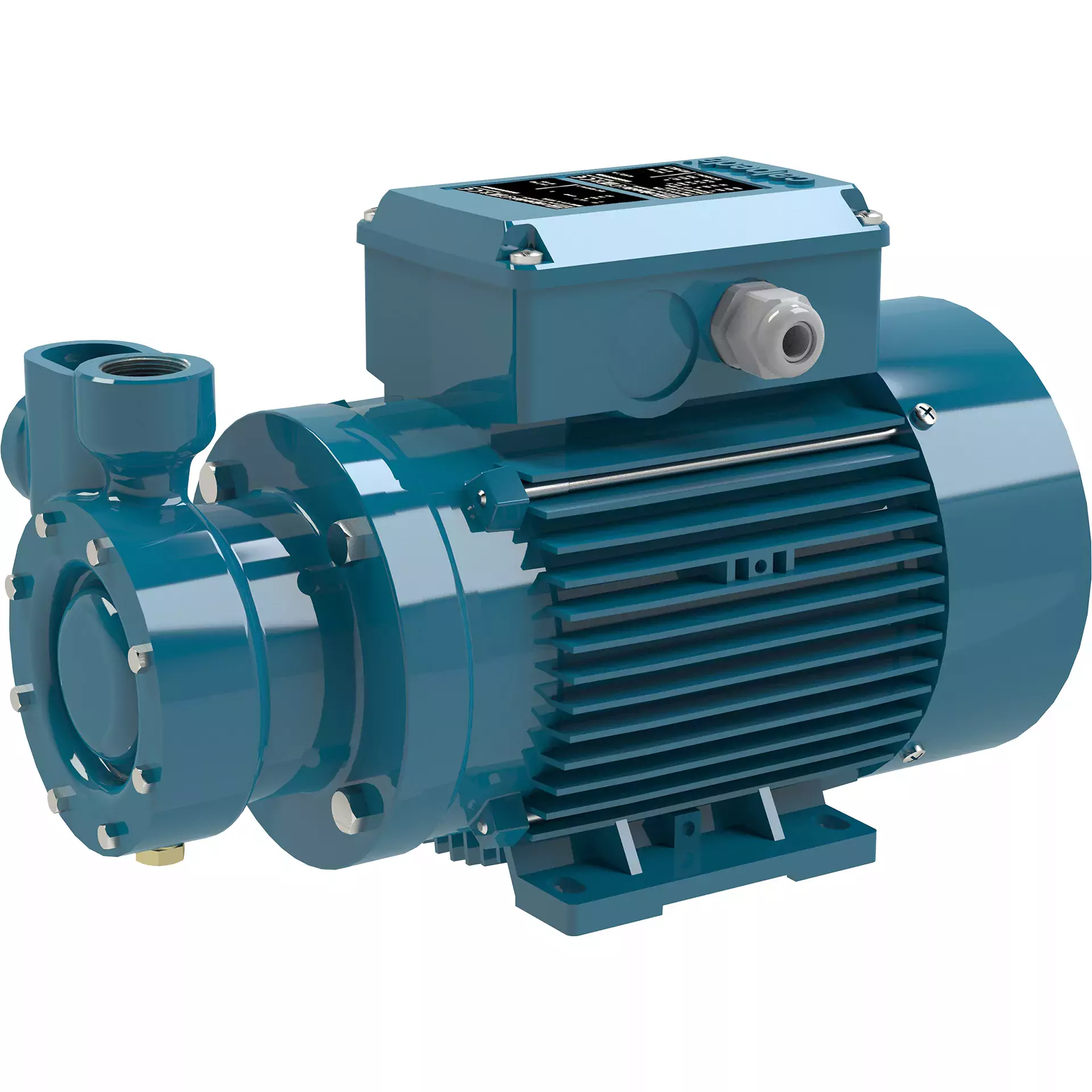
Key features
A TP 132 makes 165 m at 4.8 m³/h with a single turbine impeller of 132 mm nominal diameter. A multistage pump needs a stack of impellers in series to reach the same head.
Calpeda rates the range for liquids free of abrasives and of solid or fibrous particles. The impeller runs at a small axial clearance, so grit opens it up and fibre wraps the vanes.
CT is the compact 6 bar entry at 3–41 m. T carries a 12.5 bar casing and heads to 103 m. TP is the 16 bar high-head build that reaches 165 m.
The standard casing is cast iron GJL 200 EN 1561. BT, BTP and BCT build it in bronze CC480K EN 1982, and the ICT 61 in stainless steel 1.4401 EN 10088 (AISI 316).
CTM, TM and TPM run on 230 V with a thermal protector and the capacitor inside the terminal box, so small boosting and circulation duties do not need a three-phase supply.
A CTM 60/A weighs 5 kg and stands 63 mm to the shaft centre. Calpeda names cooling and air-conditioning equipment as a use the compact dimensions suit.
About the Calpeda peripheral range
These are the pumps for a duty that needs pressure rather than volume. Calpeda lists them for raising network pressure, for cooling and air-conditioning plant and for circulation. Three series cover the range at about 2900 rpm. CT is the compact one, two models on a patented single-piece motor casing with a pump-side wall, protected against water entering the motor from outside. T is the middle series, five models with a cast iron pump casing and lantern bracket. TP is the high-head series, five more with a 16 bar casing. B prefixes the bronze versions, I the stainless CT, and M the single-phase ones.
The three series side by side
Twelve models on one hydraulic principle. What separates them is the casing rating, and the head band follows it:
| Series | Models | Casing rating | Head band | Power band (P2) |
|---|---|---|---|---|
| CT | CT 60/A, CT 61/A | 60 m (6 bar) | 3–41 m | 0.3–0.33 kW |
| T | T 61/A, T 65E, T 70/B, T 76/A, T 100/A | 125 m (12.5 bar) | 5–103 m | 0.33–3 kW |
| TP | TP 78/A, TP 80E, TP 100/B, TP 132R/A, TP 132/A | 160 m (16 bar) | 15–165 m | 0.37–7.5 kW |
Head bands are the first and last tabulated points on Calpeda's 50 Hz curves, so shut-off head sits above the top of each band. Flow runs 0.48–2.3 m³/h on the CT, 0.38–4.8 m³/h on the T and 0.06–6 m³/h on the TP. Single-phase builds exist on all three: CTM 60/A and 61/A, TM 61E to TM 76E, TPM 78/A and TPM 80E, none above 1.1 kW.
Read the liquid specification before you look at the curve. Calpeda rates these for clean liquids that are non-explosive, non-flammable, not hazardous to health or the environment, non-aggressive to the pump materials, and free of abrasives and of solid or fibrous particles. That is about as narrow as a liquid specification gets on a centrifugal pump, and it is not a formality. The turbine impeller works by running at a small axial clearance to the casing. Abrasives wear that clearance open and you lose head you cannot get back by adjusting anything. Fibre wraps the vanes and stalls the pump. If there is grit, rag or suspended solid in the medium, this is the wrong pump and we would rather say so than sell you one.
The other thing to understand is the curve shape. A peripheral pump has a very steep characteristic: head falls away quickly as flow rises, and flow barely moves when head changes. A CT 61/A goes from 41 m at 0.48 m³/h to 3 m at 2.3 m³/h. A T 61/A goes from 38 m at 0.38 m³/h to 5 m at 2.4 m³/h. Both give up nearly all their head inside about 30 litres a minute of extra flow: 8 to 38.3 l/min on the CT, 6.33 to 40 l/min on the T. That steepness is why these suit a fixed pressure duty and suit almost nothing else. If your flow varies, you are sizing against a curve that will not follow you.
Against the rest of the Calpeda range, the choice is usually a peripheral against a multistage. Both cover high head on clean water. The multistage gets there by putting impellers in series and gives you more flow for the money; the peripheral gets there with one impeller in a smaller, cheaper, lighter body. Below about 6 m³/h, where a multistage starts to look oversized for the job, the peripheral is the honest answer. Above it, it is not, because the range simply stops there.
How a peripheral pump works, and why it is not a centrifugal
A peripheral pump regenerates head. The liquid does not pass once through the impeller. It circulates repeatedly between the impeller vanes and a channel in the casing as it travels from suction to discharge, gaining energy on every pass, which is why one impeller develops the head a centrifugal would need several to reach.
A centrifugal pump does it in a single pass. Liquid enters at the impeller eye, gets flung outwards, and the volute turns that velocity into head on the way to the discharge. One transit, one conversion. That is efficient, and it is why centrifugal is the cheapest way to move a large volume of thin liquid.
The peripheral does it many times over. The impeller carries a ring of small radial vanes around its rim and turns inside a casing with a narrow channel running around the periphery. Liquid entering the vanes is thrown outwards into that channel, slows, and re-enters the vanes further round. It repeats that circulation many times between the suction port and the discharge, and each pass adds energy. Calpeda's own designation calls the wet end what it is: a regenerative pump with a turbine impeller.
The payoff is head for very little pump. A TP 132 reaches 165 m at 4.8 m³/h from one impeller of 132 mm nominal diameter turning at about 2900 rpm. Calpeda's own multistage pumps need up to nine impellers in series to get to a comparable figure. On a small, fixed, high-pressure duty that is real money saved, and a unit you can lift.
What it costs you
Three things, and they all follow from the same mechanism: volume, clearance and curve shape.
Volume is the first. Regenerating head by circulating the same liquid through the vanes over and over is how the pressure gets made, and the whole range still tops out at 6 m³/h. It is never the pump you reach for when throughput is what you are buying.
The clearance is the second, and it is the one that ends pumps. The vanes have to run close to the casing for the regeneration to work at all. Calpeda's instructions note that slight resistance when you turn the shaft by hand before start-up is normal, and that it comes from the reduced axial clearance of the impeller. That is the tolerance you are protecting. It is also why Calpeda calls for a strainer on the suction side to stop foreign particles reaching the pump, and why the liquid specification excludes abrasives and solid or fibrous particles outright.
The steep curve is the third. Fit a gate valve in the delivery pipe and a pressure gauge, because on this curve shape the valve is how you set delivery and head. Where the geodetic head at the outlet is over 15 m, Calpeda calls for a check valve between the pump and the gate valve to protect the pump from water hammer.
Priming, dry running and starts
None of these pumps is self-priming. Fill the pump completely with liquid before starting it, and never run it dry. Where the pump sits above the water level, or the positive suction head is under 1 m and will not open the non-return valve, it fills through the priming hole. Where the liquid level is above the pump, open the suction gate valve slowly and fully with the delivery valve open to release the air.
A mechanical seal needs liquid to lubricate it. Take the liquid away and the seal goes, and on a pump this size the seal is most of the repair bill. Two further limits are worth sizing against rather than discovering: never run the pump for more than five minutes against a closed gate valve, because the water shut in the casing heats up, and hold to a maximum of 40 starts per hour at regular intervals. A pump sized well above the real draw-off will short cycle against that figure.
Reading the designation
Calpeda writes the full string as BTM 61E, or BCTM 61/A on the CT series. B is the bronze version and I the stainless one, and neither letter means the pump is cast iron. T or CT is the series. M is the single-phase version, and no M means three-phase. The number is the nominal impeller diameter in millimetres, not a flow figure. The trailing letter refers to a revision. If you are replacing an existing unit, send us that whole string and the serial number off the nameplate.
Motor, materials and standards
Motors are 2-pole induction, 50 Hz, at about 2900 rpm. Three-phase on the T and TP is 230/400 V ±10%, and 400/690 V ±10% from 4 to 7.5 kW; CT is 230/400 V ±10%. Single-phase CTM, TM and TPM are 230 V ±10% with a thermal protector and the capacitor inside the terminal box. Insulation is class F and protection IP54, with IP55 available as a special construction on the T and TP. Three-phase T and TP motors are IE3 efficiency class, IE2 up to 0.65 kW; the CT and every single-phase motor are IE2.
Watch the starting arrangement at the top of the range. Calpeda's operating instructions are explicit: with a motor power rating of 5.5 kW or more, avoid direct starting and provide a control panel with star-delta starting or another starting device. That catches the two largest pumps here, the 5.5 kW TP 132R/A and the 7.5 kW TP 132/A, which is where the 165 m headline comes from. Put the panel in the budget with the pump rather than after it.
The wetted path is cast iron GJL 200 EN 1561 for the casing on all three series, and bronze CC480K EN 1982 on BT, BTP and BCT 61. The ICT 61 builds the casing in stainless steel 1.4401 EN 10088 (AISI 316). Impellers are brass CW617N EN 12167 throughout, and bronze CC480K EN 1982 on the TP 132 and 132R. Shafts are 1.4104 EN 10088 (AISI 430F) or 1.4305 (AISI 303) depending on model, and 1.4401 (AISI 316) on the bronze T and TP builds. The mechanical seal is carbon against ceramic on NBR across the range.
Casing rating is what separates the three series. Maximum permissible working pressure is 6 bar (60 m) on the CT, 12.5 bar (125 m) on the T and 16 bar (160 m) on the TP. Liquid temperature runs -10 °C to +90 °C, and up to 60 °C on the CT. Ambient is up to +40 °C, with relative humidity 10% to 55% non-condensing and a maximum altitude of 1,000 m above sea level. Installation in a potentially explosive atmosphere is forbidden. Sound pressure rises with motor size, from a maximum of 70 dB(A) up to 0.5 kW to 85 dB(A) at 7.5 kW.
Specifications
| Type | Close-coupled peripheral (regenerative) electropump with turbine impeller, horizontal rotor axis | |
|---|---|---|
| Liquid handled | Clean liquids, non-explosive and non-flammable, non-hazardous for health or the environment, non-aggressive for the pump materials, free of abrasives and of solid or fibrous particles | |
| Flow rate | 0.06–6 m³/h | 1–100 l/min across CT, T and TP |
| Total head | 3–165 m | |
| Models | CT 60 and 61; T 61, 65, 70, 76 and 100; TP 78, 80, 100, 132R and 132 | |
| Versions | B prefix for bronze, I prefix for the stainless CT, M suffix for single-phase; no prefix or suffix is the three-phase cast iron build | |
| Rated motor power (P2) | 0.3–7.5 kW | 0.3 kW on CTM; 0.3–1.1 kW across the single-phase builds |
| Speed | approx. 2,900 rpm | 2-pole, 50 Hz |
| Maximum permissible working pressure | 6 bar (60 m) on CT; 12.5 bar (125 m) on T; 16 bar (160 m) on TP | |
| Liquid temperature | -10 °C to +90 °C | up to 60 °C on the CT |
| Ambient temperature | -10 °C to +40 °C | relative humidity 10% to 55% non-condensing, maximum altitude 1,000 m |
| Total suction lift | up to 7 m | |
| Duty | Continuous | S3 60% on the three-phase CT |
| Starting | From a motor power rating of 5.5 kW, Calpeda calls for a control panel with star-delta starting or another starting device rather than direct starting | TP 132R/A and TP 132/A |
| Maximum starts per hour | 40 at regular intervals | |
| Connections | ISO 228, G 1/2 to G 1 1/4 by model | suction and delivery are the same size on every model |
| Pump casing | Cast iron GJL 200 EN 1561; bronze CC480K EN 1982 on BT, BTP and BCT 61; stainless steel 1.4401 EN 10088 (AISI 316) on ICT 61 | |
| Lantern bracket | Cast iron GJL 200 EN 1561 on T and TP; bronze CC480K EN 1982 on BT and BTP | |
| Casing cover | Brass CW617N EN 12167 on CT; cast iron GJL 200 EN 1561 on T and TP, with brass CW617N EN 12165 on T 61, 65 and 70 | |
| Impeller | Brass CW617N EN 12167; bronze CC480K EN 1982 on TP 132 and TP 132R | |
| Pump shaft | 1.4104 EN 10088 (AISI 430F) on CT and on T 61, 65, 70 and 100 and TP 78, 132 and 132R; 1.4305 EN 10088 (AISI 303) on T 76 and TP 80–100; 1.4401 (AISI 316) on the bronze T and TP versions | |
| Mechanical seal | Carbon / ceramic / NBR | |
| Motor | 2-pole induction, 50 Hz | |
| Voltage | Three-phase 230/400 V ±10%, and 400/690 V ±10% from 4 to 7.5 kW on T and TP; single-phase CTM, TM and TPM 230 V ±10% with thermal protector | |
| Motor efficiency | IE3 on three-phase T and TP, IE2 up to 0.65 kW; IE2 on the CT and on all single-phase motors | |
| Insulation class | F | |
| Motor protection | IP54 | IP55 as a special construction on T and TP |
| Sound pressure | max 70 dB(A) to 0.5 kW, 75 to 2.2 kW, 80 to 4 kW, 85 to 7.5 kW | |
| Weight | 4.6 kg (CT 60/A) to 62.1 kg (TP 132/A) | |
| Construction standards | EN 60034-1, EN 60335-1 and EN 60335-2-41 across the range; T and TP motors also to EN 60034-30-1 | |
| Special features on request | Other voltages, 60 Hz, special mechanical seal; on T and TP also IP55, higher or lower liquid or ambient temperatures and construction with bearing bracket |
Send us the flow, the total dynamic head and what the liquid actually is, and we will tell you whether a peripheral pump is the right type before we quote one. If the medium carries any solid at all, say so and we will point you at a pump that will survive it. Replacing an existing unit? Photograph the nameplate and send us the full designation and the serial number.
Documents & downloads
Related pumps
View all →
Frequently asked
What is a peripheral pump?
A peripheral pump, also called a regenerative turbine pump, has an impeller with a ring of small radial vanes running close to a channel in the casing. The liquid circulates between the vanes and that channel repeatedly on its way from suction to discharge, gaining energy on each pass. One impeller therefore develops the head a centrifugal pump would need several to reach.
What is the difference between a peripheral pump and a centrifugal pump?
The number of passes through the impeller. A centrifugal pump gives the liquid velocity in one transit and the volute converts it to head, which suits high flow at moderate head. A peripheral pump regenerates head over many passes, which gives high head at low flow from a single impeller. In exchange it moves far less volume and tolerates far less in the liquid.
What flow and head does the Calpeda peripheral range cover?
0.06 to 6 m³/h and 3 to 165 m of total head, on rated motor powers from 0.3 to 7.5 kW at about 2,900 rpm. Maximum permissible working pressure in the pump casing is 6 bar on the CT, 12.5 bar on the T and 16 bar on the TP.
Can a Calpeda peripheral pump handle water with solids in it?
No. Calpeda rates the range for clean liquids free of abrasives and of solid or fibrous particles. The turbine impeller runs at a small axial clearance to the casing, so grit wears that clearance open and fibre wraps the vanes. Calpeda calls for a strainer on the suction side to keep foreign particles out. If the medium carries solids, ask us for a solids-handling pump instead.
What is the difference between the Calpeda CT, T and TP?
Casing rating and duty coverage, on one hydraulic principle. The CT is the compact two-model series rated to 6 bar and covering 3–41 m. The T carries a 12.5 bar casing across five models. The TP is the high-head series, rated to 16 bar and reaching 165 m at the top of the range.
Are the Calpeda CT, T and TP self-priming?
No. Fill the pump completely with liquid before starting, and never run it dry. Where the pump sits above the water level, or the positive suction head is under 1 m, fill it through the priming hole. Total suction lift is up to 7 m, with a foot valve and strainer that stays immersed.
What do the letters and numbers in Calpeda BTM 61E mean?
B is the bronze version, I is the stainless one, and neither letter means cast iron. T, or CT, is the series. M is the single-phase version, and no M means three-phase. The 61 is the nominal impeller diameter in millimetres, not a flow rating. The trailing letter refers to a revision.