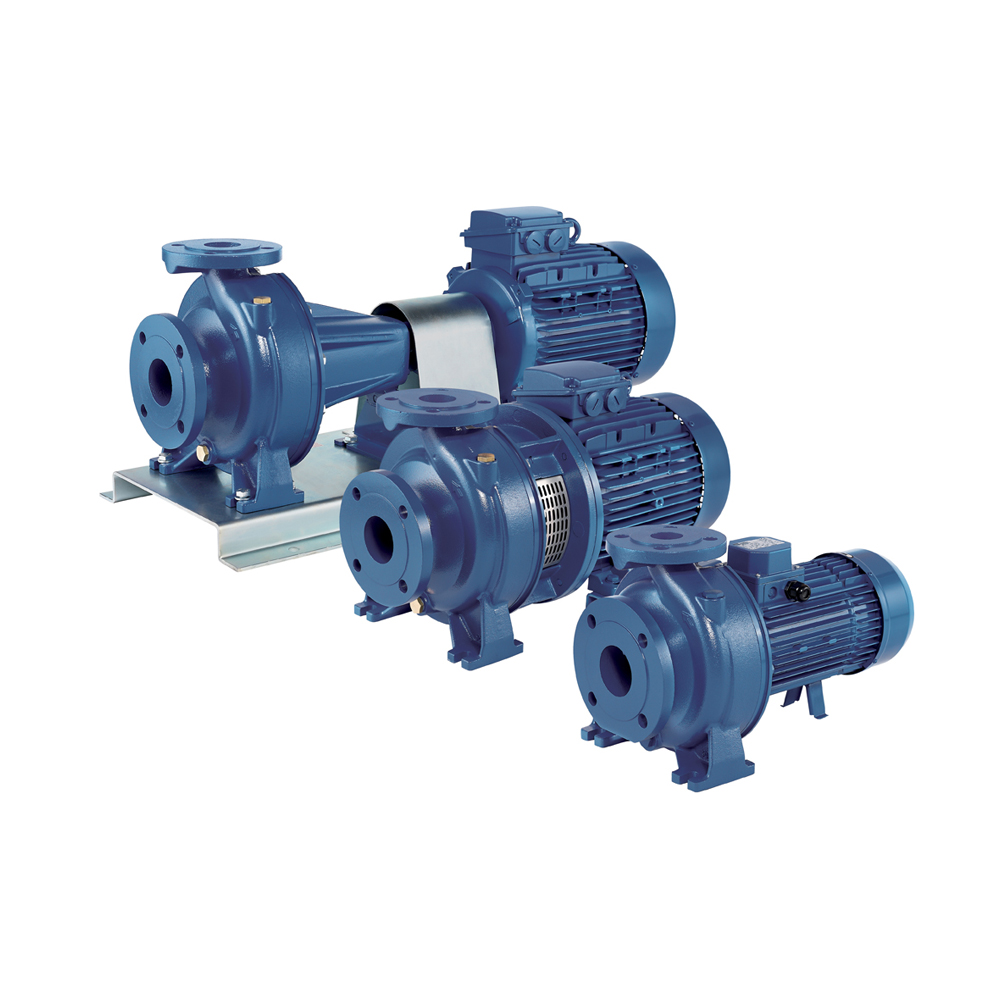
Key features
The motor, coupling, bracket and impeller come out without disturbing the pump body or breaking into the pipework, so a seal change does not mean cutting the pump out of the line.
AISI 304 on the 32, 40 and 50 sizes; AISI 316 precision cast on the 65 size. The body stays cast iron.
Ceramic, carbon and NBR as standard, through to silicon carbide and tungsten carbide faces. The seal is what sets the temperature ceiling, not the pump.
Suction flanges DN50, DN65 and DN80 and discharge flanges DN32 to DN65, all to EN 1092-2, so a replacement normally lands on the existing pipework centres.
3D is a monoblock with an extended shaft. 3DS uses a rigid coupling and an IEC standard motor, 3DP an elastic coupling and an IEC standard motor.
Three-phase versions are IE3 under Regulation 1781/2019, IP55, insulation class F with a class B temperature rise. Single-phase versions are IE2.
About the Ebara 3D series
The Ebara 3D series is a general-duty clean-water pump for building services and industrial transfer. Ebara lists it under EN 733 standardised pumps, and puts it on heating and air conditioning, water supply for civil, agricultural and industrial plants, pressurisation, firefighting systems, industrial liquid handling, irrigation and washing systems.
Read the liquid specification before anything else. Ebara rates the 3D series for clean water. It has a closed impeller, a single mechanical seal and sealed ball bearings, which is the right build for water and the wrong build for anything carrying solids. Put grit or fibre through one and you will be back for a seal, then an impeller. If the medium has solids in it, ask us for a solids-handling pump instead and we will point you at one.
The cast iron body is the other boundary. A stainless impeller helps with the wetted path, but the casing is EN-GJL-250 cast iron, so the chemistry of the medium still has to suit cast iron. Tell us what is in the water rather than just what it is called.
Sizing is where these get thrown away. Ebara's own data book says not to run the pump below 10% of the best efficiency point flow, because of the overheating risk. The more common version of the same problem is oversizing: everyone in the chain adds a little margin, the pump ends up far to the right of its curve, and you buy a motor far bigger than the duty needs and keep paying for it for twenty years. Send us the actual duty point and the pipework it sits in, not the one with the margins already stacked on.
How the Ebara 3D series works
The Ebara 3D series takes liquid in axially at the suction flange, throws it out through a closed impeller, and discharges radially at the top of the casing. A single mechanical seal keeps the liquid off the shaft, and sealed ball bearings carry it. Ebara tests the curves to ISO 9906:2012 Grade 3B with clean water at 20°C and a kinematic viscosity of 1 cSt.
Reading the type key
Ebara's own worked example is 3D S H 65-200/22 M U3U3EGG. After the series, the letter gives the version, then the optional seal code, then the discharge size in millimetres, the impeller code, the power code in kW, the motor type, and last any special seal. So a 3D 65-200/22 is a 3D with a DN65 discharge, the 200 impeller and a 22 kW motor. If you are matching an existing pump, that string and the serial number off the nameplate are what we need.
The seal decides the temperature
Temperature limits on the Ebara 3D series belong to the seal, not the hydraulics. The standard ceramic, carbon and NBR seal runs from -5°C to +90°C. The H, HS, HW and HSW builds, which swap in graphite, silicon carbide or tungsten carbide faces on FPM elastomers, take it to +110°C. The E build with EPDM and the special tungsten carbide and silicon carbide sets reach +120°C.
There is a catch worth knowing before you specify an FPM seal for hot water. Ebara recommends holding the fluid to 75°C where water is pumped with FPM elastomers, to get a longer life out of the sealing parts. That is well below the 110°C the seal is rated for, and it is the sort of detail that decides whether you are back on site in a year.
Efficiency and the motor
The minimum efficiency index (MEI) runs from ≥0.4 to ≥0.7 depending on size, with 40-160, 40-200, 50-200 and 65-160 the strongest at ≥0.7 on the 3D and 3DS builds. Three-phase motors are IE3 under Regulation 1781/2019 and single-phase IE2, all IP55, insulation class F. Supply is 230/400 V ±10% up to 4 kW and 400/690 V ±10% from 5.5 kW. Two-pole units run at about 2,900 rpm at 50 Hz; Ebara catalogues a four-pole version in its own data book.
Specifications
| Type | End suction centrifugal, axial suction and radial discharge, back pull-out | |
|---|---|---|
| Liquid handled | Clean water | |
| Flow rate | up to 138 m³/h | |
| Total head | up to 70 m | |
| Maximum working pressure | 10 bar | 1 MPa |
| Liquid temperature | -5°C to +90°C standard; +110°C on H, HS, HW and HSW; +120°C on E and the special seals | |
| Versions | 3D monoblock with extended shaft; 3DS rigid coupling; 3DP elastic coupling | |
| Power rating | 1.1–22 kW three-phase; 1.1–2.2 kW single-phase | |
| Speed | approx. 2,900 rpm | 2-pole, 50 Hz; a 4-pole version is catalogued separately |
| Suction connection | Flange DN50, DN65, DN80 to EN 1092-2 | |
| Discharge connection | Flange DN32, DN40, DN50, DN65 to EN 1092-2 | |
| Casing | Cast iron EN-GJL-250 to EN 1561 | |
| Impeller | AISI 304 on the 32, 40 and 50 sizes; AISI 316 precision cast on the 65 size | |
| Shaft | AISI 304, wet extension | |
| Bracket | Aluminium or cast iron | |
| Standard mechanical seal | Ceramic / carbon / NBR | |
| Optional mechanical seals | H, HS, HW, HSW and E builds in graphite, silicon carbide or tungsten carbide | |
| Bearings | Sealed ball bearing | |
| Motor efficiency | IE3 three-phase, IE2 single-phase, to Regulation 1781/2019 | |
| Motor protection | IP55 | |
| Insulation class | F, with class B temperature rise on three-phase | |
| Voltage | 1~230 V ±10%; 3~230/400 V ±10% up to 4 kW; 3~400/690 V ±10% from 5.5 kW | |
| MEI | ≥0.4 to ≥0.7 by size | |
| Test standard | ISO 9906:2012 Grade 3B |
Send us the flow, the total dynamic head, the liquid and its temperature, and we will size the 3D series against it and tell you if another pump suits the duty better. Replacing an existing unit? Photograph the nameplate and send the full designation and serial number.
Documents & downloads
Related pumps
View all →
Frequently asked
What is the difference between the Ebara 3D, 3DS and 3DP?
The 3D is a monoblock with an extended shaft. The 3DS uses a rigid coupling with an IEC standard motor, and the 3DP an elastic coupling with an IEC standard motor. The hydraulics are the same across all three.
What flow and head does the Ebara 3D series cover?
Up to 138 m³/h and up to 70 m, at a maximum working pressure of 10 bar. The range runs from the 32-125 at 1.1 kW to the 65-200 at 22 kW.
Can the Ebara 3D series pump dirty water or solids?
No. Ebara rates it for clean water. The closed impeller, single mechanical seal and sealed ball bearings suit water; solids and grit will take out the seal and wear the impeller. Ask for a solids-handling pump for that duty.
What temperature can an Ebara 3D series run at?
-5°C to +90°C on the standard ceramic, carbon and NBR seal, to +110°C on the H, HS, HW and HSW builds, and to +120°C on the E build and the special seals. Ebara recommends 75°C as a working ceiling for water with FPM elastomers.
What do the numbers in Ebara 3D 65-200/22 mean?
The 65 is the discharge size in millimetres, the 200 is the impeller code and the 22 is the motor rating in kW. Letters before the size give the version and the seal, so a full designation reads 3D S H 65-200/22 M U3U3EGG.
Is the Ebara 3D series an EN 733 pump?
Ebara lists the 3D series under its EN 733 standardised pumps and publishes it in the EN 733 Standardised Catalogue. Suction and discharge flanges are to EN 1092-2.