Key features
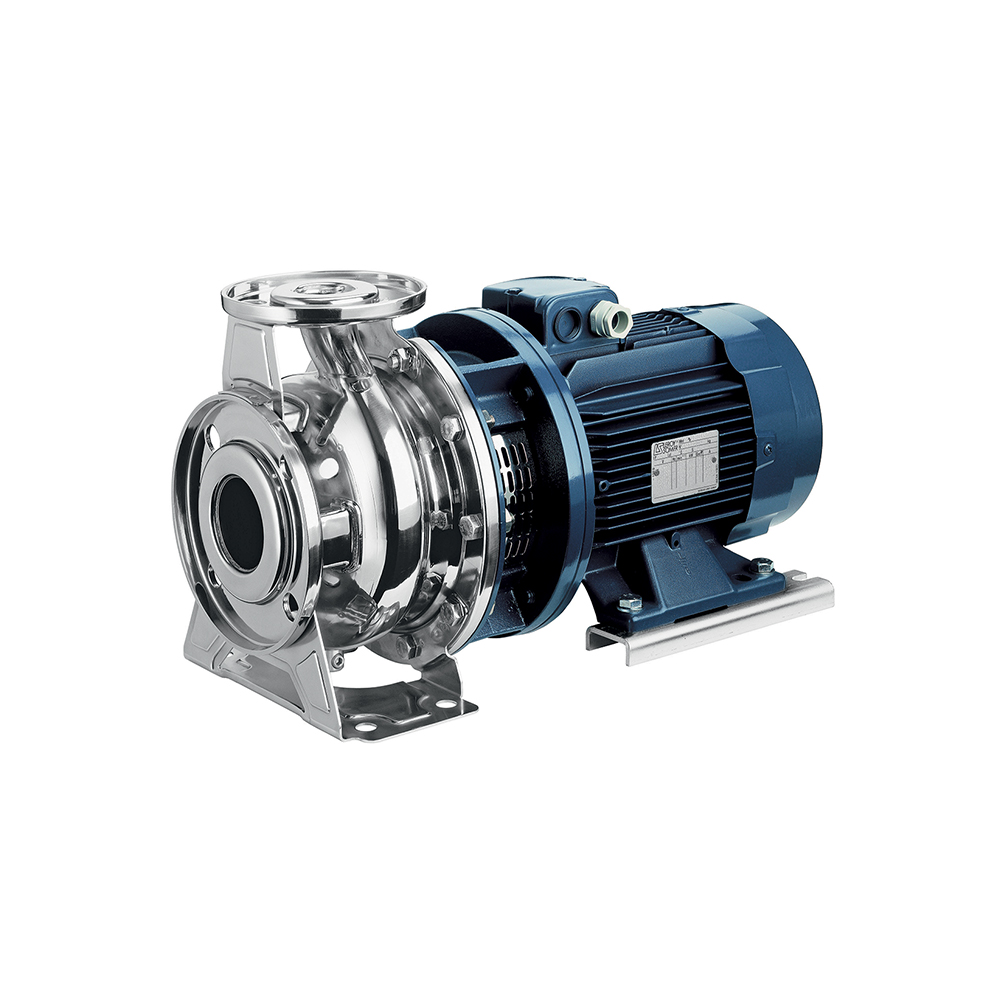
Pump and motor are one unit. No coupling, no baseplate, no alignment to check at commissioning or after a seal change, and the shortest footprint of the three builds in the range.
Ebara lists a single-phase 230 V motor on the 3M and on no other version. Six models, 1.1–2.2 kW, IE2. The 3S and 3P are three-phase only.
Casing, casing cover and impeller in EN 1.4301 (AISI 304) on the 32, 40 and 50 sizes, with a CF8M EN 1.4408 (AISI 316) impeller on the 65 sizes. The body is pressed by hydroforming, so the volute carries no weld seams.
Ebara's stated liquid rating for the 3 series. The cast iron 3D series is rated for clean water, which is the reason to pay for stainless.
The E version, with EPDM elastomers, holds WRAS approval certificate 2206044 for sizes 32, 40, 50 and 65. Ebara publishes it for the 3ME and for no other version of the range.
Motor, bracket and impeller come out without disturbing the pump body or the pipework. Suction DN50, DN65 or DN80 and discharge DN32 to DN65, all to EN 1092-1.
About the Ebara 3M series
The Ebara 3M series is the stainless steel member of Ebara's EN 733 family, in its monobloc form. Ebara answers the obvious question itself: the difference between the 3 series and the 3D series is the material they are made of, AISI 304 or AISI 316L stainless for the 3 series, cast iron for the 3D. Both are EN 733 pumps and both come in monobloc, rigid-coupling and elastic-coupling builds.
That material choice buys you two things. The wetted path suits a medium that would attack cast iron, and Ebara widens the liquid rating with it: the 3 series is rated for clean water and moderately aggressive fluids, where the 3D is rated for clean water. If your medium is plain water and always will be, you are paying for stainless you do not need. If it is not, this is the range to look at.
Then choose the build. The 3M is the monobloc, the 3S runs a rigid coupling to an IEC standard motor, and the 3P an elastic coupling. The hydraulics are the same across all three, so the choice is nothing to do with duty. It is about the motor and what happens when it fails. The 3M gives you the shortest and cheapest installation, with nothing to align. What you give up is motor interchangeability: the 3S takes a standard IEC frame you can source anywhere, and the 3M does not. You also give up quiet running, which the noise figures below make plain.
Where the 3M wins outright is a site with no three-phase supply. Ebara offers a single-phase motor on this version and no other, in six models from 1.1 kW to 2.2 kW. That is a real constraint on plenty of small industrial and agricultural sites, and it settles the decision on its own.
Two things to get right before you order. AISI 304 and AISI 316L are not interchangeable, and the 3L series exists because of it, so tell us what is actually in the medium rather than what it is called. And send the real duty point. Ebara's own data book says not to run the pump below 10% of best efficiency point flow, because of the overheating risk. The commoner fault runs the other way. Everyone in the chain adds a margin, the pump ends up far right on its curve, and you carry an oversized motor for twenty years.
How the Ebara 3M series works
The Ebara 3M takes liquid in axially at the suction flange, throws it out through a closed impeller and discharges radially at the top of the casing. A single mechanical seal keeps the liquid off the shaft and sealed ball bearings carry it. Ebara tests the curves to ISO 9906:2012 Grade 3B, with clean water at 20°C and a kinematic viscosity of 1 cSt, at about 2,900 rpm on the two-pole motor.
The body is pressed, not cast
The 3 series pump body is formed by hydroforming: a steel disc is put in a press and water at up to 1200 bar pushes it into the shape of the mould. The volute comes out in one piece with no welding points, which is what Ebara credits for the corrosion resistance and the hydraulic efficiency. The external structure is tested at 14 bar over 1 million cycles.
The impeller is closed and hydraulically balanced to keep axial thrust off the seal. On the 32, 40 and 50 sizes it is a closed centrifugal type; the 65 sizes get three-dimensional blades; the 40-200/11 and 50-200/15 use reinforced laser welding.
The seal sets the temperature, not the pump
Every temperature limit on this pump belongs to the mechanical seal. Ebara publishes them as a table.
| Seal version | Faces and elastomer | Fluid temperature |
|---|---|---|
| Standard | Ceramic / carbon / NBR | -10°C to +90°C |
| H, HS, HW, HSW | Graphite, silicon carbide or tungsten carbide on FPM | -10°C to +110°C |
| E | Graphite / ceramic / EPDM | -20°C to +120°C |
| Q1AEGG, U3U3EGG, Q1Q1EGG, Q1U3EGG, U3CEGG | Special sets | -10°C to +120°C |
One caveat matters more than the numbers. Where the medium is water and the elastomers are FPM, Ebara recommends holding the fluid to 75°C to get a longer life out of the sealing parts. That is 35°C below what the seal is rated for, and it is the difference between a seal that lasts and a return visit.
Noise is what the monobloc costs you
A monobloc puts the hydraulics and the motor fan in one short package, and it is audibly louder than the same duty on a coupled build. Ebara measures sound pressure as a mean of several readings at 1 m around the pump, tolerance ±2.5 dB.
| Model | 3M | 3S |
|---|---|---|
| 32-125/1.1 | <70 dB(A) | <70 dB(A) |
| 50-160/7.5 | 75 dB(A) | 72 dB(A) |
| 40-200/11 | 80 dB(A) | 74 dB(A) |
| 65-160/15 | 80 dB(A) | 74 dB(A) |
Up to 4 kW there is at most a decibel in it. From 5.5 kW the gap opens, and by 11 kW you are 6 dB adrift. If the pump sits in a plant room behind a door, ignore it. If it sits anywhere near people, specify the 3S instead.
Motors, and the single-phase models
Three-phase motors are IE3 under Regulation 1781/2019, single-phase IE2, all IP55 and insulation class F, with a class B temperature rise on three-phase. Supply is 230/400 V ±10% up to 4 kW and 400/690 V ±10% from 5.5 kW; single-phase is 230 V ±10%. Two-pole and four-pole versions are catalogued.
The single-phase models are 32-125/1.1, 32-160/1.5, 32-160/2.2, 40-125/1.5, 40-125/2.2 and 50-125/2.2. Nothing above 2.2 kW is offered single-phase, so if the duty needs more than that you need a three-phase supply, whatever build you choose.
On efficiency, the minimum efficiency index (MEI) is ≥0.7 on every size in the range except 32-125 and 50-125 at ≥0.4 and 32-200 at ≥0.6. Those three are the ones worth a second look if running cost matters.
Drinking water approvals
Two approvals apply, and both attach to the EPDM seal build rather than to the range as a whole. The 3ME, meaning the 3M with the E version seal, holds WRAS approval certificate 2206044 covering the 32, 40, 50 and 65 sizes, valid to the end of June 2027. Ebara publishes this one for the 3ME only. Separately, all EPDM E version models in sizes 32, 40 and 50 are approved to DM174/2004 through ICIM, on certificate ICIM-CAP-052120-00, which runs to the end of 2030. A WRAS certificate is not by itself evidence of a current approval, so check the WRAS directory before you specify against it, and tell us at enquiry that the duty is potable.
Reading the type key
Ebara's worked example is 3 L M Z H 80-160/15 R M Q1AEGG. After the series comes the material letter, then the version letter, then the optional Z, the seal option, the discharge size in millimetres, the impeller code, the power code in kW, R if the impeller is reduced, M if it is single-phase, and last any special seal. So a 3M 65-200/22 is an AISI 304 monobloc with a DN65 discharge, the 200 impeller and a 22 kW motor. The Z casing, without the support foot, is offered on the 3LM and 3LS only. If you are matching an existing pump, that string and the serial number off the nameplate are what we need.
Specifications
| Type | End suction centrifugal to EN 733, axial suction and radial discharge, back pull-out | |
|---|---|---|
| Version | Monobloc | 3S is the rigid-coupling build, 3P the elastic-coupling build |
| Liquid handled | Clean water and moderately aggressive fluids | |
| Pump sizes | 32-125, 32-160, 32-200, 40-125, 40-160, 40-200, 50-125, 50-160, 50-200, 65-125, 65-160, 65-200 | |
| Flow rate | up to 138 m³/h | 50 Hz two-pole selection chart, across the 32-125 to 65-200 sizes |
| Total head | up to 72 m | 50 Hz two-pole selection chart, across the 32-125 to 65-200 sizes |
| Maximum working pressure | 10 bar | 1 MPa |
| Liquid temperature | -10°C to +90°C on the standard seal; +110°C on H, HS, HW and HSW; -20°C to +120°C on E | |
| Power rating | 1.1–22 kW three-phase; 1.1–2.2 kW single-phase | |
| Speed | approx. 2,900 rpm | two-pole, 50 Hz; a four-pole version is catalogued separately |
| Suction connection | Flange DN50, DN65 or DN80 to EN 1092-1 | |
| Discharge connection | Flange DN32, DN40, DN50 or DN65 to EN 1092-1 | |
| Casing | EN 1.4301 (AISI 304), hydroformed | |
| Impeller | EN 1.4301 (AISI 304) on the 32, 40 and 50 sizes; CF8M EN 1.4408 (AISI 316) on the 65 sizes | |
| Casing cover | EN 1.4301 (AISI 304) | |
| Shaft | EN 1.4301 (AISI 304) | d=19 mm on most sizes, d=22 mm on 50-200/15, d=24 mm on 65-160/15 and 65-200 |
| Bracket | Cast iron or aluminium | |
| Standard mechanical seal | Ceramic / carbon / NBR | |
| Optional mechanical seals | H, HS, HW, HSW and E builds, plus the Q1AEGG, U3U3EGG, Q1Q1EGG, Q1U3EGG and U3CEGG specials | |
| O-ring | NBR standard; FPM on H, HS, HW and HSW; EPDM on E and the specials | |
| Bearings | Sealed ball bearing | |
| Motor efficiency | IE3 three-phase, IE2 single-phase, to Regulation 1781/2019 | |
| Motor protection | IP55 | |
| Insulation class | F, with class B temperature rise on three-phase | |
| Voltage | 1~230 V ±10%; 3~230/400 V ±10% up to 4 kW; 3~400/690 V ±10% from 5.5 kW | |
| MEI | ≥0.7 on all sizes except 32-125 and 50-125 (≥0.4) and 32-200 (≥0.6) | |
| Noise | <70 to 80 dB(A) across the range | mean of several readings at 1 m, tolerance ±2.5 dB |
| Test standard | ISO 9906:2012 Grade 3B |
Send us the flow, the total dynamic head, the medium and its temperature, and we will size the 3M against it and say if the 3S or the cast iron 3D suits the duty better. Tell us whether the supply is single or three-phase, and whether the duty is potable. Replacing an existing unit? Photograph the nameplate and send the full designation and the serial number.
Documents & downloads
Related pumps
View all →
Frequently asked
What is the difference between the Ebara 3M and the Ebara 3S?
The drive, not the duty. The 3M is a monobloc, with the motor bolted straight to the pump and no coupling, while the 3S uses a rigid coupling to an IEC standard motor, IM B5 up to 2.2 kW and IM B35 from 3 kW. Hydraulics and sizes are identical, so the 3M gives you the shorter and simpler installation and the 3S gives you a quieter set and a motor you can replace from stock.
What is the difference between the Ebara 3 series and the 3D series?
Material. Ebara builds the 3 series in AISI 304 stainless steel and the 3L series in AISI 316L, while the 3D series is cast iron with a stainless impeller. Ebara rates the 3 series for clean water and moderately aggressive fluids, and the 3D for clean water.
Is the Ebara 3M available with a single-phase motor?
Yes, and it is the only version of the 3 series that is. Six models are listed single-phase at 230 V and IE2 efficiency, namely 32-125/1.1, 32-160/1.5, 32-160/2.2, 40-125/1.5, 40-125/2.2 and 50-125/2.2. Anything above 2.2 kW is three-phase.
Is the Ebara 3M WRAS approved?
The 3ME is. That is the 3M built with the E version seal and EPDM elastomers, and it holds WRAS approval certificate 2206044 for the 32, 40, 50 and 65 sizes, valid to the end of June 2027. A certificate is not by itself evidence of a current approval, so confirm the scope against the WRAS directory. Tell us at enquiry that the duty is potable and we will specify the E build.
What temperature can an Ebara 3M run at?
-10°C to +90°C on the standard ceramic, carbon and NBR seal, to +110°C on the H, HS, HW and HSW builds, and -20°C to +120°C on the E build. Where the medium is water and the elastomers are FPM, Ebara recommends a 75°C working ceiling to get a longer life out of the sealing parts.
What sizes does the Ebara 3M come in?
Twelve, from 32-125 up to 65-200, covering the 32, 40, 50 and 65 discharge sizes in the 125, 160 and 200 impeller codes. The larger 65-250 and 80 sizes are built in AISI 316 as the 3LM, 3LS and 3LP, not as a 3M.
How loud is an Ebara 3M?
From under 70 dB(A) on the small models up to 80 dB(A) at 11 kW and above, measured as a mean of several readings at 1 m around the pump with a ±2.5 dB tolerance. The equivalent 3S runs 3 to 6 dB quieter from 5.5 kW up, because the motor sits away from the pump on a coupling.
- 1EBARA Pumps Europe — 3(L)(4) SERIES centrifugal pump EN 733
- 2EBARA Pumps Europe — 3 SERIES Data Book 50 Hz, 2 poles, Rev. AL
- 3EBARA Pumps Europe — 3ME WRAS approval certificate 2206044
- 4ICIM S.p.A. — product certificate ICIM-CAP-052120-00, DM 174/2004, EBARA Pumps Europe
- 5EBARA Pumps Europe — Standardised electric pumps product catalogue, 50 Hz