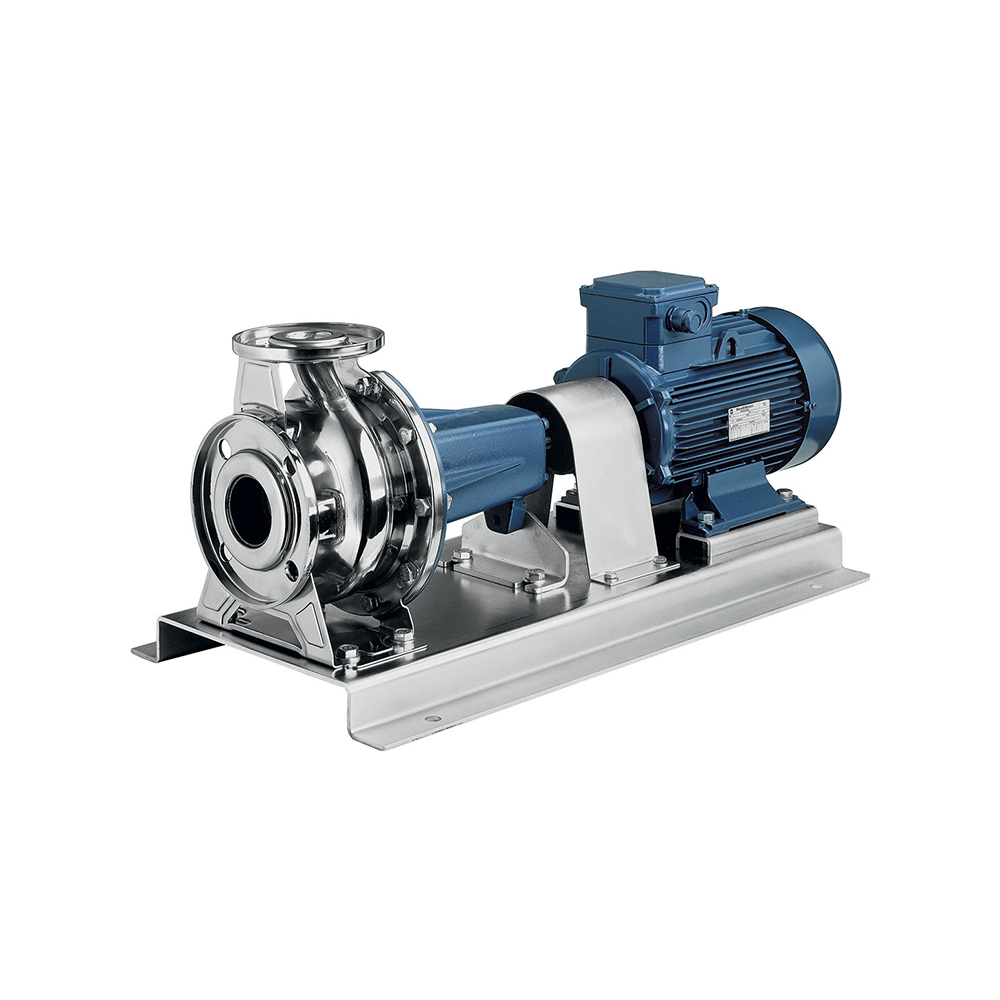
Key features
Flange-mounted IM B5 up to 2.2 kW and IM B35 from 3 kW, in frame sizes 80 through 180. When the motor goes, you replace a standard frame rather than wait on a pump-specific one.
Marked II 2G Ex h IIC T3 to T4 Gb, Group II Category 2G, for use in gas Zone 1 and Zone 2. The monobloc 3M has no equivalent, so a classified area rules it out.
74 dB(A) on the 40-200/11 against 80 dB(A) for the same size as a 3M, measured as a mean of several readings at 1 m with a ±2.5 dB tolerance.
The volute is pressed from a steel disc by water at up to 1200 bar, so it carries no weld seams. Ebara tests the external structure at 14 bar over 1 million cycles.
32-125 through 65-200, discharge DN32 to DN65. The choice between the coupled and monobloc builds is about the motor and the installation, not the duty.
From the 65-200/22 up, Ebara lists the motor with a lubricator for regular re-greasing of the bearing.
About the Ebara 3S series
Buy the Ebara 3S when the motor matters more than the footprint. Ebara builds its stainless 3 series in three drive arrangements, and the hydraulics are identical across all of them. The 3M is the monobloc, the 3S runs a rigid coupling to an IEC standard motor, and the 3P an elastic coupling. Nothing about that choice changes the duty the pump will do.
What it changes is the motor. On a 3S the motor is an ordinary IEC frame, flange-mounted IM B5 up to 2.2 kW and IM B35 from 3 kW. A 160M is a 160M whoever built it, so a failed motor is a stock replacement or a local rewind instead of a pump-specific order with a lead time on it. On plant where the pump has to be back on line the same week, that is usually the whole argument.
The second argument is the one that ends the discussion. Ebara offers an ATEX version of the 3S and the 3P and of nothing else in the range. If any part of the duty sits in a classified area, the monobloc is out and you are choosing between the 3SF and the 3PF.
Both of those come at a price, and it is alignment. A coupling has to be aligned when the set is installed and checked again after anything that separates it, including a seal change. A monobloc has no coupling and nothing to get wrong. If nobody on site is going to check alignment, you will get a longer life out of a 3M, however much better the 3S looks on paper.
Two more things before you order. Ebara rates the 3 series for clean water and moderately aggressive fluids, but AISI 304 and AISI 316L are different steels and the 3L series exists because of it, so tell us what is in the medium rather than what it is called. And send the real duty point. Ebara says not to run the pump below 10% of best efficiency point flow because of the overheating risk, and oversizing does the quieter damage: an oversized motor stays oversized, and you pay for it every hour it runs.
How the Ebara 3S series works
The Ebara 3S takes liquid in axially at the suction flange, throws it out through a closed impeller and discharges radially at the top of the casing. A single mechanical seal keeps the liquid off the shaft and sealed ball bearings carry it. The motor drives through a rigid coupling, and the whole set sits on a baseplate. Ebara tests the curves to ISO 9906:2012 Grade 3B with clean water at 20°C and a kinematic viscosity of 1 cSt, at about 2,900 rpm on the two-pole motor.
The motor is a standard IEC frame
The 3S drives through a rigid coupling to an ordinary IEC motor, flange-mounted IM B5 up to 2.2 kW and IM B35 from 3 kW. Ebara publishes the frame size against every model, so you know what you are buying before it arrives.
| Model | Power | Motor frame |
|---|---|---|
| 32-125/1.1 | 1.1 kW | 80 |
| 40-160/4.0 | 4 kW | 112M |
| 50-160/7.5 | 7.5 kW | 132S |
| 40-200/11 | 11 kW | 160M |
| 65-200/18.5 | 18.5 kW | 160L |
| 65-200/22 | 22 kW | 180 |
That is the practical difference from the monobloc: a 3M carries an Ebara motor, and a 3S carries a frame anyone makes. It also runs quieter, because the motor and its fan sit away from the hydraulics. A 40-200/11 is 74 dB(A) as a 3S and 80 dB(A) as a 3M, and a 32-200/7.5 is 72 dB(A) against 75 dB(A), measured as a mean of several readings at 1 m with a ±2.5 dB tolerance.
The cost is alignment. Ebara publishes coupling dimensions for every model, down to the set screw, which tells you this is a joint somebody has to set up properly. Get it wrong and the bearings and the seal pay for it, and the seal is what usually goes first.
The ATEX build is the 3SF
The standard 3S is not an ATEX pump. The ATEX build is a separate version, the 3SF, and Ebara publishes a separate data book and instruction manual for it. Ebara's own wording is that the 3(L)S series and 3(L)P series are available with ATEX certified hydraulics and motor.
The marking is II 2G Ex h IIC T3 to T4 Gb. That is Group II, Category 2G equipment for gas atmospheres, protected to EN 80079-36 and EN 80079-37 and certified for use in Zone 1 and Zone 2. Ebara deposited the technical file for type 3(L)SF and 3(L)PF with TÜV CYPRUS Ltd, notified body 2261, under ATEX Directive 2014/34/EU, on deposit 0205991 Rev.01. The 3SF is built in the same twelve sizes as the 3S.
The temperature class follows the medium, not the pump.
| Maximum fluid temperature | Temperature class |
|---|---|
| 80°C | T4 |
| 90°C, or 110°C on the high-temperature version | T3 |
Two conditions come with it. Ebara specifies an ambient of -20°C to +40°C and atmospheric pressure of 0.8 to 1.1 bar for explosion-proof pumps. And the set only complies as a unit when the pump and its motor are both ATEX approved, so an ATEX pump on an ordinary motor is not an ATEX pump set. Tell us the zone and the gas group at enquiry and we will specify both halves.
The seal sets the temperature
Temperature limits on this pump belong to the mechanical seal, not the hydraulics. The standard ceramic, carbon and NBR seal runs -10°C to +90°C. The H, HS, HW and HSW builds, which put graphite, silicon carbide or tungsten carbide faces on FPM elastomers, take it to +110°C. The E build with EPDM runs -20°C to +120°C, and the Q1AEGG, U3U3EGG, Q1Q1EGG, Q1U3EGG and U3CEGG special sets reach +120°C.
One caveat is worth more than the ceiling. Where the medium is water and the elastomers are FPM, Ebara recommends holding the fluid to 75°C for a reasonable life out of the sealing parts. On a 3SF that ceiling matters twice over, because the fluid temperature is what fixes the temperature class.
Motors and efficiency
Motors are three-phase only and IE3 under Regulation 1781/2019, IP55, insulation class F with a class B temperature rise. Supply is 230/400 V ±10% up to 4 kW and 400/690 V ±10% from 5.5 kW. Two-pole and four-pole versions are catalogued; the two-pole runs at about 2,900 rpm. There is no single-phase 3S. Ebara offers single-phase on the monobloc 3M only, up to 2.2 kW.
The minimum efficiency index (MEI) is ≥0.7 on every size except 32-125 and 50-125 at ≥0.4 and 32-200 at ≥0.6. Those figures match the 3M and beat the 3P, which drops to ≥0.6 on the 40-125, 50-160, 65-160 and 65-200 and to ≥0.5 on the 32-200. If you are choosing between the two coupled builds on running cost, the 3S is the better of them.
Drinking water approvals
The 3S in its EPDM E build is approved for contact with drinking water under Italian Ministerial Decree 174/2004, on ICIM certificate ICIM-CAP-052120-00, covering the 3 series in sizes 32, 40 and 50 and running to the end of 2030.
For a UK potable duty, the approval you want is WRAS, and Ebara publishes that one for the 3ME, meaning the monobloc built with the E seal. A potable specification therefore points at the 3M rather than the 3S. Say so at enquiry and we will quote the right build.
Reading the designation
A 3S 65-200/22 is an AISI 304 rigid-coupling pump with a DN65 discharge, the 200 impeller and a 22 kW motor. An L before the version letter, as in 3LS, means the pump is built in AISI 316L instead, and the F suffix marks the ATEX version. Letters between the version and the size give the seal option: H, HS, HW, HSW or E. If you are matching an existing pump, send that string and the serial number off the nameplate.
Specifications
| Type | End suction centrifugal to EN 733, axial suction and radial discharge, back pull-out | |
|---|---|---|
| Version | Rigid coupling to an IEC standard motor | 3M is the monobloc build, 3P the elastic-coupling build |
| Liquid handled | Clean water and moderately aggressive fluids | |
| Pump sizes | 32-125, 32-160, 32-200, 40-125, 40-160, 40-200, 50-125, 50-160, 50-200, 65-125, 65-160, 65-200 | |
| Flow rate | up to 138 m³/h | 50 Hz two-pole selection chart, across the 32-125 to 65-200 sizes |
| Total head | up to 72 m | 50 Hz two-pole selection chart, across the 32-125 to 65-200 sizes |
| Maximum working pressure | 10 bar | 1 MPa |
| Liquid temperature | -10°C to +90°C on the standard seal; +110°C on H, HS, HW and HSW; -20°C to +120°C on E | |
| Power rating | 1.1–22 kW, three-phase | Ebara's motor table gives 1.1–55 kW for the 3(.)S family, which takes in the larger AISI 316 3LS sizes |
| Motor mounting | IEC flange, IM B5 up to 2.2 kW and IM B35 from 3 kW | |
| Motor frame sizes | 80, 90S, 90L, 100L, 112M, 132S, 132M, 160M, 160L, 180 | |
| Speed | approx. 2,900 rpm | two-pole, 50 Hz; a four-pole version is catalogued separately |
| ATEX version | 3SF, marked II 2G Ex h IIC T3 to T4 Gb | Group II Category 2G, for gas Zone 1 and Zone 2; pump and motor must both be ATEX approved |
| Suction connection | Flange DN50, DN65 or DN80 to EN 1092-1 | |
| Discharge connection | Flange DN32, DN40, DN50 or DN65 to EN 1092-1 | |
| Casing | EN 1.4301 (AISI 304), hydroformed | |
| Impeller | EN 1.4301 (AISI 304) on the 32, 40 and 50 sizes; CF8M EN 1.4408 (AISI 316) on the 65 sizes | |
| Casing cover | EN 1.4301 (AISI 304) | |
| Shaft | EN 1.4301 (AISI 304) | d=19 mm on most sizes, d=22 mm on 50-200/15, d=24 mm on 65-160/15 and 65-200 |
| Bracket | Cast iron or aluminium | |
| Standard mechanical seal | Ceramic / carbon / NBR | |
| Optional mechanical seals | H, HS, HW, HSW and E builds, plus the Q1AEGG, U3U3EGG, Q1Q1EGG, Q1U3EGG and U3CEGG specials | |
| O-ring | NBR standard; FPM on H, HS, HW and HSW; EPDM on E and the specials | |
| Bearings | Sealed ball bearing | motor available with a lubricator for re-greasing from the 65-200/22 up |
| Motor efficiency | IE3 to Regulation 1781/2019 | |
| Motor protection | IP55 | |
| Insulation class | F, with class B temperature rise | |
| Voltage | 3~230/400 V ±10% up to 4 kW; 3~400/690 V ±10% from 5.5 kW | |
| MEI | ≥0.7 on all sizes except 32-125 and 50-125 (≥0.4) and 32-200 (≥0.6) | |
| Noise | <70 to 77 dB(A) across the range | mean of several readings at 1 m, tolerance ±2.5 dB |
| Test standard | ISO 9906:2012 Grade 3B |
Send us the flow, the total dynamic head, the medium and its temperature, and we will size the 3S against it and say whether the monobloc 3M or the cast iron 3D suits the duty better. If any of it sits in a classified area, tell us the zone and the gas group so we specify the pump and the motor together. Replacing an existing unit? Photograph the nameplate and send the full designation and the serial number.
Documents & downloads
Related pumps
View all →
Frequently asked
What is the difference between the Ebara 3S and the Ebara 3M?
The drive, not the duty. The 3S uses a rigid coupling to an IEC standard motor, flange-mounted IM B5 up to 2.2 kW and IM B35 from 3 kW, while the 3M is a monobloc with the motor bolted straight to the pump. Hydraulics and sizes are identical, so the 3S gives you a quieter set and a motor you can replace from stock, and the 3M gives you a shorter installation with no alignment to check.
Is the Ebara 3S ATEX certified?
The standard 3S is not. The ATEX build is the 3SF, marked II 2G Ex h IIC T3 to T4 Gb as Group II Category 2G equipment, certified for use in gas Zone 1 and Zone 2. Ebara deposited the technical file for type 3(L)SF and 3(L)PF with TÜV CYPRUS Ltd, notified body 2261, under Directive 2014/34/EU. The pump and the motor must both be ATEX approved for the set to comply.
Can you fit a standard motor to an Ebara 3S?
Yes, that is the point of the build. The 3S takes an IEC flange motor, IM B5 up to 2.2 kW and IM B35 from 3 kW, in frame sizes 80 through 180. Ebara publishes the frame size against each model, so you can match a replacement without going back to the pump maker.
What is the difference between the Ebara 3S and the 3P?
The coupling. The 3S uses a rigid coupling and the 3P an elastic one. Both are offered in ATEX versions as the 3SF and 3PF. On efficiency the 3S is the stronger of the two, holding MEI ≥0.7 on sizes where the 3P drops to ≥0.6 or ≥0.5.
What sizes and power does the Ebara 3S cover?
Twelve sizes from 32-125 to 65-200, at 1.1–22 kW three-phase, with discharge flanges from DN32 to DN65. The larger 65-250 and 80 sizes are built in AISI 316 as the 3LS, not as a 3S.
What temperature can an Ebara 3S run at?
-10°C to +90°C on the standard ceramic, carbon and NBR seal, to +110°C on the H, HS, HW and HSW builds, and -20°C to +120°C on the E build. Where the medium is water and the elastomers are FPM, Ebara recommends a 75°C working ceiling for a longer life out of the sealing parts.
Is the Ebara 3S approved for drinking water?
The EPDM E build is approved under Italian Ministerial Decree 174/2004 on ICIM certificate ICIM-CAP-052120-00, covering sizes 32, 40 and 50. For a UK potable duty the relevant approval is WRAS, which Ebara publishes for the 3ME, so a potable specification points at the monobloc build instead.
- 1EBARA Pumps Europe — 3(L)(4) SERIES centrifugal pump EN 733
- 2EBARA Pumps Europe — 3 SERIES Data Book 50 Hz, 2 poles, Rev. AL
- 3EBARA Pumps Europe — 3 SERIES F version Data Book 50 Hz, 2 poles, Rev. P
- 4EBARA Pumps Europe — ATEX Data Book, Rev. C
- 5TÜV CYPRUS Ltd — ATEX acknowledgement of receipt 0205991 Rev.01, type 3(L)SF and 3(L)PF
- 6ICIM S.p.A. — product certificate ICIM-CAP-052120-00, DM 174/2004, EBARA Pumps Europe