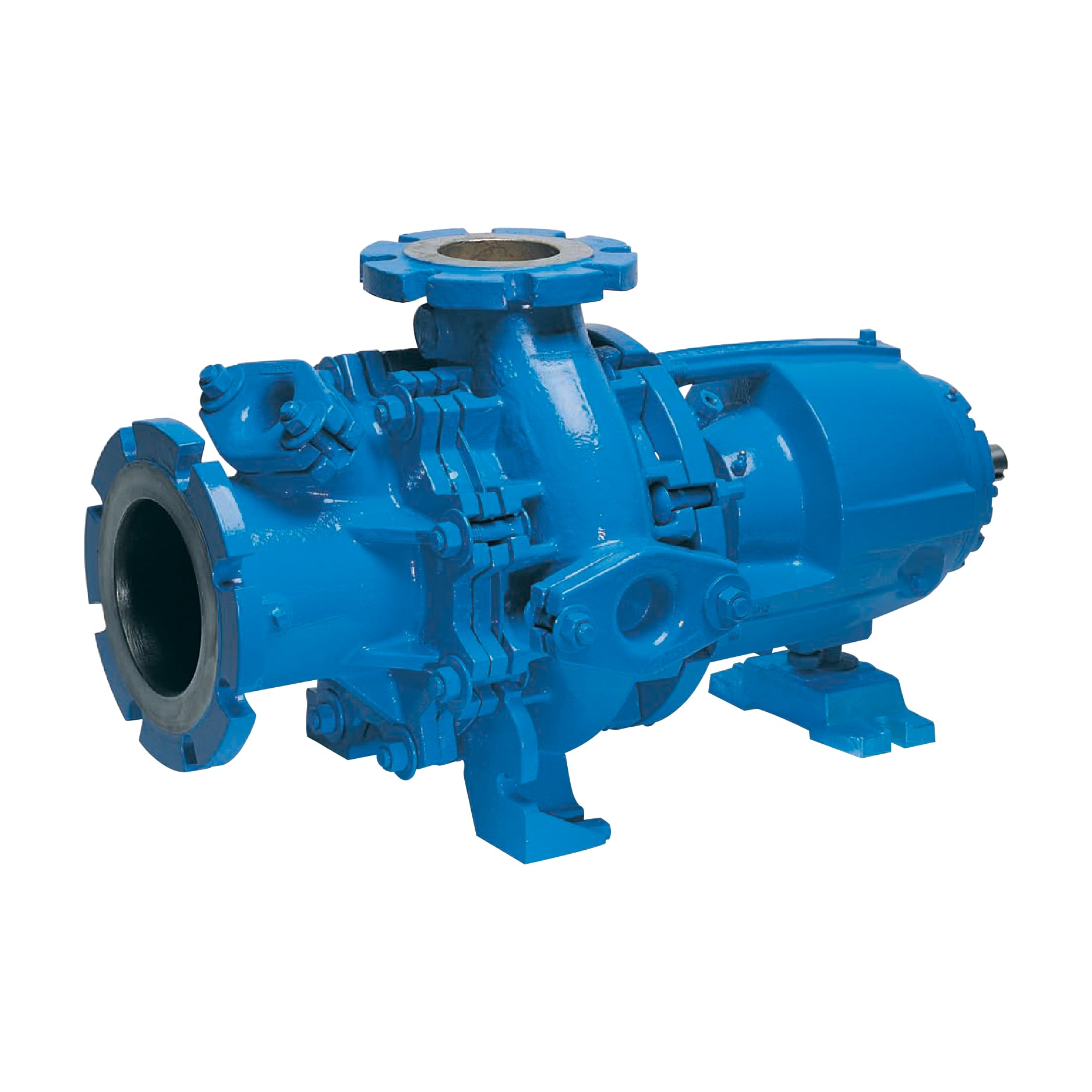
Key features
The chopping happens inside the pump, so you are not buying, installing and maintaining a separate grinder or comminutor ahead of it.
Sharpened leading edges across the cutter bar at the suction do the primary cut. Sharpened vane edges at the rear of the impeller then sweep spiral grooves in the casing backplate for a second cut.
That rear action cuts and expels stray material from behind the impeller, which is what stops solids binding the impeller or fouling the seal area.
0.25–0.38 mm on impellers below 356 mm diameter, and it is externally adjustable, so wear is taken up without stripping the pump.
Impeller and cutter bar are cast alloy steel case hardened to Rockwell C 60 minimum, with Ni-Hard, high chrome iron, 316 stainless and CD4MCu available across the wet end.
A tapered seal housing and a cartridge seal on silicon carbide faces let some slurries run without seal water, which takes out the flush piping, valves and gauges.
About the Ebara ChopX
The Ebara ChopX is EBARA HG's chopper pump, sold under the Hayward Gordon brand. It does two jobs in one casing: it reduces the solids and it moves the medium. That is the whole commercial argument for it. Where the alternative is a grinder or a comminutor in the line plus a pump behind it, you are buying one machine instead of two, with one set of wear parts and one thing to isolate.
EBARA HG puts it on scum pits, digester recirculation and digester scum blankets, on difficult lift station duties in prisons, hospitals and other public buildings, and on food waste, manure, fleshings, hides and bones. Pulp and paper gets wood yard sumps and chip and bark handling. The awkward list is the honest one: latex skins, plastics, paint sludges, detergent cakes and lagoon cleaning. These are the media where a conventional pump has already been tried.
There are two reasons to specify chopping rather than a bigger solids passage. The first is that the pump itself keeps blocking. The second, and the one that decides more jobs, is that something downstream cannot take the solids. Nozzles, heat exchangers and valves clog long before the pump does, and once the solids are reduced at the pump they stay reduced through the rest of the system. That is why EBARA HG builds its HydroMix digester mixing system around a ChopX and a set of nozzles in the tank rather than around a plain sludge pump.
Now what it costs you. Cutting takes power, so a chopper draws more for a given flow than a solids-handling pump doing the same duty, and the cutting faces are wear parts. They dull gradually rather than failing, which means throughput falls off before anything sounds different. Grit accelerates all of it. If the medium is abrasive, spend the money on the hard metal wet end and fix the grit removal upstream, because a hardened cutter bar in a gritty sump is still a consumable.
Check the flanges before you go any further. They are ANSI B16.1 Class 125, not PN16, so a UK installation needs the adaptation designed in rather than discovered on site. And be clear what you are buying. A ChopX is not the small-bore grinder pump set you would drop into a domestic or light commercial pressurised sewer. It is an engineered process pump built around a cutting head, and it is priced and sized accordingly.
If the pump on site is otherwise right for the duty and rag is the only problem, or if several pumps share one incoming flow, an inline macerator ahead of them usually does better than replacing each pump with a chopper. We will say so rather than sell you three ChopX units. Where the medium is fibrous but nothing downstream needs protecting, the Ebara XCS passes the material instead of cutting it, which is cheaper to run.
How the Ebara ChopX works
The ChopX uses an open-type impeller with sharpened leading and vane edges, and it cuts twice. The primary chop happens as the impeller's sharpened leading edges rotate in tight clearance across a cutter bar at the pump suction. A second cut happens behind the impeller, where sharpened vane edges on the rear of the impeller sweep across spiral grooves in the casing backplate. That second action cuts and expels stray solids from behind the impeller, which is what keeps them from binding the impeller or fouling the seal.
Chopper pump or macerator
A chopper pump cuts and pumps in one unit. An inline macerator only cuts, and sits in the pipeline ahead of a pump that is already correct for the duty. The ChopX is firmly on the chopper side of that line: EBARA HG's own argument for it is that it "provides cutting and pumping action in a single unit", saving the capital and maintenance cost of a separate grinder or comminutor. Choose the chopper when the pump and the cutting are one purchase; choose the macerator when the pump stays and only the rag has to go.
The cutter bar and the clearance
The cutter bar sits in a replaceable, externally adjustable suction plate. Its face towards the impeller carries multiple radial cutting slots, which stop material binding between the plate and the impeller vanes. On pumps with impellers of 381 mm (15 in) diameter and above, the cutter bars are separately replaceable from the main suction cover, so you renew the cutting faces without the whole plate.
Clearance between impeller and cutter bar is the number that decides whether the pump still cuts. EBARA HG's specification sets it at 0.25–0.38 mm (0.010–0.015 in) on impellers below 356 mm (14 in) diameter, and 0.51–0.76 mm (0.020–0.030 in) at 356 mm and above. Axial clearance at the front and rear of the impeller is externally adjustable, taken up on the double row thrust bearings in their own housing. Set the exact figure for your model from Hayward Gordon's manual at overhaul, and read the designation and serial number off the nameplate before you order anything.
A deflector nut holds the impeller on the shaft. It is 420 stainless hardened to 400 BHN, and it is shaped to protrude in front of the cutter bars so stringy material is deflected rather than allowed to wrap the shaft. For solids too large to enter the suction cleanly, an optional disintegrator tool at the inlet breaks them up first.
Materials
The standard casing is ASTM A48 cast iron with ANSI B16.1 Class 125 flanged suction and discharge. Impeller and cutter bar are cast alloy steel case hardened to a minimum of Rockwell C 60, which is what does the cutting. Where the medium is abrasive or corrosive, the wet end can be taken to ASTM A532 high chrome iron at 450 BHN minimum, Ni-Hard, hardened alloy steel, 316 stainless or CD4MCu. Clamp type construction with integrally cast feet is what makes hard metal practical, because it removes the drilled and tapped holes those metals do not tolerate.
Casings with a 4 in discharge or larger carry an inspection port with a removable cover, and there is a second port in the suction spool piece giving access to the front of the impeller and the cutter bars. That matters more than it sounds. On a chopper the first diagnostic is a look at the cutting faces, and a port means you do it without breaking into the pipework.
Sealing, including the flushless option
Three sealing arrangements are catalogued, and only one of them runs without a clean water supply.
| Sealing arrangement | Seal water | Where it suits |
|---|---|---|
| Graphite acrylic packing, PTFE lantern ring, bronze split gland | Clean water flush | The cheapest option, where flush water is already piped to the pump |
| Single mechanical seal with throttling bushing, or double | Clean water flush | Where a positive barrier is wanted and flush water is available |
| Flushless cartridge seal, silicon carbide faces | None | Sludge, scum and digester duties, and anywhere dilution of the process matters |
On a sludge, scum or digester duty the flushless cartridge is usually the one to specify.
The flushless system works by shape rather than by water. The stuffing box portion of the seal housing opens out at no less than 20°, which pushes solids back into the pumped flow instead of letting them pack in front of the faces, and the impeller back shroud is left open so pumpage circulates freely around the seal. The seal itself is a front-loading cartridge with silicon carbide faces, Viton O-rings and 316 stainless metal parts, pre-assembled and pre-tested so nothing is set in the field, with the springs shielded from the pumped medium so they cannot hang up. No separate oil chamber is needed. Where dry running is a real possibility, an oil quench is available.
What you gain is no dilution of the process and no flush piping, valves or gauges to install and maintain. On a digester that dilution is not a trivial point, since seal water added at the pump has to be handled by everything downstream of it.
Configurations
The ChopX comes in horizontal dry pit, vertical dry pit, close coupled, submersible, immersible and vertical bearing builds. The horizontal pumps use a back pullout powerframe with a clamped wet end, driven direct or on V-belts, with shafts and bearings sized for a minimum 100,000 hour L10 life. Radial bearings are cylindrical roller on every size, because a chopper takes heavy radial load while it cuts. Thrust is taken by double row angular contact bearings below a 356 mm impeller and by double row tapered roller bearings at 356 mm and above.
The vertical sump build is for sumps to 7.6 m (25 ft). Its shaft is supported along its whole length by anti-friction bearings running in an oil bath formed by the pump column, with a protection system that shuts the pump down if the oil level drops, and the lower shaft section has its own independent powerframe so shaft deflection at the seal does not grow with pump length. Its seal is hard faced, set screw driven, with no exposed springs and self-aligning faces.
The close coupled build takes a standard JM or JP frame motor on a spigotted back pullout assembly. There is no coupling to align, no bearing frame to maintain and no field alignment. Close coupled sizes run from the CHOPX3, with a 6 in suction and a 3 in discharge, to the CHOPX8L at 8 in on both. The powerframe is fully interchangeable with the XCS Series, which is worth knowing if you run both ranges on one works, because it cuts what you hold on the shelf.
Recirculation and mixing
A diverter valve and recirculation nozzle assembly can be fitted to the discharge of the submersible and vertical wet pit builds. It lets you mix a pit or a tank before pumping it out, and inside a digester it breaks up the scum blanket. The nozzle adjusts a minimum of 180° horizontally and 70° vertically, on control rods operated from outside the tank, and the valve gives full, partial or no recirculation. The valve body is ASTM A48 Class 30 cast iron with a 316 stainless disc on a Graphalloy bushing. An electric ball screw linear actuator is available to position it, and controls can include level control, duplex pump control and variable speed drives, with alarms for high temperature, low oil, seal leakage and level.
Motor and hazardous areas
The submersible motor is air-filled with copper windings, NEMA Design B, Class F insulation minimum rated at 155°C, with two normally closed automatic reset thermostats in series in adjoining stator phases. It is rated for continuous full load duty fully submerged with no external cooling, and EBARA HG rules out a cooling jacket as an equivalent. Nameplate ratings are based on a 40°C ambient, the seals are designed for 200 psi differential water pressure, and the motor is rated to run 15 minutes in air. Allow 15 starts an hour, a service factor of 1.15 minimum, and a 10:1 turndown on an inverter at unity service factor.
On hazardous areas, read the wording as it stands. EBARA HG's specification calls for an explosion proof TENV-TEXP motor construction capable of being certified for Class I, Groups C and D hazardous locations by Factory Mutual or Underwriters Laboratories. That is the North American scheme. A classified area in the UK is classified by zone, and the equipment carries an ATEX category under Directive 2014/34/EU, which is a separate certification. Tell us the zone and we will establish what can be certified for it before anything is quoted.
Specifications
| Type | Centrifugal chopper pump, open impeller with sharpened leading and vane edges | |
|---|---|---|
| Liquid handled | Fluids with entrained solids requiring size reduction or protection of downstream equipment | |
| Flow rate | up to 3,180 m³/h (14,000 USGPM) | range-chart maximum, on the ChopX-16 |
| Total head | up to 91 m (300 ft) | range-chart maximum, on the ChopX 3H and 4H |
| Cutting action | Primary cut across a cutter bar at the suction; secondary cut by sharpened rear vane edges sweeping spiral grooves in the casing backplate | |
| Impeller to cutter bar clearance | 0.25–0.38 mm (0.010–0.015 in) | on impellers below 356 mm (14 in) diameter; 0.51–0.76 mm (0.020–0.030 in) at 356 mm and above. Externally adjustable |
| Configurations | Horizontal dry pit, vertical dry pit, close coupled, submersible, immersible, vertical bearing | |
| Connections | Flanged to ANSI B16.1 Class 125 | close-coupled builds run 6 in suction / 3 in discharge on the CHOPX3 up to 8 in / 8 in on the CHOPX8L |
| Casing | ASTM A48 cast iron | optional high chrome iron 450 BHN minimum, 316 stainless or CD4MCu |
| Impeller | Cast alloy steel case hardened to Rockwell C 60 minimum, dynamically balanced | optional high chrome iron 450 BHN minimum, 316 stainless or CD4MCu |
| Cutter bar | Replaceable, externally adjustable suction plate with integral cutter bars, cast alloy steel case hardened to Rockwell C 60 minimum | separately replaceable cutter bars on pumps with impellers of 381 mm (15 in) and above |
| Deflector nut | 420 stainless hardened to 400 BHN | protrudes ahead of the cutter bars to deflect stringy material |
| Abrasion and corrosion options | Ni-Hard, high chrome iron, hardened alloy steel, 316 stainless, CD4MCu | |
| Shaft | 4140 carbon steel with a renewable 420 stainless sleeve hardened to 400 BHN | 316 stainless sleeve where mechanical seals are specified; one-piece 416 stainless on the submersible build |
| Sealing options | Graphite acrylic braided packing with a PTFE lantern ring and bronze split gland; single mechanical seal with throttling bushing, or double; or a flushless cartridge seal | |
| Flushless seal | Tapered seal housing opening at 20° minimum, front-loading cartridge with silicon carbide faces, Viton O-rings and 316 stainless metal parts, shielded springs, no separate oil chamber | optional oil quench where dry running is possible |
| Bearings | Cylindrical roller radial bearings on all sizes; double row angular contact thrust below a 356 mm impeller, double row tapered roller at 356 mm and above | |
| Bearing life | 100,000 hours L10 minimum | 100,000 hours L10 at 25% of best efficiency point flow on the submersible build; grease rated -25°C to +120°C |
| Inspection ports | Removable cover on casings with a 4 in discharge or larger, plus a port in the suction spool piece giving access to the impeller face and cutter bars | |
| Optional inlet disintegrator | Breaks up large solids before they enter the suction | |
| Vertical sump depth | up to 7.6 m (25 ft) | |
| Motor, submersible | Air-filled, copper windings, NEMA Design B, Class F insulation minimum rated at 155°C, two normally closed automatic reset thermostats in series; rated to run 15 minutes in air | |
| Starts per hour, submersible | 15 maximum | |
| Service factor, submersible | 1.15 minimum | inverter duty at 10:1 turndown, service factor 1.0 |
| Seal chamber pressure, submersible | 200 psi differential water pressure at all seal locations | |
| Hazardous area | Explosion proof TENV-TEXP motor construction, capable of certification for Class I Groups C and D by Factory Mutual or Underwriters Laboratories | North American classification; ask us before specifying against an ATEX zone |
| Recirculation nozzle | Optional diverter valve and nozzle assembly, adjustable 180° horizontally and 70° vertically, giving full, partial or no recirculation | ASTM A48 Class 30 cast iron valve body with a 316 stainless disc on a Graphalloy bushing |
| Powerframe | Modular, fully interchangeable with the XCS Series |
Tell us the flow, the total dynamic head and what is actually in the medium, including whether the cutting is there to stop the pump blocking or to protect something downstream. Those two answers lead to different pumps. We also want to know whether the sump has a grit problem, because that decides the wet-end metal, and whether seal water is available, because that decides whether the flushless cartridge is worth specifying. Replacing an existing unit? Photograph the nameplate and send us the full designation and the serial number.
Documents & downloads
Related pumps
View all →
Frequently asked
What is a chopper pump?
A chopper pump is a centrifugal pump with cutting faces built into its wet end, so it reduces the solids and moves the medium in one unit. On the Ebara ChopX the sharpened leading edges of an open impeller cut across a cutter bar at the suction, and sharpened vane edges at the rear of the impeller cut again against spiral grooves in the casing backplate.
What is the difference between a chopper pump and a macerator?
A chopper pump cuts and pumps in one unit. An inline macerator only cuts, and sits in the pipeline ahead of a separate pump, which suits you better when several pumps share one incoming flow or when the pump itself is already right for the duty.
What is the Ebara ChopX used for?
EBARA HG lists scum pits, digester recirculation and digester scum blankets, difficult lift station duties in prisons, hospitals and other public buildings, food waste, manure, fleshings, hides and bones, and wood yard and chip handling sumps in pulp and paper. It also names latex skins, plastics, paint sludges, detergent cakes and lagoon cleaning.
Does the Ebara ChopX need a grinder ahead of it?
No. The cutting is inside the pump, which is the point of a chopper. EBARA HG's case for it is that a single unit saves the capital and maintenance cost of a separate grinder or comminutor, and an optional disintegrator tool at the inlet can be added where solids are too large to enter the suction cleanly.
How is the cutter bar clearance set on an Ebara ChopX?
EBARA HG's specification calls for 0.25–0.38 mm (0.010–0.015 in) between impeller and cutter bar on impellers below 356 mm diameter, and 0.51–0.76 mm (0.020–0.030 in) at 356 mm and above. Front and rear clearances are externally adjustable on the double row thrust bearings, so wear is taken up without stripping the pump.
What is a flushless seal on a chopper pump?
A flushless seal runs without a clean water supply. The ChopX version uses a seal housing tapered at 20° minimum to push solids back into the flow and an open impeller back shroud so pumpage circulates around the seal, with a front-loading silicon carbide cartridge whose springs are shielded from the medium.
What flow and head does the Ebara ChopX cover?
EBARA HG's published range charts run to about 3,180 m³/h (14,000 USGPM) on the ChopX-16, and to 91 m (300 ft) of head on the ChopX 3H and 4H. Send us the duty point and we will size against the curve rather than the envelope.
Will the Ebara ChopX handle fat, oil and grease?
Yes, and it is one of the duties EBARA HG builds it for, alongside scum, digested sludge and manure. Scum pits, digester scum blankets and lift stations carrying fat, oil and grease are all named applications, and the diverter valve and recirculation nozzle option exists to break a scum blanket up before pumping it out.
What connections does the Ebara ChopX use?
Suction and discharge flanges conform to ANSI B16.1 Class 125, so a UK installation on PN16 pipework needs the adaptation designed in. On the close coupled builds the sizes run from a 6 in suction and 3 in discharge on the CHOPX3 to 8 in on both for the CHOPX8L.
Is the Ebara ChopX certified for hazardous areas?
EBARA HG's submersible specification calls for an explosion proof TENV-TEXP motor construction capable of certification for Class I, Groups C and D hazardous locations by Factory Mutual or Underwriters Laboratories. That is the North American scheme, not ATEX. Tell us the zone under Directive 2014/34/EU and we will establish what can be certified before quoting.
- 1EBARA HG — ChopX Chopper Pump
- 2EBARA HG — ChopX Series Chopper Pumps brochure
- 3Hayward Gordon — CHOPX Chopper Pumps, base mounted specification
- 4Hayward Gordon — CHOPX Chopper Pumps, submersible specification
- 5Hayward Gordon — CHOPX Chopper Pumps, close coupled specification
- 6Hayward Gordon — CHOPX Chopper Pumps, vertical bearing specification
- 7Hayward Gordon — CHOPX operation and maintenance manual
- 8Hayward Gordon — CHOPX flushless seal bulletin
- 9Hayward Gordon — Close coupled CHOPX chopper pumps bulletin
- 10EBARA HG — ChopX diverter valve and recirculation nozzle assembly
- 11EBARA HG — Solids Handling Submersible Pumps brochure