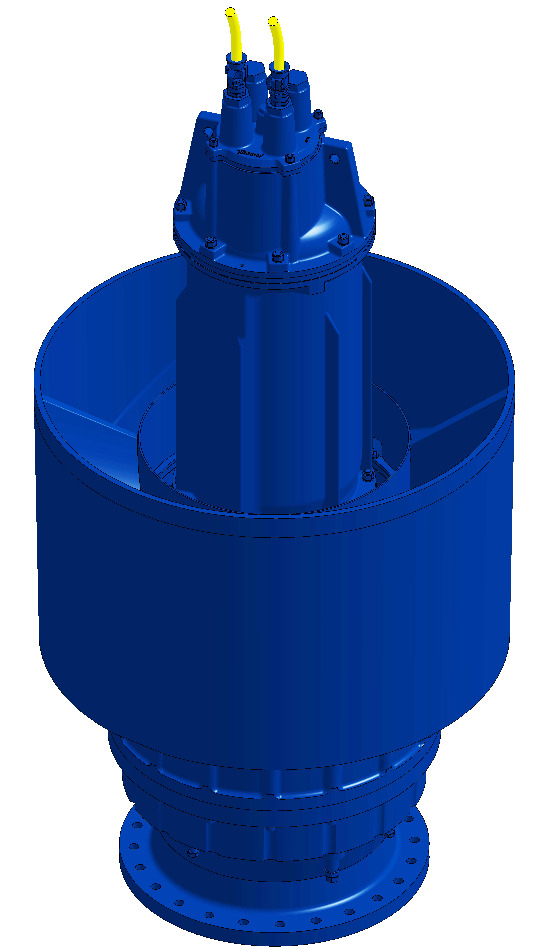
Key features
The screw centrifugal impeller keeps a large clear passage through the wet end, so rag and solids go through rather than binding on the vane.
Absorbed power stays flat over the whole performance range, so the motor is not overloaded when the duty point moves.
Flow holds up as the discharge level rises, which is what a drainage station asks of a pump during a storm.
Hidrostal states the combination of a large free ball passage and a relatively low motor speed suits duties where live fish have to pass through the pump.
The pump seats on a horizontal contact face and seals against the sump on its own mass, using the supplied elastomer sealing ring and a mechanical anti-rotation device.
Cast iron is standard; ductile iron, Hidrohard, stainless steel and Duplex are available where the medium carries grit.
About the Hidrostal Axial Column Pump
The Hidrostal Axial Column Pump is a high-flow, low-head machine, and the head figure is what rules it in or out. The range runs to 1500 l/s but only to 20 m of discharge head. Land drainage, rainwater and flood pumping stations, watering and drainage systems, coastal and flood protection, water regulation: duties where the flow is high and the lift is short. Hidrostal also names return activated sludge and oily water, where the low-shear handling of the screw centrifugal impeller matters more than the head.
If your duty needs pressure rather than volume, this is the wrong pump and no amount of sizing will fix that. Tell us the total dynamic head first and we will say so before you get as far as a quotation. Above 1500 l/s the range stops as well; larger flows, up to 10,000 l/s, come from Bedford Pumps, part of the Hidrostal Group, using other impeller types.
The mistake we see most often on drainage stations is not the pump at all. It is a suction arrangement that was never checked against what the pump needs, or a flow rate that has picked up a safety margin at every stage of the design. Send us the sump geometry and the pipework with the flow figure, and we will check the duty before we size anything.
How the Hidrostal Axial Column Pump works
The pump replaces the volute of a conventional submersible with a pipe casing that discharges axially, so the whole unit sits inside a vertical tube chamber rather than a wet well. Water enters through a fixed suction cover, or an adjustable wear cone where the medium is abrasive, and is driven up the column by the screw centrifugal impeller. The impeller is the reason the pump passes solids: it works with a large free ball passage and low shear, which is why Hidrostal specifies the same hydraulic for return activated sludge and for fish passage.
Sealing and motor
The shaft is sealed by a double mechanical seal in a tandem arrangement with barrier fluid. The drive is a Hidrostal submersible motor, cooled by the pumped liquid, with built-in circuit breakers monitoring winding temperature to protect against overload. Shaft power runs from 1.5 kW to 250 kW at 375–1500 rpm, on 50 Hz, 60 Hz or through a frequency converter. Options include a conductivity probe and float switch for mechanical seal leakage, bearing temperature sensors at both bearing locations, and screened cables where electromagnetic radiation is a concern.
Installation
The pump is lowered into the vertical tube chamber and rests on the horizontal contact surface. The elastomer sealing ring supplied with it, loaded by the mass of the pump, seals against the sump. A mechanical anti-rotation device holds it against starting torque. The tube chamber and the pump sump stay separate, and the pump lifts out on a permanent or mobile crane for maintenance.
Hazardous areas
Hidrostal offers submersible motors for the Axial Column Pump for use in potentially explosive atmospheres as an option. Certification applies to a specific build, so send us the zone classification for the station and we will get the certificate for the exact motor and pump from Hidrostal before anything is ordered.
Specifications
| Flow rate | 6–1500 l/s | |
|---|---|---|
| Discharge head | up to 20 m | |
| Tube chamber diameter | 400–1500 mm | 16–60 inch |
| Hydraulic efficiency | over 82% | peak figure quoted by Hidrostal |
| Impeller | Hidrostal screw centrifugal impeller | |
| Suction cover | Fixed, or adjustable wear cone | wear cone interchangeable |
| Shaft seal | Double mechanical seal, tandem arrangement with barrier fluid | |
| Materials of construction | Cast iron, ductile iron, Hidrohard, stainless steel, Duplex | cast iron is the standard build |
| Motor shaft power | 1.5–250 kW | |
| Motor shaft speed | 375–1500 rpm | |
| Supply | 50 Hz, 60 Hz, or frequency converter | |
| Motor materials | Cast iron, stainless steel, Duplex | |
| Hazardous area | Submersible motors available for potentially explosive atmospheres | optional; certification is per build |
Send us the flow rate, the static and discharge levels, the tube chamber diameter you have or can build to, and what the water carries. We will size the Axial Column Pump against the duty point and tell you if a different Hidrostal range fits it better.
Documents & downloads
Related pumps
View all →
Frequently asked
What flow and head does the Hidrostal Axial Column Pump cover?
6–1500 l/s at discharge heads up to 20 m. It is a low-head, high-flow pump, so the head figure is usually the one that decides whether it fits your duty.
What size tube chamber does it need?
Tube chamber diameters run from 400 mm (16 inch) to 1500 mm (60 inch). The pump is lowered in, seats on the horizontal contact surface and seals against the sump using its own mass and the elastomer sealing ring supplied with it.
Can it be used in a hazardous area?
Hidrostal offers submersible motors for this pump for use in potentially explosive atmospheres as an option. Certification covers a specific build, so tell us the zone classification and we will get the certificate for the exact pump and motor from Hidrostal.
What if my duty is above 1500 l/s?
The Axial Column Pump range stops at 1500 l/s. Bedford Pumps, part of the Hidrostal Group, covers flows up to 10,000 l/s with other impeller types, and we can take that enquiry the same way.
Will it handle grit and abrasive water?
Cast iron is the standard build. For abrasive media, Hidrostal supplies wearing parts in material combinations with higher wear resistance, including Hidrohard, stainless steel and Duplex, and an adjustable wear cone in place of the fixed suction cover.
Is it suitable for pumping live fish?
Hidrostal states the pump suits fish passages, on the basis of the large free ball passage and the relatively low motor speed. Send us the passage duty and the species, and we will put the question to Hidrostal with it.