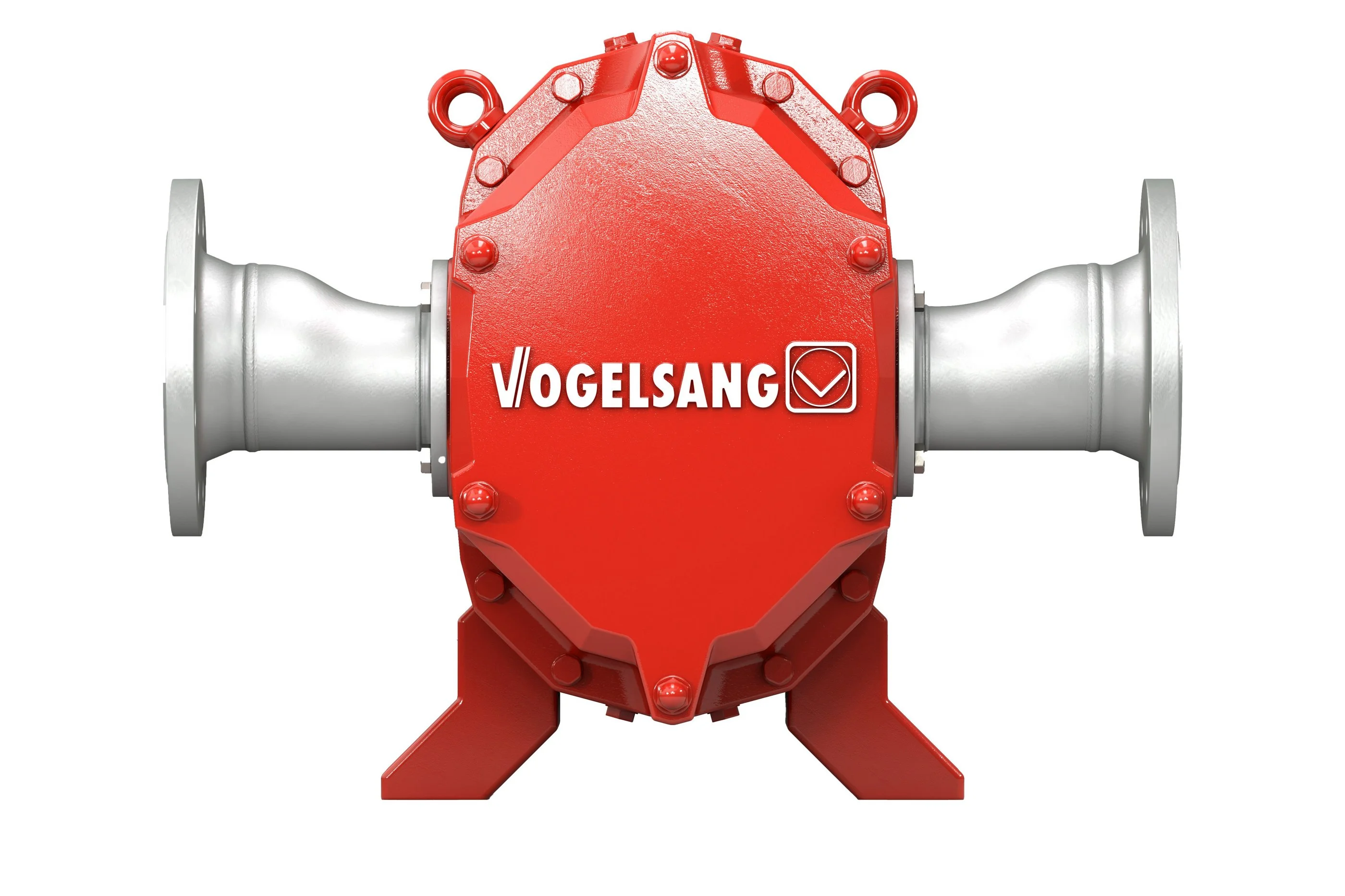
Key features
An atmospheric gap separates the two. If the pump chamber leaks, the liquid drains outwards instead of into the gearbox, and the gearbox stays clear of the heat coming off a hot medium.
The housing is a single casting with few welds, ribs and grooves, so there is little dead space for product to sit in. Vogelsang states it can be cleaned to CIP and SIP guidelines.
Helical gears on the drive shafts spread the torque more evenly, which cuts noise and vibration. Thick shafts, hardened and ground tooth faces and stiff tapered roller bearings are what let it hold 18 bar continuously.
Quality-Cartridge, CoX-Cartridge, or the API-Cartridge, a double mechanical seal to API 682 guidelines that Vogelsang supplies on the EP series only.
Axial and radial wear plates in wear-resistant special steel, with the radial plates bolted from outside so they come out without dismantling the lobes.
Straight double-wing lobes, or 3-wing, 4-wing and 6-wing HiFlo lobes, in elastomers from NBR through EPDM, CSM, FKM and PU, or in stainless or nitrided steel.
About the Vogelsang EP series
The Vogelsang EP series is the high-pressure, high-temperature end of the Vogelsang rotary lobe range. Vogelsang developed it for duties that used to go to screw, gear or progressive cavity pumps: oil and gas, sugar production, paints and varnishes, adhesives, paper, and tank farms. Both ends of the viscosity scale are in scope. Thin, low-viscosity media are as hard on a pump as thick ones, because the flow is higher and the pressure is up with it.
The EP series is the wrong pump for most wastewater work, and that is worth saying before you get a price. If you are moving sewage sludge or manure at two or three bar, it is more pump than the duty needs and you pay for the gearbox twice, once at purchase and once in the space it takes. That is a VX series job. The EP earns its money where the differential pressure is genuinely high, the medium is hot or chemically aggressive, or a plant standard dictates the sealing arrangement.
The weak point in a rotary lobe pump is the seal, and that is where most of the specification effort should go. A mechanical seal needs liquid to lubricate it, so a dry run costs you the seal whatever the pump. Tell us the medium, its temperature, whether it is abrasive and what a seal failure would do to the process, and the seal choice follows from that rather than from the pump size.
How the Vogelsang EP series works
Two lobed rotors turn against each other inside the pump chamber, carrying a fixed volume of medium round the outside of the chamber on each revolution. The rotors are driven through the gearbox so they never touch each other, and delivery rate follows shaft speed directly, which is why Vogelsang offers a speed sensor as the basis for flow measurement and control. Because the displacement is positive, flow holds up as the discharge pressure rises, which is the whole reason a lobe pump is chosen over a centrifugal for this kind of duty.
The gearbox and the AirGap
The EP series gearbox uses helical gears on the drive shafts. Torque transmits more evenly than with straight-cut gearing, so the pump runs quieter and puts less vibration into the adjacent pipework. Bend-resistant shafts, hardened and ground tooth faces, stiff tapered roller bearings and wide bearing spacing are what carry 18 bar in continuous duty. Between the gearbox and the pump chamber sits the AirGap, an atmospheric separation. A leak in the chamber drains to outside rather than into the gear oil, and the gearbox is shielded from the temperature of the medium.
Wetted materials
Grey cast iron is the standard build. ADI and stainless steel versions are stocked, and Vogelsang will make pump chamber components in duplex steel or a nickel-based alloy on request, with heat treatment and wear-resistant coatings available for the wear plates and housing parts. The pump chamber connects to the pipework through a Quick connection with O-ring sealing, rated for high flange loads. The QuickService design gives access to the wetted parts without taking the pump out of the line.
Sealing and seal support
Vogelsang offers three cartridge seals for the EP series. The Quality-Cartridge is the standard. The CoX-Cartridge is a double mechanical seal with coaxially arranged seal pairs for high pressures and temperatures, and Vogelsang states it is TA-Luft compliant. The API-Cartridge is a double mechanical seal to API 682 guidelines, including the flushing plans, and is supplied on the EP series only. Vogelsang also offers the Automatic Supply Unit, a compact seal support system that holds the seal chamber at 2.0 bar for applications up to 3 bar differential pressure, or at 4.3 bar for 3–7 bar differential.
Hazardous areas and standards
Vogelsang states that an ATEX-compliant version of the EP series can be supplied for use in areas subject to explosion hazards, and lists TA-Luft conformity as an option. Certification applies to a specific build, not to a range, so send us the zone classification and the medium and we will get the paperwork for the exact pump from Vogelsang before you order.
Specifications
| Maximum differential pressure | 18 bar | continuous duty |
|---|---|---|
| Medium temperature | up to 200°C | |
| Model | EP136 | |
| Housing | One-piece casting, steel or stainless steel | |
| Pump chamber materials | Abrasion-resistant grey cast iron, ADI, stainless steel | duplex steel or nickel-based alloy on request |
| Wear plates | Axial and radial, wear-resistant special steel | radial plates bolted from outside |
| Lobe geometry | Straight double-wing, or 3-wing, 4-wing and 6-wing HiFlo | |
| Lobe materials | NBR, NBR white, EPDM-SL, EPDM-AL, EPDM white, CSM, FKM, PU, stainless steel, nitrided steel | |
| Seal options | Quality-Cartridge, CoX-Cartridge, API-Cartridge | API-Cartridge is EP series only |
| Seal support | Automatic Supply Unit at 2.0 bar or 4.3 bar seal chamber pressure | 2.0 bar up to 3 bar differential; 4.3 bar for 3–7 bar differential |
| Pipe connection | Quick connection with O-ring sealing | designed for high flange loads |
| Cleaning | CIP and SIP conformity | |
| Hazardous area | ATEX-compliant version available | option; certification covers a specific build |
| Emissions | TA-Luft conformity available |
Send us the medium, its temperature and viscosity, the differential pressure across the pump and the flow you need. We will size the EP136 against it, or tell you a lighter Vogelsang range does the same job for less.
Documents & downloads
Related pumps
View all →
Frequently asked
What pressure and temperature can the Vogelsang EP series handle?
Continuous differential pressures up to 18 bar and media up to 200°C. Vogelsang designed the series specifically for those conditions, including abrasive, chemically aggressive and ignitable media.
What models are in the EP series?
Vogelsang lists one model, the EP136. The build varies considerably underneath that designation, through the housing material, the lobe geometry and material, the wear plates and the seal cartridge.
Is the Vogelsang EP series available for hazardous areas?
Vogelsang states an ATEX-compliant version can be supplied for use in areas subject to explosion hazards. Certification covers a specific build rather than the range, so tell us the zone classification and we will get the documentation for your exact pump.
Can the EP series be cleaned in place?
Yes. The one-piece housing has little dead space, and Vogelsang states the pumps can be flushed and disinfected to CIP and SIP guidelines.
What mechanical seals does the EP series take?
Three cartridge options: the Quality-Cartridge, the CoX-Cartridge double mechanical seal for high pressure and temperature, and the API-Cartridge to API 682 guidelines, which Vogelsang supplies on the EP series only.
Is the EP series the right pump for sludge or slurry?
Usually not. Sludge and manure duties rarely need 18 bar or 200°C, and a lighter Vogelsang rotary lobe range will do the same work for less capital and less installed space. Send us the duty and we will say which one.