Key features
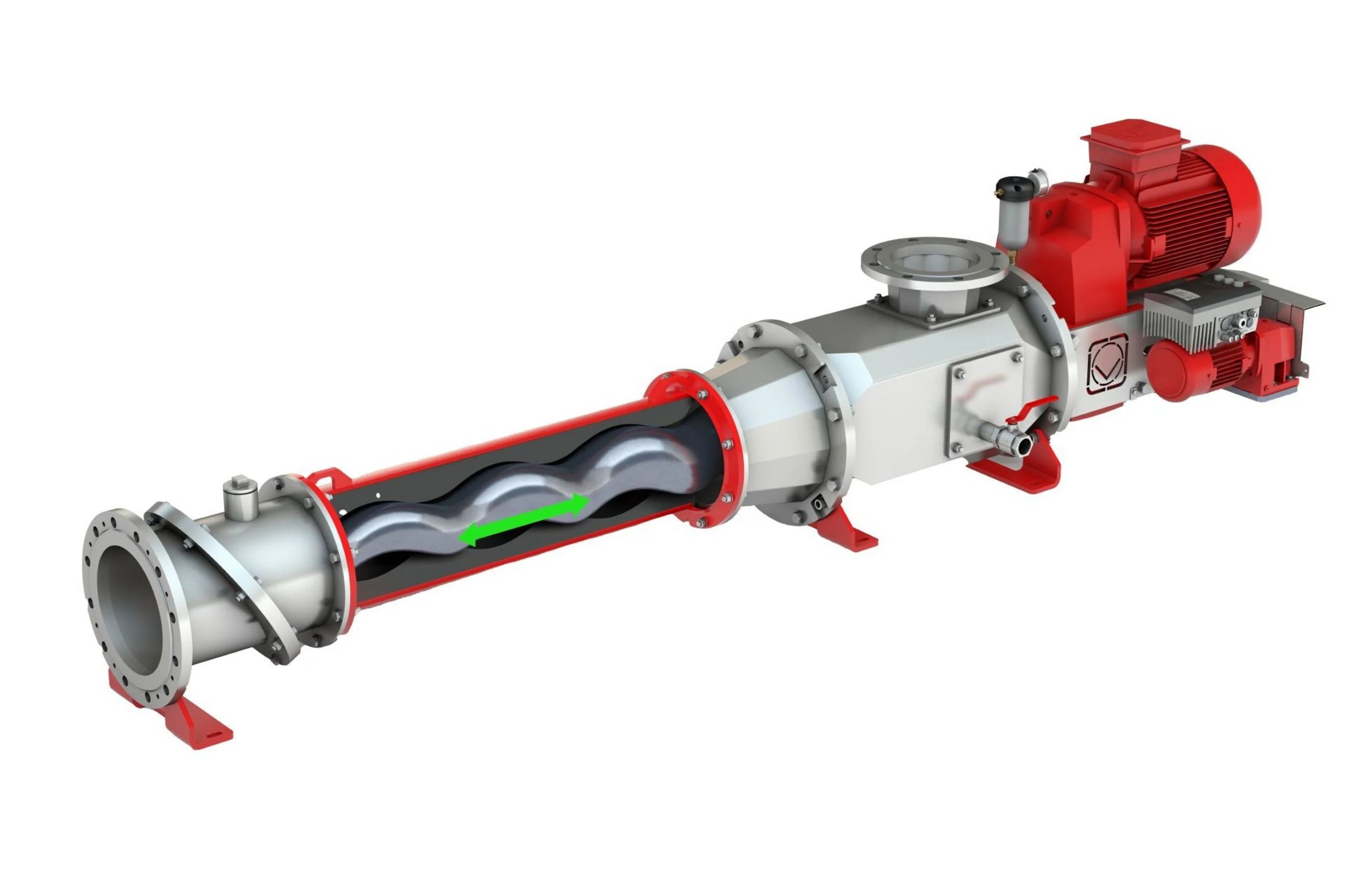
The conical rotor and stator geometry lets you restore the clamping between them in service, instead of replacing parts.
The pump shows its wear status in real time, so a stator change becomes a planned job rather than a surprise.
The rotor and stator unit swivels out for replacement without dismantling the suction or discharge pipework.
The start-up sequence lowers the power demand, and with it the cost of the drive electronics.
Delivery rate holds as pressure changes, as you'd expect from a positive displacement pump.
Large solids pass through, with free passage from 48 mm on the smallest size to 98 mm on the largest.
About the Vogelsang HiCone
Every progressive cavity pump wears the same way. The rotor turns inside an elastomer stator, the medium is abrasive, and the interference between the two gradually opens into a gap. Delivery falls away, and on a conventional pump the fix is a new stator and the downtime that goes with it.
The HiCone changes what you do about that. Its rotor and stator taper towards the discharge, so moving the rotor along its axis closes the clearance back up. You adjust, in service, and the pump is back at its duty point. The pump also monitors the conveying elements and displays the wear status, so you order the spare parts before you need them.
Vogelsang aims the HiCone at biogas, wastewater, agricultural and industrial duties: digestate, slurry and sewage sludge, the thick, solids-laden media that wear stators quickly. That is where the adjustment system earns its keep. On thin, clean liquid it is the wrong pump; the trade rule of thumb is that positive displacement starts to make sense above roughly 3–4% solids, and below that a centrifugal pump usually does the job for less.
We supply and support Vogelsang pumps in the UK. Send us the medium, the flow and the pressure and we'll tell you which size, or whether a different pump suits the duty better.
How the Vogelsang HiCone works
A progressive cavity (PC) pump turns a helical rotor inside a stator. Sealed cavities form between the two and progress from suction to discharge as the rotor turns, so delivery is proportional to speed and holds near-constant as pressure changes.
The difference is the geometry. Rotor and stator are conical, tapering towards the discharge, and the rotor's axial position sets the clamping between them. As the stator wears, the adjustment system moves the rotor to restore the fit, and the same adjustment adapts the pump to the operating conditions: pressure, temperature and the state of wear. The automatic start-up sequence brings the pump up with lower power demand, which also reduces what you spend on drive electronics.
Service follows Vogelsang's QuickService principle. The rotor and stator unit swivels out and can be replaced without dismantling the suction or discharge pipework, drive shaft included. The pre-assembled mechanical seal is replaced from the side once the geared motor is removed.
Two limits worth knowing before you specify one. Pressure tops out at 12 bar across the range, and the two larger sizes run at 300 rpm rather than 350. And no adjustment system compensates for dry running: a PC pump that runs dry burns through its stator and damages the rotor, so protect the suction side as you would on any PC pump.
Specifications
| Sizes | HiCone 44, 55, 66, 77 | |
|---|---|---|
| Maximum delivery rate | 37–290 m³/h | 37 / 75 / 150 / 290 m³/h by size |
| Maximum pressure | 12 bar | all sizes |
| Maximum speed | 300–350 rpm | 350 rpm on the 44 and 55; 300 rpm on the 66 and 77 |
| Free passage | 48–98 mm | 48 / 62 / 78 / 98 mm by size |
Documents & downloads
Related pumps
View all
Frequently asked
How does the HiCone compensate for wear?
The rotor and stator are conical, so moving the rotor along its axis restores the clamping between them as the stator wears. The adjustment is made during operation, and the pump displays its wear status so you can see when an adjustment or a stator change is due.
What flow rates does the Vogelsang HiCone cover?
Four sizes. The HiCone 44 delivers up to 37 m³/h and the HiCone 77 up to 290 m³/h, all at up to 12 bar. Speed is limited to 350 rpm on the two smaller sizes and 300 rpm on the two larger ones.
Can the HiCone be serviced without removing the pipework?
Yes. The rotor and stator unit swivels out and can be replaced without dismantling the suction or discharge pipework, including the drive shaft if needed. The mechanical seal is pre-assembled and is changed from the side after the geared motor is removed.
Can a HiCone run dry?
No. Like any progressive cavity pump, it relies on the medium to lubricate the rotor and stator. Run one dry and it burns through the stator and damages the rotor. The adjustment system compensates for wear, not for a starved suction line, so fit dry-running protection.