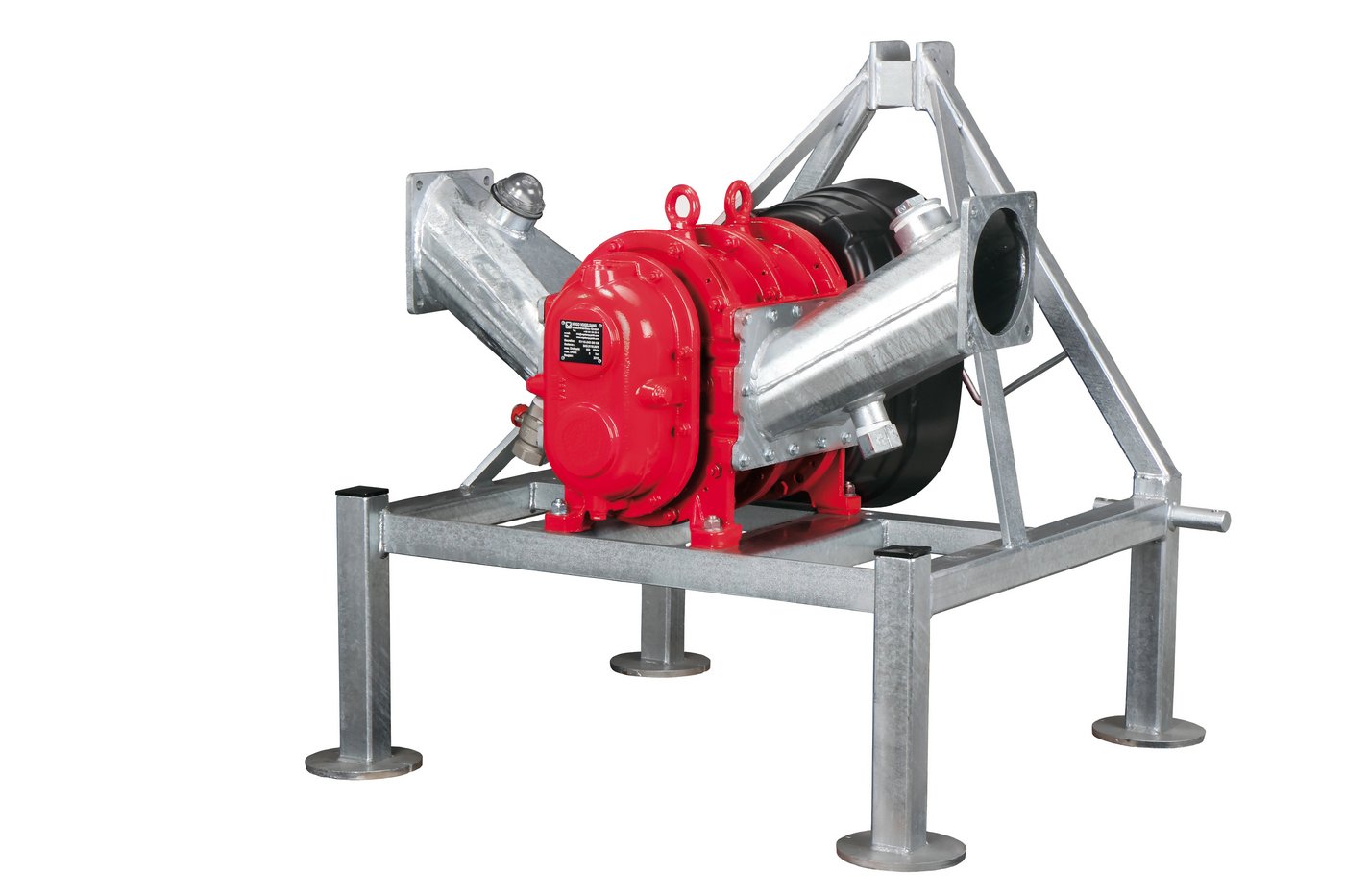
Key features
The R116 covers 750 to 4,500 l/min across six sizes and the R136 800 to 5,000 l/min across seven, so you can match a tanker fill time rather than round up to the next pump.
One pump fills the tanker and empties it. Vogelsang's stated payoff is fewer pipes on the vehicle, and the same pump then works off a base as a mobile unit.
Vogelsang lists the R series as self-priming, very resistant to dry running, and able to prime even from deep pits.
Highly wear-resistant special steel across the face sides of the pump chamber, which is where a slurry pump wears first. Vogelsang credits it with longer maintenance intervals.
Vogelsang's foreign-matter protection is offered on request, and on the R136 only. If the store has straw and stones in it, that decides which range you buy.
Cardan shaft, hydraulic motor, geared motor or combustion motor, so the same pump goes on the tanker, on a three-point base or on a skid.
About the Vogelsang R series
Vogelsang's own line for the R series is keep it simple: all the necessary functions for little money. That is a fair description of it. The pump has a double bearing, a large shaft diameter and a basic selection of sizes, lobes and materials, and Vogelsang sells it for the jobs a farm actually has. Slurry around the yard, filling and draining a tanker, or a mobile pump on a base.
Agriculture is where it belongs and where it should stay. The specification says so plainly: a grey cast iron pump chamber, straight rotary lobes, 5 bar, 650 rpm. Put it on a sewage works, a digester recirculation line or an industrial transfer duty and you are asking a farm pump to do process work. That job wants the VX series, which carries the wear plate options, the seal choices and the pressure to go with them, and costs accordingly.
The sizes
| Series | Size | Max. pressure | Max. capacity |
|---|---|---|---|
| R116 | 60 | 5 bar | 750 l/min |
| R116 | 120 | 5 bar | 1,500 l/min |
| R116 | 180 | 5 bar | 2,250 l/min |
| R116 | 240 | 5 bar | 3,000 l/min |
| R116 | 300 | 4 bar | 3,800 l/min |
| R116 | 360 | 3 bar | 4,500 l/min |
| R136 | 70 | 5 bar | 800 l/min |
| R136 | 105 | 5 bar | 1,200 l/min |
| R136 | 140 | 5 bar | 1,650 l/min |
| R136 | 210 | 5 bar | 2,500 l/min |
| R136 | 280 | 5 bar | 3,300 l/min |
| R136 | 350 | 5 bar | 4,100 l/min |
| R136 | 420 | 5 bar | 5,000 l/min |
Two things in that table are worth a second look. The first is the pressure on the R116: the top two sizes derate, to 4 bar at size 300 and 3 bar at 360. The R136 holds 5 bar right across its range. So if the duty is high flow at full pressure, the answer is an R136, not the biggest R116 you can find.
The second is Vogelsang's own footnote on the capacity column. Those are maximum theoretical capacities. What you get in service is lower, and how much lower depends on the differential pressure, the viscosity of the slurry and how the pump is installed. Size against the theoretical figure and you will be short on the day you need it.
R116 or R136
The R116 is the occasional-use pump. Tanker filling, moving slurry between stores, work measured in hours a week rather than hours a day. The R136 is the one to have if there is anything in the medium beyond slurry, because the InjectionSystem is offered on the R136 only. Straw, stone and the rest of what finds its way into a store is what shortens a lobe pump's life on a farm, and that option is the difference between the two ranges once you are past the flow figures.
What we need from you to specify it
The build matters more than the size, and the build is the part that gets skipped. The lobe elastomer has to suit the medium, and on a farm that means the bedding, the dosing chemicals and anything else going into the store, not just the slurry. Tell us the flow you want and the time you have to move the volume in, the suction lift and the pipe run, what is in the medium, and how the pump will be driven. The drive is a real question here rather than a formality, because a cardan shaft off a tractor and a geared motor on a base lead to different pumps.
How the Vogelsang R series works
Two lobed rotors turn in opposite directions inside the pump chamber and carry the medium round the outside from the suction side to the discharge side. That is the rotary lobe principle, and it is why the flow holds up as the discharge pressure rises instead of falling away as it would on a centrifugal. Vogelsang rates every size in the R series to a maximum of 650 rpm.
The lobes are straight, and Vogelsang sets them in an offset arrangement so the pump runs with low pulsation. That matters more on a tanker than it looks on paper, because pulsation goes into the pipework, the drive line and the coupling. Reverse the drive and the pump runs the other way, which is how one pump both fills and empties the vehicle.
Wear, and what protects the chamber
The pump chamber is grey cast iron, chosen for its anti-friction behaviour and its resistance to abrasive wear. The face sides take the greater strain, so Vogelsang protects them with high-strength special steel plates. Those axial wear plates are highly wear-resistant special steel and they cover the whole chamber, which is the difference between changing a plate and changing a housing. Alongside the standard grey cast iron build, Vogelsang stocks ADI and stainless steel versions, and will make the pump chamber components in duplex steel or a nickel-based alloy on request, with heat treatment and wear-resistant coatings available for the wear plates and housing parts.
Lobes are the other consumable. Vogelsang develops its own elastomer compounds for the material that surrounds the lobe core, and names NBR and FKM as the examples for the R series. The wider set it lists under the R series features runs to NBR, NBR white, EPDM-SL, EPDM-AL, EPDM white, CSM, FKM, PU, stainless steel and nitrided steel.
Foreign matter
Stone and grit are what a slurry pump dies of. The R series can be supplied with a stone trap, and Vogelsang shows it working in combination with a foreign matter separator upstream. On the R136 there is a third defence: the InjectionSystem, which Vogelsang offers on request for improved resistance to foreign matter. Take the separator seriously whichever range you choose. Protecting the pump upstream is cheaper than replacing lobes, and it is the same argument we make on a sewage works about grit.
Drive
Cardan shaft, hydraulic motor, geared motor or combustion motor. That spread is what lets one pump range cover a tractor-driven tanker, a fixed installation on a base and a mobile set, and it is why the drive belongs in the enquiry rather than after it.
Specifications
| Ranges | R116, R136 | |
|---|---|---|
| R116 capacity | up to 4,500 l/min | six sizes, from 750 l/min |
| R116 pressure | up to 5 bar | 4 bar at size 300 and 3 bar at size 360 |
| R136 capacity | up to 5,000 l/min | seven sizes, from 800 l/min |
| R136 pressure | up to 5 bar | across every size |
| Maximum speed | 650 rpm | |
| Capacity basis | Maximum theoretical capacity | lower in practice, depending on differential pressure, medium viscosity and installation |
| Pump chamber | Grey cast iron | face sides protected by high-strength special steel plates |
| Material options | ADI and stainless steel stocked; duplex steel or a nickel-based alloy on request | heat treatment and wear-resistant coatings also offered |
| Wear protection | Axial wear plates in highly wear-resistant special steel | |
| Lobe design | Straight rotary lobes in an offset arrangement | |
| Lobe materials | NBR, NBR white, EPDM-SL, EPDM-AL, EPDM white, CSM, FKM, PU, stainless steel, nitrided steel | Vogelsang names NBR and FKM as the R series examples |
| Bearings | Double bearing | |
| Flow direction | Reversible | |
| Foreign matter protection | InjectionSystem on the R136, on request | also available with a stone trap |
| Drive types | Cardan shaft, hydraulic motor, geared motor or combustion motor |
Send us the volume you need to move and the time you have to move it in, the suction lift and the pipe run, what is in the slurry, and how the pump will be driven. That is enough to size an R116 or an R136, choose the lobe material and tell you whether you need the InjectionSystem. If the duty is really process work rather than farm work, we will say so and quote the right range instead.
Documents & downloads
Related pumps
View all →
Frequently asked
What flow rate can a Vogelsang R series pump deliver?
The R116 reaches up to 4,500 l/min across six sizes and the R136 up to 5,000 l/min across seven. Both are maximum theoretical capacities. The delivered flow is lower and depends on the differential pressure, the viscosity of the medium and how the pump is installed.
What is the difference between the R116 and the R136?
Capacity and foreign-matter protection. The R116 runs to 4,500 l/min and derates to 4 bar at size 300 and 3 bar at size 360; the R136 runs to 5,000 l/min and holds 5 bar across every size. Vogelsang also offers the InjectionSystem on the R136 only, on request, which is the option to have where there is straw and stone in the store.
What pressure does the Vogelsang R series run at?
Up to 5 bar. Every R136 size is rated to 5 bar, and so are the R116 sizes up to 240. The R116 at size 300 is rated to 4 bar and at size 360 to 3 bar.
Can a Vogelsang R series pump run dry?
Vogelsang lists the R series as very resistant to dry running, which is a design property rather than permission to do it. A mechanical seal still needs liquid to lubricate it. If the pump is running dry, the fault is the suction conditions or a valve somebody left shut, and that is where the fix belongs.
Will the R series pump in both directions?
Yes. The flow direction reverses, so the same pump fills a tanker and empties it. Vogelsang's point about it is that it cuts the number of pipes needed on the vehicle.
Is the R series the right pump for a sewage works?
No. It is built and priced as an agricultural slurry pump, at 5 bar and 650 rpm in a grey cast iron chamber. Municipal and industrial duties want a heavier rotary lobe range with the wear plate, seal and pressure options to match. Send us the duty and we will point you at the right one.
- 1Vogelsang UK — R series rotary lobe pump
- 2Vogelsang — Powerful and reliable agricultural technology (agricultural brochure; R series pages 8–11, also covers the FX series and Vogelsang's agricultural cutters)
- 3Vogelsang — Solutions for efficient slurry management (slurry brochure; R series on the 34 | 35 spread, FX116 on the 32 | 33 spread, also covers the ProCap T and the spreading technology)