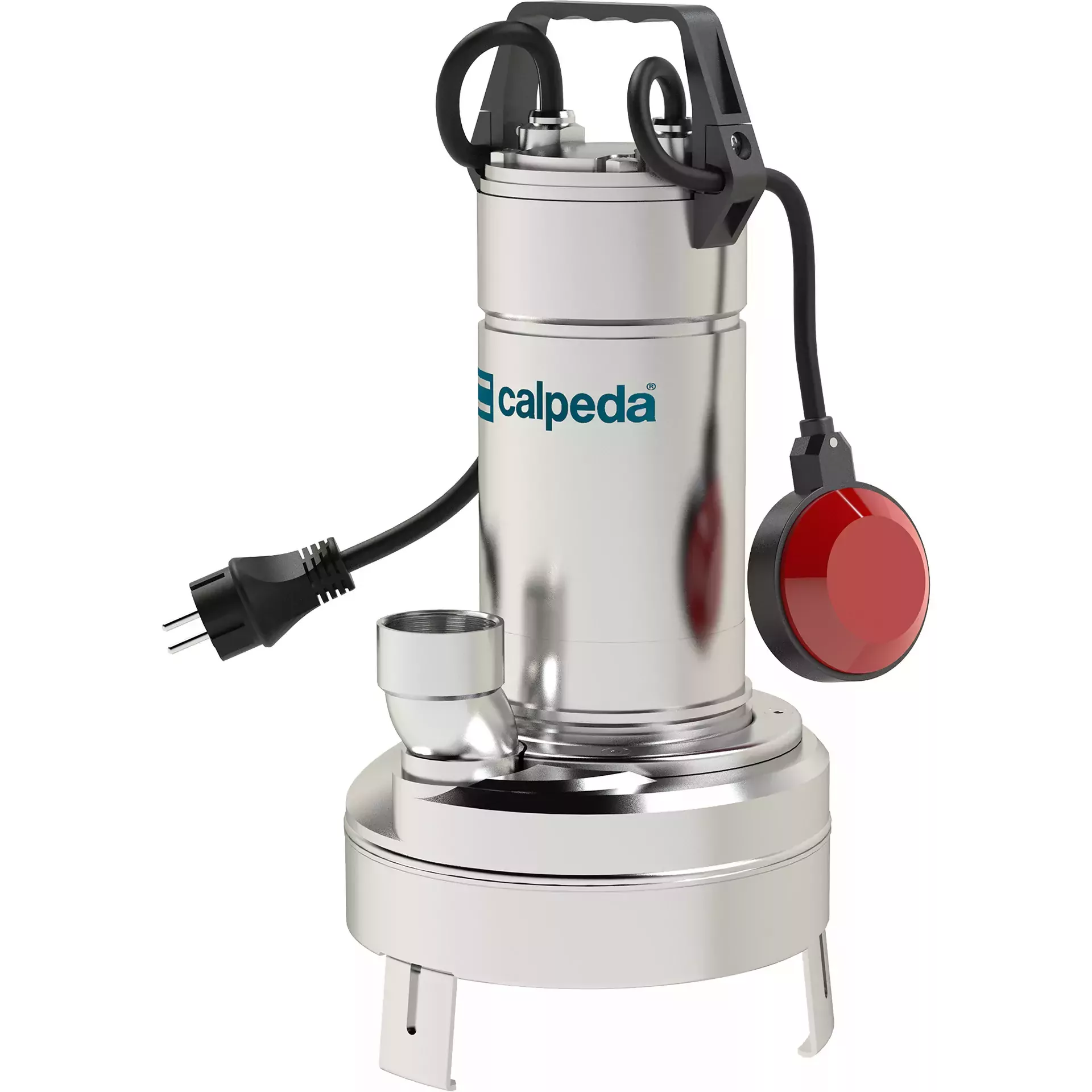
Key features
The GXC 40 runs a two-passage impeller and the GXV 40 a free-flow vortex. Body, motor, seal and the 35 mm solids passage are common to both. Only the wet end and the curve change.
Pump casing, impeller, motor jacket, jacket cover, casing cover and shaft are all 1.4301 (AISI 304). The handle is polypropylene on a 1.4301 frame.
Two mechanical seals, ceramic against carbon with NBR at both, with 0.08 litres of white oil for food and pharmaceutical machinery between them.
GXCM and GXVM carry a capacitor, a thermal protector, a float switch and a plug on 10 m of H07RN-F. On three-phase the overload device is yours to fit.
Calpeda rates the range for clean and dirty water carrying solids to 35 mm grain size, discharging through a G 1½ (DN 40) ISO 228 vertical port.
Liquid to 35°C, 5 m maximum immersion, 30 starts an hour at regular intervals, and a working pressure ceiling of 25 m (2.5 bar).
About the Calpeda GX 40
The GX 40 is the stainless drainage and sewage end of Calpeda's submersible range. It is a single-impeller pump in chrome-nickel stainless steel with a vertical delivery port, and Calpeda puts it on clean and dirty water carrying solids up to 35 mm grain size. It is 2-pole, 0.55 kW to 0.9 kW, on a G 1½ (DN 40) connection, and it goes in the sump on the end of a hose or a screwed pipe rather than onto guide rails.
Size it against the 50 Hz datasheet, not against a summary range. The tables are where the frames are. There are three rated outputs, 0.55, 0.75 and 0.9 kW, and the widest curve in the range stops at 26 m³/h and 12.9 m, both on the GXC 40-13.
Calpeda also notes that the smooth rolled-stainless surfaces and the easy access for cleaning make this construction suitable for certain uses in the food industry. That is Calpeda's wording about the build, and on a wash-down floor it is worth having. Where the duty needs a certificate behind it, send us the specification and we will put it to Calpeda.
Two-passage or vortex, and what the vortex costs
Take the GXC 40 unless the medium will bind it. Here is what each side costs you.
A two-passage impeller is a proper hydraulic passage. The liquid goes through the vanes, so the pump converts the motor's work efficiently and holds a real duty point. A free-flow vortex works the other way round. The impeller is recessed up into the casing and drives the water by the swirl it sets up, so most of what you pump never reaches the vanes. That is why it takes rag and fibre a vane would catch, and it is also why it gives up so much duty.
Calpeda's own 50 Hz tables price it:
| Rating | Model | Head at zero flow | Head at 12 m³/h | Last tabulated point |
|---|---|---|---|---|
| 0.55 kW | GXC 40-10 | 10.4 m | 6.3 m | 21 m³/h at 3.2 m |
| 0.55 kW | GXV 40-7 | 7 m | 3.7 m | 15 m³/h at 3 m |
| 0.75 kW | GXV 40-8 | 8 m | 4.6 m | 18 m³/h at 2.8 m |
| 0.9 kW | GXC 40-13 | 12.9 m | 8.7 m | 26 m³/h at 4 m |
| 0.9 kW | GXV 40-9 | 9 m | 5.4 m | 21 m³/h at 2.4 m |
Read the 0.9 kW pair. At 12 m³/h the GXC 40-13 gives 8.7 m and the GXV 40-9 gives 5.4 m, for the same motor and the same 35 mm passage. At 21 m³/h the GXC is still holding 5.9 m while the vortex has fallen to 2.4 m and stopped. Suppose the duty is 15 m³/h at 7 m. The 0.9 kW GXC 40-13 sits on it with 7.8 m to spare at that flow. No GXV 40 in the range reaches it, because the biggest vortex build gives 4.5 m there. On the GX 40 the vortex does not cost you a frame size, it costs you the duty.
So the vortex has to earn that, and Calpeda's instruction manual says when it does: where the liquid has a high solid content or carries filamentous particles, use only the free-flow construction. Wipes, rag and fibre are that case. A two-passage impeller that blocks costs a lifted pump and a site visit every time, and that arithmetic beats a few metres of head quickly. Seepage, a flooded basement, a clean excavation or a rainwater sump is not that case, and the GXC is the right answer and the better pump on the duty.
Neither is a macerator. Where a chamber is putting through more rag than any impeller was going to clear, the fix is screening or maceration upstream, not a different wet end. The enquiry we decline most often is a like-for-like swap on a pump that keeps clogging when the pump already fitted was a good solids-handling pump.
Reading the designation, and one trap in it
Calpeda's key runs GX for the series, then the impeller letter, then M for single phase, then the port size, then the head. C is the two-passage impeller, V the free-flow vortex, and no M means three phase. So a GXCM 40-10 is a single-phase two-passage pump on a 40 mm port, and a GXV 40-9 is a three-phase vortex. The last number is Calpeda's total head figure in metres, and it lines up with the head at zero flow in the tables.
The trap is the middle number. On this range the 40 is the delivery port diameter in millimetres. On Calpeda's smaller stainless submersibles the same position carries the solids passage instead, so a GXV 25 is a 25 mm passage, not a 25 mm port, and it is a different, lighter pump on a G 1¼ connection. Two pumps in the catalogue wear a V and a two-digit number and they do not mean the same thing. If you are matching an existing unit, read the full designation and the serial number off the nameplate and send us both.
Where the GX 40 stops
The limits are set by the sump, not the pump. Liquid temperature stops at 35°C, and a single-phase motor run for long in water above that will trip its thermal protector and restart when the windings cool. Maximum immersion is 5 m. Maximum liquid density is 1100 kg/m³. Starts are limited to 30 an hour at regular intervals, which on a small chamber is a volume calculation as much as a pump selection. Calpeda's manual also puts a ceiling of 25 m (2.5 bar) on the working pressure in the casing, which the range's own 12.9 m of head never approaches.
Calpeda states plainly that the pump cannot be used in explosive or flammable environments, and that it must not be used in ponds, tanks or pools where people are in the water.
How the Calpeda GX 40 works
The GX 40 draws through the base of the pump, works the liquid with either a two-passage or a free-flow vortex impeller in 1.4301 stainless, and discharges up through a G 1½ ISO 228 port. The motor is a 2-pole induction motor running at about 2900 rpm at 50 Hz, rated for continuous duty with the motor submerged, IP X8 and insulation class F, with a triple-impregnation humidity-proof dry winding. Calpeda builds it to EN 60034-1, EN 60335-1 and EN 60335-2-41. The head and power figures in the tables hold for a liquid at density 1.0 kg/dm³ and a kinematic viscosity no higher than 20 cSt.
The two wet ends
Both builds pass 35 mm spherical solids, so free passage is not what separates them. What separates them is what happens to a length of fibre once it is inside. In the GXC it has to travel down a vane passage, and if it catches on a leading edge it stays there and collects more until the passage shuts. In the GXV it is carried round the open casing and out, because there is no vane in its path to catch on. You pay for that in efficiency, every hour the pump runs.
Two seals and an oil chamber
The shaft runs through a double shaft seal with an oil chamber between the two faces. Both the upper and the lower mechanical seal are ceramic against carbon with NBR elastomers, and the chamber holds 0.08 litres of white oil suitable for food machinery and pharmaceutical use. Wear the lower face and the oil chamber is still between the liquid and the windings.
Dry running is what kills the arrangement fastest. A mechanical seal needs liquid to lubricate it, and the faces go as soon as the film does. Calpeda's instruction is short on this: avoid running dry, and on a build without a float, start the pump only when it is fully immersed. On a drainage pump that usually means a level control that has stopped working, or somebody pulling the sump down further than the design allowed. Calpeda's manual also warns against taking the pump out of the water while it is still running.
The electrical side
Single-phase GXCM and GXVM builds run on 230 V ±10% with an incorporated capacitor, a thermal protector, a float switch and a plug, on 10 m of H07RN-F 3G1 mm² cable. Full load current is 4.6 A on both 0.55 kW builds, 5.4 A on the 0.75 kW GXVM 40-8, 6 A on the GXVM 40-9 and 6.6 A on the GXCM 40-13. Maximum power input runs from 1 kW to 1.45 kW, so size the supply against P1 rather than the rated 0.9 kW output.
Three-phase GXC and GXV builds run on 230 V or 400 V ±10% and come with cable and no plug. Calpeda's manual is explicit that you fit the overload-protective device in the control box, with a curve D characteristic set to the nameplate current, and that where the water level is not under direct visible control you add a float switch wired to the panel to set the start and stop levels. Full load current at 400 V is 1.6 A on the GXC 40-10 and the GXV 40-7, 2.2 A on the GXV 40-8 and 2.3 A on the GXV 40-9 and the GXC 40-13. Check the direction of rotation on first start; running backwards costs you delivery and can damage the mechanical seal.
A float switch on the three-phase build, other voltages, a 60 Hz build, a 20 m cable, a different mechanical seal and a motor suitable for inverter duty are all listed by Calpeda as available on request.
Installing and servicing it
Keep the internal diameter of the delivery pipe at G 1½ (DN 40) or larger, fit a check valve in the delivery against back flow, and arrange a gate valve and union so the pump can come out without draining the system. Where slime collects at the bottom of the pit, stand the pump on a support so it sits clear. Sand and grit are what wear a stainless drainage pump out, so on stagnant water or a river intake mount it on a flat surface raised off the ground. Use a rope or chain to lower and lift it, never the power cable.
To look at the impeller on a GXC or GXV, take out the nuts (12.20) and lift off the casing cover (12.00), then check the impeller turns freely by hand. The impeller itself comes off with the nut (28.04). After pumping muddy liquid, run the pump briefly on clean water before it stands idle. The oil chamber can be under slight pressure, so open the plug carefully.
Specifications
| Type | Single-impeller submersible pump, stainless steel, vertical delivery port | |
|---|---|---|
| Liquid handled | Clean and dirty water, also containing solids up to 35 mm grain size | |
| Impeller | Two-passage (GXC 40) or free-flow vortex (GXV 40) | |
| Flow rate | up to 26 m³/h | GXC 40-13, at 4 m |
| Total head | up to 12.9 m | GXC 40-13, at zero flow |
| Maximum solids passage | 35 mm | |
| Liquid temperature | up to 35°C | |
| Maximum liquid density | 1100 kg/m³ | |
| Maximum immersion depth | 5 m | |
| Maximum working pressure | 25 m (2.5 bar) | |
| Maximum starts per hour | 30 | at regular intervals |
| Rated power P2 | 0.55, 0.75 and 0.9 kW | |
| Maximum power input P1 | 1–1.45 kW | single-phase builds |
| Speed | about 2900 rpm | 2-pole, 50 Hz |
| Voltage | three-phase 230 V or 400 V ±10%; single-phase 230 V ±10% | |
| Full load current | 1.6–2.3 A at 400 V three-phase; 4.6–6.6 A single-phase | |
| Capacitor | 450 V, 16 µF or 25 µF | single-phase builds |
| Overload protection | Thermal protector built into the single-phase motor; fitted by the user in the control box on three-phase, curve D to the nameplate current | |
| Delivery connection | G 1½ ISO 228 (DN 40) | |
| Duty | Continuous, with the motor submerged | |
| Pump casing | Chrome-nickel steel 1.4301 EN 10088 (AISI 304) | |
| Impeller material | Chrome-nickel steel 1.4301 EN 10088 (AISI 304) | |
| Motor jacket, jacket cover and casing cover | Chrome-nickel steel 1.4301 EN 10088 (AISI 304) | |
| Shaft | Chrome-nickel steel 1.4301 EN 10088 (AISI 304) | |
| Handle | Polypropylene on a 1.4301 (AISI 304) frame | |
| Shaft seal | Double shaft seal with interposed oil chamber; upper and lower mechanical seals ceramic, carbon and NBR | |
| Seal lubrication oil | 0.08 litres of white oil for food and pharmaceutical machinery | |
| Protection degree | IP X8 | for continuous immersion |
| Insulation class | F | |
| Winding | Triple impregnation, humidity-proof dry winding | |
| Power cable | 10 m of H07RN-F 3G1 mm² | with plug on the single-phase builds |
| Sound pressure | under 70 dB(A) | at minimum immersion depth; it falls further once submerged |
| Height | 433–458 mm | |
| Weight | 10–13.3 kg | with the 10 m cable |
| Standards | EN 60034-1, EN 60335-1, EN 60335-2-41 |
Send us the flow, the total dynamic head, what the water is carrying and whether there is rag or fibre in it, and we will tell you whether this wants the GXC 40, the GXV 40 or a bigger pump on a different range. Give us the chamber dimensions too, because at 30 starts an hour the sump volume decides the frame as much as the duty does. Replacing an existing pump? Photograph the nameplate and send the full designation and the serial number.
Documents & downloads
Related pumps
View all →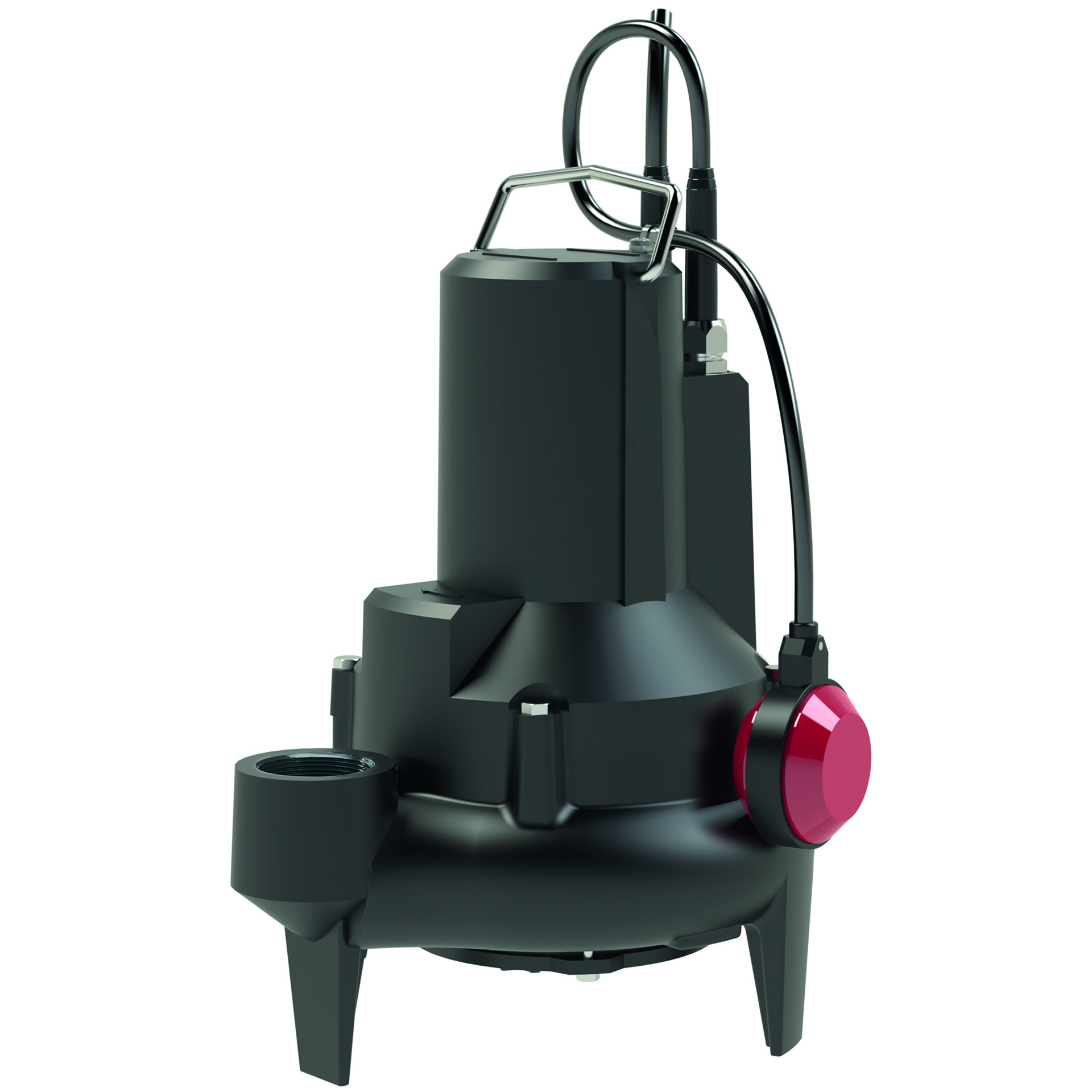
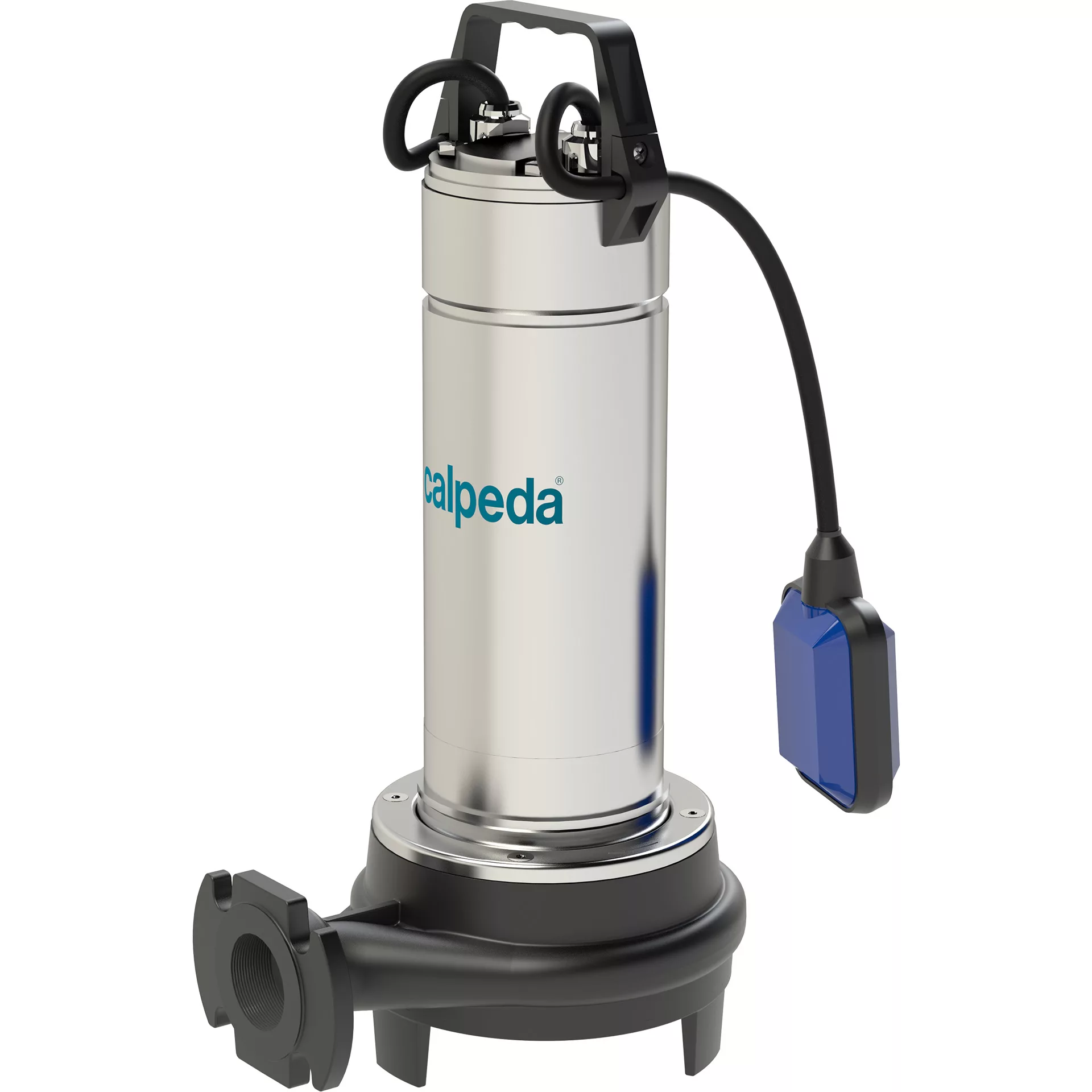
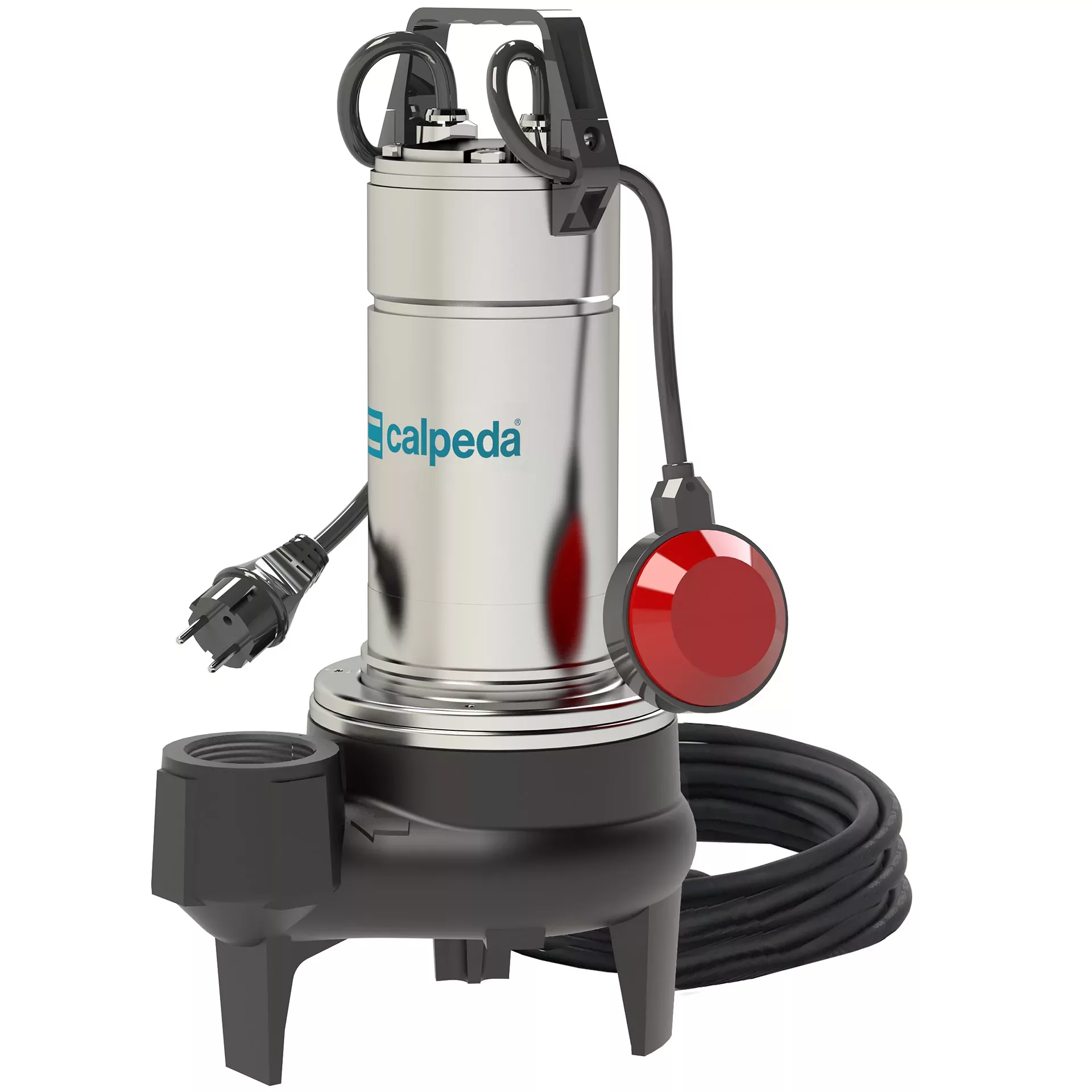
Frequently asked
What is the difference between the Calpeda GXC 40 and the GXV 40?
The impeller. GXC is a two-passage impeller and GXV a free-flow vortex. Both pass 35 mm solids in the same stainless body on the same motor ratings, but the vortex sits back out of the flow, so it fouls less and delivers less. At 12 m³/h the 0.9 kW GXC 40-13 gives 8.7 m and the 0.9 kW GXV 40-9 gives 5.4 m.
Should I choose a two-passage or a vortex impeller on the GX 40?
Take the GXC 40 unless the water carries wipes, rag or fibre that would wrap a vane. Calpeda's own manual says to use the free-flow construction only where the liquid has a high solid content or filamentous particles. Everywhere else the two-passage build holds a better duty point for the same motor.
What flow and head does the Calpeda GX 40 give?
The 50 Hz tables run to 26 m³/h and 12.9 m on the 0.9 kW GXC 40-13, and to 21 m³/h and 9 m on the 0.9 kW GXV 40-9. The smallest 0.55 kW GXC 40-10 reaches 10.4 m at zero flow and 21 m³/h at 3.2 m.
What size solids will a Calpeda GX 40 pass?
35 mm grain size, on both the GXC and the GXV build. Calpeda rates the range for clean and dirty water containing solids up to that size, and puts the free-flow GXV on liquids with a high solid content or filamentous particles.
Is the Calpeda GX 40 available single-phase?
Yes. GXCM 40-10, GXCM 40-13, GXVM 40-7, GXVM 40-8 and GXVM 40-9 all run on 230 V ±10% with a capacitor, a thermal protector, a float switch and a plug on 10 m of H07RN-F cable. Three-phase builds run on 230 V or 400 V and come without a plug.
Does a three-phase Calpeda GX 40 need separate overload protection?
Yes. Calpeda's manual gives the overload-protective device as something you install in the control box, with a curve D characteristic set to the nameplate current. The single-phase builds have a thermal protector in the motor already.
What temperature and depth can a Calpeda GX 40 handle?
Liquid up to 35°C and a maximum immersion of 5 m. Maximum liquid density is 1100 kg/m³. A single-phase motor run for long above 35°C will stop on its thermal protector and restart when the windings have cooled.
What does a designation like GXCM 40-10 mean?
GX is the series, C the two-passage impeller, M single phase, 40 the delivery port diameter in millimetres and 10 the total head in metres. V in place of C is the free-flow vortex impeller, and no M means three phase.
What connection does the Calpeda GX 40 take?
A G 1½ ISO 228 vertical delivery port, DN 40. Calpeda's manual says the internal diameter of the delivery pipe must never be smaller than the pump connection, so keep the hose or pipe at G 1½ or larger.
How often can a Calpeda GX 40 start?
30 times an hour at regular intervals. On a small chamber that is a wet volume calculation rather than a pump one, so send us the sump dimensions along with the duty.