Key features
Calpeda rates the GXV for clean or slightly dirty water carrying solids in suspension up to 25 mm grain size, on a G 1¼ delivery, across all three frames.
A free-flow vortex sits up out of the flow path and drives the water by the swirl it sets up. There is no vane in the solid's way to catch it.
The pumped water passes between the motor jacket and the external jacket on its way out, which is what lets the pump run continuously.
Alumina against carbon with NBR elastomers, with 0.04 litres of white oil for food and pharmaceutical machinery in the chamber between the faces.
GXVL 25-10 and GXVLM 25-10 are 1.4404 (AISI 316L) through the wetted path and give the same 10 m and 13.2 m³/h as the 1.4301 build.
GXVM carries a capacitor, a thermal protector, a float switch and a plug. On three-phase the overload device goes in your control box.
About the Calpeda GXV 25
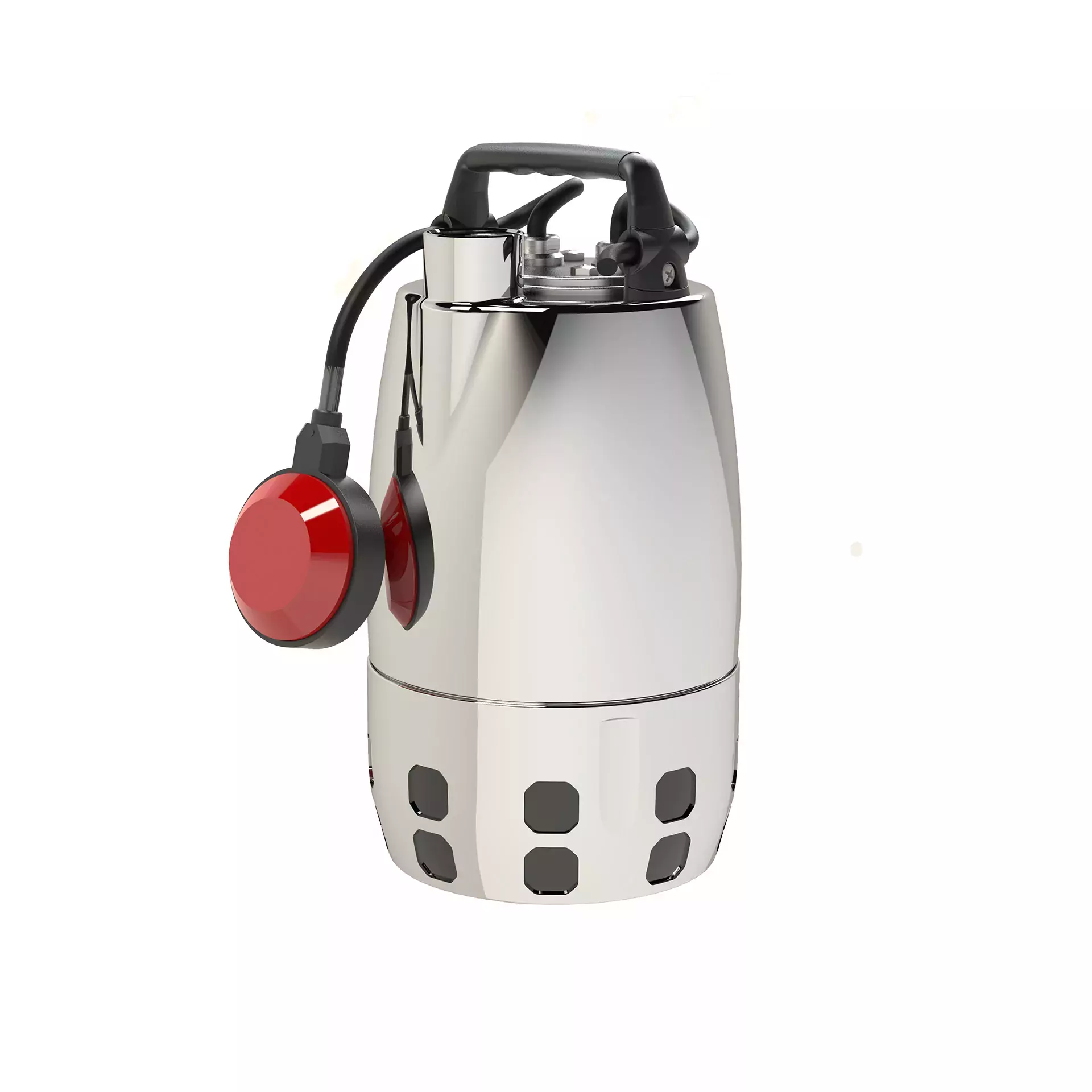
The GXV 25 is the vortex half of Calpeda's small stainless submersible range. It is a single-impeller pump in chrome-nickel stainless steel with a vertical G 1¼ delivery, in three frames at 0.25, 0.37 and 0.45 kW, and Calpeda puts it on clean or slightly dirty water carrying solids up to 25 mm grain size and particularly on liquids with a high solid content. It goes into the sump on a hose or a screwed pipe, lowered on a rope.
Why you would take the vortex over the open impeller
Take the GXV 25 when the solid is bigger than 10 mm or when the water carries fibre. Take the open-impeller GXR for everything else, because it is the better pump on the duty.
An open impeller still has vanes, and the liquid works against them. That is an efficient way to move water and it holds a real duty point. A free-flow vortex is recessed up into the casing, and the water leaves on the swirl the impeller sets up rather than by being pushed through a passage. Most of what you are pumping never meets the vanes, which is why a 25 mm solid gets through and why fibre does not wrap.
Calpeda's own 50 Hz tables show what that costs, frame for frame at the same rated output:
| Rating | Model | Solids | Head at zero flow | Head at 9 m³/h |
|---|---|---|---|---|
| 0.25 kW | GXR 9 | 10 mm | 9 m | 2.5 m |
| 0.25 kW | GXV 25-6 | 25 mm | 6 m | 2.2 m |
| 0.37 kW | GXR 11 | 10 mm | 11 m | 5.3 m |
| 0.37 kW | GXV 25-8 | 25 mm | 8.2 m | 4.5 m |
| 0.45 kW | GXR 13 | 10 mm | 12.7 m | 6.3 m |
| 0.45 kW | GXV 25-10 | 25 mm | 10 m | 5.7 m |
Read the 0.45 kW pair. At zero flow the GXR 13 is 2.7 m ahead. At 9 m³/h it is 0.6 m ahead. Keep going and the gap closes and then reverses: at 12 m³/h the GXR 13 gives 3.2 m and the GXV 25-10 gives 3.7 m, and at 13.2 m³/h it is 2 m against 2.6 m. The vortex curve is the flatter of the two. So the penalty you pay for the 25 mm passage is worst on a high-head, low-flow duty and close to nothing on a flat one. If you are lifting 2 m out of a basement at 12 m³/h, the vortex is not costing you anything worth having.
There is a second cost, and it is the one people miss. The GXV needs more water under it. Calpeda's minimum water level with the float fitted is 130 mm for the GXV against 70 mm for the GXR, and in manual operation 30 mm against 15 mm. On the float build that is 60 mm more water left standing in the sump. On a wash-down bay or a flooded plant room, check that figure before you check the head.
This is not a sewage pump, and the vortex impeller does not make it one. Calpeda's wording for the GXV is clean or slightly dirty water, and the passage is 25 mm. Foul sewage carrying rag wants a solids-handling pump with the free passage to match, and the enquiry we decline most often is a like-for-like swap onto a duty the last pump was never going to survive either.
The stainless choice, and when 316L is worth it
Take 316L where there are chlorides in the water, and 304 everywhere else. Chlorides are the usual reason 304 pits, and on ordinary drainage they are not there.
The standard build is 1.4301 (AISI 304) for the casing, the filter, the impeller, the motor jacket and the pump jacket, on a 1.4305 (AISI 303) shaft. Calpeda also builds the top frame in 1.4404 (AISI 316L) throughout, as the GXVL 25-10 and the single-phase GXVLM 25-10, and the curve is identical. So the material upgrade costs you nothing in duty, only in price.
Reading the designation, and what the 25 means
Calpeda's key runs GX for the series, then the impeller letter, then L for the 316L version, then M for single phase, then the solids passage, then the head. V is the free-flow vortex and R the open impeller. So a GXVLM 25-10 is a single-phase 316L vortex pump passing 25 mm, and a GXV 25-6 is a three-phase 304 build. The last number is Calpeda's total head figure in metres, and it lines up with the head at zero flow in the tables.
Watch the middle number. It does not mean the same thing twice in Calpeda's catalogue. Here the 25 is the solids passage. On the bigger stainless GX 40 the same position carries the delivery port instead, so a GXV 40 is a 40 mm port with a 35 mm passage, on a heavier G 1½ pump. Two vortex builds, both wearing a V and a two-digit number, and the number is measuring different things. Matching an existing unit? Send us the full designation and the serial number from the nameplate.
The limits Calpeda sets
Liquid temperature stops at 50°C, and at 40°C on the single-phase GXVM builds, where a long run in warmer water trips the thermal protector until the windings cool. Maximum immersion is 5 m and maximum liquid density is 1100 kg/m³. Starts are capped at 30 an hour at regular intervals, so a tight sump will limit which frame you can run. Calpeda puts a ceiling of 20 m (2 bar) on the working pressure in the casing, comfortably above the 10 m the range delivers.
Two more limits Calpeda puts in writing: the pump is not for explosive or flammable environments, and it is not to be used in garden ponds, tanks or swimming pools while people are in the water.
How the Calpeda GXV 25 works
The GXV 25 draws through a stainless filter in the base, works the water with a free-flow vortex impeller, and discharges up through a G 1¼ ISO 228 port. The motor is a 2-pole induction motor at about 2900 rpm on 50 Hz, cooled by the pumped water passing between the motor jacket and the external jacket on its way to the delivery. That jacket flow is why the pump is rated for continuous duty. Protection is IP X8 for continuous immersion, insulation is class F on a double-impregnation humidity-proof dry winding, and Calpeda builds the motor to EN 60034-1. Calpeda's table figures assume a density of 1.0 kg/dm³ and a kinematic viscosity no higher than 20 cSt, so a thicker medium will not follow the curve.
What the vortex impeller actually does
The impeller sits back in a recess at the top of the casing rather than in the middle of the flow. Spinning, it drives the whole body of water in the casing round, and that rotating column carries the solids to the delivery. A 25 mm stone or a length of fibre travels through an open chamber, not down a vane passage, so there is nothing for it to bridge across. The price is efficiency. You are moving water by stirring it rather than by pushing it, and the tables above show the head that costs.
The filter over the suction is a wear part in the same sense the impeller is. Calpeda's manual asks for water-resistant, anti-cut gloves when you take it off, which tells you what tends to be caught in it.
The seal and the oil chamber
The shaft runs through a double shaft seal with an oil chamber between the two faces. The mechanical seal is alumina against carbon with NBR elastomers, and the chamber holds 0.04 litres of white oil suitable for food machinery and pharmaceutical use. Wear the wet-side face and the oil chamber is still between the water and the windings.
Dry running is what kills it. Calpeda's instruction is blunt: avoid running dry, and on a build without a float, start the pump only when it is immersed. The mechanism is the seal. Its faces are lubricated by the liquid they run in, and once that film goes so do they. On a pump this size the usual cause is a float that has fouled against the sump wall, which is why Calpeda asks you to check the float is free of obstruction. Do not lift the pump out while it is still running.
Motors, currents and protection
Single-phase GXVM builds run on 230 V ±10% with an incorporated capacitor, a thermal protector, a float switch and a plug. Full load current is 2.5 A at 0.25 kW, 3.5 A at 0.37 kW and 4.5 A at 0.45 kW, with capacitors of 8, 12.5 and 16 µF at 450 V. Size the supply on the maximum power input, which runs 0.5 kW to 0.95 kW across the three frames; the rated output on the nameplate is the smaller number.
Three-phase GXV builds run on 230 V or 400 V ±10%, come without a plug and carry no float. Calpeda's manual is explicit that you fit the overload-protective device in the control box, with a curve D characteristic set to the nameplate current, and that where the water level is not under direct visible control you add a float switch wired to the panel to set the start and stop levels. Full load current at 400 V is 0.9 A, 1.3 A and 1.6 A across the three frames.
Cable is 5 m as standard: H05RN-F 3G0.75 mm² on the GXVM 25-6 and H07RN-F 3G1 mm² on the GXVM 25-8 and 25-10, with a plug; the three-phase builds take the four-core equivalents without one. Calpeda's own instruction is that outdoor use wants a supply cable of not less than 10 m, to EN 60335-2-41, and a 10 m cable is one of the options Calpeda lists on request. Ask for it at order rather than extending it on site.
Other voltages, a 60 Hz build, a different mechanical seal, a vertical magnetic float switch, a motor suitable for inverter duty and a three-phase build with a built-in switch and float are the other options Calpeda lists.
Getting it in and out
Fit a ball valve in the delivery as a check against back flow, and arrange the pipework so the pump can come out without draining the system. Calpeda's installation examples give a minimum chamber of 350 × 350 mm for the GXV, and 250 × 250 mm on the GFA builds with the vertical magnetic float, which is the option to reach for when the sump is tight. If the pit silts up, put the pump on a stand so it is not sitting in the deposit. Use the handle and a rope; the cable is not a lifting point.
To look at the impeller, take out the screws (15.70) or the strainer (15.50), then the screws (14.24) and the pump casing (14.00), and check the impeller turns freely by hand. The impeller comes off with the nut (28.04). The mechanical seal is behind the screws (70.18). Open the oil plug carefully, because the chamber can hold slight pressure, and do not refill it to the top; the air left in it takes up the expansion when the oil warms.
Specifications
| Type | Single-impeller submersible pump, stainless steel, vertical delivery port | |
|---|---|---|
| Impeller | Free-flow (vortex) | |
| Liquid handled | Clean or slightly dirty water with solids in suspension up to 25 mm grain size | particularly suited to liquids with a high solid content |
| Flow rate | up to 13.2 m³/h | GXV 25-10, at 2.6 m |
| Total head | up to 10 m | GXV 25-10, at zero flow |
| Maximum solids passage | 25 mm | |
| Liquid temperature | up to 50°C; 40°C on the single-phase builds | |
| Maximum liquid density | 1100 kg/m³ | |
| Maximum immersion depth | 5 m | |
| Minimum water level | 130 mm with the float; 30 mm in manual operation | |
| Maximum working pressure | 20 m (2 bar) | |
| Maximum starts per hour | 30 | at regular intervals |
| Rated power P2 | 0.25, 0.37 and 0.45 kW | |
| Maximum power input P1 | 0.5–0.95 kW | single-phase builds |
| Speed | about 2900 rpm | 2-pole, 50 Hz |
| Voltage | three-phase 230 V or 400 V ±10%; single-phase 230 V ±10% | |
| Full load current | 0.9–1.6 A at 400 V three-phase; 2.5–4.5 A single-phase | |
| Capacitor | 450 V, 8, 12.5 or 16 µF | single-phase builds |
| Overload protection | Thermal protector built into the single-phase motor; fitted by the user in the control box on three-phase, curve D to the nameplate current | |
| Delivery connection | G 1¼ ISO 228 | |
| Duty | Continuous | |
| Motor cooling | By the pumped water, between the motor jacket and the external jacket | |
| Pump casing, filter, impeller, motor jacket and pump jacket | Chrome-nickel steel 1.4301 EN 10088 (AISI 304) | 1.4404 (AISI 316L) on the GXVL 25-10 and GXVLM 25-10 |
| Shaft | 1.4305 EN 10088 (AISI 303) | 1.4404 (AISI 316L) on the GXVL builds |
| Handle | Polypropylene | |
| Shaft seal | Double shaft seal with oil chamber; mechanical seal alumina, carbon and NBR | |
| Seal lubrication oil | 0.04 litres of white oil for food and pharmaceutical machinery | |
| Protection degree | IP X8 | for continuous immersion |
| Insulation class | F | |
| Winding | Double impregnation, humidity-proof dry winding | |
| Power cable | 5 m | H05RN-F 3G0.75 mm² on the 25-6, H07RN-F 3G1 mm² on the 25-8 and 25-10; 10 m available on request and required outdoors |
| Sound pressure | under 70 dB(A) | at minimum immersion depth; it falls further once submerged |
| Height | 302–337 mm | |
| Weight | 5.3–7.3 kg | with the 5 m cable |
| Minimum chamber | 350 × 350 mm | 250 × 250 mm on the GFA builds with the vertical magnetic float |
| Standards | EN 60034-1 |
Send us the flow, the total dynamic head, the largest solid the pump has to pass and how low you need to draw the sump down, and we will tell you whether this wants the GXV 25, the open-impeller GXR or a heavier pump on a bigger connection. Say whether the water carries chlorides, because that is what decides the 316L build. Replacing an existing pump? A photograph of the nameplate is usually enough for us to identify it.
Documents & downloads
Related pumps
View all →
Frequently asked
What is the difference between the Calpeda GXV and the GXR?
The impeller, and what it lets through. The GXV has a free-flow vortex impeller and passes 25 mm solids; the GXR has an open impeller and passes 10 mm. At the same rated power the GXR holds more head, so the vortex is the choice when the solid or the fibre decides it.
What size solids will a Calpeda GXV 25 pass?
25 mm grain size, on all three frames. Calpeda rates the GXV for clean or slightly dirty water with solids in suspension up to that size, and calls it particularly suitable for liquids with a high solid content.
What flow and head does the Calpeda GXV 25 give?
Up to 13.2 m³/h and 10 m, both on the 0.45 kW GXV 25-10. The 0.37 kW GXV 25-8 reaches 8.2 m at zero flow and the 0.25 kW GXV 25-6 reaches 6 m.
How does a vortex impeller work?
The impeller sits recessed at the top of the casing rather than in the flow path, and moves the water by spinning the whole body of liquid in the casing. Solids and fibre are carried round an open chamber instead of through a vane passage, so there is nothing for them to catch on.
Is a vortex impeller less efficient?
Yes, and Calpeda's tables show it. At 0.45 kW the open-impeller GXR 13 gives 12.7 m at zero flow against the GXV 25-10's 10 m. The gap narrows as flow rises, and past 12 m³/h the vortex is slightly ahead because its curve is flatter.
How low can a Calpeda GXV 25 pump a sump down?
To a minimum water level of 130 mm with the float fitted, or 30 mm in manual operation. The open-impeller GXR goes lower, to 70 mm and 15 mm, so check the draw-down before the duty point if you need to clear a floor.
Is the Calpeda GXV available in AISI 316L?
Yes. GXVL 25-10 and the single-phase GXVLM 25-10 are 1.4404 (AISI 316L) through the casing, filter, impeller, jackets and shaft, and give the same 10 m and 13.2 m³/h as the AISI 304 build.
Is the Calpeda GXV 25 available single-phase?
Yes. GXVM 25-6, GXVM 25-8 and GXVM 25-10 run on 230 V ±10% with a capacitor, a thermal protector, a float switch and a plug. The three-phase builds run on 230 V or 400 V and come without a plug or a float.
Does a three-phase Calpeda GXV need separate overload protection?
Yes, on three-phase the protection is yours to provide. Calpeda asks for an overload-protective device in the control box, set with a curve D characteristic to the nameplate current. Single-phase GXVM builds already carry a thermal protector in the motor.
What does a designation like GXVLM 25-10 mean?
GX is the series, V the free-flow vortex impeller, L the AISI 316L version, M single phase, 25 the solids passage in millimetres and 10 the total head in metres. R in place of V is the open impeller, and no L means the AISI 304 build.
What cable does a Calpeda GXV 25 come with?
5 m as standard, H05RN-F 3G0.75 mm² on the 25-6 and H07RN-F 3G1 mm² on the 25-8 and 25-10. Calpeda says outdoor use wants at least 10 m to EN 60335-2-41, and lists a 10 m cable as an option, so specify it at order.