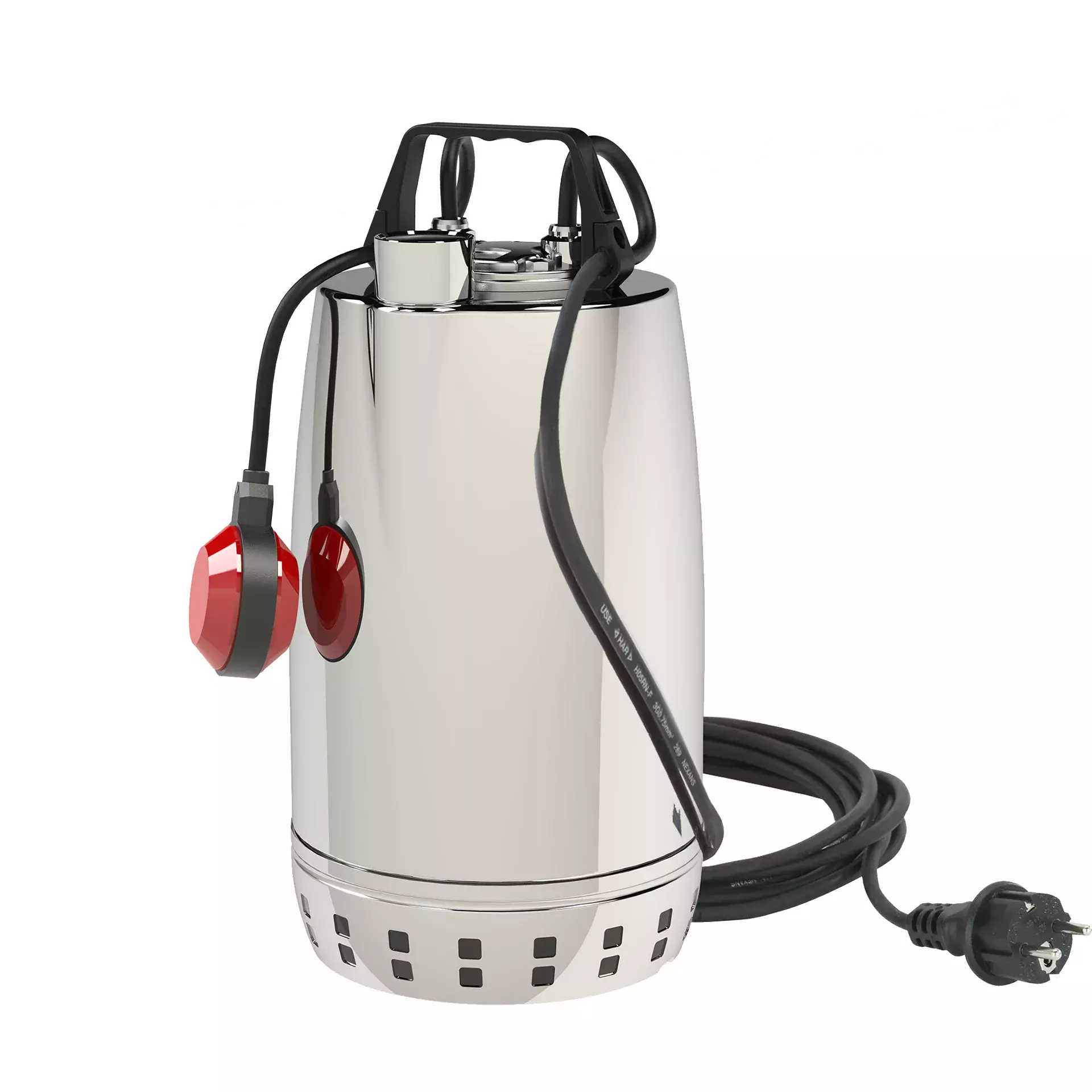
Key features
GXR 9, 11 and 13 pass 10 mm on a G 1¼ delivery at 0.25 to 0.45 kW. The GXR 12 passes 12 mm on a G 1½ delivery at 0.45 to 1.5 kW.
Minimum water level in manual operation is 15 mm, and 70 mm with the float fitted. The vortex GXV builds need 30 mm and 130 mm to do the same job.
An open impeller works the water against real vanes, so the GXR converts the motor's output into head rather than into swirl.
Pump casing, filter, impeller, motor jacket and pump jacket are all 1.4301 (AISI 304), on a 1.4305 (AISI 303) shaft. The GXR 12 shaft is 1.4301.
Alumina against carbon with NBR elastomers. The oil chamber holds 0.04 litres on the small frames and 0.08 litres on the GXR 12.
The heavy frames ship on 10 m of cable, which is the length Calpeda wants outdoors anyway. The small frames ship on 5 m and take 10 m on request.
About the Calpeda GXR
The GXR is the open-impeller half of Calpeda's small stainless submersible range. It is a single-impeller pump in chrome-nickel stainless steel with a vertical delivery port, and Calpeda puts it on clean or slightly dirty water carrying solids in suspension up to 10 mm grain size, and 12 mm on the GXR 12. The applications Calpeda names are draining flooded rooms and tanks, drawing water out of ponds, streams and pits, and rainwater collection. It goes into the sump on a hose or a screwed pipe, lowered on a rope.
Two frames wearing one name
Size against the 50 Hz tables, because the GXR is really two pumps. The small frame is a floor-clearing pump. The GXR 12 is a transfer pump that happens to be submersible, and it is nearly three times the weight.
| Model | Solids | Rated power P2 | Head at zero flow | Last tabulated point |
|---|---|---|---|---|
| GXR 9 | 10 mm | 0.25 kW | 9 m | 10.2 m³/h at 1.7 m |
| GXR 11 | 10 mm | 0.37 kW | 11 m | 12 m³/h at 2.2 m |
| GXR 13 | 10 mm | 0.45 kW | 12.7 m | 13.2 m³/h at 2 m |
| GXR 12-10 | 12 mm | 0.45 kW | 9.3 m | 18 m³/h at 3.3 m |
| GXR 12-12 | 12 mm | 0.55 kW | 12 m | 21 m³/h at 3.7 m |
| GXR 12-14 | 12 mm | 0.75 kW | 13.5 m | 24 m³/h at 3.3 m |
| GXR 12-16 | 12 mm | 0.9 kW | 15.5 m | 27 m³/h at 3.2 m |
| GXR 12-18 | 12 mm | 1.1 kW | 17 m | 30 m³/h at 3 m |
| GXR 12-20 | 12 mm | 1.5 kW | 19.2 m | 30 m³/h at 4.7 m |
Read the two 0.45 kW builds against each other, because they show what the frame does. The GXR 13 lifts 12.7 m at zero flow and runs out of curve at 13.2 m³/h. The GXR 12-10 lifts 9.3 m and is still delivering at 18 m³/h. Same rated output, and the smaller pump is the better lifter while the bigger one is the better mover. Pick on the duty point, not on the kilowatts.
The number after GXR does not always mean the same thing
On GXR 9, 11 and 13 the number is Calpeda's total head figure in metres. On the GXR 12 it is the solids passage, and the second number is the head. So a GXR 12-20 passes 12 mm and lifts 19.2 m, while a GXR 13 passes 10 mm and lifts 12.7 m. The 13 and the 12 are measuring different things.
This catches people ordering a replacement from a scribbled note. Send us the full designation and the serial number off the nameplate and we will read it for you.
Where the open impeller stops
10 mm is a small stone. It is not rag, and it is not sewage.
An open impeller has vanes standing in the flow path, which is what makes it efficient and what gives it something for fibre to catch on. Wipes, hair and textile bind across a vane and stay there, and the pump then runs at a duty point it was never selected for until somebody lifts it out. Where the water carries that, take the free-flow GXV 25 instead and accept the head it costs you, or move up to a solids-handling pump with the free passage to match.
For seepage, a flooded plant room, a clean excavation, a rainwater sump or drawing off a stream, the GXR is the right answer and the better pump on the duty. That is most of what these get bought for.
How low it will draw the sump down
To 15 mm in manual operation, and to 70 mm with the float fitted. That is the GXR's real advantage over the vortex builds, and on a wash-down bay or a flooded floor it decides the job before the head does.
The GXR 12 does not do it. It is a taller pump and its float sits higher, so the level it switches off at climbs with the frame:
| Build | Float switches on at | Float switches off at |
|---|---|---|
| GXRM 9 GF | 190 mm | 100 mm |
| GXRM 11 GF, GXRM 13 GF | 225 mm | 135 mm |
| GXRM 12-10 GF | 270 mm | 180 mm |
| GXRM 12-12 GF | 285 mm | 195 mm |
| GXRM 12-14 GF, GXRM 12-16 GF | 310 mm | 220 mm |
Those are the GF builds with the vertical magnetic float, which is the option to specify when the chamber is tight. They need a minimum chamber of 250 × 250 mm on the small frames against 350 × 350 mm for a standard installation. If it is the bottom of the pit you care about, that is a small frame with a magnetic float, not a GXR 12.
The limits Calpeda sets
Liquid temperature stops at 50°C, and at 40°C on the GXR 12. Maximum immersion is 5 m and maximum liquid density is 1100 kg/m³. Calpeda caps the working pressure in the casing at 20 m (2 bar), comfortably above the 19.2 m the range delivers.
Starts are capped at 30 an hour at regular intervals, and the GXR 12 gets 20. That lower ceiling is easy to miss and it bites on exactly the installation people reach for a GXR 12 to fix. A big pump empties a small chamber quickly, the float calls it again, and the motor is restarting more often than Calpeda allows. Work the drawn-down volume against the flow before you settle on a frame, and widen the float band if the sum comes out tight.
Two duties are off the table. A hazardous area is one: Calpeda excludes explosive and flammable environments outright, and there is no build of the GXR that changes that. The other is any garden pond, tank or swimming pool with people in the water, whatever the residual current device is doing.
How the Calpeda GXR works
An open impeller raises head by pushing water along vanes that stand in the flow. Water enters through a stainless filter in the base, is worked by those vanes, and leaves up a vertical ISO 228 port at the top. Behind the wet end sits a 2-pole induction motor turning at about 2900 rpm on 50 Hz, and the water on its way out passes between the motor jacket and the outer jacket, carrying the motor's heat away with it. Cool a motor with the medium and it will run continuously, which is how the GXR is rated. The winding is a double-impregnation humidity-proof dry type to class F, sealed to IP X8 for permanent immersion, built to EN 60034-1.
One caveat on the tables. Every head figure assumes a medium of density 1.0 kg/dm³ with a kinematic viscosity no worse than 20 cSt. Push something thicker through it and the pump leaves the published curve.
What the open impeller is doing to the water
The vanes are exposed to the flow rather than recessed out of it, so the liquid works against them directly. That is what turns motor output into head efficiently, and it is also what sets the passage at 10 mm. The gap a solid has to survive is the clearance between a vane tip and the casing wall, and on a pump weighing 5 kg that clearance is not generous. Efficiency and passage are one design decision read from two ends.
Wear the gloves Calpeda asks for when you pull the filter. Anti-cut and water resistant, specified for a reason that becomes obvious the moment the filter is off.
The two ways these die
Air lock comes first, because it catches people who did everything else right. A sump that empties under a primed pump traps air around the rotor, and the pump then spins against nothing. Calpeda's remedy is a 3 mm hole drilled in the delivery pipe below the non-return valve, giving that air a route out so the pump can re-prime. One drill bit, and it decides whether the pump comes back on the next cycle.
Dry running is the other, and it is terminal. The mechanical seal is alumina on carbon with NBR elastomers, and those faces survive on a film of the liquid they turn in. Take the liquid away and the film goes with it, and the faces go shortly after. Behind the wet face sits the oil chamber, 0.04 litres of white oil for food and pharmaceutical machinery on the small frames and 0.08 litres on the GXR 12, and behind that a second face. Two barriers between the sump and the windings is the reason a worn wet-side face is a service job rather than a scrapped pump. On a build with no float, wait until the pump is under water before switching it on, and switch it off before lifting it out. A fouled float is the usual culprit, so check it swings clear of the sump wall.
Opening the oil chamber, expect a little pressure behind the plug. Refill it short of full. The air you leave in there takes up the expansion once the oil comes to temperature.
The electrical side, and the GXR 12-20 in particular
Current is where the two frames part company. On 400 V three-phase the whole range sits between 0.9 A and 4 A, which asks nothing of a panel. Single phase at 230 V is a different proposition:
| Build | Full load current | Capacitor | Maximum power input P1 |
|---|---|---|---|
| GXRM 9 | 2.5 A | 8 µF | 0.5 kW |
| GXRM 13 | 4.5 A | 16 µF | 0.95 kW |
| GXRM 12-14 | 6 A | 20 µF | 1.3 kW |
| GXRM 12-18 | 9.5 A | 30 µF | 2 kW |
| GXRM 12-20 | 13 A | 35 µF | 2.2 kW |
A GXRM 12-20 drawing 13 A is not a pump to hang off whatever socket is nearest. Give it a circuit of its own. Calpeda also fits its single-phase builds with a CEI-UNEL 47166 plug, the Italian pattern, so a UK installation has that to resolve before anything gets switched on. Size the supply against the maximum power input in that last column, not the rated output stamped on the nameplate. The nameplate figure is the smaller of the two, and reading the wrong one is how a circuit ends up undersized.
Single-phase GXRM builds come with capacitor, thermal protector and float switch already fitted. Three-phase GXR builds arrive bare on 230 V or 400 V ±10%, so protection and level control are both down to you. That means an overload-protective device in the control box on a curve D characteristic set to the nameplate current, and a float switch wired back to the panel anywhere the water level is out of sight. Prove the rotation on first start. Backwards, the pump vibrates, loses delivery, and can take the mechanical seal with it long before anyone works out why the flow is down.
Cable is 5 m on the small frames and 10 m on the GXR 12, in H05RN-F 3G0.75 mm² on the GXRM 9, H07RN-F 3G1 mm² through the middle of the range, then 3G1.5 mm² on the GXRM 12-18 and 3G2.5 mm² on the GXRM 12-20. EN 60335-2-41 wants no less than 10 m outdoors, so a small frame going outside should be ordered on the 10 m option rather than extended on site. Add a residual current device of 30 mA or less if the pump is going anywhere near a pond or a pool.
Putting it in the sump
The delivery pipe bore is never smaller than the port, so G 1¼ on the small frames and G 1½ on the GXR 12. Calpeda calls for a swing valve on the GXR against back flow where the vortex builds take a ball valve, so do not carry a fitting straight across from one to the other. Put a gate valve and a union in the line too, or the first service lift means draining the system.
The pump stands upright on the floor of the pit, and there are two reasons to get it off that floor. Silt packs the suction filter, so a pit that builds up slime wants the pump on a stand. Stagnant water and river beds put sand through the impeller, so raise it onto a flat surface clear of the bottom. Clamp the cable to the pipe or the safety rope with slack left in it, since the pipe grows as it warms and a taut cable takes that strain. Lift on the handle and a rope of non-perishable material, never on the cable.
Run it briefly on clean water after any spell on muddy water, and again before it goes away for the season. If the pit can freeze, take it out and store it dry.
Specifications
| Type | Single-impeller submersible pump, stainless steel, vertical delivery port | |
|---|---|---|
| Impeller | Open | |
| Liquid handled | Clean or slightly dirty water with solids in suspension up to 10 mm grain size | 12 mm on the GXR 12 |
| Flow rate | up to 30 m³/h | GXR 12-20, at 4.7 m |
| Total head | up to 19.2 m | GXR 12-20, at zero flow |
| Maximum solids passage | 10 mm; 12 mm on the GXR 12 | |
| Liquid temperature | up to 50°C; 40°C on the GXR 12 | |
| Maximum liquid density | 1100 kg/m³ | |
| Maximum immersion depth | 5 m | |
| Minimum water level | 70 mm with the float; 15 mm in manual operation | GXR 9, 11 and 13; on the GXR 12 the float switches off between 180 mm and 220 mm depending on frame |
| Maximum working pressure | 20 m (2 bar) | |
| Maximum starts per hour | 30; 20 on the GXR 12 | at regular intervals |
| Rated power P2 | 0.25–1.5 kW | |
| Maximum power input P1 | 0.5–2.2 kW | single-phase builds |
| Speed | about 2900 rpm | 2-pole, 50 Hz |
| Voltage | three-phase 230 V or 400 V ±10%; single-phase 230 V ±10% | |
| Full load current | 0.9–4 A at 400 V three-phase; 2.5–13 A single-phase | |
| Capacitor | 450 V, 8 to 35 µF | single-phase builds |
| Overload protection | Thermal protector built into the single-phase motor; fitted by the user in the control box on three-phase, curve D to the nameplate current | |
| Delivery connection | G 1¼ ISO 228; G 1½ ISO 228 on the GXR 12 | |
| Duty | Continuous | |
| Motor cooling | By the pumped water, between the motor jacket and the external jacket | |
| Pump casing, filter, impeller, motor jacket and pump jacket | Chrome-nickel steel 1.4301 EN 10088 (AISI 304) | |
| Shaft | 1.4305 EN 10088 (AISI 303) | 1.4301 EN 10088 (AISI 304) on the GXR 12 |
| Handle | Polypropylene | |
| Shaft seal | Double shaft seal with oil chamber; mechanical seal alumina, carbon and NBR | |
| Seal lubrication oil | 0.04 litres of white oil for food and pharmaceutical machinery | 0.08 litres on the GXR 12 |
| Protection degree | IP X8 | for continuous immersion |
| Insulation class | F | |
| Winding | Double impregnation, humidity-proof dry winding | |
| Power cable | 5 m on the GXR 9, 11 and 13; 10 m on the GXR 12 | H05RN-F 3G0.75 mm² to H07RN-F 3G2.5 mm² by frame; 10 m available on request for the small frames and required outdoors |
| Sound pressure | under 70 dB(A) | at minimum immersion depth; it falls further once submerged |
| Height | 265–450 mm | |
| Weight | 5.2–15.5 kg | three-phase builds, with cable |
| Minimum chamber | 350 × 350 mm | 250 × 250 mm on the small-frame GF builds with the vertical magnetic float |
| Standards | EN 60034-1 |
Four numbers get you a straight answer on the GXR: the duty point, the biggest solid in the water, the internal size of the chamber, and the level you need the pump to draw down to. The last two are what usually decide it, and they are the two people leave out. Tell us as well whether the water carries any fibre, since that rules the open impeller out before the curve gets a look in. Working from an old unit? Photograph the nameplate and we will read the designation off it.
Documents & downloads
Related pumps
View all →
Frequently asked
What size solids will a Calpeda GXR pass?
10 mm grain size on the GXR 9, 11 and 13, and 12 mm on the GXR 12 frames. Calpeda rates the range for clean or slightly dirty water with solids in suspension up to that size, not for sewage.
What flow and head does the Calpeda GXR give?
Up to 30 m³/h and 19.2 m, both on the 1.5 kW GXR 12-20. The small frames stop earlier. The 0.45 kW GXR 13 gives 12.7 m at zero flow and runs to 13.2 m³/h.
What does the 12 mean in a Calpeda GXR 12-20?
The solids passage in millimetres, and the 20 is Calpeda's total head figure. On a GXR 9, 11 or 13 the single number is the head instead, so a GXR 13 lifts 12.7 m and passes 10 mm.
What is the difference between a Calpeda GXR and a GXV?
The impeller. The GXR runs an open impeller and passes 10 mm; the GXV runs a free-flow vortex and passes 25 mm. The GXR holds more head for the same rated power, so take the vortex only when the solid or the fibre decides it.
How low can a Calpeda GXR pump a sump down?
To 15 mm in manual operation, or 70 mm with the float fitted, on the GXR 9, 11 and 13. The GXR 12 sits higher and its float switches off between 180 mm and 220 mm depending on the frame.
Is the Calpeda GXR suitable for sewage?
No. Calpeda rates it for clean or slightly dirty water with solids up to 10 mm, and an open impeller catches rag and fibre on its vanes. Foul sewage wants a solids-handling pump with the free passage to match.
Is the Calpeda GXR available single-phase?
Yes, as the GXRM builds on 230 V ±10%, complete with capacitor, thermal protector and float. Watch the current at the top of the range: a GXRM 12-20 draws 13 A and wants a circuit of its own.
What size delivery pipe does a Calpeda GXR need?
G 1¼ ISO 228 on the GXR 9, 11 and 13, and G 1½ on the GXR 12. Calpeda's rule is that the internal diameter of the delivery pipe is never smaller than the pump's connection port.
How many starts an hour can a Calpeda GXR take?
30 at regular intervals, and 20 on the GXR 12. On a small sump that ceiling decides the frame, because a big pump empties a small chamber faster than it is allowed to restart.
Does a three-phase Calpeda GXR need separate overload protection?
Yes, and level control with it. A three-phase GXR arrives bare, so the curve D overload device goes in your panel against the nameplate current, and a float switch goes back to that panel wherever the water level is out of sight.
What cable comes with a Calpeda GXR?
The GXR 12 ships on 10 m, the small frames on 5 m. That 5 m is short of the 10 m EN 60335-2-41 requires outdoors, so order the 10 m option if the pump is going outside.
Why does my Calpeda GXR run but deliver nothing after the sump empties?
Air trapped around the rotor. Calpeda's fix is a 3 mm hole drilled in the delivery pipe below the non-return valve, which lets that air out so the pump can re-prime.