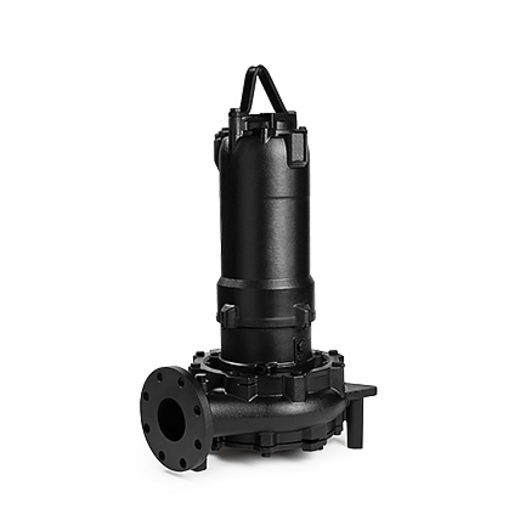
Key features
The hydraulic the range is built around. Free passage runs from 38 mm to 89 mm depending on discharge size and motor rating.
A pin in the suction cover works with the impeller to steer solid and fibrous material into a groove, so it leaves with the flow instead of winding on the vane.
Air-filled dry submersible, IP68, insulation class H, 1.5–45 kW. Direct on line to 7.5 kW, star-delta from 11 kW.
Silicon carbide against silicon carbide on the impeller side, carbon against ceramic on the motor side, running in turbine oil. Single spring to 22 kW, tandem spring on 30 and 45 kW.
A protector in each winding opens at 150±5°C. A float-type detector reports pumped water or seal oil reaching the motor. Both need wiring to the panel.
Ebara lists a quick discharge connector for a guide-rail installation and an elbow with pump legs for a portable one.
About the Ebara DKE
The Ebara DKE is a wastewater lift pump for sewage and industrial effluent carrying solids or fibre. Ebara puts it on wastewater transport, wastewater treatment and the handling of industrial liquids, in fixed or mobile installations. The whole range is metric and 50 Hz: discharges run DN65 to DN300, motors 1.5–45 kW, and the frequency sits in the model code itself.
Read the medium specification before you look at the curve. Ebara rates the DKE for water, for dirty or sewage water with solids in suspension, and for emptying cesspits, septic tanks and trenches. Its manual also sets out what the pump is not designed for: liquids other than water, water containing acids or alkalis, corrosive liquids in general, seawater, flammable and hazardous liquids, and anything in contact with food products. Corrosive atmospheres and explosive or fire danger zones are excluded too. If the wet well is a classified hazardous area, this is the wrong pump, and we will point you at one certified for the zone rather than sell you this one.
Cycling is the constraint people miss. Ebara limits the DKE to 10 starts an hour up to 7.5 kW and six an hour above it, which works out at 200 and 144 a day. That is a wet well volume calculation as much as a pump selection, and on a small station it is often what decides the rating. It tends to get discovered after the chamber is poured.
Sizing is the other place these get thrown away. The customer states a flow. The consultant adds margin for future duty, the contractor adds margin, the installer adds a little more. Nobody in that chain is careless and the pump that comes out of it is far too big. You pay for the oversized motor for the life of the installation, and a centrifugal run off the end of its curve without the back pressure it needs will cavitate and take the seal with it. Send us the duty you actually have, not the one with the margins already stacked on.
The anti-clogging hydraulics earn their keep on rag, but they are not a macerator. The blockage problem that reaches us most often is a station passing more rag than any impeller was going to clear, and the answer there is removal upstream rather than a bigger solids-handling pump. Grit is the other one. Where the grit removal on the works is not doing its job, abrasion wears the wet end and the pump fails early whatever the impeller looks like. Both are worth ruling out before you blame the pump you have.
How the Ebara DKE works
The Ebara DKE takes liquid in through the suction cover, works it with a back-swept semi-open impeller, and discharges through a flange on the side of the volute. A guide pin set in the suction cover works with the impeller to direct solid and fibrous material towards a groove in the cover, so it passes out with the flow instead of binding on the vane. That pairing is what Ebara means by anti-clogging on this range.
Reading the model code
Ebara's worked example is 80 DKE 5 1.5. The first figure is the discharge size in millimetres, then the model, then the frequency digit, then the motor output in kW. The 5 is 50 Hz. So a 150 DKE 522 is a DN150 discharge at 50 Hz on a 22 kW motor. At DN100 there are two hydraulics: Ebara publishes 100 DKE and 100 DKEB on separate selection charts, covering different parts of the DN100 flow range. If you are matching an existing pump, send us the full designation and the serial number off the nameplate.
The motor and the supply
The DKE motor is air-filled dry submersible, IP68, insulation class H, four poles, designated ZDKEEU3. Supply is three-phase at 380, 400 or 415 V, 50 Hz, ±10%. Running speed falls between 1,430 rpm and 1,475 rpm across the range depending on rating and voltage. Service factor is 1.0. Starting is direct on line to 7.5 kW and star-delta from 11 kW to 45 kW. The standard cable is 10 m of H07RN-F. Ebara lists the motor as available for inverter control, admitting a voltage fluctuation of up to ±10% and a frequency fluctuation of up to ±1%, with the sum of the two absolute values not exceeding 10.
The seal and what watches it
The DKE shaft runs a double mechanical seal lubricated by turbine oil. The impeller side is silicon carbide against silicon carbide, the motor side carbon against ceramic. It is single spring up to 22 kW and tandem spring on the 30 kW and 45 kW units. Bearings are prelubricated ball bearings, and the shaft is AISI 403 stainless steel.
Two protection devices are built into the motor, and both do nothing until they are wired to the panel. A miniature thermal protector is embedded in each winding, normally closed, opening at 150±5°C and resetting at around 100°C. A float-type leakage detector inside the motor senses pumped water or seal oil getting in after a seal failure. That second one is worth wiring properly. The seal is the weak point in almost any pump, and the detector tells you it has gone while the motor is still repairable.
Standards and installation
Ebara's CE declaration of conformity for the DKE series cites the Machinery Directive 2006/42/EC and the RoHS II Directive 2011/65/EU, against the harmonised standards EN 60204-1:2006+A1:2009 and EN 809:1998+A1:2009. Maximum submergence is 7 m. Ebara asks for a check valve and then a gate valve on the delivery pipe, in that order, and sets the level control so the pump starts once the liquid is above the motor cover and stops when it reaches the motor flange.
Specifications
| Type | Submersible wastewater pump, back-swept semi-open anti-clogging impeller | |
|---|---|---|
| Liquid handled | Sewage; dirty water with solids in suspension | |
| Flow rate | 4.2–780 m³/h | 0.07–13 m³/min |
| Total head | 3–44 m | |
| Liquid temperature | 0–40°C | |
| Discharge connection | DN65, DN80, DN100, DN150, DN200, DN250, DN300 | |
| Max. solids passage | 38–89 mm | by discharge size and motor rating |
| Power rating | 1.5–45 kW, three-phase | |
| Poles | 4 | |
| Speed | 1,430–1,475 rpm | 50 Hz, by rating and voltage |
| Voltage | 3~380/400/415 V ±10%, 50 Hz | |
| Starting | Direct on line to 7.5 kW; star-delta 11–45 kW | |
| Starts per hour | 10 up to 7.5 kW; 6 above 7.5 kW | 200 and 144 per day respectively |
| Max. submergence | 7 m | |
| Cable | 10 m H07RN-F | |
| Motor | Air-filled dry submersible, IE3, IP68, insulation class H, model ZDKEEU3 | |
| Service factor | 1.0 | |
| Inverter duty | Available; voltage ±10% and frequency ±1%, absolute values summing to no more than 10 | |
| Casing, impeller, suction cover, motor frame | Cast iron | pump body and impeller listed as cast iron G25 |
| Shaft | AISI 403 stainless steel | |
| Fasteners | AISI 304 stainless steel | |
| Mechanical seal | Oil-lubricated double seal; impeller side silicon carbide / silicon carbide, motor side carbon / ceramic | single spring to 22 kW, tandem spring on 30 and 45 kW |
| Lubricant | Turbine oil VG32 (SAE 10W/20W) | |
| Bearings | Prelubricated ball bearings | |
| Motor protection | Miniature thermal protector in each winding, opening at 150±5°C, resetting at approx. 100°C | |
| Leak detection | Float-type leakage detector in the motor | |
| Accessories | Quick discharge connector (fixed installation); elbow and pump legs (mobile installation) | |
| Conformity | Machinery Directive 2006/42/EC; RoHS II Directive 2011/65/EU; EN 60204-1:2006+A1:2009; EN 809:1998+A1:2009 |
Send us the flow, the total dynamic head, what the medium carries, the wet well dimensions and the cycles an hour you expect, and we will size a DKE against it or tell you the duty wants a different pump. Replacing an existing unit? Photograph the nameplate and send the full designation and the serial number.
Documents & downloads
Related pumps
View all →
Frequently asked
What is the difference between the Ebara DKE and the Ebara DRD?
The impeller and the motor range. The DKE runs a back-swept semi-open anti-clogging impeller on a 4-pole motor at 380/400/415 V, covering 780 m³/h, 44 m and solids to 89 mm. The DRD runs a channel impeller, either two-channel or three-channel, and Ebara offers it in 2, 4, 6 and 8 poles at 400/690 V, covering 1800 m³/h, 47 m and solids from 30 mm to 140 mm. The DRD covers the wider envelope. Pick the DKE where clogging is the problem you are actually trying to solve.
What flow and head does the Ebara DKE cover?
4.2–780 m³/h against a total head of 3–44 m, at 50 Hz. Discharges run DN65 to DN300 and motors 1.5 kW to 45 kW.
What size solids will an Ebara DKE pass?
Between 38 mm and 89 mm, depending on the discharge size and the motor rating. A DN65 unit passes 40 mm and a DN300 unit passes 86 mm. The 89 mm figures sit on the DN150 at 22 kW and the DN200 at 18.5–22 kW.
Can the Ebara DKE be used in a hazardous area?
No. Ebara's instruction manual lists corrosive atmospheres and explosive or fire danger zones among the environments the DKE is not designed for. For a classified wet well, ask us for a pump certified for the zone.
What do the numbers in a designation like 80 DKE 51.5 mean?
The 80 is the discharge size in millimetres, DKE is the model, the 5 is the frequency digit for 50 Hz, and the 1.5 is the motor output in kW. So a 150 DKE 522 is a DN150 discharge at 50 Hz on a 22 kW motor.
How many starts an hour can an Ebara DKE take?
Ten an hour up to 7.5 kW and six an hour above 7.5 kW, which Ebara gives as 200 and 144 starts a day. Size the wet well volume against that before you fix the pump rating.
Can the Ebara DKE run on an inverter?
Yes. Ebara lists the DKE motor as suitable for inverter control, admitting voltage fluctuation of up to ±10% and frequency fluctuation of up to ±1%, with the sum of the two absolute values no greater than 10.