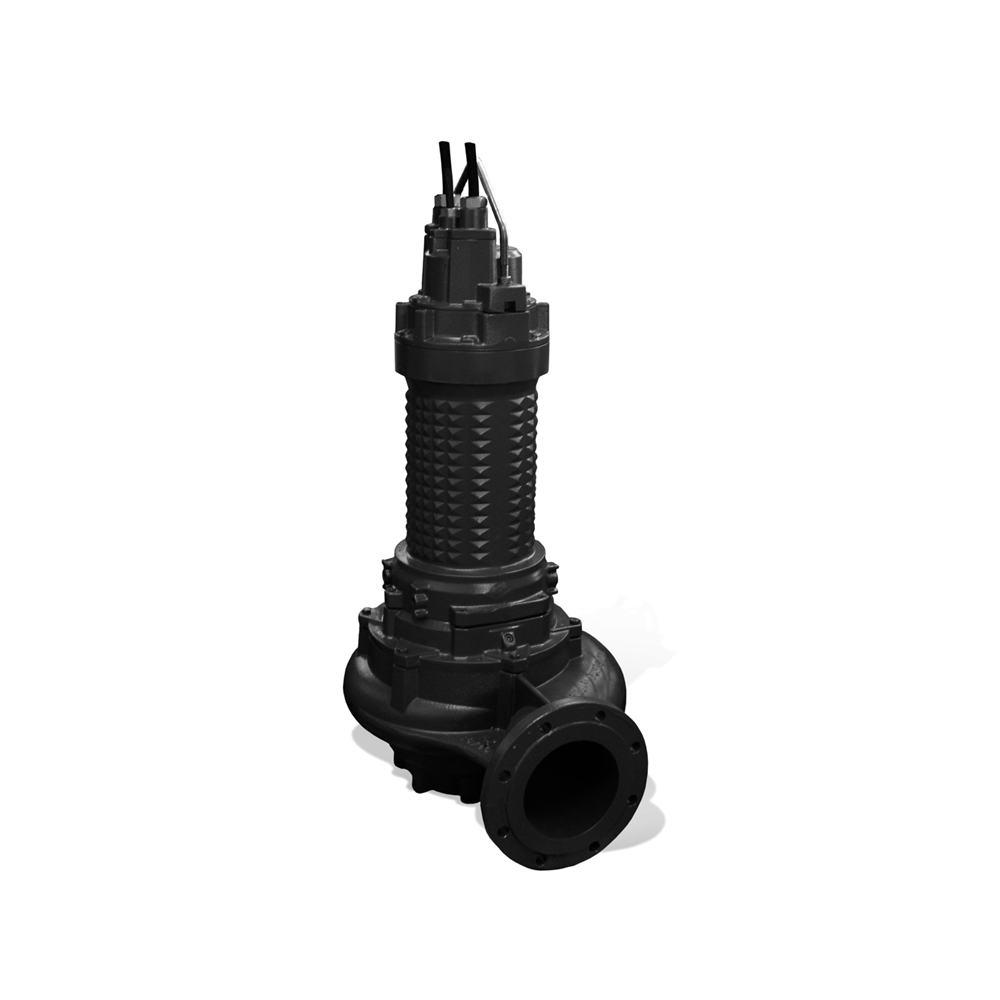
Key features
Ebara builds the DRD around a multi-channel cast iron impeller. Free passage runs from 30 mm on the 65DRD to 50 × 140 mm on the 300DRD.
2, 4, 6 and 8 poles, giving 2,850, 1,450, 950 and 750 rpm. Slower is what you want where the medium is abrasive, and the 8-pole build at 750 rpm is the slowest Ebara publishes for the range.
Suction DN80 to DN400, discharge DN65 to DN350, both to EN 1092-2. Sizes step apart on the larger units, so a 300DRD takes DN350 suction and DN300 discharge.
The standard motor is cooled by the surrounding liquid. Ebara also offers a cooling jacket version, which its manual clears for dry installation.
The sensor reports water in the oil above 30%. Change the oil when it trips. If it trips again soon after, the mechanical seal is the next job.
A lowering device couples the pump onto a foot with two guide tubes, or a support foot version takes a flexible hose and handle.
About the Ebara DRD
The Ebara DRD is a submersible wastewater pump for soiled liquids and sewage in civil and industrial systems. Ebara also puts it on liquids with filamentary substances or solid particles, on emptying tanks, and in its manual on mud and light agricultural sewage. The range is metric and 50 Hz throughout, with flanges to EN 1092-2 and voltage at 400/690 V.
The width of the range is the reason to look at it. Sizes from the 65DRD to the 350DRD, motors from 2.7 kW to 85 kW, and four pole counts. That last one matters more than the catalogue makes it look. Abrasive media want pumping slowly, and a slow pump is a selection constraint that never shows up on a performance curve. Where grit is doing the damage, the 6-pole and 8-pole builds at 950 rpm and 750 rpm are the reason to be looking at a DRD rather than something that only comes at 1,450 rpm.
There is a real limit on the other side of the curve, and Ebara states it plainly. The DRD cannot be run at heads below the lowest point on its published characteristic curve, because the motor overloads there. This is the mirror image of the sizing mistake that lands on the desk most often. Everyone in the chain adds a little margin, the pump is specified far bigger than the duty, and it then runs off the end of its curve. On a DRD the penalty is not just poor efficiency. It is an overloaded motor.
Cast iron sets the chemistry. Casing, suction cover and motor frame are EN-GJL-250 cast iron, the impeller EN-GJS-250, the shaft AISI 420B stainless. Ebara's manual also rules the DRD out of environments with a risk of explosion and out of flammable liquids. If your sump is a classified hazardous area, ask us for a pump certified for the zone instead.
A multi-channel impeller is not a macerator. It passes what fits through the channel and it binds on what does not. Where a station is putting more rag through than the free passage can take, the answer is screening or maceration upstream, not a larger pump. That is a system change rather than a pump change, and it is the one that holds.
How the Ebara DRD works
The Ebara DRD draws through a flanged suction, works the medium with a two- or three-channel cast iron impeller, and discharges through a second flange. Both connections are to EN 1092-2. Ebara tests the range to ISO 9906 Annex A.
Sizes, poles and speed
Ebara publishes a separate specification and selection chart for each DRD size, each with its own pole options and power band. Speed follows the pole count directly: 2 poles gives 2,850 rpm, 4 poles 1,450 rpm, 6 poles 950 rpm and 8 poles 750 rpm.
| Size | Suction | Discharge | Poles | Power |
|---|---|---|---|---|
| 65–80DRD | DN80, DN100 | DN65, DN80 | 2 | 3.1–7.5 kW |
| 100DRD | DN100 | DN125 | 2, 4, 6 | 2.7–20 kW |
| 150DRD | DN150, DN200 | DN150 | 2, 4, 6 | 6–80 kW |
| 200DRD | DN200 | DN200 | 4, 6, 8 | 6–48 kW |
| 250DRD | DN250 | DN250 | 4, 6, 8 | 12.4–85 kW |
| 300DRD | DN350 | DN300 | 6, 8 | 21.8–65 kW |
| 350DRD | DN400 | DN350 | 8 | 40–45 kW |
Designations look like 150DRD530T4BG. The 5 in that string is Ebara's frequency digit for 50 Hz across the D Series. If you are matching an existing pump, send us the whole designation and the serial number off the nameplate rather than the size.
The motor
The DRD motor is an asynchronous squirrel cage machine, insulation class H at 180°C, IP68, dry and cooled by the liquid around it. Supply is three-phase 400/690 V ±10% at 50 Hz, with the frequency tolerance given as -5/+3%. Starting is direct on line or star-delta. Ebara allows a maximum of 5% voltage unbalance between phases, in line with CEI EN 60034-1, and rates the motor for a maximum of 15 starts an hour at regular intervals. Overload protection and a humidity probe are fitted across most of the range. Cable is 10 m of neoprene H07RN/F.
A cooling jacket version is available. Ebara's manual is specific about what that buys you: with the jacket the pump can work continuously at full load in a dry installation, or with the diffuser completely submerged. Without it, the liquid level has to stay above the midpoint of the stator housing for continuous full-load running.
Seal, oil and bearings
The DRD runs an oil-lubricated single spring single mechanical seal with a lip seal behind it. Faces are silicon carbide against silicon carbide on the pump side, carbon against ceramic on the motor side, with nitrile o-rings and lip seal. Bearings are oversized and life-lubricated; the 4-pole builds and some of the slower ones use an oversized double ball bearing with greasers.
The oil chamber carries a water infiltration detector. It reports when water in the oil passes 30%, which is your early warning that the seal is going. Change the oil at that point. If it trips again shortly afterwards, replace the mechanical seal rather than the oil, because the seal is what is letting the water in.
Installation and upkeep
Ebara catalogues two installation arrangements for the DRD. The lowering device drops the pump onto a coupling foot fitted with two guide tubes, so it can be lifted for inspection without breaking into the pipework. The support foot version takes a flexible hose, a handle and a supporting foot for portable use. Where more than one pump shares a sump, Ebara requires an automatic alternating system, which is the duty and standby arrangement a UK station runs anyway. Maximum immersion depth is 20 m. Ebara asks for an inspection at least once a year, more often on hard duties, and a full overhaul by a qualified mechanic every three years under normal working conditions.
Specifications
| Type | Submersible wastewater pump, two-channel or three-channel impeller | |
|---|---|---|
| Liquid handled | Dirty water and wastewater with suspended solids and filamentary material | |
| Flow rate | 12–1,800 m³/h | |
| Total head | up to 47 m | |
| Liquid temperature | below 40°C | |
| Max. solids passage | 30–140 mm | 30 mm on 65–80DRD; 40–80 mm on 100DRD; 50–100 mm on 150DRD; 102 mm on 200DRD; 73–105 mm on 250DRD; 50 × 140 mm on 300DRD; 112 mm on 350DRD |
| Power rating | 2.7–85 kW, three-phase | |
| Poles | 2, 4, 6 and 8 | |
| Speed | 2,850 / 1,450 / 950 / 750 rpm | by pole count, 50 Hz |
| Suction connection | DN80 to DN400, to EN 1092-2 | |
| Discharge connection | DN65 to DN350, to EN 1092-2 | |
| Voltage | 3~400/690 V ±10% | 400 V ±10% on 65DRD53.1T2CG, 65DRD53.6T2BG and 100DRD52.7T4CG |
| Frequency | 50 Hz, -5/+3% | |
| Starting | Direct on line or star-delta | |
| Starts per hour | 15 maximum, at regular intervals | |
| Max. immersion depth | 20 m | Ebara lists 7 m with the standard 10 m cable, and 17 m with a 20 m cable on request |
| Minimum liquid level | Above the midpoint of the stator housing for continuous full-load running | cooling jacket version runs continuously at full load in a dry installation |
| Motor | Asynchronous squirrel cage, dry, cooled by the surrounding liquid, IP68, insulation class H (180°C) | |
| Cooling jacket | Available as an option | |
| Voltage unbalance | 5% maximum between phases, to CEI EN 60034-1 | |
| Motor protection | Overload protection and humidity probe fitted across most of the range | |
| Cable | 10 m neoprene H07RN/F | |
| Casing, suction cover and motor frame | Cast iron EN-GJL-250 | |
| Impeller | Cast iron EN-GJS-250 | |
| Shaft | AISI 420B stainless steel | EN 1.4028; the data book gives AISI 420B/431 |
| Fasteners | A2 class, AISI 304 | |
| Mechanical seal | Oil-lubricated single spring single mechanical seal plus lip seal; silicon carbide / silicon carbide / NBR pump side, carbon / ceramic / NBR motor side | |
| Lubricant | AGIP ITE 360 | |
| Bearings | Oversized, life-lubricated and maintenance free; oversized double ball bearing with greasers on the 4-pole builds | |
| Leak detection | Water infiltration detector in the oil chamber, reporting above 30% water | |
| Accessories | Screwed square flange, discharge threaded elbow, quick discharge connector (QDC) PA type | |
| Test standard | ISO 9906 Annex A | |
| Service interval | Inspection at least annually; overhaul every three years under normal working conditions |
Send us the flow, the total dynamic head, what the medium carries and the largest solid it has to pass, and we will size a DRD against it. Tell us if the medium is abrasive, because that decides the pole count long before it decides the size. Replacing an existing unit? Photograph the nameplate and send the full designation and the serial number.
Documents & downloads
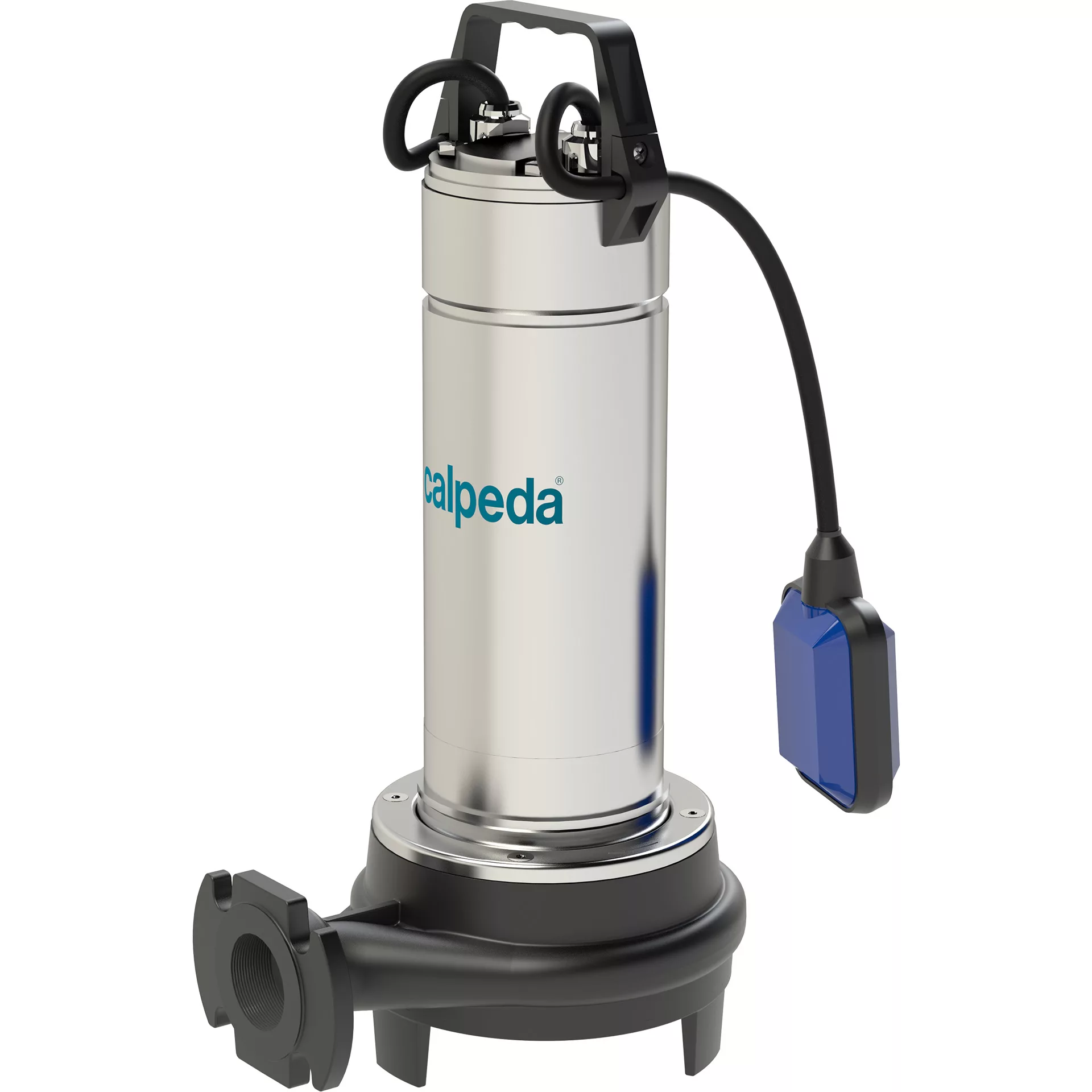
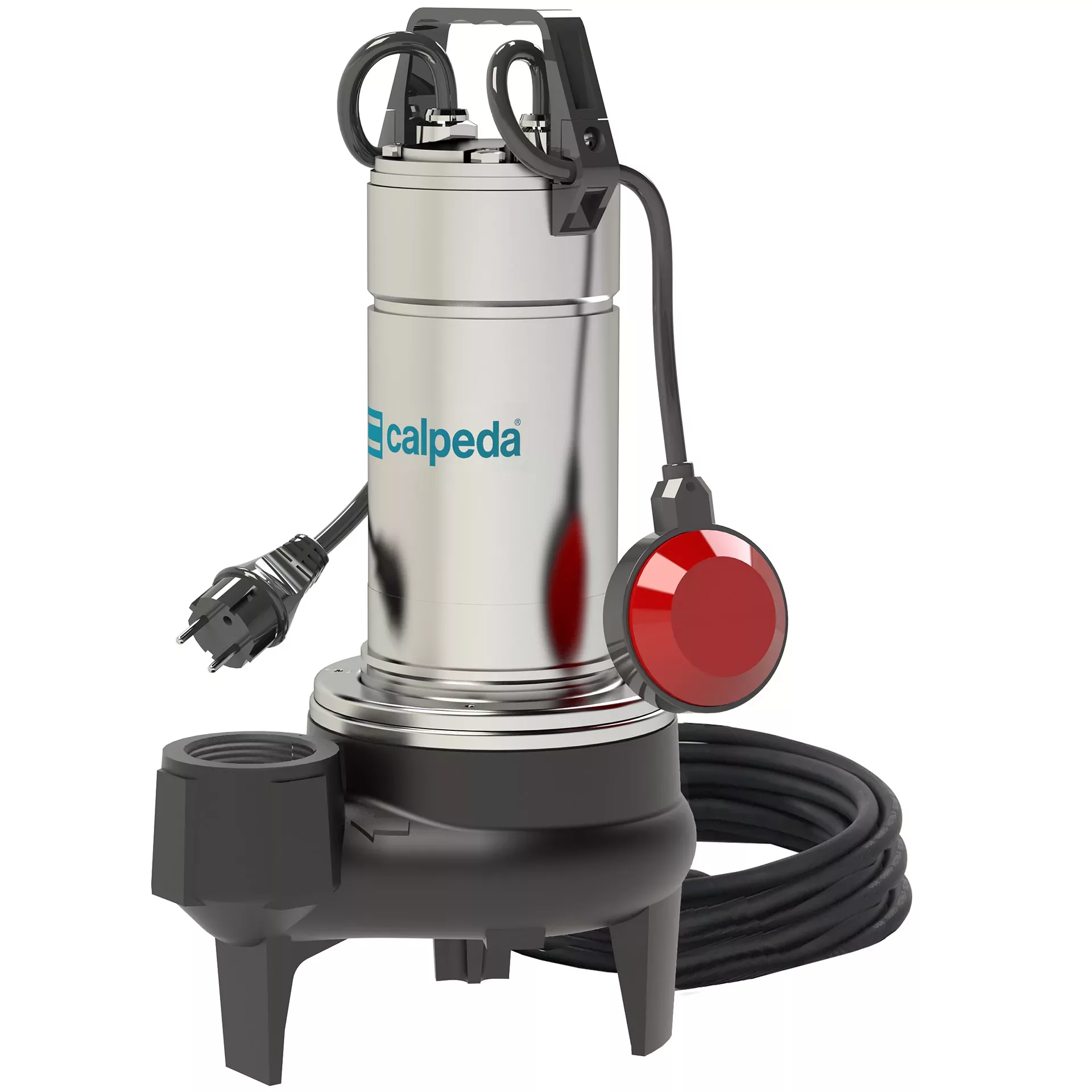
Related pumps
View all →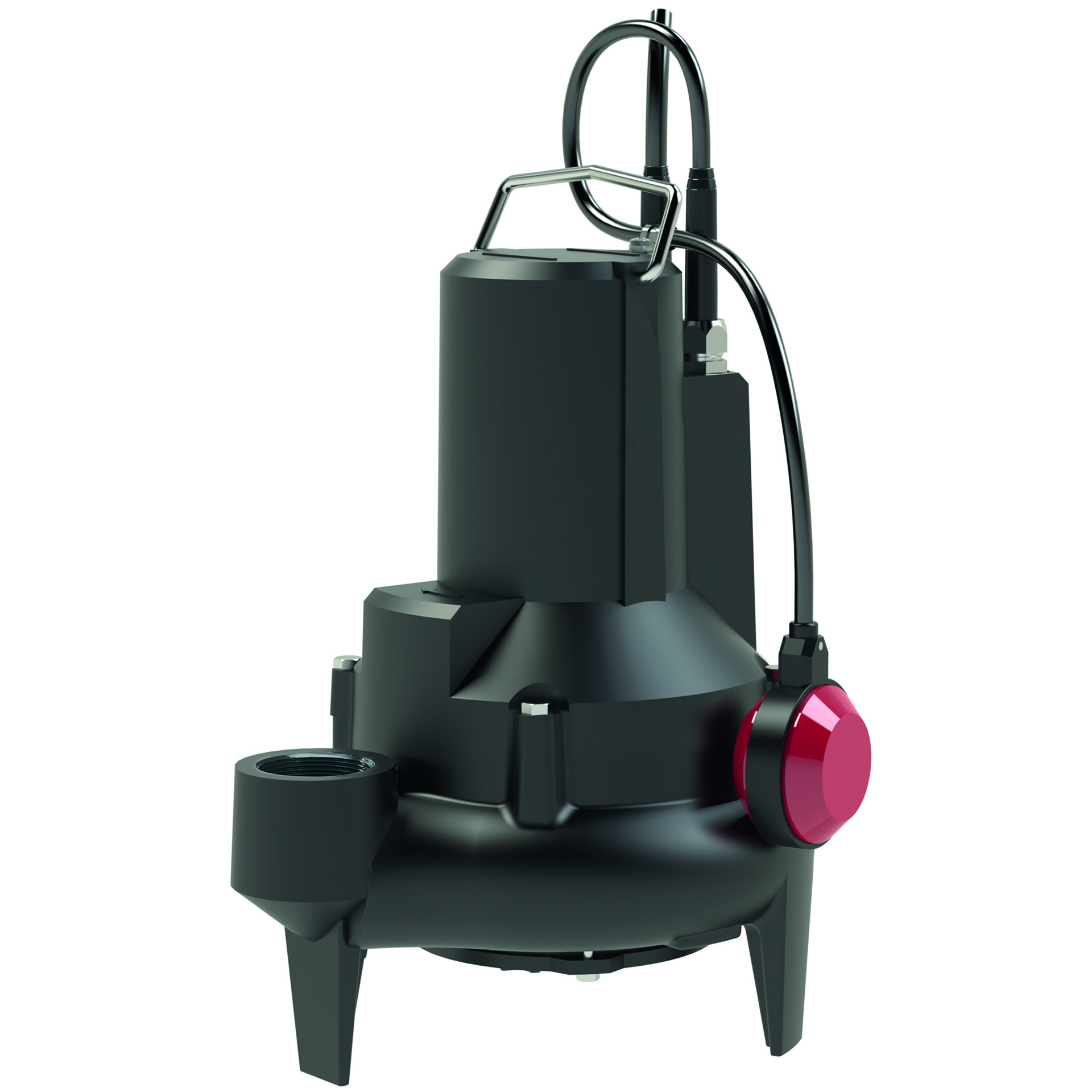
Frequently asked
What is the difference between the Ebara DRD and the Ebara DKE?
The impeller, the speed options and the installation. The DRD uses a two- or three-channel impeller and comes in 2, 4, 6 and 8 poles at 400/690 V, with separate suction and discharge flanges and an optional cooling jacket that clears it for dry installation. The DKE uses a back-swept semi-open anti-clogging impeller, is 4-pole only, and runs at 380/400/415 V. The DRD covers the wider envelope, to 1,800 m³/h and 140 mm solids against the DKE's 780 m³/h and 89 mm.
What flow and head does the Ebara DRD cover?
12–1,800 m³/h against a head of up to 47 m, at 50 Hz. Motors run from 2.7 kW to 85 kW across seven pump sizes.
What size solids will an Ebara DRD pass?
Between 30 mm and 140 mm, depending on size and model. The 65DRD passes 30 mm, the 200DRD 102 mm, and the 300DRD has a 50 × 140 mm passage.
Can the Ebara DRD be installed dry?
Only in the cooling jacket version. Ebara's manual clears that build for continuous full-load running in a dry installation, or with the diffuser fully submerged. The standard build needs the liquid level to stay above the midpoint of the stator housing.
How many starts an hour can an Ebara DRD take?
Ebara rates the motor for a maximum of 15 starts an hour at regular intervals. Size the sump volume so the pump is not asked for more than that.
What speed does the Ebara DRD run at?
It depends on the pole count. 2 poles gives 2,850 rpm, 4 poles 1,450 rpm, 6 poles 950 rpm and 8 poles 750 rpm, all at 50 Hz. Abrasive media suit the slower builds.
What does the water infiltration detector on an Ebara DRD do?
It senses water in the oil chamber and signals once the water content passes 30%. Change the oil when it trips. If it trips again shortly afterwards, replace the mechanical seal.
Can the Ebara DRD be used in a hazardous area?
No. Ebara's instruction manual states the pumps must not be used in environments where there is a risk of explosion, or for pumping flammable liquids. For a classified sump, ask us for a pump certified for the zone.