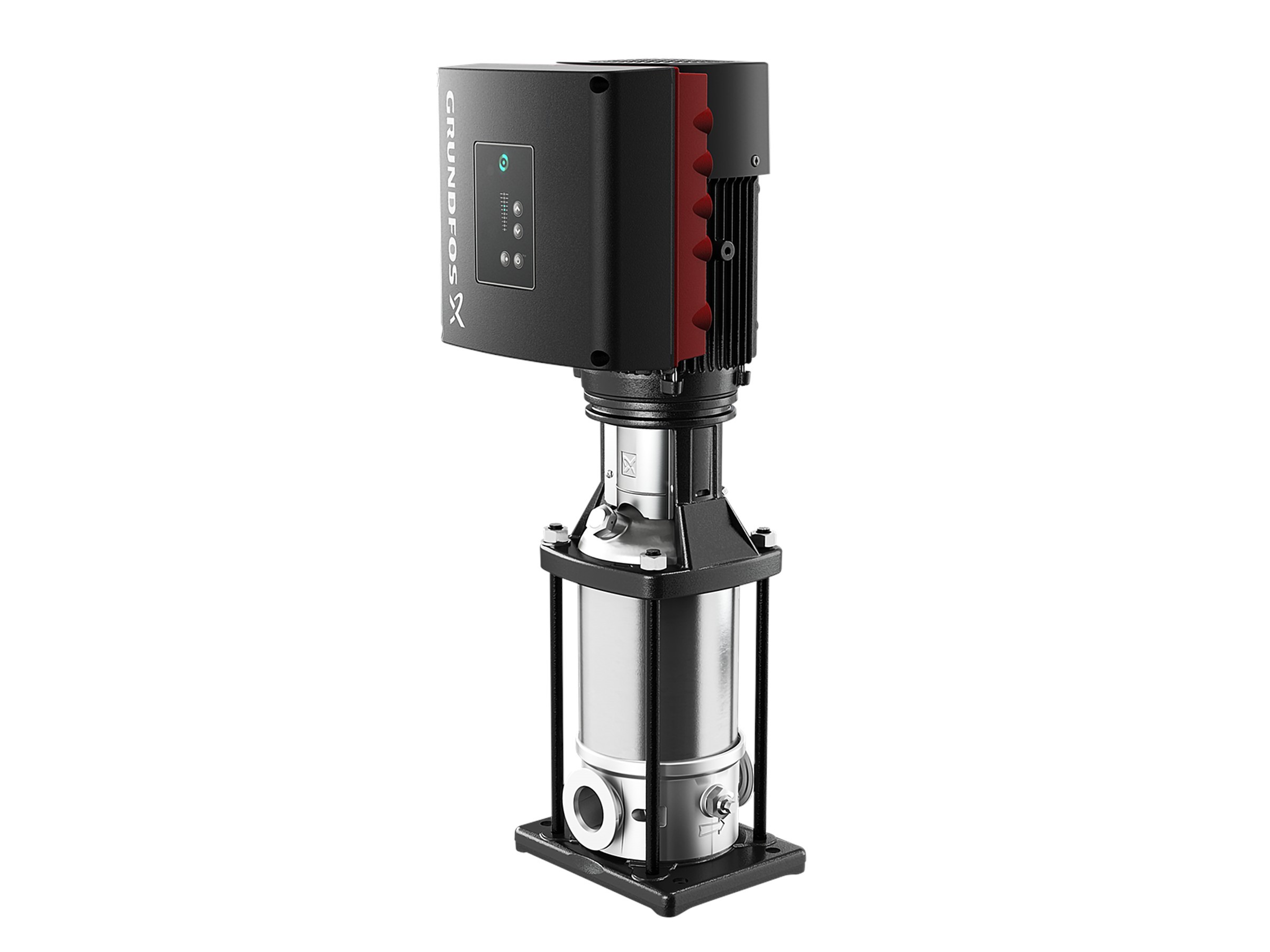
Key features
The MGE motor carries its own frequency converter, so there is no separate inverter to mount, wire, cool or find space for in the starter panel.
Order the CRE with the integrated pressure sensor and constant pressure is the factory control mode. Set the pressure you want and the pump varies its speed to hold it.
Grundfos states that E-pump installations need only normal short-circuit protection for the cable. The converter protects the motor and the electronics against overload.
Grundfos rates the MGE motor at IE5 level from 0.37 to 26 kW, with insulation class F and IP55 enclosure as standard, IP66 on request.
Cast iron pump head and base, EN 1.4301 (AISI 304) stainless wetted parts, cartridge shaft seal. Grundfos builds the CRE on the CR, so the curve and the materials are unchanged.
MGE motors from 3 to 26 kW carry a Bluetooth module for Grundfos GO, so setpoint and operating data come off the pump without opening the terminal box.
About the Grundfos CRE
The Grundfos CRE is a vertical multistage centrifugal pump with a variable-speed drive built into the motor. It is a clean-water pump: Grundfos lists it for industrial and municipal water supply, distribution from waterworks, pressure boosting in mains and in high-rise buildings, washing and cleaning, water treatment, boiler feed and condensate, cooling and air-conditioning, machine tools and irrigation. The pump head and base are cast iron and every other wetted part is EN 1.4301 stainless steel, which is the AISI 304 grade. Non-corrosive liquids only.
Sizes run CRE 1 to CRE 155, where the number is roughly the rated flow in m³/h, and each size carries a range of stage counts. Ports are in line, at the same level, so the pump drops into a horizontal pipe run. That is the CR layout and the CRE inherits it, along with the chamber stack, the staybolts and the cartridge shaft seal. It sits in our centrifugal pump category and comes from Grundfos.
What the integrated converter actually buys you
Grundfos is blunt about the difference: "The difference between the CR and CRE pump ranges is the motor." The hydraulics, the materials and the seal are the same. What changes is that the motor is an MGE, and the MGE has a frequency converter inside its terminal box.
| CR | CRE | |
|---|---|---|
| Motor | No built-in frequency converter | MGE motor, converter built into the terminal box |
| Speed | Fixed | Continuously variable, so any duty point on the curve |
| Constant pressure | Needs a sensor and a controller finding space in the panel | Integrated pressure sensor option; constant pressure is the factory setting |
| Motor protection | Motor-protective circuit breaker | In the converter. Short-circuit protection for the cable only |
| Hydraulics, chamber stack, shaft seal | Same | Same |
| Wetted materials | Cast iron head and base, EN 1.4301 stainless | Same |
Read that as a list of things you no longer buy and no longer commission. The inverter, its enclosure, its cooling and the cable run between panel and pump all disappear into the motor. So does the motor-protective circuit breaker. The pump arrives tested and pre-configured, and the person commissioning it types in a pressure.
When a plain CR is the better buy
Grundfos names three reasons to select an E-pump: the consumption fluctuates, you want constant pressure, or you want to communicate with the pump. If none of those is true, a CRE is money spent on control you will not use. A transfer duty that runs flat out into a tank does not vary, and a fixed-speed CR with a starter is the cheaper pump with less to go wrong.
The other check is where the pump lives. Putting the drive on the motor puts the electronics in the plant room, at whatever temperature and altitude the plant room happens to be. Grundfos calls for an oversize motor above 50 °C ambient or above 1000 metres, which is the sort of derate that turns a straightforward selection into a bigger frame size. Tell us the ambient and the site altitude when you enquire.
How the Grundfos CRE works
A stack of impellers, each in its own chamber, adds pressure to the same flow. That is how a tall, narrow pump reaches 262 m of head. The CRE is not self-priming, so the inlet has to be flooded.
The E-motor is what makes it a CRE. Grundfos builds the MGE as a totally enclosed, fan-cooled motor with a frequency converter in the terminal box and a PI controller behind it. On a pump ordered with the integrated pressure sensor, the sensor on the outlet feeds pressure back to the controller, the controller compares it with the setpoint and the converter trims motor speed until the two agree. Because that runs continuously, the pressure in the pipework stays put while the draw on it changes. Two control modes ship on the pump: constant pressure, which is the factory setting, and constant curve.
Order a CRE without the sensor and you get open-loop speed control, or a pump ready for a sensor you fit later. That variant covers flow, level, temperature, differential pressure and differential temperature control, and it is also the one to specify when a remote analogue signal sets the speed from a building management system.
Protection is inside the converter rather than the panel. The MGE carries thermal protection against slow overload and blocking, and Grundfos states that E-pump installations do not require a motor-protective circuit breaker, only normal short-circuit protection for the cable. Motors from 3 to 26 kW include a Bluetooth module that talks to Grundfos GO at up to 10 metres; pumps from 0.37 to 2.2 kW are factory-fitted with the FM300 functional module, which brings three analogue inputs, two Pt100/1000 inputs, two LiqTec sensor inputs and two signal relays for anyone wiring the pump into a wider control scheme.
On efficiency, Grundfos rates the MGE motor at IE5 level from 0.37 to 26 kW, and states that the product complies with the ecodesign requirements for water pumps in the ErP Directive, Commission Regulation (EC) No 547/2012. The hydraulic side is measured by the Minimum Efficiency Index, and the benchmark Grundfos quotes for the most efficient water pumps is MEI ≥ 0.70.
Specifications
| Pump type | Vertical multistage centrifugal pump with integrated frequency converter | non-self-priming, in-line ports |
|---|---|---|
| Maximum flow | 240 m³/h | CRE 155 maximum, 50 Hz |
| Maximum head | 262 m | range maximum |
| Maximum operating pressure | 30 bar | CRE 32-6-2 to 32-10-2 and CRE 45-5-2 to 45-7, PJE, clamp, union or DIN connection; 16 or 25 bar on smaller sizes |
| Liquid temperature | −30 to +120 °C | −20 to +120 °C on CRE 1 to CRE 20 |
| Pump sizes | CRE 1, 3, 5, 10, 15, 20, 32, 45, 64, 95, 125, 155 | rated flow 1.2 to 185 m³/h |
| Materials | Cast iron pump head and base; all other wetted parts EN 10088 1.4301 (AISI 304) stainless steel | |
| Shaft seal | Maintenance-free cartridge mechanical seal, HQQE/V as standard | |
| Motor | Grundfos MGE, totally enclosed fan-cooled, frequency converter built in | 0.37 to 1.5 kW single-phase; 0.37 to 26 kW three-phase |
| Motor efficiency | IE5 level, 0.37 to 26 kW | |
| Enclosure and insulation | IP55 standard, IP66 optional; insulation class F | |
| Supply | 1 x 200-240 V (0.37-1.5 kW); 3 x 380-500 V (0.37-11 kW); 3 x 380-480 V (15-26 kW), 50/60 Hz | |
| Pipe connections | Oval flange or DN 25/32 to DN 150, by size | PJE (Victaulic) coupling available from DN 32 |
| Control modes | Constant pressure (factory setting) and constant curve | on pumps with the integrated pressure sensor |
Send us the flow, the head, the medium and the liquid temperature, plus how much the demand varies over a day, and we will tell you whether the duty justifies a CRE or a fixed-speed CR. Add the ambient temperature, the site altitude and the supply voltage and we can size the motor properly.
Documents & downloads
Related pumps
View all →
Frequently asked
What is the difference between a Grundfos CR and a Grundfos CRE?
The motor. Grundfos builds the CRE on the CR, with the same hydraulics, chamber stack, shaft seal and materials, then fits an MGE E-motor with a frequency converter in the terminal box. That gives continuously variable speed and, with the integrated pressure sensor, constant pressure control.
Does a Grundfos CRE need a motor-protective circuit breaker?
No. Grundfos states that E-pump installations do not require a motor-protective circuit breaker, only normal short-circuit protection for the cable. The built-in frequency converter protects both the motor and the electronics against overload, and the MGE motor carries thermal protection against slow overload and blocking.
What flow and head does the Grundfos CRE cover?
Up to 240 m³/h and up to 262 m of head, at a maximum operating pressure of 30 bar. Sizes run from CRE 1 to CRE 155, with rated flows from 1.2 to 185 m³/h, and each size carries a range of stage counts so the duty point lands on a curve.
Do I need a CRE, or will a plain CR do?
Grundfos names three reasons to pick an E-pump. The consumption fluctuates, you need constant pressure, or you want to communicate with the pump. If the duty is a fixed flow that runs the same all day, a fixed-speed CR and a starter costs less and has less to go wrong.
What liquids can a Grundfos CRE handle?
Non-corrosive liquids, cold or hot. The pump head and base are cast iron and the other wetted parts are EN 1.4301 stainless, the AISI 304 grade, at liquid temperatures from −30 to +120 °C. For industrial liquids that need a high-grade stainless wetted path, Grundfos points to the CRNE instead.
Can Channel Pumps size a Grundfos CRE for my duty?
Yes. Send us the flow, the head, the medium, the liquid temperature and how much the demand varies, plus the supply voltage, ambient temperature and site altitude. We size the pump and the motor, and we will say so if a fixed-speed CR is the better buy.