Key features
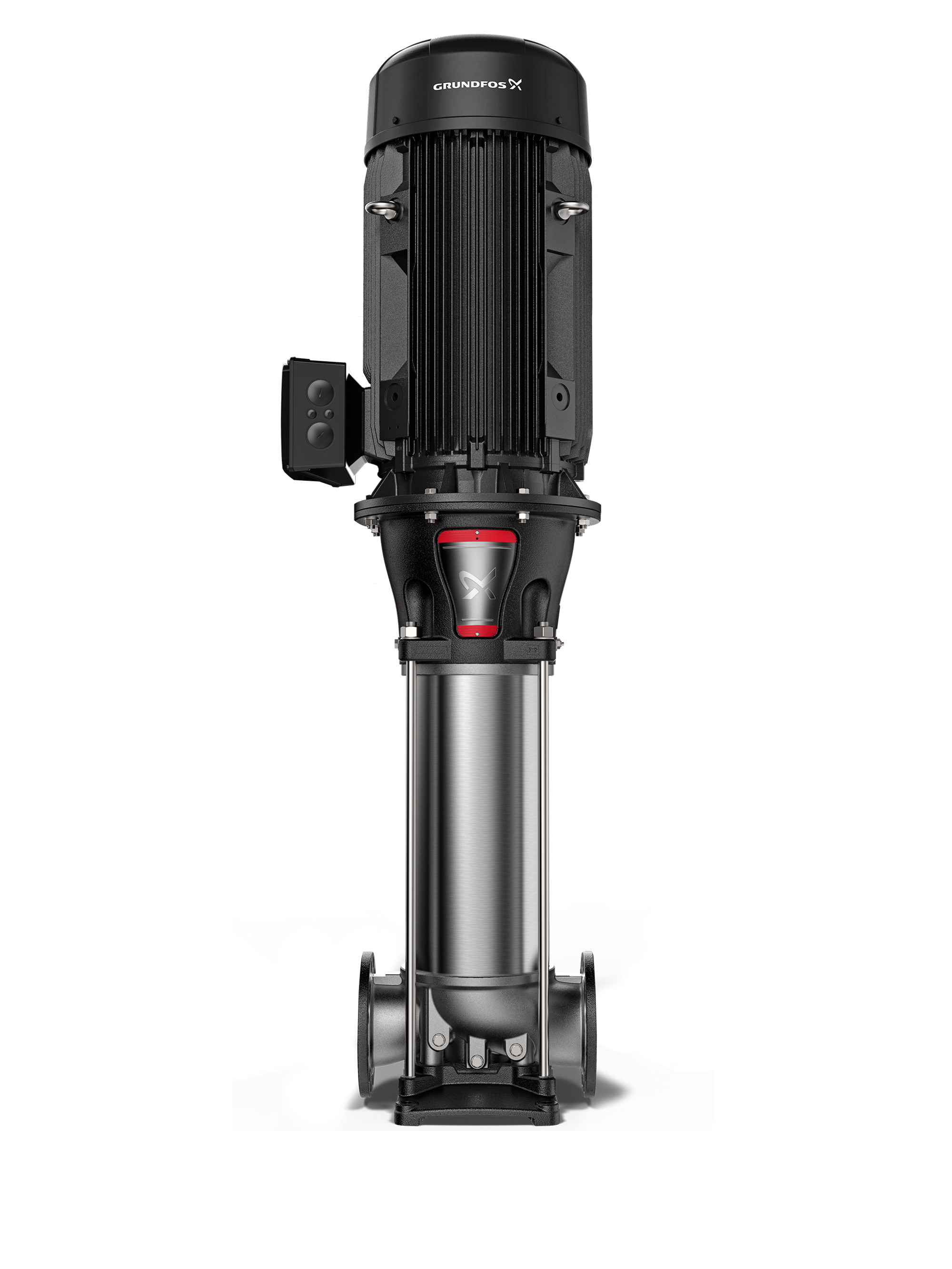
Inlet and outlet sit at the same level and take the same pipe size. The pump goes into an existing horizontal run without anyone cutting and re-piping around it.
Grundfos rates this build for non-corrosive liquids. Impeller, chamber and sleeve are EN 1.4301 stainless; the pump head and base are cast iron.
Rated flows run from 0.8 m³/h to 255 m³/h, and each size carries a range of stage counts, so the duty point lands on the curve rather than on a margin.
Every CR ships with a maintenance-free cartridge mechanical seal, HQQE/V with silicon carbide faces. The seal is the part that fails on most pumps, and this one changes as a unit.
Two-pole totally enclosed fan-cooled motors to IE4 and IP55. Grundfos MG to 18.5 kW, Innomotics from 22 to 200 kW, with single-phase options from 0.37 to 2.2 kW.
Most sizes carry a Minimum Efficiency Index at or above 0.70, which is the benchmark Grundfos cites for the most efficient water pumps.
About the Grundfos CR
The Grundfos CR gets high head out of a small footprint by stacking impellers. Each stage adds pressure to the same flow, so a tall, narrow pump does work that would otherwise need a much larger single-stage machine. Grundfos builds it for water supply, pressure boosting in high-rise buildings and hotels, boiler feed and condensate, cooling and air-conditioning, washing and cleaning, firefighting systems, machine tools and irrigation.
The layout is why it caught on. Grundfos launched the CR30 in 1971 as the first inline multistage centrifugal pump made, with the inlet and outlet at the same level and the same size. It installs in a horizontal one-pipe system, which is why it turns up in plant rooms where nobody wants to cut into the pipework. Grundfos has built it ever since, and it sits in our centrifugal pump category.
CR or CRN: the medium decides, not the budget
The CR and the CRN are the same hydraulic in different metal, and Grundfos is direct about which goes where. The CR is for non-corrosive liquids. The CRN is for industrial liquids, in systems where every part touching the medium has to be high-grade stainless steel. Four parts change between them.
| Part | CR | CRN |
|---|---|---|
| Pump head | Cast iron | Cast stainless steel, EN 10283 1.4408 (CF 8M) |
| Base | Cast iron | Cast stainless steel, EN 10283 1.4408 (CF 8M) |
| Impeller, chamber, sleeve | EN 10088 1.4301, AISI 304 | EN 10088 1.4401, AISI 316 |
| Staybolts | Bright steel | Stainless steel |
Grundfos spells out what that buys in its own applications list, duty by duty. Acids and alkalis, ultra-filtration, reverse osmosis, softening and demineralising, and distillation are all CRN duties, and the CR is not listed for any of them. Chloride-bearing water goes on the CRN too, below 30°C and up to 500 ppm. Firefighting runs the other way: the CR is listed for it and the CRN is not.
So if the medium is clean water and always will be, the CR is the pump and the stainless is money you do not need to spend. If there is anything in the water that will find the 304, pay for the CRN once rather than re-piping a corroded base later. The awkward cases are the ones where the medium changes with the season or with a cleaning cycle, and those are worth a phone call rather than a guess.
One more version worth knowing. The CRE is the same wet end with an integrated variable-speed motor, so it holds a setpoint instead of throttling against a valve.
Where these get specified wrong
Oversizing, almost every time, and it is decided long before anyone reads a curve. The customer states a flow. The consultant adds margin for future duty, the contractor adds a little more, the installer rounds up again. Nobody in that chain is careless and the pump that comes out is far too big. You then carry an oversized motor for the life of the installation, and on a multistage pump running past the end of its curve you get the worse problem: not enough back pressure, cavitation, and a shaft seal that goes early.
The other one is suction. NPSHa has to beat NPSHr at the duty point, and on a CR the tall chamber stack tempts people to forget that the inlet conditions have not changed. Send us the real duty point and the suction arrangement, not the one with everyone's margin already in it.
How the Grundfos CR works
The CR is a non-self-priming vertical multistage centrifugal pump. Liquid enters at the base, passes up through a stack of chambers, and each impeller adds head to it before it leaves through the outlet port alongside the inlet. The chamber stack and the outer sleeve are clamped between the base and the pump head by staybolts, so the number of stages sets the pressure and the pump's height at the same time.
The motor sits on top and drives the shaft through a coupling. Grundfos fits two-pole totally enclosed fan-cooled motors built to EN dimensions, IE4 efficiency, insulation class F and IP55: MG motors up to 18.5 kW and Innomotics motors from 22 to 200 kW. Three-phase motors from 3 kW carry a PTC thermistor to DIN 44082 and a TP 211 thermal overload switch; the single-phase versions have the TP 211 built in.
The shaft seal decides the temperature limit
Every CR leaves the factory with a cartridge mechanical seal, and the seal, not the pump body, is what fixes the temperature window. Grundfos publishes the standard options as a table.
| Shaft seal | Faces and elastomer | Liquid temperature |
|---|---|---|
| HQQE | Silicon carbide / silicon carbide, EPDM | -40°C to +120°C |
| HQQV | Silicon carbide / silicon carbide, FKM | -20°C to +90°C |
| HQBE | Silicon carbide / carbon, EPDM | 0°C to +120°C |
| HQBV | Silicon carbide / carbon, FKM | 0°C to +90°C |
HQQE/V is the standard fit. The standard seal range is stated for clean water and water with anti-freeze, so tell us what is actually in the liquid before the seal gets picked. Run outside the published range and the seal life shortens, which is the failure everyone then blames on the pump.
Pressure and temperature limits are by size, not by range
The maximum operating pressure depends on the size and the connection, and it is not a single number for the CR. Oval-flange builds on the small sizes are rated to 10 or 16 bar, and PJE, clamp, union or DIN connections take 25 bar. Sizes 32 to 64 reach 30 to 33 bar, and the largest sizes reach 40 bar. The exception worth knowing is that CR 95 to CR 155 is capped at 25 bar, where the CRN equivalent goes to 40 bar.
Standard liquid temperature is -20°C to +120°C, with a -30°C minimum on CR 32, 45 and 64. For CR 32 to 155, Grundfos offers versions for liquids up to +180°C on request, and oils to +240°C, using an air-cooled shaft seal chamber that keeps the liquid around the seal cooler than the liquid in the pipe.
Efficiency and the ecodesign rules
The CR is energy-optimised to the ecodesign requirements for water pumps in Commission Regulation (EU) No 547/2012. Most sizes carry a Minimum Efficiency Index above or at 0.70, which the regulation names as the benchmark for the most efficient water pumps on the market. Two sizes sit below it: CR 1s-3 at 0.54 and CR 5-3 at 0.57. Trimming an impeller to a fixed duty point lowers efficiency against the full diameter, so an oversized pump trimmed back is not the same as the right pump run whole.
Specifications
| Pump type | Vertical multistage centrifugal, inline ports, non-self-priming | |
|---|---|---|
| Sizes | CR 1s, 1, 3, 5, 10, 15, 20, 32, 45, 64, 95, 125, 155, 185, 215, 255 | 16 flow sizes, each with a range of stage counts |
| Flow rate | 0.3 to 330 m³/h | CR 1s minimum to CR 255 maximum, 50 Hz |
| Head | up to 362 m | range maximum |
| Maximum operating pressure | 10 to 40 bar | by size and connection; CR 95 to 155 is limited to 25 bar |
| Liquid temperature | -20°C to +120°C | -30°C minimum on CR 32, 45 and 64; up to +180°C on request for CR 32 to 155 |
| Motor power | 0.37 to 200 kW | |
| Motor | 2-pole, totally enclosed fan-cooled, IE4, IP55, insulation class F | Grundfos MG to 18.5 kW, Innomotics 22 to 200 kW; single-phase 0.37 to 2.2 kW |
| Wetted materials | Impeller, chamber and sleeve EN 10088 1.4301 (AISI 304); pump head and base cast iron | |
| Shaft seal | HQQE/V cartridge seal, silicon carbide faces | maintenance-free, changed as a unit |
| Connections | Oval flange Rp 1 to Rp 2; DIN flange DN25 to DN200; PJE (Victaulic) coupling; union | |
| Efficiency | MEI at or above 0.70 on most sizes | CR 1s-3 is 0.54 and CR 5-3 is 0.57 |
Send us the flow, the total dynamic head, the medium and its temperature, the suction arrangement and the connection type you need, and we will size the CR against the curve and specify the seal, materials and motor to go with it. If the medium wants stainless we will say so.
Documents & downloads
Related pumps
View all →
Frequently asked
What is the Grundfos CR pump used for?
The CR is an inline vertical multistage centrifugal pump for non-corrosive liquids. Grundfos lists it for water supply and distribution, pressure boosting in mains and high-rise buildings, boiler feed and condensate, cooling and air-conditioning, washing and cleaning, firefighting systems, machine tools and irrigation.
What is the difference between a Grundfos CR and a CRN?
Materials. On the CR the pump head and base are cast iron and the impeller, chamber and sleeve are EN 1.4301 (AISI 304) stainless. On the CRN the head and base are cast stainless (EN 10283 1.4408) and the wetted parts are EN 1.4401 (AISI 316). Grundfos rates the CR for non-corrosive liquids and the CRN for industrial liquids, including acids and alkalis, reverse osmosis and demineralising duties.
What flow and head does the Grundfos CR cover?
The range runs from 0.3 m³/h on the CR 1s to 330 m³/h on the CR 255 at 50 Hz, with head to 362 m. There are 16 flow sizes and a range of stage counts inside each, so the duty point usually lands close to a published curve rather than between two.
What temperature and pressure can a Grundfos CR handle?
Standard liquid temperature is -20°C to +120°C, with a -30°C minimum on CR 32, 45 and 64. Maximum operating pressure runs from 10 bar to 40 bar depending on the size and the connection, and CR 95 to 155 is limited to 25 bar. Versions for liquids to +180°C are available on request for CR 32 to 155.
Can a Grundfos CR run on a single-phase supply?
Yes, from 0.37 kW to 2.2 kW. Above that the CR takes a three-phase motor. Grundfos MG covers up to 18.5 kW and Innomotics 22 kW to 200 kW, all two-pole, IE4 and IP55.
How do I identify which Grundfos CR I have?
Read the type key off the nameplate. In a designation like CR 32-3-2, the 32 is the rated flow in m³/h, the 3 is the number of impellers and the 2 is how many of those are reduced diameter. The letters that follow set the pump version, pipe connection, materials, rubber parts and shaft seal. Send us the full string and the serial number and we will match the pump.
Can Channel Pumps size a Grundfos CR for my duty?
Yes. Give us the flow, the total dynamic head, the medium and its temperature, the suction conditions and the connection type. We size the pump against the curve and specify the seal, materials and motor. If the medium wants a CRN instead, we will tell you that.