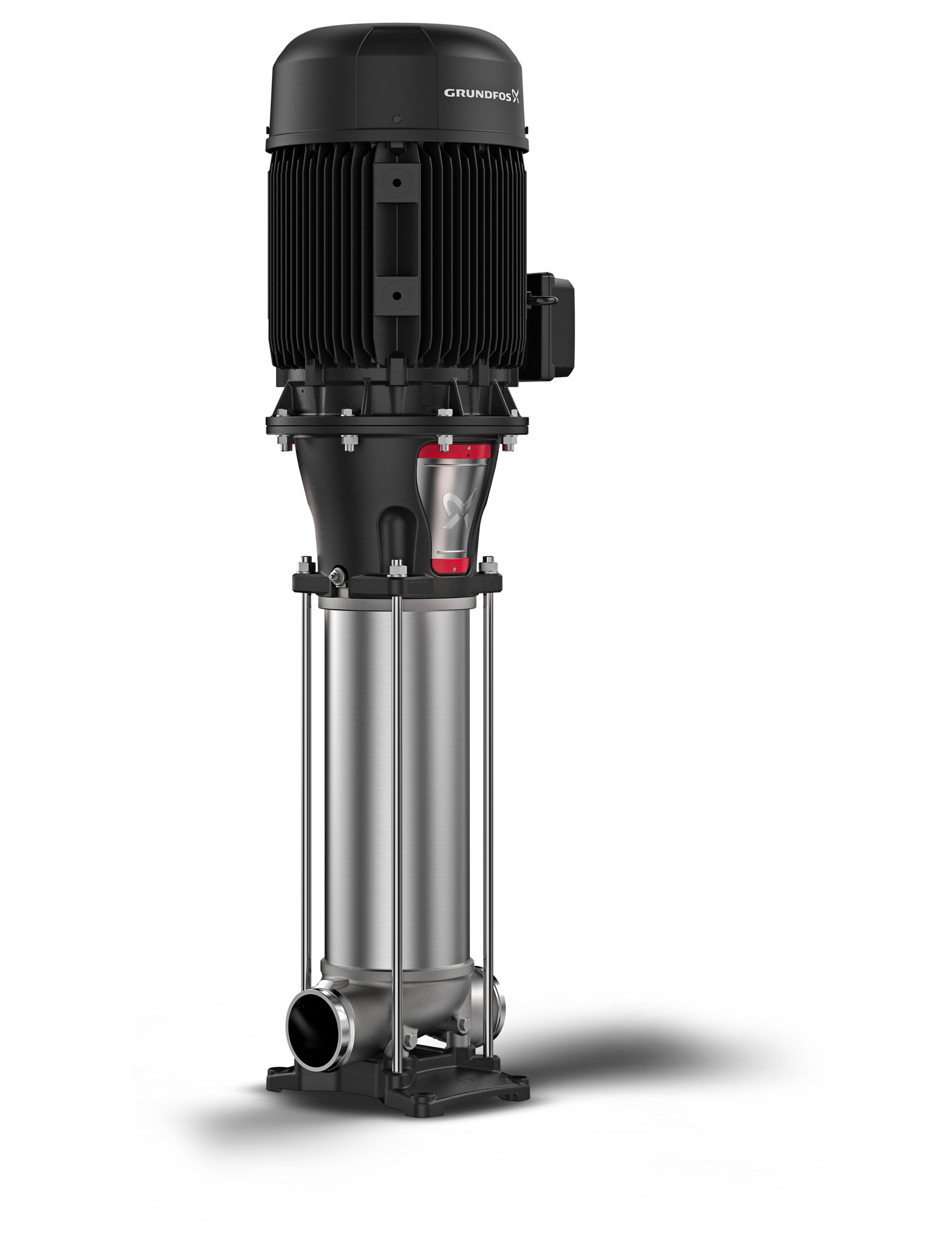
Key features
Impeller, chamber and sleeve in EN 1.4401, with a cast stainless pump head and base in EN 10283 1.4408. Even the staybolts are stainless.
Acids and alkalis, ultra-filtration, reverse osmosis, softening and demineralising, and distillation are all CRN duties on Grundfos's applications list, with no cast iron version offered.
On sizes 95 to 155 the CRN takes 40 bar of operating pressure against the CR's 25 bar, and high-pressure CRN versions reach 50 bar on request.
CRN 32, 45 and 64 carry a -40°C minimum liquid temperature as standard, and CRN 95, 125 and 155 can be built to it on request.
TriClamp connections and electropolished bodies are offered for pharmaceutical and food work, and Grundfos lists a number of ATEX-approved CRN pumps.
HQQE/V is the standard fit, and Grundfos publishes a per-liquid seal recommendation so the faces and the elastomer match what you are actually pumping.
About the Grundfos CRN
The Grundfos CRN is the pump you specify when the medium would eat the cast iron out of a standard multistage. Grundfos puts it plainly: use the CRN in systems where all parts in contact with the liquid must be made of high-grade stainless steel. The hydraulics are the CR's, so flow, head and the inline port layout do not change. What changes is the metal.
| Part | CR | CRN |
|---|---|---|
| Pump head | Cast iron | Cast stainless, EN 10283 1.4408 (CF 8M) |
| Base | Cast iron | Cast stainless, EN 10283 1.4408 (CF 8M) |
| Impeller, chamber, sleeve | EN 10088 1.4301 (AISI 304) | EN 10088 1.4401 (AISI 316) |
| Staybolts | Bright steel | Stainless steel |
| Shaft, sizes 32 to 64 | EN 10088 1.4057 | EN 10088 1.4462 duplex |
| Shaft, sizes 125 and above | EN 10088 1.4462 duplex | EN 10088 1.4462 duplex |
Here is the honest version of what that buys. Moving from 304 to 316 buys chloride resistance, which is why Grundfos lists chloride-bearing water on the CRN below 30°C and up to 500 ppm. Casting the head and base in CF 8M removes the two iron parts that would corrode first. From CRN 32 up the shaft is duplex stainless, EN 1.4462, where the CR uses EN 1.4057 — though at CR 125 and above the CR takes a duplex shaft too, so that particular difference closes on the largest frames. If your medium is plain water and will stay plain water, none of that earns its keep and the CR is the pump. We would rather say that now than sell you the stainless.
Where the CRN is the only version offered
Water treatment, mostly. Grundfos's applications list gives the CRN as the recommended version for ultra-filtration, reverse osmosis, softening, ionising and demineralising systems, and distillation, and offers no CR for any of them. Acids and alkalis are the same story. On the industrial side the CRN shares process water, washing and cleaning, machine tools, oils and alcohols, and glycol and coolants with the CR.
It runs the other way too, and that matters before you order. On water supply work, waterworks filtration and transfer, mains pressure boosting, high-rise buildings and hotels, the CR is the recommended version and the CRN is the alternative. Firefighting systems are listed for the CR only. A stainless pump is not automatically the safer specification, and on a clean-water duty it is money spent on corrosion resistance that nothing is going to test.
The seal, not the pump body, is the part to get right
The CRN body survives plenty of media that will still take the shaft seal out. Grundfos publishes a per-liquid recommendation for exactly that reason, and two of the entries are worth repeating.
Demineralised water below 2 µS/cm conductivity is the first. Run it through the standard silicon carbide against silicon carbide seal and there is an increased risk of electrochemical corrosion; Grundfos recommends silicon carbide against carbon, or against tungsten carbide, instead. That is a reverse osmosis permeate duty, and reverse osmosis is one of the commonest reasons a CRN gets specified in the first place.
The acids are the second. Grundfos lists sulphuric acid at 1% and 20°C and sodium hypochlorite at 0.1% and 20°C on an FKM seal, while acetic acid, sodium hydroxide and potassium hydroxide take EPDM. Same pump body, two different elastomers, and getting it the wrong way round is a fast seal failure rather than a slow one. Tell us the concentration and the temperature, not just the name of the chemical.
Variants that change the specification
Three are worth naming. Grundfos builds a CRN High Pressure programme for systems working above 25 bar, as a single pump or two pumps in series, reaching 50 bar. An air-cooled shaft seal chamber takes the CRN to liquids at 180°C, at 25 bar maximum, by keeping the liquid around the seal cooler than the liquid in the pipe. And the CRN MAGdrive is a magnetically driven version for aggressive, volatile or dangerous liquids such as organic compounds and solvents, where a shaft seal is the wrong answer at any specification.
For pharmaceutical and biotechnology work, Grundfos designs CRN pumps for systems that need the pipes, valves and pump sterilised and cleaned in place. TriClamp connections and an electropolished body are the options that go with it. If you run clean-in-place with a motor above 55 kW, Grundfos requires a bearing flange and a base where the pump has no thrust bearing or thrust-balancing device. That is the kind of detail missed at order stage and found at commissioning.
This pump sits in our centrifugal pump category. If you want the same wet end with an integrated variable-speed motor, look at the CRE.
How the Grundfos CRN works
The CRN is a non-self-priming vertical multistage centrifugal pump. Liquid enters the base, climbs through a stack of chambers, and each impeller adds head before it leaves through the outlet alongside the inlet. Staybolts clamp the chamber stack and the sleeve between the base and the pump head, so the stage count sets both the pressure and the height of the pump. A cartridge mechanical seal keeps the liquid off the shaft.
The motor is a two-pole totally enclosed fan-cooled unit built to EN dimensions, IE4 efficiency, insulation class F and IP55. Grundfos MG motors cover up to 18.5 kW and Innomotics motors 22 to 200 kW, with single-phase available from 0.37 to 2.2 kW. Two size-specific rules matter on the larger CRNs: CRN 95 above 55 kW, and CRN 125 to 155 above 110 kW, need a soft starter or a frequency converter.
Pressure and temperature go further than on the CR
The material change lifts two limits. On sizes 95 to 155 the maximum operating pressure is 40 bar for the CRN and 25 bar for the CR, and the high-pressure CRN programme reaches 50 bar on the CRN 32, 49 bar on the 45 and 41 bar on the 64, all on request. Standard operating pressure on the smaller sizes runs from 16 bar to 33 bar depending on size and connection.
Temperature moves at the cold end. Standard liquid temperature is -20°C to +120°C, but CRN 32, 45 and 64 carry a -40°C minimum as standard, and CRN 95, 125 and 155 can be built to -40°C on request. At the hot end, versions for liquids up to +180°C are available on request for sizes 32 to 155, using the air-cooled shaft seal chamber.
Shaft seals and their windows
Every CRN ships with a cartridge seal, HQQE/V as standard. The published operating ranges apply to clean water and water with anti-freeze, so on anything else the per-liquid recommendation is what to follow.
| Shaft seal | Faces and elastomer | Liquid temperature |
|---|---|---|
| HQQE | Silicon carbide / silicon carbide, EPDM | -40°C to +120°C |
| HQQV | Silicon carbide / silicon carbide, FKM | -20°C to +90°C |
| HQBE | Silicon carbide / carbon, EPDM | 0°C to +120°C |
| HQBV | Silicon carbide / carbon, FKM | 0°C to +90°C |
Hazardous areas
Grundfos offers a number of ATEX-approved CRN pumps, selected against the locality, the hazard and how likely a dangerous situation is. ATEX equipment is certified for use in a classified zone, so the classification for the area comes first and the pump is specified against it. Send us the zone and the medium and we will take the requirement to Grundfos rather than infer it.
Specifications
| Pump type | Vertical multistage centrifugal, inline ports, non-self-priming | |
|---|---|---|
| Sizes | CRN 1s, 1, 3, 5, 10, 15, 20, 32, 45, 64, 95, 125, 155, 185, 215, 255 | |
| Flow rate | 0.3 to 330 m³/h | CRN 1s minimum to CRN 255 maximum, 50 Hz |
| Head | up to 406 m | range maximum |
| Maximum operating pressure | 16 to 40 bar | by size and connection; high-pressure versions to 50 bar on request |
| Liquid temperature | -20°C to +120°C | -40°C minimum as standard on CRN 32, 45 and 64; up to +180°C on request for CRN 32 to 155 |
| Motor power | 0.37 to 200 kW | |
| Motor | 2-pole, totally enclosed fan-cooled, IE4, IP55, insulation class F | CRN 95 above 55 kW and CRN 125 to 155 above 110 kW need a soft starter or frequency converter |
| Wetted materials | Impeller, chamber and sleeve EN 10088 1.4401 (AISI 316); pump head and base EN 10283 1.4408 (CF 8M) | |
| Shaft | EN 10088 1.4401 or 1.4460 on CRN 1s to 20; EN 10088 1.4462 duplex on CRN 32 and above | |
| Shaft seal | HQQE/V cartridge seal, silicon carbide faces | faces and elastomer selected against the pumped liquid |
| Connections | Oval flange Rp 1 to Rp 2; DIN flange DN25 to DN200; PJE (Victaulic) coupling; union; TriClamp on request | |
| Variants | High Pressure programme, air-cooled top, MAGdrive, electropolished, ATEX-approved pumps | on request |
Tell us the medium by name, its concentration and its temperature, then the flow, the total dynamic head and the connection you need. We size the CRN against the curve and specify the seal faces, the elastomer and the motor to suit the liquid. If a cast iron CR would do the job, we will say so.
Documents & downloads
Related pumps
View all →
Frequently asked
What is the difference between a Grundfos CR and a CRN?
Materials. The CRN has every wetted part in high-grade stainless: the impeller, chamber and sleeve in EN 1.4401 (AISI 316) and the pump head and base cast in EN 10283 1.4408, where the CR uses EN 1.4301 (AISI 304) wetted parts with a cast iron head and base. Grundfos rates the CR for non-corrosive liquids and the CRN for industrial liquids.
What is the Grundfos CRN pump used for?
Water treatment and industrial process duties. Grundfos lists it as the recommended version for ultra-filtration, reverse osmosis, softening, ionising and demineralising systems, distillation, and acids and alkalis, alongside process water, washing and cleaning, machine tools, oils and alcohols, and glycol and coolants.
Is the Grundfos CRN made of 316 stainless steel?
Yes. The impeller, chamber and sleeve are EN 10088 1.4401, which is approximately AISI 316, and the sleeve on the largest sizes is 1.4404 (AISI 316L). The pump head and base are cast stainless to EN 10283 1.4408, equivalent to CF 8M.
What pressure and temperature can a Grundfos CRN handle?
Standard operating pressure runs from 16 bar to 40 bar by size and connection, and high-pressure versions reach 50 bar on request. Standard liquid temperature is -20°C to +120°C, with a -40°C minimum as standard on CRN 32, 45 and 64 and versions to +180°C on request for sizes 32 to 155.
Is the Grundfos CRN available ATEX-approved?
Grundfos offers a number of ATEX-approved CRN pumps, chosen against the locality, the hazard and the likelihood of a dangerous situation. The area is classified into a zone first and the pump is then specified for use in it, so send us the zone classification with the duty.
Which shaft seal should a Grundfos CRN have?
It depends on the liquid, not the pump. HQQE with EPDM is the standard fit, HQQV with FKM suits liquids such as sulphuric acid and sodium hypochlorite, and on demineralised water below 2 µS/cm Grundfos recommends a silicon carbide against carbon or tungsten carbide seal instead of the standard pairing.
Can Channel Pumps size a Grundfos CRN for my duty?
Yes. Send the medium, its concentration and temperature, the flow, the total dynamic head, the connection type and any hazardous-area requirement. We size the pump against the curve and specify the seal, the elastomer and the motor with it.