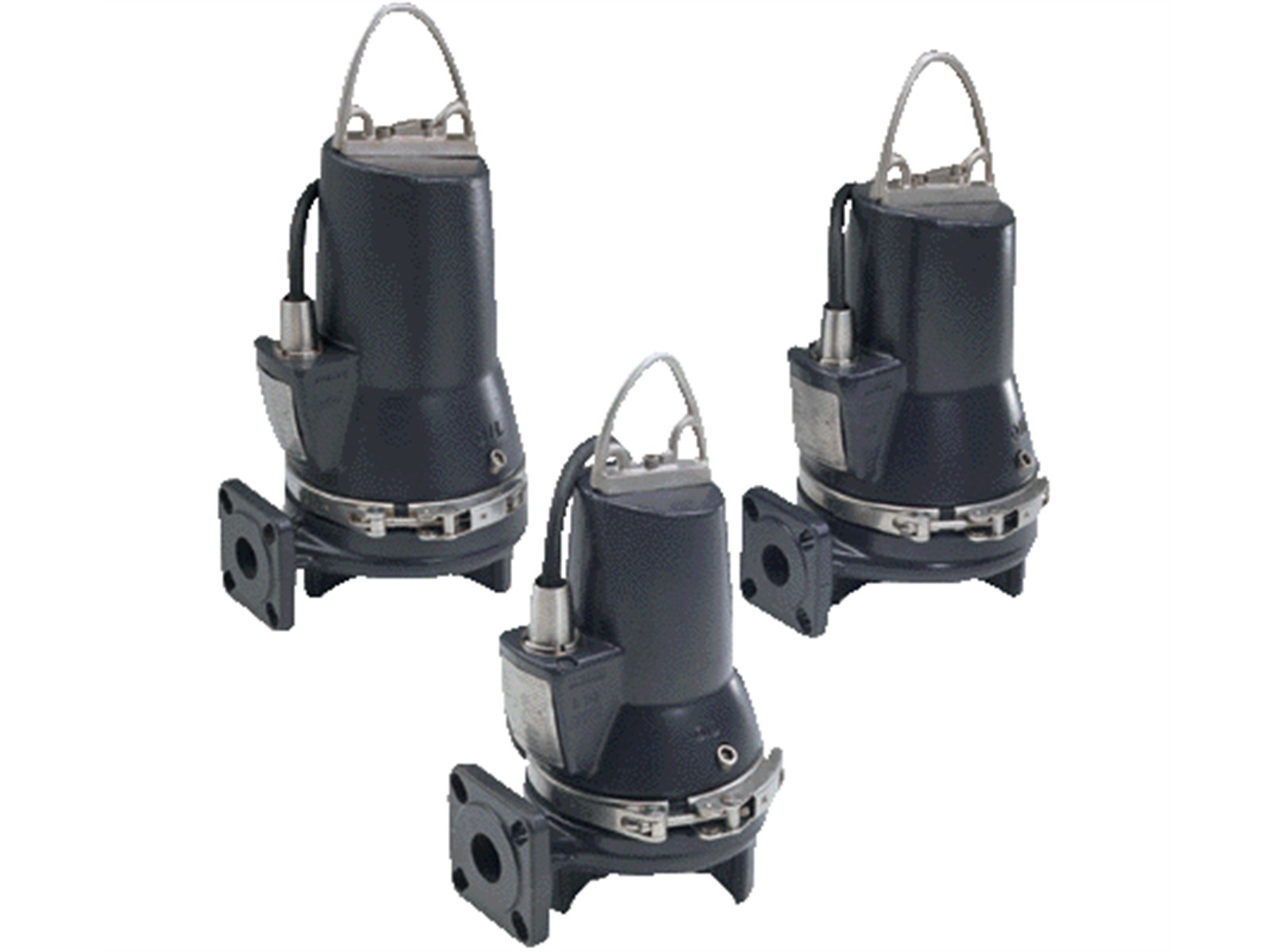
Key features
A rotating grinder head works against a grinder ring at the inlet, reducing solids before they reach the semi-open impeller.
The grinder head is fastened to the same shaft end as the impeller, so one machine does both jobs.
A DN40 outlet, or DN50 on the high-flow variants, which is what makes a pressurised sewer viable where gravity will not run.
The impeller clearance is reset without stripping the wet end, so the pump holds its performance as the faces wear.
The seal lifts out as one unit. Pumps of 2.6 kW and up carry a double seal with a SiC/SiC primary.
The E versions carry the controller, level and dry-running sensors and motor protection inside the pump.
About the Grundfos SEG
The Grundfos SEG is the pump you specify when the sewage has to travel and the pipe has to stay small. Grundfos built it for places a gravity system is not available: small villages, farms, and sites on rocky ground with large differences in level. It takes untreated wastewater, sludge-containing water and toilet waste, and puts it into a rising main a fraction of the bore a solids-handling pump would need.
The range runs on 2-pole motors of 0.9, 1.2, 1.5, 2.6, 3.1 and 4.0 kW, with a DN40 outlet as standard and DN50 on the high-flow variants. Pumps install submerged on an auto-coupling with guide rails, or free-standing on the bottom of the pit. Explosion-proof builds are available for classified zones, and the AUTOADAPT versions fold the controller and the level sensing into the pump itself.
Channel Pumps supplies and sizes the SEG. Send us the duty and the pipework, and we specify the motor, the installation, the controls and the certification. Where the answer is a different pump, we will say so.
How the Grundfos SEG works
A rotating grinder head works against a stationary grinder ring at the pump inlet, and everything that enters the pump is cut before it reaches the impeller. The impeller behind the cutters is semi-open. Grundfos states the point plainly: the grinder reduces solids into small pieces so they can be led away through outlet pipes of a relatively small diameter.
The grinder head and the impeller are fastened to the same shaft end and driven by the same motor. That is the detail that settles a distinction people get wrong. A grinder pump cuts and pumps in one unit. An inline macerator only cuts, and sits in the pipeline ahead of a pump that already suits the duty. If the pump you have is right and rag is what keeps stopping it, the macerator is the cheaper fix.
Grinder or free-flow: the SEG against the SEV
The SEG cuts the solid down; the SEV leaves it whole and gives it somewhere to go. Those are the two ends of the same argument, and the pipework decides which end you want.
| SEG (grinder) | SEV (SuperVortex) | |
|---|---|---|
| How solids get through | Cut at the inlet, before the impeller | Passed whole, free passage up to 100 mm |
| Outlet | DN40, or DN50 on high-flow variants | DN65, DN80 or DN100 |
| Motor range | 0.9 to 4.0 kW | 1.1 to 11 kW |
| Maximum flow | 10 l/s | 40 l/s |
| Maximum head | 49 m | 44 m |
Read the outlet row first, because it is the one that decides. To pass a 100 mm solid whole you need a 100 mm passage through the pump and a DN100 line to put it into. The SEG's answer is to stop the solid being 100 mm. Cut it at the inlet and a DN40 line will carry it. A DN100 main is two and a half times that bore and over six times the cross-section, and you dig, joint and maintain all of it for the life of the scheme.
What the grinder does not buy you is throughput. Grundfos rates the whole SEG range at 10 l/s on motors to 4.0 kW; the SEV reaches 40 l/s on motors to 11 kW. So the grinder is not a way of getting more flow down a small pipe. It is a way of getting unscreened sewage down a small pipe at all.
What the grinder costs you
Cutting faces wear, and Grundfos treats them as a serviceable item. The instructions tell you to check the grinder system for visible wear where the pump chokes up repeatedly, and they carry a procedure for replacing the grinder head and the grinder ring. Budget for it the way you budget for any wear part. The faces dull gradually, so the pump quietly stops keeping up long before anything sounds different.
A small rising main also has to be kept clean. Where an SEG runs on a frequency converter, Grundfos recommends holding the speed between 30 and 100% and keeping the flow above 1 m/s so the pipe does not silt up, and notes that converter operation affects the efficiency of the grinder system itself. The AUTOADAPT versions must not be run on a converter at all.
Duty, cooling and certification
The SEG is rated for intermittent duty, S3, and for continuous duty, S1, when it is completely submerged and the surrounding liquid is cooling the motor. Maximum 30 starts per hour, maximum installation depth 10 m, enclosure class IP68, insulation class F. The liquid may run from 0 to 40°C, and up to 60°C for a maximum of three minutes on non-Ex versions.
On certification, be specific about the build. The standard SEG is tested by VDE, and the standard SEG and all SEG AUTOADAPT versions are approved by TÜV Rheinland LGA to EN 12050-1. The explosion-proof SEG is certified by DEKRA under ATEX Directive 2014/34/EU and marked CE 0344 II 2 G Ex db IIB T4 Gb; the explosion-proof SEG AUTOADAPT is marked CE 0344 II 2 G Ex h db ib IIB T4 Gb. Those marks belong to the Ex builds, not to the range. If the wet well is a classified zone, specify the Ex version and tell us the zone.
Specifications
| Impeller type | Semi-open, with a grinder system in the pump inlet | |
|---|---|---|
| Solids handling | Grinder system at the inlet | solids are cut rather than passed |
| Motor power | 0.9, 1.2, 1.5, 2.6, 3.1 and 4.0 kW | all 2-pole |
| Maximum flow | up to 10 l/s (36 m³/h) | range maximum |
| Maximum head | up to 49 m | range maximum |
| Maximum operating pressure | 6 bar | |
| Outlet | DN40; DN50 on high-flow variants | |
| Liquid temperature | 0 to 40°C | up to 60°C for a maximum of three minutes, non-Ex versions only |
| pH range | 4–14 | |
| Maximum starts per hour | 30 | |
| Maximum installation depth | 10 m | |
| Enclosure and insulation class | IP68; insulation class F (155°C) | |
| Shaft seal | Cartridge seal, SiC/SiC primary | lip seal secondary up to 1.5 kW; carbon/aluminium oxide mechanical secondary from 2.6 kW |
| Materials and finish | Cast iron and stainless steel; cataphoresis treatment on cast iron parts and NCS 9000 N black powder coating | |
| Installation | Submerged on an auto-coupling, or submerged free-standing | |
| Operation | S3 intermittent; S1 continuous when completely submerged | |
| Explosion protection | CE 0344 II 2 G Ex db IIB T4 Gb | explosion-proof SEG; the explosion-proof SEG AUTOADAPT is CE 0344 II 2 G Ex h db ib IIB T4 Gb, both certified by DEKRA under ATEX Directive 2014/34/EU |
Channel Pumps sizes and supplies the Grundfos SEG. Tell us the flow, the total dynamic head, the bore and length of the rising main, and whether the wet well is a classified zone, and we come back with the motor, the installation, the controls and the certification specified.
Documents & downloads
Related pumps
View all →
Frequently asked
What is the Grundfos SEG pump used for?
The SEG moves untreated wastewater, sludge-containing water and toilet waste into a pressurised rising main. Grundfos built it for sites a gravity sewer will not reach, such as small villages, farms and rocky ground with large differences in level.
How does a Grundfos SEG grinder pump work?
A rotating grinder head works against a stationary grinder ring at the inlet, cutting solids before they reach the semi-open impeller. The grinder head sits on the same shaft end as the impeller, so one motor cuts and pumps, and the reduced solids leave through a DN40 or DN50 outlet.
What is the difference between the Grundfos SEG and the SEV?
The SEG cuts solids at the inlet and discharges through DN40 or DN50, on motors to 4.0 kW. The SEV uses a SuperVortex free-flow impeller, passes solids up to 100 mm whole, and discharges through DN65 to DN100 on motors to 11 kW. The rising main usually decides.
What flow and head does the Grundfos SEG reach?
Up to 10 l/s and up to 49 m of head, at a maximum operating pressure of 6 bar, across the 0.9 to 4.0 kW range. Confirm the figures for a given model against the duty point with Channel Pumps.
Is the Grundfos SEG available for hazardous areas?
There are explosion-proof versions. The explosion-proof SEG is marked CE 0344 II 2 G Ex db IIB T4 Gb and the explosion-proof SEG AUTOADAPT CE 0344 II 2 G Ex h db ib IIB T4 Gb, both certified by DEKRA under ATEX Directive 2014/34/EU. Tell us the zone and we specify the right build.
How often does a Grundfos SEG need servicing?
Change the oil in the oil chamber every 3000 operating hours, or at least once a year, or whenever the shaft seal is replaced. Where the pump chokes up repeatedly, Grundfos tells you to check the grinder system for visible wear and replace it if needed.
Can Channel Pumps size a Grundfos SEG for my duty?
Yes. Give us the flow, the total dynamic head, the bore and length of the rising main and any hazardous-area requirement, and we specify the motor, installation, controls and certification. Sizing pumps is our core service.