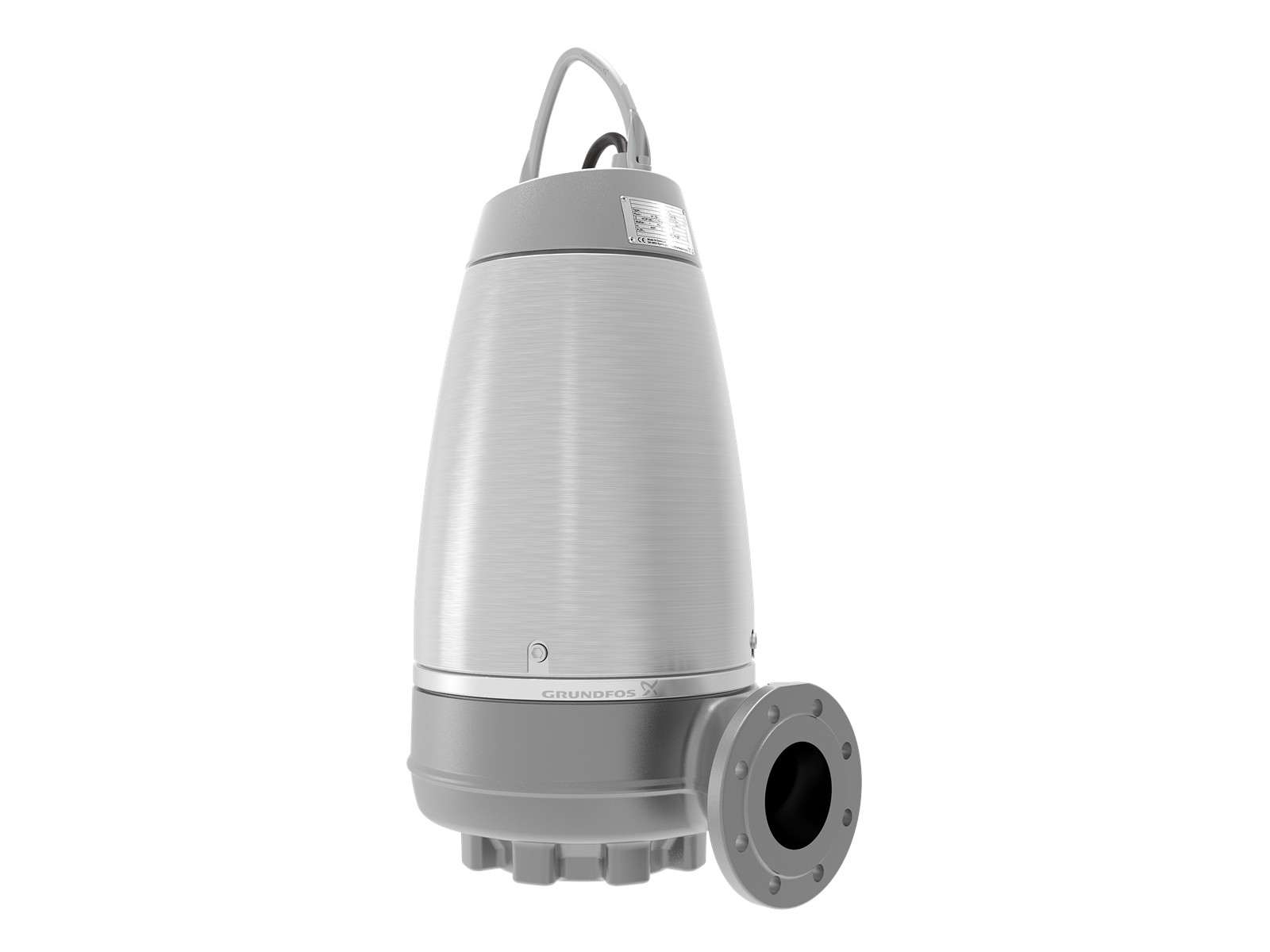
Key features
The impeller sits recessed in the casing and moves the liquid by the swirl it creates, so very little of the medium touches it.
Solids of 65, 80 or 100 mm pass whole depending on the model, so rag and fibre are never forced through a narrow vane.
Grundfos rates the SuperVortex build for dry solids content up to 5% DS, where the S-tube build stops at 3%.
A cooling jacket cools the motor internally, so the pump installs vertically or horizontally in a dry well without a separate cooling circuit.
Primary and secondary seals come out as one cartridge, with SiC/SiC on the primary face.
Sensor versions report winding temperature and the water content of the oil chamber back to an IO 113 module, so a failing seal shows up before it floods the motor.
About the Grundfos SEV
The Grundfos SEV is the pump for wastewater that would defeat a conventional impeller. It handles unscreened raw sewage, process water and surface water in municipal, utility and industrial stations, and Grundfos singles the SuperVortex out for media carrying a high content of fibres and for gassy sludge. It shares its motor, seal and cooling arrangement with the S-tube SE1; the impeller is the difference between them.
The range runs from 1.1 to 11 kW on IEC IE1 motors, 2- or 4-pole depending on size, and discharges through a cast iron PN 10 flange of DN65, DN80 or DN100. Free passage is 65, 80 or 100 mm, set by the model. Pumps install dry beside the well, vertically or horizontally, or submerged on an auto-coupling or a ring stand. Standard builds are cast iron with a stainless steel impeller, and full stainless steel builds are available for aggressive effluent, abrasives and seawater contaminated with wastewater.
Channel Pumps supplies and sizes the SEV. Tell us what the medium actually carries and we will size against that, including the case where the answer is a different impeller or a different pump entirely.
How the Grundfos SEV works
A free-flow impeller sits recessed in the pump casing, out of the main path through the volute, and drives the liquid by the vortex it spins up rather than by pushing it through vanes. Solids ride that swirl and leave through the discharge without ever meeting the impeller squarely. That is why the SEV survives rag, long fibre and grit that would wrap or wear a channel impeller, and it is also why it is a less efficient pump than one whose liquid goes through the vane.
The free passage is what you specify against. It is 65, 80 or 100 mm depending on the model, and it is spherical, so a 100 mm SEV takes a 100 mm ball. The type designation carries it: in SEV.80.100.40, the 80 is the maximum solids size in millimetres, the 100 is the outlet diameter, and the 40 is the motor output in tenths of a kilowatt.
S-tube or SuperVortex, in Grundfos's own words
The SuperVortex takes the harder medium and the S-tube takes the harder duty cycle. Grundfos publishes a selection table for the range that says so, and it is more useful than any adjective. These are the rows where the two impellers part company.
| Grundfos ticks it for | SE1 (S-tube) | SEV (SuperVortex) |
|---|---|---|
| Dry solids content up to 3% DS | Yes | Yes |
| Dry solids content up to 5% DS | No | Yes |
| Relatively high content of fibres and solids | No | Yes |
| Industrial process water with fibres and solids | No | Yes |
| Relatively high number of operating hours | Yes | No |
| Industrial process water without solids or fibres | Yes | No |
Read the last two rows. Grundfos will put the SuperVortex on 5% DS and a heavy fibre load, and it will not put it on a station that runs a lot of hours. That is the free-flow trade priced by the people who build it: you buy tolerance of the medium, and you pay for it in efficiency, every hour the pump runs.
So specify the SuperVortex for the medium, not for the running hours. It earns its keep where the medium is the problem: long fibre from laundries, gassy sludge, abrasive surface water, industrial process water carrying solids. On a station that runs hard on a medium an S-tube can handle, the S-tube moves the same water for less power, and Grundfos will tell you so itself.
Vortex or grinder: the SEV against the SEG
The SEV gives the solid room; the SEG makes the solid smaller, cutting it against a grinder ring at the pump inlet before it reaches the impeller. Both are Grundfos answers to solids, and they take opposite routes to the same wet well.
| SEV (SuperVortex) | SEG (grinder) | |
|---|---|---|
| What happens to the solid | Passes whole, up to 100 mm | Cut at the inlet |
| Outlet | DN65, DN80 or DN100 | DN40, or DN50 on high-flow variants |
| Motor range | 1.1 to 11 kW | 0.9 to 4.0 kW |
| Maximum flow | 40 l/s | 10 l/s |
| Maximum head | 44 m | 49 m |
| Cutting faces to service | None | The grinder head and ring |
The pipe decides more often than the pump does. A DN100 rising main is what a 100 mm free passage is for, and if you have it, the SEV moves four times the flow of the biggest SEG with nothing in the wet end to blunt. If the scheme is pressurised and the main is DN40 or DN50, no free passage will help you and the grinder is the only route. Where the main is not built yet, that choice is still open, and it is worth costing both ways before the trench is dug.
Neither of them is a fix for a rag load that is beating a correctly specified pump. That one is solved upstream, with screening or maceration, and fitting another submersible fails the same way as the last one.
Installation, cooling and certification
The SEV installs dry or submerged, and the cooling jacket is the reason it can do both. The motor is cooled internally rather than by the liquid outside it, so a dry-installed SEV needs no separate cooling circuit. It runs S1 continuous duty whenever the pump housing is completely submerged. Enclosure class is IP68, insulation class F, and the liquid may run from 0 to 40°C, and to 60°C for a maximum of one hour on non-Ex versions.
Sensing comes in layers. Thermal switches in the stator windings are standard. Above that, the water-in-oil sensor reads the water content of the oil chamber from 0 to 20% and signals a warning when it leaves the normal range, and a moisture switch in the motor chamber trips if water reaches the motor. Water in the oil means the shaft seal is letting go, and on a pump you cannot see, knowing that early is worth paying for. The seal is the weak point in almost any pump.
On certification, name the build rather than the range. SE1 and SEV pumps are tested by Dekra/KEMA, the standard versions are tested by VDE, and standard variants are approved by TÜV Rheinland (LGA) to EN 12050-1 or EN 12050-2 as stated on the nameplate. The explosion-proof versions carry Dekra certificates ATEX KEMA 04ATEX2201X, IECEx DEK 21.0017X and UKEX DEKRA 22UKEX0011X, and are marked CE 0344 II 2 GD Ex db eb h mb IIB T4/T3 Gb; Ex h mb tb IIIC T135°C/200°C Db. Note the T4/T3 split: the maximum surface temperature is 135°C on direct drive and 200°C on a frequency converter, which is a live consideration if the wet well is a classified zone. Tell us the zone and we specify against it.
Specifications
| Impeller type | SuperVortex free-flow | |
|---|---|---|
| Free passage | 65, 80 or 100 mm | spherical; set by the model |
| Motor power | 1.1 to 11 kW | IEC IE1 efficiency; 2- or 4-pole depending on size |
| Maximum flow | up to 40 l/s (144 m³/h) | range maximum |
| Maximum head | up to 44 m | range maximum |
| Maximum operating pressure | 6 bar | |
| Outlet | DN65, DN80 or DN100 | cast iron PN 10 flange to EN 1092-2 |
| Liquid temperature | 0 to 40°C | up to 60°C for a maximum of one hour, non-Ex versions only |
| Enclosure and insulation class | IP68; insulation class F (155°C) | |
| Shaft seal | Double mechanical cartridge seal | SiC/SiC primary, carbon/ceramics secondary |
| Materials | EN-GJL-250 cast iron pump housing and motor top with an EN 1.4408 stainless steel impeller | full stainless steel builds available |
| Finish | NCS 9000N black powder paint, 100 μm | |
| Installation | Dry, vertical or horizontal, without separate motor cooling; submerged on an auto-coupling or free-standing on a ring stand | |
| Operation | S1 continuous when the pump housing is completely submerged | |
| Sensors | Thermal switches in the stator windings as standard | water-in-oil and moisture sensors, and Pt1000 winding sensors, available |
| Performance test | ISO 9906:2012, grade 3B | |
| Explosion protection | CE 0344 II 2 GD Ex db eb h mb IIB T4/T3 Gb; Ex h mb tb IIIC T135°C/200°C Db | explosion-proof versions only, on Dekra certificates ATEX KEMA 04ATEX2201X, IECEx DEK 21.0017X and UKEX DEKRA 22UKEX0011X |
Channel Pumps sizes and supplies the Grundfos SEV. Send us the flow, the total dynamic head, the largest solid the pump has to pass, the dry solids content, whether the pump sits in the wet well or beside it, and any hazardous-area requirement. We come back with the impeller, the materials, the seal and the certification specified.
Documents & downloads
Related pumps
View all →
Frequently asked
What is the Grundfos SEV pump used for?
The SEV transfers wastewater, process water and unscreened raw sewage in heavy-duty municipal, utility and industrial stations. Grundfos points it in particular at media with a high content of fibres, at gassy sludge, and at dry solids content up to 5% DS.
How does a SuperVortex impeller work?
The impeller sits recessed in the casing, out of the main flow path, and moves the liquid by the vortex it creates rather than through vanes. Very little of the medium touches it, so rag and fibre pass rather than wrap, at the cost of efficiency.
What size solids can the Grundfos SEV pass?
Free passage is 65, 80 or 100 mm depending on the model, and it is spherical, so a 100 mm pump takes a 100 mm ball. The figure sits in the type designation, for example the 80 in SEV.80.100.40.
What is the difference between the Grundfos SEV and the SE1?
The impeller. The SE1 uses the S-tube and the SEV the SuperVortex, on the same frame, motor and seal. Grundfos rates the SEV for 5% dry solids and a high fibre content, and rates the SE1 rather than the SEV for stations running a high number of operating hours.
Should I choose a Grundfos SEV or a Grundfos SEG?
Choose the SEV where the rising main is DN65 or larger and the medium carries fibre, abrasives or gas. Choose the SEG where the scheme is pressurised on a DN40 or DN50 main, because no free passage will get an unscreened solid down a pipe that size.
Can the Grundfos SEV be dry-installed?
Yes, vertically or horizontally, and it needs no separate motor cooling because a cooling jacket cools the motor internally. It also installs submerged on an auto-coupling or free-standing on a ring stand.
How often does a Grundfos SEV need inspecting?
Grundfos asks for inspection every 3000 operating hours, or at least once a year, on pumps in normal operation. Where the pumped liquid is muddy or sandy, inspect at shorter intervals.
Can Channel Pumps size a Grundfos SEV for my duty?
Yes. Give us the flow, the total dynamic head, the largest solid to pass, the dry solids content, the installation type and any hazardous-area requirement, and we specify the impeller, materials, seal and certification. Sizing pumps is our core service.