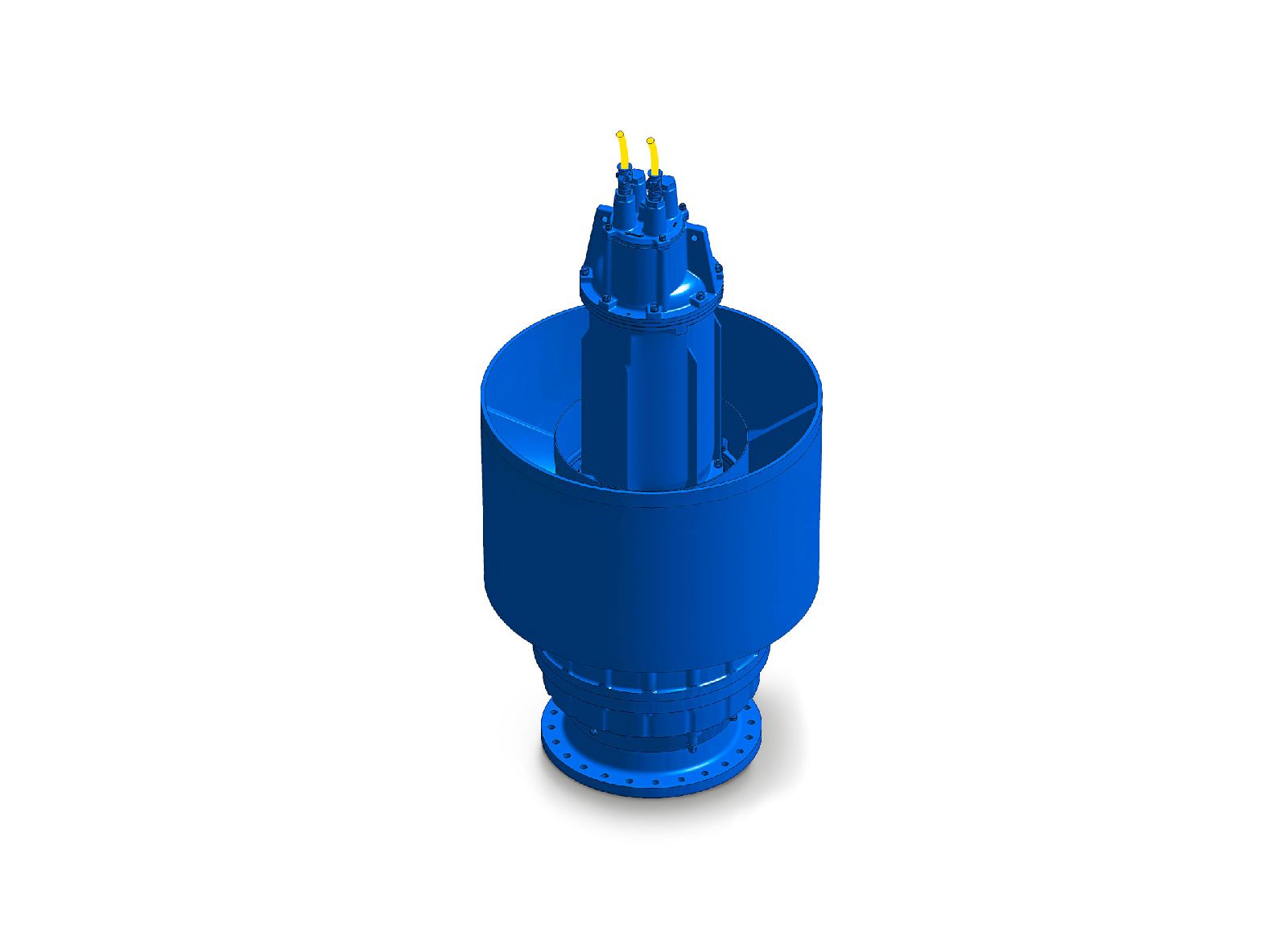
Key features
The Axial Column Pump is built for large quantities of water at low delivery heads. The Vertical Turbine Pump is for a pumping water level below the limits of a volute centrifugal pump.
Hidrostal's own hydraulic, which it lists as low-clogging with a large free ball passage. That is why the same pump appears on return activated sludge and on fish passages.
Hidrostal states the absorbed power stays flat across the whole performance range, so the motor is not overloaded when the duty point moves during a storm.
Hidrostal develops and builds its own motors, cooled by the pumped liquid, with built-in circuit breakers monitoring winding temperature to protect against overload.
On the turbine version the impellers sit submerged, so priming problems are avoided, and the first stage can be dropped deeper to buy the NPSH margin the site needs.
Hidrostal states the large free ball passage at relatively low motor speed suits fish passages, and that the behaviour has been tested and confirmed by testing laboratories.
About Hidrostal Axial Diffuser Pumps
Axial Diffuser Pumps is Hidrostal's name for its pumps with an axial flow direction, and it is a group rather than a single machine. Hidrostal supplies it in two versions, the Axial Column Pump and the Vertical Turbine Pump, and both come in a wide range of sizes. If you have arrived here from a search, the version you want is almost certainly decided by head, not by flow.
Axial Column or Vertical Turbine
| Axial Column Pump | Vertical Turbine Pump | |
|---|---|---|
| Built for | Large quantities of water at low delivery heads | A pumping water level below the limits of a volute centrifugal pump |
| Flow rate | 6 to 1500 l/s | Up to 15,000 l/s |
| Head | Up to 20 m | Up to 250 m |
| Hydraulic | Hidrostal screw centrifugal impeller | Single or multistage, with radial, mixed or axial flow impellers |
| Installation | Submersible, into a vertical tube chamber of 400 to 1500 mm | Suspended bowl, vertical, with above or below floor discharge |
| Built by | Hidrostal | Bedford Pumps, part of the Hidrostal Group |
The turbine figures are Bedford Pumps' own, for the DA and DB range. That is the brochure Hidrostal publishes on its Vertical Turbine Pumps page, and the page links straight to Bedford. Worth knowing before you send the enquiry, because it tells you where the engineering answer will come from.
The numbers are an envelope, not a duty point
Hidrostal quotes the Axial Column Pump as 6 to 1500 l/s and up to 20 m. Both figures are true, and they are not true at the same time. This is the part that costs people money. The performance range chart in the brochure shows the top of the envelope reaching 20 m over the middle of the flow range, and by the right-hand end of the chart the available head has fallen to single figures. Ask for 1500 l/s and 20 m together and you are asking for a corner of the chart that has no pump in it.
So take the head first. If the total dynamic head is a few metres and the flow is large, you are on the Axial Column Pump and the full column range is where to look. If the head runs to tens of metres and the water sits well below floor level, you are on the Vertical Turbine Pump, and the flow figure will rarely be what decides it.
Where these fit, and where they do not
Hidrostal names land drainage, rainwater and flood pumping stations, watering and drainage systems, coastal and flood protection, water regulation, return activated sludge and oily water for the Axial Column Pump. Bedford names water abstraction and supply, flood alleviation, surface and storm water, dock dewatering and impounding, cooling water circulation and irrigation for the turbine range.
Neither drops into a wet well. The column version wants a tube chamber built to it, down to the counter flange it seats and seals against, and the turbine version wants a well or suction chamber with the inlet conditions right, which is why Bedford offers bellmouth and draft tube options at all. On a drainage station that is where most of the trouble starts. The mistake we see most often is not the pump at all. It is a sump geometry that was never checked against what the pump needs, or a flow figure that has collected a safety margin at every stage of the design and arrived far larger than the site will ever deliver. Send us the sump drawing with the flow figure and we will check the duty before anyone sizes anything.
How Hidrostal Axial Diffuser Pumps work
An axial diffuser pump discharges along the axis of its own shaft instead of sideways through a volute. On the Axial Column Pump, Hidrostal replaces the volute of the low pressure version with a casing that discharges axially, which is what lets the whole unit sit inside a tube or concrete chamber rather than in a wet well. Water enters through a fixed suction cover, or an adjustable wear cone where the medium carries grit, and is driven up the column.
The screw centrifugal impeller
The impeller on the column version is Hidrostal's screw centrifugal impeller, the same hydraulic it uses across its range. Hidrostal's own claims for it are a large free ball passage, low-clogging and clog-free pumping, gentle delivery through low shear forces, low pulsation, a stable and steep pump curve, and flow proportional to speed. That combination is why the same pump is specified for return activated sludge, for oily water where an emulsion has to be avoided, and for passing live fish.
Hidrostal puts the hydraulic efficiency at up to over 82%, which with its own submersible motor gives the low energy consumption a drainage station is judged on over twenty years rather than on the day it is commissioned.
Sealing, motor and monitoring
The Axial Column Pump shaft is sealed by a double mechanical seal in a tandem arrangement with barrier fluid. The drive is a Hidrostal submersible motor cooled by the pumped liquid, from 1.5 kW to 250 kW at 375 to 1500 rpm, on 50 Hz, 60 Hz or through a frequency converter. Built-in circuit breakers monitor the winding temperature. On request Hidrostal adds a conductivity probe and float switch for mechanical seal leakage, bearing temperature sensors at both bearing locations, and screened cables where electromagnetic radiation is a concern.
Take the leakage detection. A mechanical seal is the weak point in almost any pump, and on a machine that sits at the bottom of a tube chamber you will not see a seal weeping until the motor has drunk it.
The turbine version
Bedford builds the Vertical Turbine Pump as a suspended bowl pump, single or multistage. The bowl assemblies carry integral diffuser options, and the impellers can be radial, mixed or axial flow, fully shrouded or semi-open. Multistage construction is what gives the higher efficiencies on high head and lower flow. Inlet conditions are handled with bellmouth and draft tube options, shafts are designed as stiff shaft construction operating below the first critical speed, and sealing runs from a soft packed gland through a controlled leakage device to split, single or double mechanical seals.
Hazardous areas
Both routes offer explosion protection as an option rather than as a property of the range. Hidrostal states its submersible motors for the Axial Column Pump are available optionally for applications in potentially explosive atmospheres; Bedford states ATEX compliant options are available for hazardous area applications such as storm water pumping. Certification covers a specific build, so send us the zone classification for the station and we will get the certificate for the exact pump and motor before anything is ordered.
Specifications
| Versions | Axial Column Pump, Vertical Turbine Pump | |
|---|---|---|
| Axial Column flow rate | 6 to 1500 l/s | |
| Axial Column discharge head | up to 20 m | |
| Axial Column tube chamber diameter | 400 to 1500 mm | 16 to 60 inch |
| Axial Column hydraulic efficiency | up to over 82% | Hidrostal's own figure for the axial flow pump |
| Axial Column impeller | Hidrostal screw centrifugal impeller | |
| Axial Column suction cover | Fixed, or interchangeable adjustable wear cone | |
| Axial Column shaft seal | Double mechanical seal, tandem arrangement with barrier fluid | |
| Axial Column materials | Cast iron, ductile iron, Hidrohard, stainless steel, Duplex | cast iron is the standard build |
| Submersible motor shaft power | 1.5 to 250 kW | |
| Submersible motor shaft speed | 375 to 1500 rpm | |
| Supply | 50 Hz, 60 Hz, or frequency converter | |
| Vertical Turbine flow rate | up to 15,000 l/s | Bedford Pumps DA and DB range |
| Vertical Turbine head | up to 250 m | Bedford Pumps DA and DB range |
| Vertical Turbine branch sizes | up to 2200 mm | Bedford Pumps DA and DB range |
| Vertical Turbine construction | Single and multistage suspended bowl, with radial, mixed or axial flow hydraulics | |
| Vertical Turbine shaft sealing | Soft packed gland, controlled leakage device, or split, single or double mechanical seal | |
| Hazardous area | Submersible motors for potentially explosive atmospheres (Hidrostal); ATEX compliant options (Bedford) | optional on both versions; certification is per build |
| Larger flows | Bedford axial flow pumps to 10,000 l/s | other impeller types, outside the Hidrostal screw centrifugal range |
Send us the flow rate, the static lift and the total dynamic head with the pipe run behind it, the water level you are pumping from, what the water carries, and the chamber you have or can build to. The head figure alone usually settles which of the two versions you are on, and we will tell you if a different Hidrostal range fits the duty better.
Documents & downloads
Related pumps
View all →
Frequently asked
What is a Hidrostal Axial Diffuser Pump?
It is Hidrostal's group name for its pumps with an axial flow direction, supplied in two versions: the Axial Column Pump and the Vertical Turbine Pump. Both are available in a wide range of pump sizes.
What is the difference between the Axial Column Pump and the Vertical Turbine Pump?
Head. The Axial Column Pump was developed for large quantities of water at low delivery heads and covers 6 to 1500 l/s up to 20 m. The Vertical Turbine Pump is for a pumping water level below the limits of a volute centrifugal pump, and its multistage construction gives the higher efficiencies on high head and lower flow.
Can an Axial Column Pump give me 1500 l/s at 20 m?
No. Those are the two edges of the range chart rather than one duty point. The envelope reaches 20 m over the middle of the flow range, and at the top flows the available head is in single figures. Send the duty point and we will read it off the curve.
What flow and head does the Vertical Turbine Pump cover?
Bedford Pumps quotes flow rates up to 15,000 l/s and heads up to 250 m for its DA and DB range, with branch sizes up to 2200 mm. That is the brochure Hidrostal publishes for this version.
Can these pumps be used in a hazardous area?
As an option, yes. Hidrostal offers its submersible motors for the Axial Column Pump for applications in potentially explosive atmospheres, and Bedford lists ATEX compliant options on the turbine range. Certification is per build, so send us the zone classification and we will get the certificate for the exact pump.
What happens if the duty is above 1500 l/s?
The Axial Column Pump range stops there. Bedford Pumps, part of the Hidrostal Group, covers flows up to 10,000 l/s with axial flow pumps using other impeller types, and its vertical turbine range goes further again. We can take either enquiry the same way.
- 1Hidrostal — Axial Diffuser Pumps
- 2Hidrostal — Axial Column Pump
- 3Hidrostal — Vertical Turbine Pumps
- 4Hidrostal — Axial Column Pump brochure (PR09437EN), including the performance range chart
- 5Bedford Pumps — Vertical Turbine Pumps, DA and DB range (the brochure Hidrostal publishes on its Vertical Turbine Pumps page)