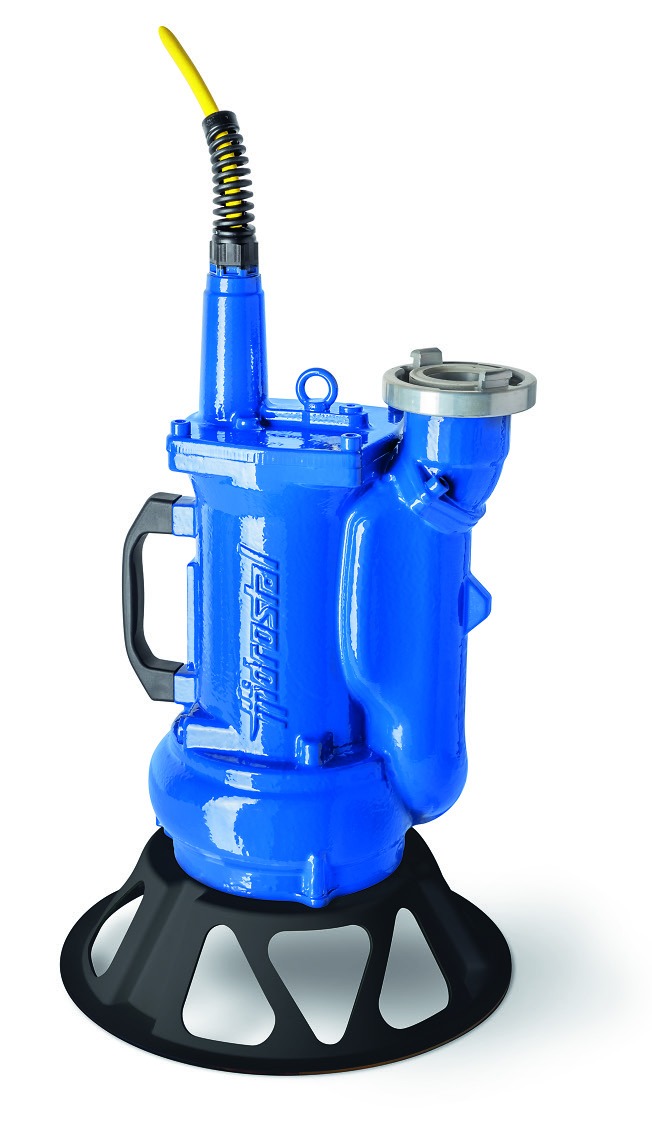
Key features
The free ball passage runs from 50 mm to 75 mm, so the pump takes solids and fibrous material that would bind a conventional small drainage pump.
The A2U build weighs 23 kg including 5 m of cable. The heaviest in the range is 40 kg.
Hidrostal credits the steep curve with giving pressure and power reserve when the medium turns thick, which is what a sump-cleaning or sludge duty does to a pump partway through the job.
Absorbed power does not run away as the duty point moves along the curve, so the motor is not the thing that fails when site conditions differ from the ones you were told about.
Two seals between the medium and the motor. On a pump that gets dropped into whatever needs emptying, the seal is the part that decides how long it lasts.
Cast iron, ductile iron, Hi-Chrome, stainless steel and Duplex, chosen against what the water actually carries rather than what is quickest to ship.
About Hidrostal compact pumps
The compact is the small end of the Hidrostal catalogue, and it is meant to be carried. Hidrostal calls the range portable, heavy duty field units, and puts its screw centrifugal impeller into them so they handle solids the way the big pumps do. The duties it names are industrial effluent, viscous sludge, return activated sludge, drainage, process waste and sump cleanup, and the jobs where the pump turns up on a van: construction sites, flood defence, and emergency management or fire brigade work. Hidrostal also lists it for stationary installations, not only portable ones.
The builds in the range
Hidrostal publishes four builds, with the best efficiency point, free ball passage, material and weight for each.
| Build | BEP head | BEP flow | Free ball passage | Material | Ex protection | Weight |
|---|---|---|---|---|---|---|
| A2U | up to 11.4 m | up to 9.3 l/s | 50 mm | Cast iron | — | 23 kg |
| A2Q | up to 9.5 m | up to 9.5 l/s | 50 mm | Duplex | — | 32 kg |
| BE2 / BN2 | up to 10.1 m | up to 8 l/s | 50 mm | Cast iron | X | 32 kg |
| BK3 / BN3 | up to 13.5 m | up to 10.8 l/s | up to 75 mm | Cast iron | X | 40 kg |
Read that table against the headline figures before you size anything. The 17.7 m and 24.6 l/s quoted for the range are the ends of the envelope, and no single build gives you both. The best efficiency points Hidrostal publishes top out at 13.5 m and 10.8 l/s. Send the duty point, not the range.
Where it is the wrong pump
Above 2.4 kW there is no compact. If the station is permanent, the duty is fixed and the pump will sit in a wet well for the next twenty years, you are specifying the wrong range: the submersible pumps start where this one stops and go to 2500 l/s. The compact earns its keep when the pump has to move between jobs.
Every supply voltage Hidrostal lists for the range is three phase. Plan the supply, or the generator, around that before the pump arrives on site.
What we see go wrong on a temporary duty is rarely the pump. It is a suction that was never going to give the flow somebody promised, grit nobody mentioned, and a valve left shut. Tell us what the medium carries, how far and how high it has to go, and what the supply on site actually is, and we will tell you which build fits before anything is quoted.
How Hidrostal compact pumps work
The compact uses the same screw centrifugal impeller Hidrostal builds into its larger ranges, scaled into a portable unit. Solids pass through rather than binding on the vane, which is why Hidrostal specifies these pumps for slurry, mud and wastewater rather than clean water only. The free ball passage is 50 mm on the A2U, A2Q and BE2 / BN2 builds and up to 75 mm on the BK3 / BN3.
The curve
The performance curve is steep and the power curve is non-overloading. Hidrostal credits the steep curve with giving pressure and power reserve when the medium is thick, and a non-overloading power curve means absorbed power does not climb without limit as the duty point moves. Between them, that is a pump you can put on an unknown duty without the motor being the first casualty.
Motor and supply
Motor efficiency runs to IE3 equivalent. Hidrostal offers 50 Hz, 60 Hz and frequency converter operation, on three-phase supplies of 380 V, 400 V, 415 V, 460 V, 480 V and 575 V. The 23 kg quoted for the A2U includes 5 m of cable.
Sealing and materials
The medium is kept off the motor by a double mechanical seal arrangement. Wetted materials are cast iron, ductile iron, Hi-Chrome, stainless steel and Duplex. The A2Q is the Duplex build in Hidrostal's own range table; the rest are listed against cast iron. On abrasive water the material choice is what decides the service interval, so it is worth settling early.
Hazardous areas
Hidrostal offers an Ex-proof execution of the compact pump as an option, and marks it against the BE2 / BN2 and BK3 / BN3 builds in its range table. Explosion protection is certified for a specific build, not for a range, so send us the zone classification for the area and we will get the certificate for the exact pump from Hidrostal before anything is ordered.
Specifications
| Flow rate | 0.8–24.6 l/s | |
|---|---|---|
| Head | 0.5–17.7 m | |
| Discharge size | 50–80 mm | |
| Suction size | 50–80 mm | |
| Motor rated power | 0.1–2.4 kW | |
| Free ball passage | 50–75 mm | 75 mm on the BK3 / BN3 build |
| Supply frequency | 50 Hz, 60 Hz, or frequency converter | |
| Supply voltage | Three phase, 380 V, 400 V, 415 V, 460 V, 480 V, 575 V | |
| Impeller | Hidrostal screw centrifugal impeller | |
| Shaft seal | Double mechanical seal arrangement | |
| Motor efficiency | Up to IE3 equivalent | |
| Wetted materials | Cast iron, ductile iron, Hi-Chrome, stainless steel, Duplex | |
| Weight | From 23 kg | A2U build, including 5 m of cable; 40 kg for the BK3 / BN3 |
| Hazardous area | Ex-proof execution available | optional; listed against the BE2 / BN2 and BK3 / BN3 builds; certification is per build |
Send us the flow rate, the lift, what the medium carries and the supply available on site. We will tell you which compact build fits, or say plainly if the duty wants a bigger Hidrostal range instead.
Documents & downloads
Related pumps
View all →
Frequently asked
What flow and head do Hidrostal compact pumps cover?
0.8–24.6 l/s at heads of 0.5–17.7 m, on suction and discharge sizes of 50–80 mm, with motors from 0.1 kW to 2.4 kW. Those are the ends of the range envelope. The best efficiency points Hidrostal publishes for the four builds top out at 13.5 m and 10.8 l/s, so size against the duty point rather than the headline.
How heavy is a Hidrostal compact pump?
The A2U weighs 23 kg including 5 m of cable. The A2Q and the BE2 / BN2 weigh 32 kg, and the BK3 / BN3 weighs 40 kg.
What size solids will it pass?
The free ball passage is 50 mm on the A2U, A2Q and BE2 / BN2, and up to 75 mm on the BK3 / BN3. Hidrostal also specifies the range for liquids containing fibrous material, which is what the screw centrifugal impeller was designed for.
Can a Hidrostal compact pump be used in a hazardous area?
An Ex-proof execution is available as an option, and Hidrostal marks it against the BE2 / BN2 and BK3 / BN3 builds. Certification applies to a specific build, so send us the zone classification for the area and we will get the certificate for the exact pump from Hidrostal.
What supply does it need?
Three phase. Hidrostal lists 380 V, 400 V, 415 V, 460 V, 480 V and 575 V, at 50 Hz, 60 Hz or through a frequency converter. Check the generator on a temporary site before the pump turns up.
What is the difference between a Hidrostal compact and a Hidrostal submersible pump?
Size and purpose. The compact is a portable field unit topping out at 2.4 kW and 24.6 l/s. The submersible range is built into a fixed wet well and runs to 400 kW and 2500 l/s. Both use the same screw centrifugal hydraulics.
What materials can the wet end be supplied in?
Cast iron, ductile iron, Hi-Chrome, stainless steel and Duplex. In Hidrostal's range table the A2Q is the Duplex build; the others are listed against cast iron. On grit-laden water the material choice decides how long the wet end holds its duty.