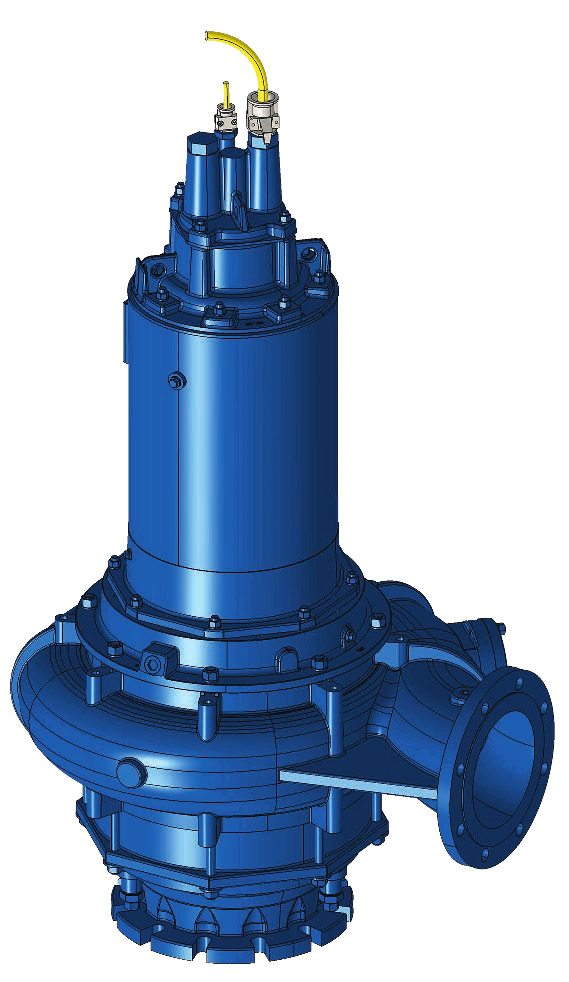
Key features
Hidrostal describes it as independent closed loop cooling, and states the pumped medium is not used to cool the motor, so there is no slime building up in a cooling channel to overheat it.
The same pump works in a dry well or in a wet pit, and in a wet pit the level can be drawn down to the pump casing without risk of overheating the motor.
Hidrostal lists flood-proof operation among the advantages of the dry well arrangement. A flooded dry well stops the station; it does not destroy the pump.
Tandem seals run in an oil bath. Hidrostal contrasts this with the leakage commonly seen from soft-packed glands.
Built for wastewater, effluent and process fluids with a high solids content. Hidrostal names viscous liquids, fragile flocs and live fish among the media these pumps handle.
The dry well arrangement takes either orientation, with no exposed rotating shafts or couplings and an inspection port for opening the wet end in place.
About Hidrostal immersible pumps
An immersible pump is a dry pit pump that does not care whether it is wet. Hidrostal builds the motor with its own cooling circuit, so the pump runs in air, partly submerged or fully submerged with the same performance. That is the whole point of the range, and it is the one thing that separates it from the submersible range, where the motor is cooled by the liquid it sits in and therefore has to stay under it.
The duty is difficult municipal and industrial wastewater. Hidrostal also names viscous liquids, fragile flocs and live fish, all of which the screw centrifugal impeller is built to pass. The range runs 0.5–3000 l/s at 0.5–90 m of head, on discharge sizes of 50–700 mm and suction sizes of 65–700 mm, with motors from 0.1 kW to 650 kW.
When to specify it, and when not to
Specify it when the level in the sump varies, when the station is dry pit, or when the building has to be clean and quiet. Hidrostal makes a point of the last one: its immersible wastewater stations are frequently mistaken for clean water stations, because there is no odour and the building stays clean.
Do not specify it just because it is the better motor. If your wet well keeps a stable level and the pump is permanently submerged, the submersible range does the same hydraulic job without a dry well to build and maintain. A dry pit station is civils, access and a building. That cost is real and it is usually the thing that decides between the two ranges, not the pump.
The head ceiling is worth checking early. The range stops at 90 m, and the pumps that reach it are not the pumps that reach 3000 l/s. Send the duty point rather than the ends of the range, and send what the medium carries with it. On wastewater the pump is rarely what fails first. Rag, grit getting past a grit stage that is not doing its job, and dry running are what kill pumps on a sewage works, and a better pump fixes none of them.
How Hidrostal immersible pumps work
The hydraulic end is the standard Hidrostal screw centrifugal arrangement: liquid enters the suction, the impeller picks it up and the volute discharges it. The difference is entirely in the motor. Hidrostal fits an oil jacket with forced circulation around the stator housing, and an oil circulation impeller locked onto the shaft drives the coolant round it. The finned back cover acts as the heat exchanger. The coolant is a closed circuit that never mixes with the medium, and heat leaves through the exchange surface in the back cover.
That is why the pump does not depend on the liquid level. Hidrostal states its dry well immersible pumps have independent closed loop cooling that lets the motor run in either a wet or a dry well, and that because these units do not use pumped media to cool the motor there are no problems of overheating from slime building up in a cooling channel. Put the same pump in a wet pit and the level can be drawn down to the pump casing without risk of overheating, which is what allows a shallower sump than a conventional submersible installation.
Sealing
Tandem mechanical seals run in an oil bath, and Hidrostal states this eliminates leakage of the pumped product. It offers a standard mechanical seal and a patented balanced premium seal, the latter aimed at aggressive media. A conductivity probe monitors the medium-side seal and a float switch checks the motor-side seal, so a primary seal failure shows up before the motor sees the medium.
The Tuma motor line
Hidrostal's Tuma line is a new motor line for screw centrifugal pumps, rated 10–200 kW, for vertical or horizontal installation. Cooling is a patented integral circuit: the coolant flows around all electrically active components and the bearings, circulated by a cooling impeller on the shaft. Speed range is 375–3600 rpm, voltages 220–690 V, frequencies up to 66 Hz, insulation class F or H, continuous duty (S1), and IP68 to 40 m immersion depth. Bearings have a minimum L10h service life of 50,000 operating hours, with emergency plain bearings fitted and ceramic bearings standard from 75 kW. Hidrostal states the Tuma motors reach IE3-equivalent premium efficiency, while noting that submersible motors are excluded from the IEC efficiency classes by design. The Tuma line stops at 200 kW, well below the 650 kW top of the pump range, so a large duty takes a different motor.
Monitoring
Winding heads carry bimetallic switches or PTC thermistors, with PT100 sensors optional if you want the winding temperature measured rather than tripped. Both bearings can take PT100 sensors. Vibration sensors on the X, Y and Z axes are available for the motor and the pump mounted on it. On a dry pit station where nobody is standing next to the machine, that instrumentation is worth specifying at the outset rather than retrofitting.
Hazardous areas
Hidrostal states its Tuma motors are certified for applications in Ex zones 1 and 2, temperature class T4, to the requirements of IECEx, ATEX, FM and CSA, and that all motors are approved for operation with frequency converters. For its wider submersible motor range, Hidrostal offers explosion-proof versions certified for Ex zones 1 and 2 with the type of protection flameproof enclosure, temperature classes T3 or T4, to ATEX and FM requirements. Electric motors are prohibited in Zone 0. Certification applies to a specific build, so send us the zone classification for the station and we will get the certificate for the exact pump and motor from Hidrostal before anything is ordered.
Specifications
| Flow rate | 0.5–3000 l/s | |
|---|---|---|
| Head | 0.5–90 m | |
| Discharge size | 50–700 mm | |
| Suction size | 65–700 mm | |
| Motor power | 0.1–650 kW | |
| Supply frequency | 50 Hz, 60 Hz, or frequency converter | |
| Impeller | Hidrostal screw centrifugal impeller | |
| Installation | Dry well, vertical or horizontal; or wet pit as a submersible | |
| Motor cooling | Independent closed loop; oil jacket with forced circulation around the stator housing | oil circulation impeller locked onto the shaft; finned back cover acts as heat exchanger |
| Motor insulation | Class F, with built-in thermal sensors | |
| Shaft seal | Tandem mechanical seals running in an oil bath | |
| Seal monitoring | Conductivity probe on the medium-side seal, float switch on the motor-side seal | |
| Wetted materials | Cast iron, ductile iron, Hi-Chrome, stainless steel, Duplex | |
| Wear parts | Optional adjustable replaceable liner, set by external regulating nuts | |
| Tuma motor rating | 10–200 kW | one motor option within the range |
| Tuma motor speed | 375–3600 rpm | |
| Tuma motor protection | IP68 to 40 m immersion depth | |
| Hazardous area | Tuma motors certified for Ex zones 1 and 2, temperature class T4 | IECEx, ATEX, FM and CSA; certification is per build |
Send us the flow rate, the static and discharge levels, whether the station is dry pit or wet pit, and what the medium carries. We will size a Hidrostal immersible against the duty point, and if a submersible would do the same job for less civils we will say so.
Documents & downloads
Related pumps
View all →
Frequently asked
What is the difference between an immersible pump and a submersible pump?
Cooling. An immersible motor carries its own closed cooling circuit, so it runs dry, partly submerged or fully submerged; a submersible motor is cooled by the liquid it is submerged in, so it has to stay under the liquid. That is what decides which Hidrostal range suits a station.
What flow and head do Hidrostal immersible pumps cover?
0.5–3000 l/s at 0.5–90 m of head, on discharge sizes of 50–700 mm and suction sizes of 65–700 mm, with motors from 0.1 kW to 650 kW. No single pump covers both ends, so the duty point sets the size.
Can a Hidrostal immersible pump run dry?
Yes. It is built to operate continuously in a dry installation, and Hidrostal states it runs with equal performance in air, partly submerged or fully submerged. That is the reason the range exists.
Can an immersible pump be installed in a wet well?
Yes, in the same manner as a submersible pump. Hidrostal notes two consequences: the liquid level can be drawn down to the pump casing without risk of overheating the motor, and the sump can be shallower than a conventional submersible installation.
What happens if the dry well floods?
The pump keeps running. Hidrostal lists flood-proof operation as one of the advantages of the dry well arrangement, because the motor cooling does not depend on where the liquid is.
Are Hidrostal immersible pumps certified for hazardous areas?
Hidrostal states its Tuma motors are certified for Ex zones 1 and 2, temperature class T4, to IECEx, ATEX, FM and CSA requirements, and offers explosion-proof versions of its wider submersible motor range for zones 1 and 2 at T3 or T4. Certification covers a specific build, so send us the zone classification and we will get the certificate for the exact pump and motor.
Why are immersible pump stations quieter and cleaner?
The pumped product stays inside the pump. Tandem seals running in an oil bath remove the leakage you get from soft-packed glands, and Hidrostal reports its immersible wastewater stations are frequently mistaken for clean water stations because of the lack of odour.