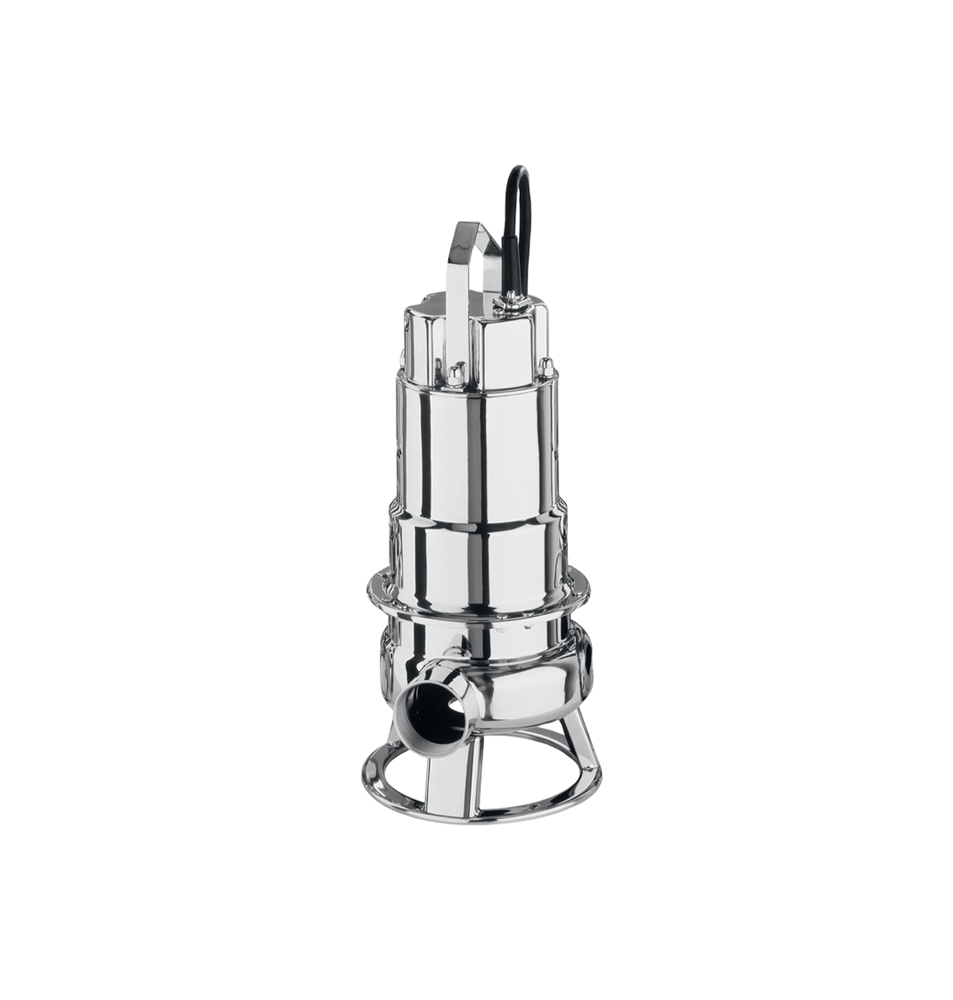
Key features
DW is the single-channel impeller, DW VOX the vortex. Materials, the 50 mm solids passage, the seal and the motor ratings are common to both. Only the wet end and the duty change.
Casing, impeller, casing cover, seal cover, motor cover and handle are AISI 304. That is the material difference between this range and Ebara's cast iron station pumps.
Ebara rates the whole range at 50 mm spherical, on dirty water and sewage, including liquids carrying solid or filamentary material in suspension.
DW and DW VOX take a G 2 threaded connection. DWF and DW VOXF are DN50 flanged with a base; DW FZ and DW VOX FZ are flanged without one, which takes 58 mm off the height.
Silicon carbide against silicon carbide on the pump side, carbon against ceramic on the motor side, in 385 cc of white mineral oil. Two seals in series, not one seal and a lip.
The single-phase builds carry a capacitor, built-in overload protection and an optional float. On three-phase the overload protection is yours to provide.
About the Ebara DW and DW VOX
The Ebara DW is a small stainless submersible sewage pump, for dirty water and sewage carrying solid or filamentary material. Ebara puts it on emptying cesspits, on civil and industrial wastewater, on draining wells, excavations and flooded ground, and on sanitary services. It is one pump on a DN50 connection, not a station pump, and everything wet on it is AISI 304.
The published headline needs one line of explanation. Ebara gives up to 54 m³/h and 20 m for the DW and up to 48 m³/h and 15.7 m for the DW VOX. Those heads are taken at the 6 m³/h minimum rated flow on the biggest frame, the 2.2 kW DW 300. That frame's curve starts at 21.8 m at shutoff and ends at 5 m at 54 m³/h. Read the frame you are buying, not the range.
Single-channel or vortex, and why it is the whole decision
Take the single-channel DW unless the medium will bind it. That is the verdict, and here is what it costs on either side.
A single-channel impeller is a proper hydraulic passage. The liquid goes through the vane, so the pump converts the motor's work efficiently and holds a real duty point. A vortex impeller sits back out of the flow and moves liquid by the swirl it creates, so very little of what you are pumping ever touches it. That is why it survives rag and filamentary material a channel would wrap, and it is also why it is a worse pump.
Ebara's own selection chart prices it, frame by frame, at 50 Hz:
| Rating | DW, maximum capacity | DW head at shutoff | DW VOX, maximum capacity | DW VOX head at shutoff |
|---|---|---|---|---|
| 0.55 kW | 30 m³/h | 11.1 m | 24 m³/h | 7.3 m |
| 0.75 kW | 36 m³/h | 13.3 m | 30 m³/h | 9 m |
| 1.1 kW | 42 m³/h | 15 m | 36 m³/h | 11.4 m |
| 1.5 kW | 48 m³/h | 18.2 m | 42 m³/h | 13.8 m |
| 2.2 kW | 54 m³/h | 21.8 m | 48 m³/h | 17 m |
Same motor, same solids passage, and the vortex is 6 m³/h and about 4 m of head behind at every rating. Put that in terms of what you actually pay. Suppose the duty is 18 m³/h at 9.5 m. A 1.1 kW DW 150 sits on it, drawing 1.55 kW at the input on three phase. The vortex cannot reach it at 1.1 kW, because a DW VOX 150 gives 7.6 m there, so you go up a frame to the 1.5 kW DW VOX 200, which gives 9.8 m and draws 1.92 kW. That is 0.37 kW more, every hour the pump runs, for the same water moved to the same place. On a pump sitting on level control for twenty years, that is not an abstraction.
So the vortex has to earn that. It earns it when the flow carries wipes, rag or fibre, because a blocked channel impeller costs a site visit and a lifted pump every time, and that arithmetic beats 0.37 kW quickly. It does not earn it on grey water, seepage or a clean excavation, where the channel build is the right answer and the cheaper one to run.
Neither is a macerator. Where a station is putting through more rag than any impeller was going to clear, the fix is screening or maceration upstream, not a different impeller. The enquiry we decline most often is a like-for-like swap on a pump that keeps clogging when the pump already fitted was a good solids-handling pump.
Where the DW stops and a station pump starts
The DW is the small stainless end of Ebara's sewage range, and the boundary is easy to see. It is 2-pole, 0.55 kW to 2.2 kW, DN50, to 54 m³/h. The DKE is cast iron on a 4-pole motor from 1.5 kW to 45 kW, DN65 to DN300, covering 780 m³/h. The multi-channel DRD is cast iron in 2, 4, 6 and 8 poles and covers 1800 m³/h and solids to 140 mm.
Speed is the part of that comparison people miss. The DW turns at about 2,800 rpm. Abrasive media want pumping slowly, and grit is what wears out wastewater pumps once rag has been dealt with. On a duty with grit in it the slower 4-pole DKE is the better call, and we would rather say so than sell you a DW that comes back. Where the medium is dirty water without much abrasion, the DW's speed is not a problem and its stainless construction is worth having.
The temperature limit is +40°C, and the motor is IPX8 with class F insulation. Maximum immersion is 7 m on the 10 m cable Ebara supplies as standard.
How the Ebara DW works
The DW draws sewage in through a 50 mm open suction in the base, works it with either a single-channel or a vortex impeller in AISI 304, and discharges through a G 2 connection to UNI ISO 228 or a DN50 flange. The motor is a submersible dry type, two pole, running at 2,800 rpm at 50 Hz. Ebara measures the curves to ISO 9906 Annex A, on clean water at 20°C and a kinematic viscosity of 1 cSt.
The two wet ends
The impellers are different sizes as well as different shapes. On the 2.2 kW frame the single-channel impeller is 125 mm and the vortex is 116.5 mm; on the 0.55 kW frame it is 92 mm against 88 mm. Ebara also fits an NBR casing ring to the DW that the DW VOX does not get. That is the wear part you would expect on an impeller running close to the casing, and would not expect on one sitting back out of the flow.
Both builds pass 50 mm spherical solids, so the free passage is not what separates them. What separates them is what happens to a length of fibre once it is inside.
Two seals and an oil chamber
The shaft runs through two mechanical seals with an oil chamber between them. The pump-side seal is silicon carbide against silicon carbide with NBR elastomers, the motor-side seal carbon against ceramic. Between them sits 385 cc of white mineral oil, Esso Marcol 152.
Two seals in series is not the same as one seal and a lip, and on sewage that matters more than it does on clean water. Wear the pump-side face and the oil chamber is still between the liquid and the windings. Milky oil in that chamber is your warning, and it arrives before the motor does anything expensive. Dry running is what kills the arrangement fastest: a mechanical seal needs liquid to lubricate it, and the faces go as soon as the film does. On a sewage pump that usually means a level control that has stopped working, or a wet well drawn down further than the design allowed.
The electrical side
Single-phase runs 0.55 kW to 1.1 kW on 1~230 V ±10%, with a built-in capacitor, built-in overload protection and an optional float switch. Full load current is 3.9 A, 5.9 A and 7.3 A on the three single-phase frames, with locked rotor currents of 17 A, 26 A and 35 A. Cable is 10 m of H07RN-F, 3G1 at 0.55 kW and 3G1.5 from 0.75 to 1.1 kW.
Three-phase runs 0.55 kW to 2.2 kW on 3~400 V ±10% and carries no float and no built-in protector. Ebara's data book states plainly that overload protection on the three-phase build is provided by the user, so it comes from your starter or your board. Full load current runs 1.5 A at 0.55 kW to 5.0 A at 2.2 kW on the DW, and the cable is 10 m of FG50K, 4G1.5 plus two 0.5 mm² cores.
Ebara also sets a floor on flow, and says the pumps should not be run below 10% of the best efficiency point because they overheat. On a small wet well that is a chamber volume calculation as much as a pump selection.
Reading the type key
Ebara's key runs DW, then the build letter, then the phase letter, then the power code, then the automatic letter. F marks the flanged version with a base and FZ the flanged version without one. M means single phase only. The power code is 75, 100, 150, 200 or 300, which is 0.55, 0.75, 1.1, 1.5 and 2.2 kW. A marks the automatic version, supplied with a float switch. So a DW F M 100 A is a flanged, single-phase 0.75 kW pump with a float, and a DW VOX 300 is the three-phase 2.2 kW vortex build on the threaded connection. If you are matching an existing unit, send us the full designation and the serial number off the nameplate.
Specifications
| Type | Submersible sewage pump, fixed or mobile installation | |
|---|---|---|
| Liquid handled | Dirty water and sewage | including solid or filamentary material in suspension |
| Impeller | Single channel (DW) or vortex (DW VOX) | |
| Flow rate | up to 54 m³/h (DW); up to 48 m³/h (DW VOX) | 2.2 kW frame |
| Total head | up to 20 m (DW); up to 15.7 m (DW VOX) | at the 6 m³/h minimum rated flow on the 2.2 kW frame |
| Maximum solids passage | 50 mm spherical | |
| Liquid temperature | up to +40°C | |
| Maximum immersion | 7 m | with the 10 m cable |
| Impeller diameter | 92–125 mm (DW); 88–116.5 mm (DW VOX) | |
| Power rating | 0.55–1.1 kW single-phase; 0.55–2.2 kW three-phase | |
| Speed | 2,800 rpm | 2-pole, 50 Hz |
| Voltage | 1~230 V ±10%; 3~400 V ±10% | |
| Full load current | 3.9–7.3 A single-phase; 1.5–5.0 A three-phase | DW builds, 0.55 kW to 2.2 kW |
| Overload protection | Built in on the single-phase build; provided by the user on three-phase | |
| Suction | 50 mm open | |
| Discharge connection | G 2 to UNI ISO 228 (DW); DN50 flange (DWF) | |
| Casing | AISI 304 | |
| Impeller material | AISI 304 | |
| Casing cover and seal cover | AISI 304 | |
| Motor cover and handle | AISI 304 | |
| Shaft | AISI 303 (EN 1.4305) | part in contact with the liquid |
| Shaft seal | Double mechanical seal; silicon carbide against silicon carbide with NBR pump side, carbon, ceramic and NBR motor side | |
| Lubricating oil | White mineral oil, Esso Marcol 152, 385 cc | |
| Bearings | Sealed ball bearings, 6303 ZZ pump side and 6203 ZZ cover side | |
| Protection degree | IPX8 | |
| Insulation class | F | |
| Power cable | 10 m | H07RN-F single-phase, 3G1 or 3G1.5; FG50K 4G1.5 + 2x0.5 three-phase |
| Float switch | Optional on the single-phase build | |
| Height | 486–546 mm | 428–488 mm on the FZ flanged build without a base |
| Weight | 15.2–25.8 kg | unpackaged, DW and DW VOX threaded builds; the flanged builds run to 26.6 kg |
| Test standard | ISO 9906 Annex A |
Send us the flow, the total dynamic head, what the sewage is carrying and how much rag comes with it, and we will tell you whether this wants the single-channel DW, the DW VOX, or a bigger cast iron pump altogether. Tell us the wet well dimensions too, because on a small chamber the starts per hour decide the frame. Replacing an existing pump? Photograph the nameplate and send the full designation and serial number.
Documents & downloads
Related pumps
View all →
Frequently asked
What is the difference between the Ebara DW and the DW VOX?
The impeller. DW is a single-channel impeller and DW VOX is a vortex. Both pass 50 mm solids in the same AISI 304 body on the same motor ratings, but the vortex sits back out of the flow, so it fouls less and delivers less. At every rating it is 6 m³/h and about 4 m of head behind the DW.
Should I choose a channel or a vortex impeller for sewage?
Take the single-channel build unless the flow carries wipes, rag or fibre that would wrap a vane. The vortex costs you duty and running cost for the life of the installation, so it has to be paying for itself in blockages avoided.
What flow and head does the Ebara DW give?
Up to 54 m³/h and 20 m for the DW, and up to 48 m³/h and 15.7 m for the DW VOX, both on the 2.2 kW frame. The smallest 0.55 kW frame reaches 30 m³/h and 11.1 m at shutoff as a DW.
What size solids will an Ebara DW pass?
50 mm spherical, on both the channel and the vortex build. Ebara rates the range for dirty water and sewage, including liquids carrying solid or filamentary material in suspension.
What is the difference between the Ebara DW and the DKE or DRD?
Material and size. The DW is AISI 304 stainless, 2-pole, DN50 and stops at 54 m³/h. The DKE and the DRD are cast iron station pumps covering 780 m³/h and 1800 m³/h on discharges up to DN300. Use the DW for a single small chamber and the cast iron ranges for a pumping station.
Is the Ebara DW available flanged?
Yes. DWF and DW VOXF are DN50 flanged with a base, and DW FZ and DW VOX FZ are flanged without one, which is 58 mm shorter. The plain DW and DW VOX take a G 2 threaded connection.
Is the Ebara DW available single-phase?
Up to 1.1 kW, as the 75 M, 100 M and 150 M frames. Those carry a capacitor, overload protection built into the motor and an optional float switch. The 1.5 kW and 2.2 kW frames are three-phase only.
Does an Ebara DW need separate overload protection?
On the three-phase build, yes. Ebara's data book gives overload protection on three-phase as provided by the user, so it comes from your starter or control panel. The single-phase build has it built into the motor.
What temperature and depth can an Ebara DW handle?
Up to +40°C, immersed to 7 m on the 10 m cable Ebara supplies as standard. The motor is IPX8 with class F insulation.
What does a designation like DW F M 100 A mean?
F is the flanged version with a base, M is single phase only, 100 is the power code for 0.75 kW and A is the automatic version with a float switch. FZ in place of F is flanged without a base, and VOX after DW marks the vortex impeller.