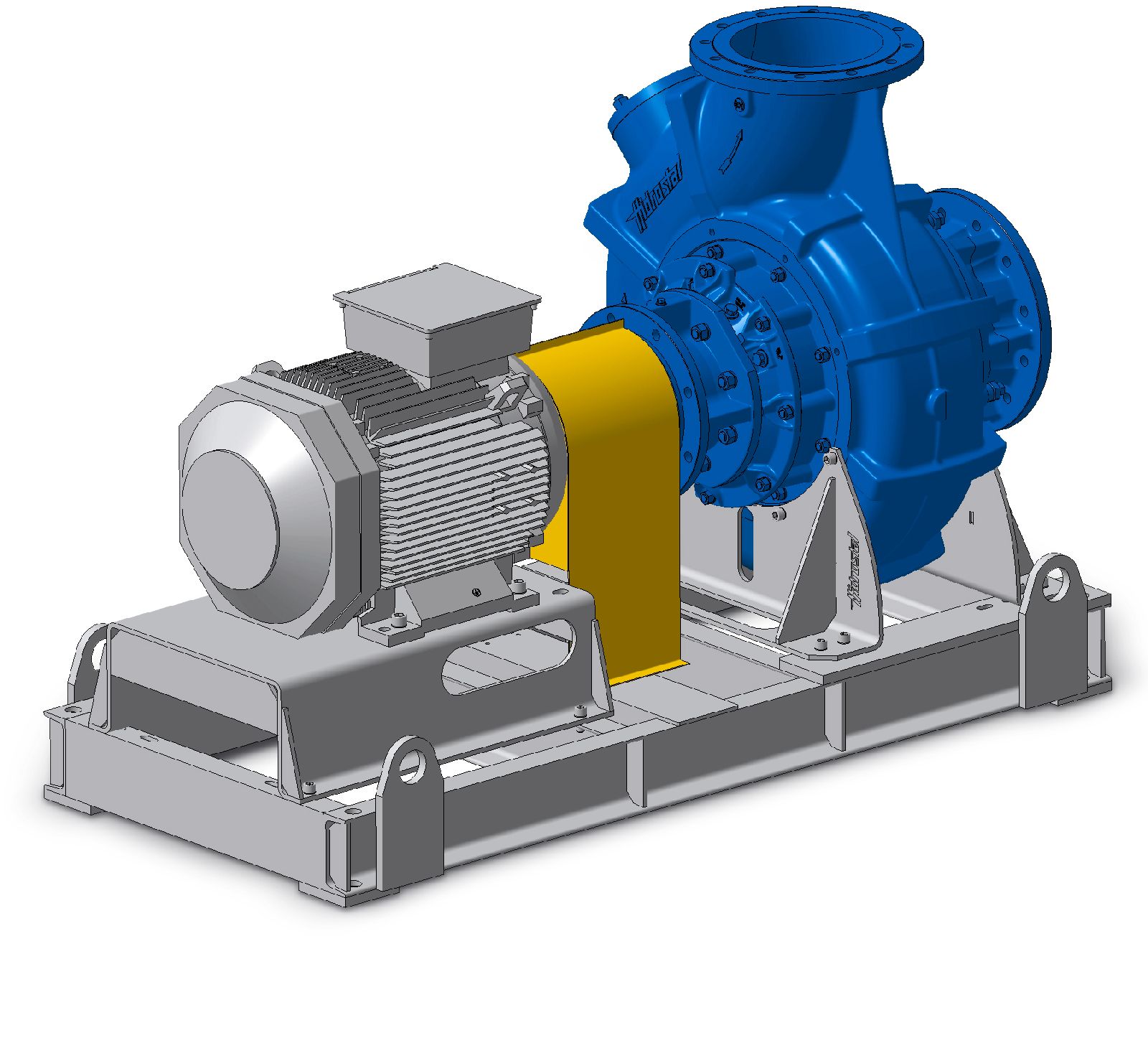
Key features
The complete rotating unit withdraws for inspection and maintenance of the wet end. On the direct coupled build that includes the motor, so the pipework stays where it is.
Hidrostal lists raw unscreened sewage, viscous sludge and return activated sludge among the duties. The impeller passes solids and fibre rather than binding on them.
Hidrostal names direct access to the pump and to the instrumentation, and maintenance in a clean environment, as the reasons to install dry rather than in the wet well.
Commercially available drive elements can be used, and the shaft end bearings are selected for belt drives. That keeps the motor a part you can source locally.
An optional liner, set by external regulating nuts, lets you reset the clearance at the wet end as grit wears it, instead of watching the duty fall away.
Cast iron, ductile iron, Hi-Chrome, stainless steel and Duplex, chosen against what the medium carries.
About Hidrostal bearing frame pumps
A Hidrostal bearing frame pump is the dry-installed member of the Hidrostal range: the same screw centrifugal impeller, in an end suction casing, driven through a bearing frame by an ordinary motor rather than a submersible one. It is the range you specify when the pump belongs in a dry chamber or a plant room and not in the sump.
Hidrostal lists it for industrial effluent, raw unscreened sewage, viscous sludge, return activated sludge, drainage and storm water, process waste and sump cleanup, and then for duties that have nothing to do with sewage at all: bacterial floc, live fish, and fruits and vegetables. That second group is the screw centrifugal impeller earning its keep on gentle handling rather than on rag.
The three arrangements
All three mount horizontally or vertically, and all three use the same hydraulic end.
| Arrangement | Drive | What it buys you |
|---|---|---|
| Direct coupled | Flange-mounted motor spigoted onto the bearing frame, with a flexible coupling as additional security | No shaft misalignment, and the back pull-out withdraws the rotating unit with the motor still on it |
| Close coupled | The same bearing frame, with a free shaft end | The direct coupled frame where you want to bring your own drive arrangement |
| Long coupled | Separate motor, direct or belt driven | Grease lubricated bearings as standard, oil lubrication available on horizontal units for process duties, and a modular bearing housing that takes several sealing arrangements |
Hidrostal lists the direct and close coupled arrangements for discharge sizes of 50 to 700 mm. The range as a whole starts at 32 mm. Its brochure treats direct and close coupled as one design, because the bearing frame is the same casting either way.
Where it is the wrong pump
A dry-installed pump needs somewhere dry to stand. That means a chamber, its drainage and its access, and on a small station the civils will cost more than the pump you saved. If the station is a wet well and always will be, the submersible range is the honest answer. If the level draws down and you still want the motor to survive it, the immersible range carries its own closed cooling circuit and does not care whether it is wet.
The other thing dry installation hands you is the suction side. A submersible pump is flooded by definition; this one is not. NPSHa has to exceed NPSHr at the duty point, and on a lift the margin is yours to find. Get that wrong and you cavitate, which pits the impeller and takes the seal with it.
Read 3000 l/s and 90 m as the ends of the envelope, not as a duty you can order. No single pump in the range does both. What we see go wrong on sewage works is rarely the pump anyway: it is rag arriving faster than the screening stage can handle, grit that got past a grit plant nobody maintains, and a suction arrangement that was never going to deliver the flow written on the drawing. Send us the duty point, the medium and the pipework, and we will tell you which of the three you are actually dealing with.
How Hidrostal bearing frame pumps work
The medium enters the end suction branch, is picked up by the screw centrifugal impeller and leaves through the volute. The impeller sits on a tapered shaft carried in the bearing frame, and the frame is what separates the wet end from the drive. Nothing about the hydraulics changes between the three arrangements; what changes is how the motor is attached.
Bearings and drive
Hidrostal specifies heavy duty bearings for L-10 bearing life in both direct and belt driven applications, and selects the shaft end bearings so a belt drive does not shorten them. Long coupled units run grease lubricated bearings as standard, with oil lubrication available on horizontal units to meet process industry requirements. On the direct coupled build the motor flange spigots onto the bearing frame, which removes the chance of shaft misalignment, and a flexible coupling is fitted as well.
Sealing
The bearing housing on the long coupled build is modular, so it takes several arrangements of mechanical seals or soft packing. Hidrostal also specifies an oversized integrated seal oil chamber. The seal is the part that decides how long any of these pumps lasts, and the choice follows from the medium, the temperature and what a leak would do on that site. Where it is genuinely difficult, the seal manufacturer's advice is the one to take.
Getting at the wet end
The back pull-out design withdraws the complete rotating unit for inspection and maintenance of the hydraulic end, including the motor on the direct coupled build. An inspection port lets you look at the impeller without stripping the pump. An optional adjustable replaceable liner, set by external regulating nuts, resets the running clearance as the wet end wears. On grit-laden water that adjustment is worth more than the material upgrade people usually ask for first.
Materials and supply
Wetted materials are cast iron, ductile iron, Hi-Chrome, stainless steel and Duplex. Hidrostal offers 50 Hz, 60 Hz and frequency converter operation across the range.
Specifications
| Flow rate | 0.5–3000 l/s | |
|---|---|---|
| Head | 0.5–90 m | |
| Discharge size | 32–700 mm | 50–700 mm on the direct and close coupled arrangements |
| Suction size | 32–700 mm | |
| Motor rated power | 0.1–650 kW | |
| Supply frequency | 50 Hz, 60 Hz, or frequency converter | |
| Impeller | Hidrostal screw centrifugal impeller | carried on a tapered shaft |
| Installation | Dry, horizontal or vertical | |
| Arrangements | Direct coupled, close coupled, long coupled | |
| Bearings | Heavy duty, rated for L-10 bearing life on direct and belt driven applications | |
| Bearing lubrication | Grease as standard; oil available on horizontal long coupled units | |
| Shaft seal | Modular bearing housing taking mechanical seals or soft packing | long coupled build; oversized integrated seal oil chamber |
| Wear parts | Optional adjustable replaceable liner with external regulating nuts; inspection port | |
| Maintenance access | Back pull-out design | withdraws the rotating unit including the motor on the direct coupled build |
| Wetted materials | Cast iron, ductile iron, Hi-Chrome, stainless steel, Duplex |
Send us the duty point, what the medium carries, and how the suction is arranged. We will size a Hidrostal bearing frame pump against it and say plainly if the station would be better served by a submersible or immersible pump instead.
Documents & downloads
Related pumps
View all →
Frequently asked
What flow and head do Hidrostal bearing frame pumps cover?
0.5–3000 l/s at heads of 0.5–90 m, on suction and discharge sizes of 32–700 mm, with motors from 0.1 kW to 650 kW. Those are the ends of the range, not a single pump, so size against the duty point.
What is the difference between direct coupled, close coupled and long coupled?
How the motor attaches. Direct coupled flange-mounts the motor onto the bearing frame with a flexible coupling; close coupled uses the same frame with a free shaft end; long coupled is the traditional separate motor, suitable for a belt drive. All three mount horizontally or vertically.
Can a Hidrostal bearing frame pump be belt driven?
Yes. Hidrostal selects the shaft end bearings on the long coupled build for use with belt drives, and specifies heavy duty bearings for L-10 bearing life on both direct and belt driven applications.
Will it handle raw unscreened sewage?
Hidrostal lists raw unscreened sewage among the duties for this range, along with viscous sludge, return activated sludge and bacterial floc. That is the screw centrifugal impeller doing what it was designed for.
Can it be mounted vertically?
Yes. All three arrangements are suitable for horizontal or vertical mounting. Oil lubrication of the bearings is the one option Hidrostal restricts to horizontal long coupled units.
How do you service a Hidrostal bearing frame pump?
Through the back pull-out design, which withdraws the complete rotating unit for inspection and maintenance of the wet end. On the direct coupled build the motor comes with it. An inspection port lets you check the impeller without taking the pump apart.
When would you choose this over a Hidrostal submersible pump?
When the pump can stand in a dry chamber. You get direct access to the pump and its instrumentation, maintenance in a clean environment, and an ordinary motor you can source anywhere. You pay for it in civils, and you take on the suction side.